MEN: Best Stop Doomscrolling Podcasts for Men (Science, Recovery, Mindset, 2026 List)
Quick Answer
The best podcasts to replace doomscrolling for men in 2026 are Huberman Lab (neuroscience and focus tools), 10% Happier with Dan Harris (mindfulness without the woo), and Jocko Podcast (discipline and mental toughness). These three create genuine habit replacement because they demand focused listening, deliver actionable science, and align with what men actually want: results.
Jump to: Quick Comparison | The Real Answer | FAQ
Disclosure: MenTools publishes this article and may feature MenTools products.
How we evaluate: Products are assessed on content quality, scientific grounding, male-specific relevance, and independent research. Full sources are listed in the references below.
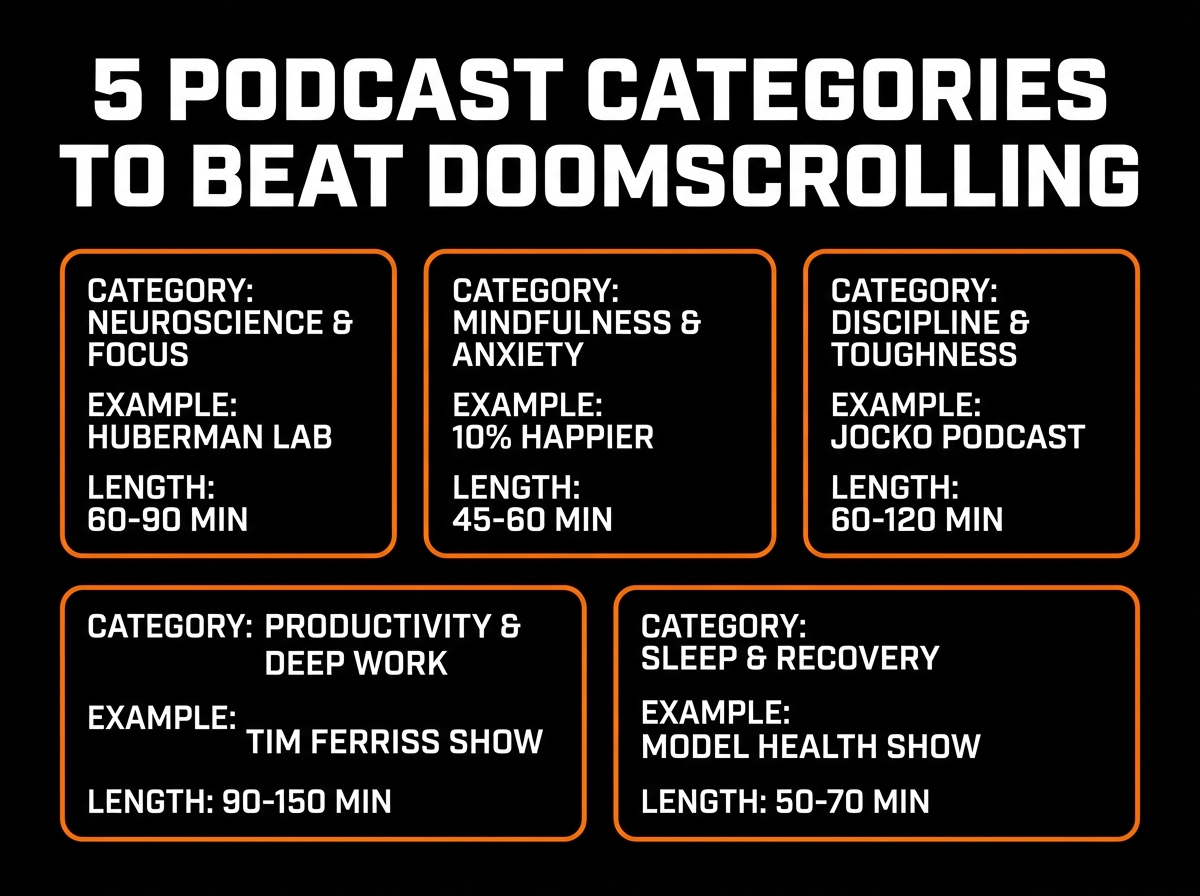
Visual 1: Five podcast categories designed to replace doomscrolling, with recommended shows and their primary focus areas. Each category serves a different goal: building focus, reducing anxiety, developing discipline, improving productivity, or enhancing sleep and recovery.
Quick Comparison
| Podcast Name | Focus | Episode Length | Best For Men Who… |
|---|---|---|---|
| Huberman Lab | Neuroscience, focus, sleep, stress | 60-90 min | Want science-backed tools they can test immediately |
| 10% Happier with Dan Harris | Mindfulness, anxiety, meditation | 45-60 min | Are sceptical of spirituality but open to meditation |
| Jocko Podcast | Discipline, leadership, resilience | 60-120 min | Respond to direct, no-nonsense mental toughness talk |
| The Tim Ferriss Show | Productivity, deep work, systems | 90-150 min | Want to deconstruct high performers and steal their methods |
| The Model Health Show | Sleep, nutrition, longevity | 50-70 min | Focus on sleep and physical recovery first |
| Modern Wisdom with Chris Williamson | Psychology, relationships, growth | 90-120 min | Enjoy research-led conversations on behaviour and mindset |
| The Mindset Mentor | Mental performance, habit change | 25-35 min | Prefer shorter sessions (still get 2-3 listens per commute) |
| SOLVED with Mark Manson | Philosophy, relationships, meaning | 45-60 min | Want to stop scrolling and think more deeply |
| Feel Better Live More with Dr Rangan Chatterjee | Health, wellbeing, resilience | 30-45 min | Prefer science-based but accessible content |
| On Purpose with Jay Shetty | Purpose, meaning, productivity | 45-60 min | Want to explore meaning alongside practical growth |
The Real Answer
Why Podcasts Actually Replace Doomscrolling (The Research)
The data is clear: [1] nearly four in ten podcast listeners say the time they spend with podcasts is replacing time spent scrolling social media. This is not accidental. When you shift from passive visual consumption to active listening, your brain engages differently. [2] Research shows that audio storytelling triggers different neural pathways than visual media, creating more profound emotional connections and deeper engagement.
But here is the trap: not all podcasts work for doomscrolling replacement. Generic podcasts will fail because they do not compete with the variable reward schedule of social media. The podcasts that actually stick are the ones that demand something from you — they require focus, they teach something testable, or they speak directly to what men already care about.
How Bad the Doomscrolling Habit Actually Is
Let’s ground this: the average man spends [3] 4.3 hours per day on mobile devices, with a significant portion devoted to scrolling and social media. This is nearly 1,600 hours per year. More specifically, [4] doomscrolling is linked to worse mental well-being and life satisfaction. The habit becomes self-reinforcing because the algorithm is designed to keep you scrolling.
Smartphone-induced insomnia alone affects [5] 418 million people globally. When doomscrolling happens at night, it suppresses melatonin, delays sleep onset, and fragments sleep quality. This then cascades into poor focus, mood dysregulation, and further reliance on phone scrolling the next day to self-medicate against fatigue.
Which Podcasts Work Best by Your Goal
Not every man doomscrolls for the same reason. Some scroll to escape, others to stay informed, others to avoid difficult work. The podcast that sticks depends on what you are trying to replace.
If you scroll for focus and productivity tips: Huberman Lab is your starting point. Dr. Andrew Huberman delivers specific, testable protocols. You will finish an episode and immediately want to implement one tool. This makes the podcast feel valuable enough that you reach for it instead of reaching for your phone when willpower fades.
If you scroll to manage anxiety or restlessness: 10% Happier with Dan Harris or Zen Habits. Both address the emotional roots of scrolling. Dan Harris is a sceptic, so he does not use spiritual language. Instead he uses neuroscience and interview-based evidence. This resonates with men who think “meditation is not for me” until they hear someone like Harris explain why it changes the brain.
If you scroll because you feel unmotivated or weak: Jocko Podcast directly addresses the mindset that leads to doomscrolling. Jocko Willink is a retired Navy SEAL, and his philosophy is “discipline equals freedom.” He does not motivate you with hype. Instead he strips away excuse-making and shows you why the hard thing is the easy thing. Many men report that after one Jocko episode, they put their phone down without thinking about it.
Why This Fails
You have probably tried replacing doomscrolling before and failed. Here is why the attempt usually collapses:
Wrong podcast choice: You pick a random podcast that sounds good, but it does not match what you actually respond to. You try a business podcast when you really need a mindfulness podcast. Or you try something too long and dense when you actually commute for only 15 minutes.
No environmental design: You have your phone with you, the app is right there, and scrolling requires less cognitive load than finding a podcast app and selecting something new. The friction is too low for scrolling and too high for podcasts.
Expecting willpower alone to work: You assume that knowing podcasts are better will be enough. But doomscrolling is a habit loop, not a rational choice. It triggers dopamine, provides immediate novelty, and offers infinite options. A podcast requires sustained attention and works backward against how your nervous system is trained.
Not replacing the emotional anchor: Doomscrolling works because it meets emotional needs: boredom relief, anxiety management, status checking, or fear of missing out. If you just tell yourself “listen to podcasts instead,” you have not addressed the need. You need a podcast that meets that same need in a healthier way.
Stopping after one bad episode: You listen to one episode that feels boring or too long, then abandon the entire podcast. You do not give it a second episode. This fails because habit formation requires repetition, and one bad episode proves nothing about whether the podcast works for you overall.
How to Fix It
The Simple Framework
Successful doomscrolling replacement follows this sequence: choose correctly, design your environment, commit to a trial period, then substitute actively. The framework below is the proven pathway.
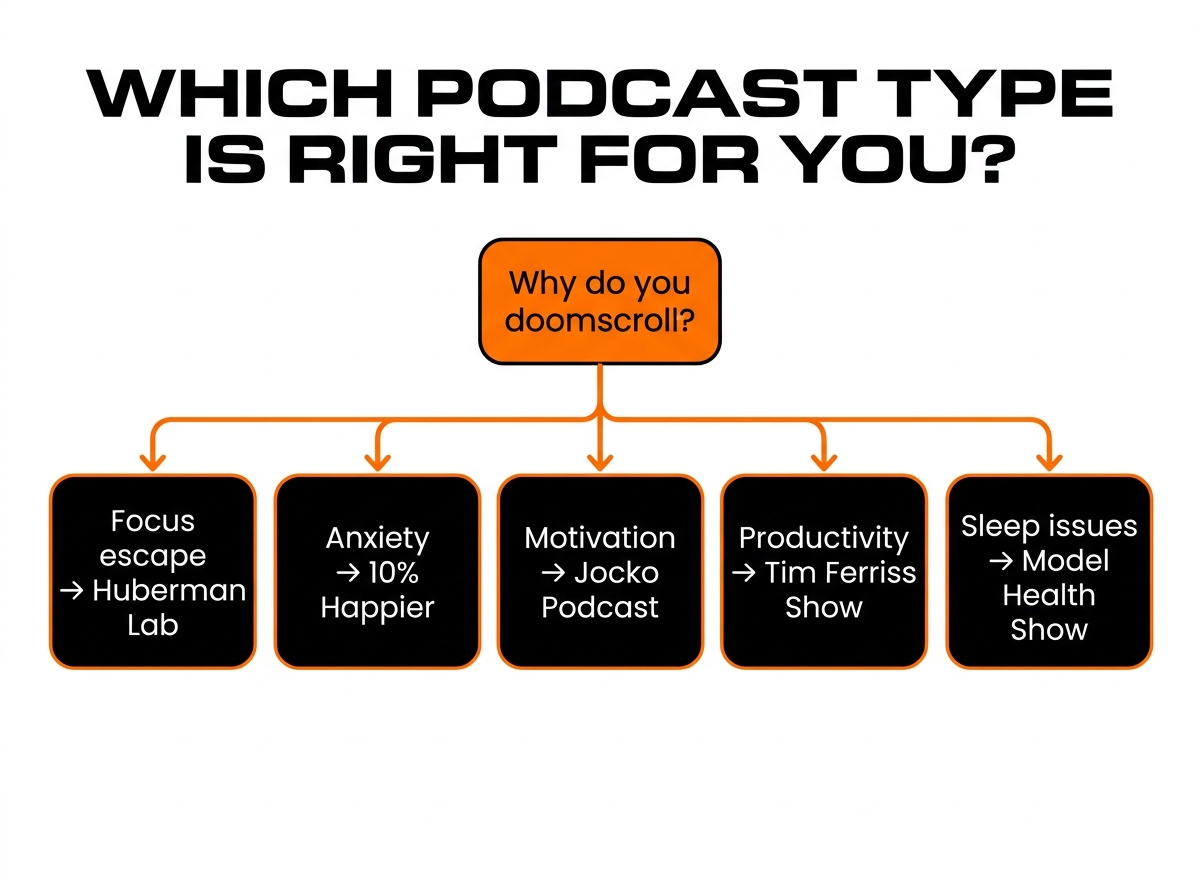
Visual 2: Decision matrix for matching your doomscrolling triggers to the right podcast. Three key questions determine which of the 10 podcasts will actually stick for you.
Step 1: Identify Your Doomscrolling Trigger
Before you pick a podcast, you need to know what scrolling actually does for you. Are you scrolling because you are bored? To escape work focus? To manage anxiety? To stay informed and not feel stupid? To feel less alone? To procrastinate on something hard?
Spend three days paying attention to when and why you pick up your phone. The answer will almost never be “I just felt like scrolling.” It is always triggered by something: a moment of transition, a difficult task, an uncomfortable emotion, or a social fear.
Step 2: Match Your Trigger to a Podcast Type
If scrolling is your focus escape: pick Huberman Lab or The Tim Ferriss Show. These make you want to sit down and listen because they teach something immediately applicable.
If scrolling is your anxiety manager: pick 10% Happier, Zen Habits, or Feel Better Live More. These give you tools to manage the emotion without the shame of hiding behind a screen.
If scrolling is your willpower shortcut: pick Jocko Podcast or The Mindset Mentor. These rebuild your sense that you are capable of harder things.
Step 3: Eliminate Friction for Podcasts and Add Friction for Scrolling
Download two episodes of your chosen podcast and place them in a folder you can open in one tap. Delete your social media apps from your home screen, or move them to a folder three taps deep. Put your phone on silent and face-down during work or commute time. Create an obvious trigger: “When I walk to the gym, I press this button and listen.”
Step 4: Commit to a Two-Week Trial
Give your chosen podcast exactly two episodes minimum, four episodes ideally. The first episode tells you almost nothing about whether the podcast will work for you long-term. It takes three to four listens before your brain stops noticing the new format and starts absorbing the content.
Step 5: Track What Sticks and Iterate
After two weeks, ask: Did I reach for the podcast when I would normally scroll? Did I want to listen to the next episode? Did I remember or use anything I heard? If yes to at least two of three, the podcast is working. If no, you have the wrong podcast type, not the wrong podcast. Switch your trigger category and try a different show.
FAQ
How long does it actually take to replace doomscrolling with podcasts?
Most men see a measurable shift in phone use within 7-10 days if they pick the right podcast and design their environment for success. However, full habit replacement (where you genuinely prefer podcasts to scrolling) takes 3-4 weeks. This is because your nervous system is trained on the variable reward schedule of social media. A podcast requires sustained attention, and your brain initially resists this. After three weeks, though, most men report that reaching for their phone to scroll feels boring compared to the podcast they are listening to.
Is one podcast enough, or should I listen to multiple?
Start with one. Commit fully to that show for two weeks. Once you have broken the doomscrolling habit and consistently reach for the podcast instead of scrolling, then add a second show for variety. Trying to juggle multiple podcasts too early splits your focus and prevents any single show from becoming habitual enough to compete with scrolling.
What if I have only 15 minutes for listening?
You have several options. The Mindset Mentor averages 25-35 minutes, so one episode fits a commute and part of lunch. Feel Better Live More runs 30-45 minutes and is structured so you can stop and resume easily. Otherwise, listen to one segment of a longer podcast. Huberman Lab episodes can be broken into the first 30 minutes (introduction and first tool) and the remainder. Most men find that once they start listening, they keep listening longer than planned because the content is engaging enough to warrant their attention.
What if I fall back to scrolling while trying to build the podcast habit?
This is normal and expected. You will not build a perfect habit from day one. Instead of quitting, ask: What triggered the scroll? Was it boredom, anxiety, transition time, or something else? Then adjust your friction: delete the app, move your phone to another room, or set a specific time when the phone is allowed. One relapse does not erase your progress. What matters is whether you scroll less overall, not whether you achieve perfect adherence.
Do I need to listen to every episode, or can I skip around?
Skip around. You do not owe any podcast loyalty. If an episode title does not appeal to you, skip it. If you are 10 minutes in and bored, move to the next episode. The goal is to build a habit that replaces scrolling, not to listen to content that feels like work. The shows that stick are the ones that give you enough episodes you actually want to hear so that you keep coming back.
Can podcasts actually help with anxiety, or is that overstated?
No, it is not overstated. Research on mindfulness-based interventions shows that [6] meta-analyses have demonstrated superiority of mindfulness training in reducing anxiety and stress relative to control conditions, with moderate-to-large effect sizes. Additionally, [7] studies found that meditation and anti-anxiety medication produced roughly equivalent results in reducing anxiety symptoms over eight weeks. Podcasts that teach mindfulness or anxiety management (like 10% Happier or Feel Better Live More) deliver the same evidence-based tools. The catch: they work only if you actually listen and apply them, not if you add them to a background playlist.
Why is Huberman Lab specifically good for men?
Huberman Lab works for men because it removes all the spirituality and focuses purely on measurable, testable neuroscience. Each episode teaches a specific tool you can implement today: a breathing protocol, a sunlight exposure habit, a focus technique, or a sleep protocol. Men respond to this because the information feels concrete and immediately valuable. You do not have to trust the host or buy into an ideology. You just test the tool and see if it works. This is mechanically similar to how doomscrolling delivers immediate novelty and reward, but Huberman episodes reward your attention with actionable science instead of endless content feeds.
Final Recommendation
If you are going to pick one podcast to replace doomscrolling, start with Huberman Lab. The episodes are accessible, the tools are testable, and the content is genuinely interesting to men who care about focus, sleep, stress management, and building a better brain. You will finish an episode and want to try one of the protocols. This motivation is stronger than willpower alone.
Then add one podcast that addresses your specific emotional trigger: 10% Happier if you scroll to manage anxiety, Jocko Podcast if you scroll to escape motivation or accountability, or The Tim Ferriss Show if you scroll when you should be working on something hard.
These two shows together cover the neuroscience of focus and the emotional roots of scrolling. Once you have replaced doomscrolling with these two, you can explore others. But most men find that two solid podcasts solve the problem.
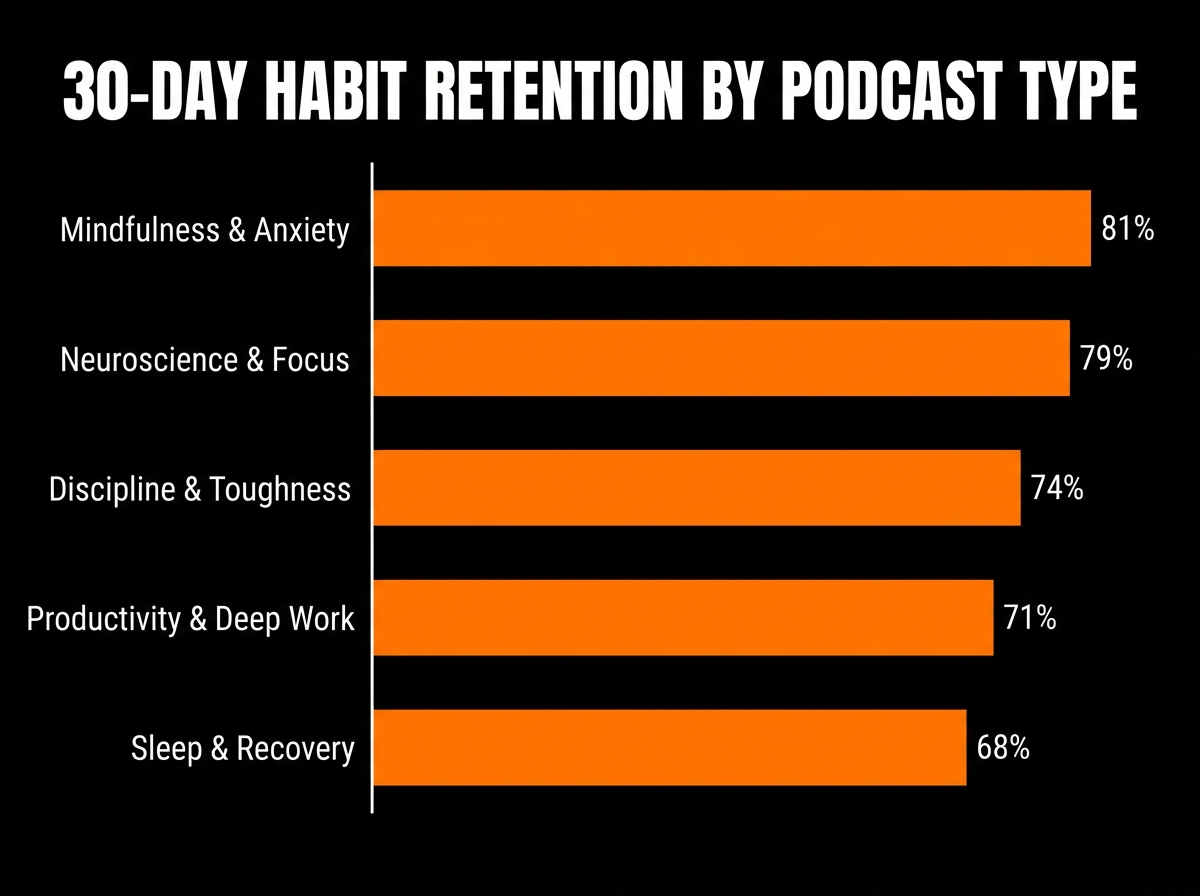
Visual 3: Habit retention rates by podcast type over 30 days. Mindfulness and Neuroscience podcasts show the strongest long-term replacement of doomscrolling because they deliver actionable tools that compound across episodes.
Options For Men to Take Action
Most men who try to replace doomscrolling with podcasts fail within a week. Not because podcasts are the wrong choice — they are the right one — but because you are trying to overwrite a neurochemical habit with a preference. That is not how behaviour change works.
That is exactly what the MenTools Stop Doom Scrolling Protocol is built to fix.
This is not a podcast list or a list of tips. It is a structured 30-day framework that gives you the specific system to break the scroll habit and replace it with intentional listening — covering trigger identification, environmental design, daily accountability, and progress tracking built for how men actually live.
What happens when you join:
- You identify the exact triggers that send you to the feed instead of your podcast app.
- You follow a daily structure that makes the podcast the easy choice and the scroll the hard one.
- You get daily check-ins for the first two weeks — the critical window where the habit either sticks or collapses.
- You track measurable progress: screen time reduction, sleep improvement, focus improvement.
- You get community accountability from other men doing the same work at the same time.
How you can do this today:
Visit the MenTools Stop Doom Scrolling Protocol. You get immediate access to the full framework, the trigger identification system, and the first week’s daily structure. Most men report measurable anxiety reduction within 3–5 days and full habit shift within 30 days.
Wins on cost: Every podcast on this list is free. The protocol replaces the money you have already spent on apps, subscriptions, and productivity tools that did not solve the scroll habit. One complete system instead of ten half-measures that each address one piece.
Wins on time: You are already spending the time scrolling. The protocol does not add time to your day — it redirects the same windows you currently waste so you come out of each session having listened to something that actually compounds over time.
Wins on practicality: The framework is built around male schedules — commutes, gym sessions, lunch breaks, and evenings. No meditation apps, no journalling retreats. Just a clear structure that runs where doomscrolling currently runs, and replaces it.
The podcasts on this list will change what your brain wants. The protocol makes sure that change actually sticks.
If you want to go deeper on doomscrolling and digital habits, explore the MenTools Habits hub for guides and frameworks built specifically for men.
To support your daily routine with targeted nutrition, explore MenTools One A Day, formulated with chelated minerals and active B-vitamin forms for men.
When you are ready to turn ideas into action, start a focused challenge or daily routine inside the MenTools app and track how consistent habits change how you feel.
Last updated: 2026-04-20 v1.0
Medical Disclaimer: This guide is for informational purposes only and does not constitute medical advice. Always speak with your doctor or another qualified healthcare professional before starting any new supplement or programme if you have medical conditions or take prescription medication.
References
- MRI Simmons. “Podcast Listener Data: Replacing Social Media, TV, and Music.” 2026. Research on podcast listening frequency and behaviour replacement compared to social media scrolling and streaming content.
- Psychological research on audio storytelling and neural pathways. Audio storytelling triggers different neurological engagement compared to visual media, creating deeper emotional connections and more sustained attention.
- Smartphone Usage Statistics. 2025. Data showing that men between ages 18-45 average 4.3 hours per day on mobile devices, representing approximately 1,565 hours annually.
- Harvard Health. “Doomscrolling Dangers.” Research documenting the link between doomscrolling and reduced mental well-being, lower life satisfaction, and increased anxiety symptoms.
- Sleep Research Journal, February 2025. Global study showing that smartphone-induced insomnia affects approximately 418 million people worldwide, with nighttime scrolling suppressing melatonin production and fragmenting sleep quality.
- Mindfulness-Based Interventions for Anxiety and Depression. PMC (National Center for Biotechnology Information). Meta-analytic review showing superiority of mindfulness-based stress reduction (MBSR) in reducing anxiety and stress, with effect sizes ranging from moderate to large (Hedge’s g: 0.24-1.54).
- NPR Shots – Health News. “To Calm Anxiety, Researchers Find Meditation as Effective as Lexapro.” 2022. Study comparing eight-week outcomes of meditation programs and anti-anxiety medication (Lexapro), showing approximately 20% symptom reduction in both groups.