No products in the cart.
Return To Shop
MEN: Money for Men: The Complete Guide to Taking Control of Your Finances
Quick Answer
Taking control of your money is an order of operations, not a personality change. Know your real monthly numbers, build a one month buffer, clear debt above roughly 8 percent, claim your full employer pension match, finish a three month emergency fund, then invest the surplus simply. Doing them in that order is what makes each step affordable.
**Jump to:** The seven areas | How we chose this order | FAQ | Options for men
Disclosure: MenTools publishes this article and may feature MenTools products.
How we evaluate: Each area is assessed on real-world use, evidence, cost and time, and how well it suits men. Every area including the MenTools option carries an honest limitation. Full sources are in the references below.
The Seven Areas at a Glance
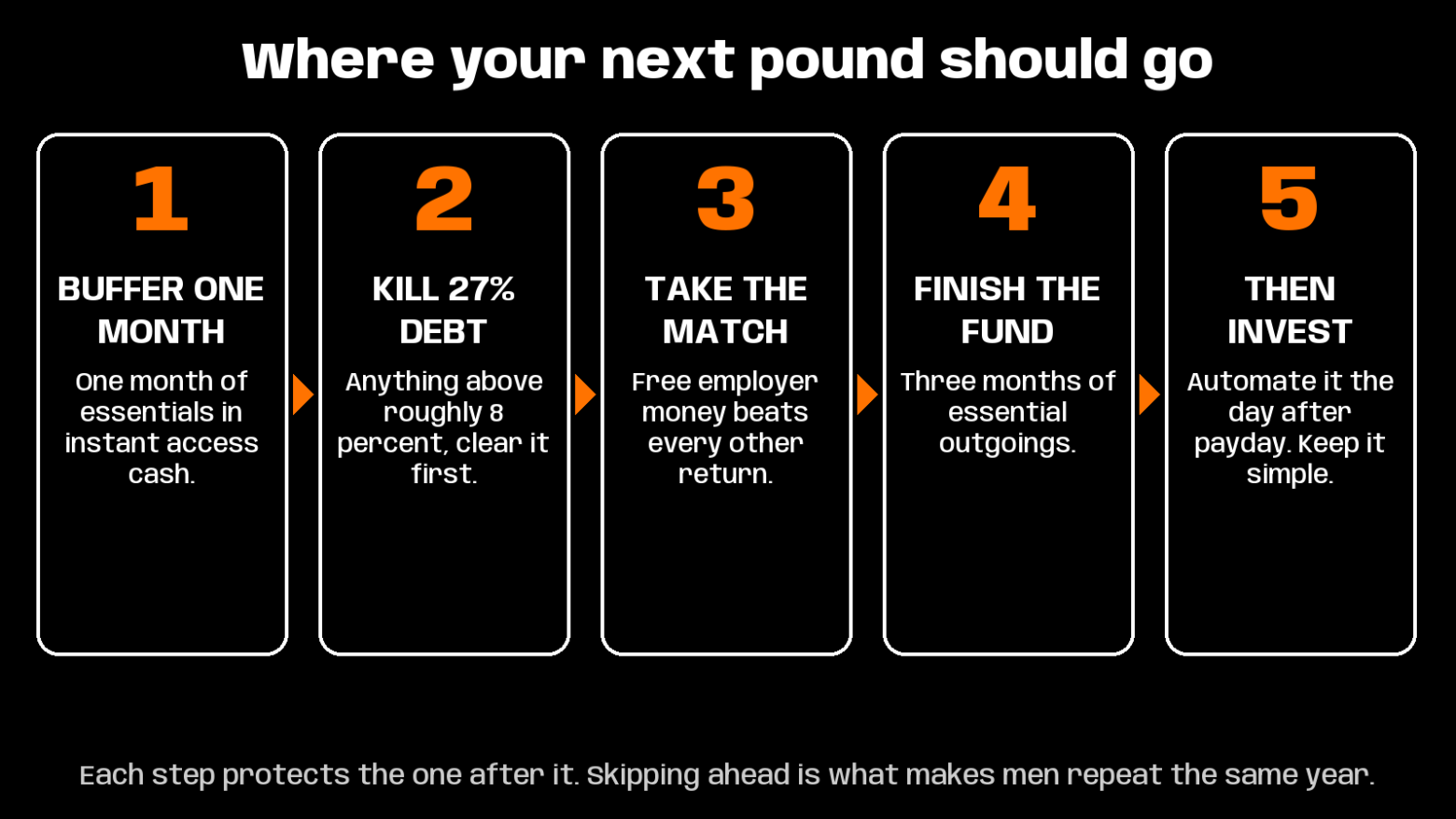
Where the next pound goes, in the order that makes each step affordable.
| Area | What it fixes | Do it when | Watch-out |
|---|---|---|---|
| Know your numbers | Guessing, and the anxiety that comes with it | First, before anything else | One month of data is not a pattern, use three |
| One month buffer | Small shocks going straight onto credit | Immediately after the numbers | Easy to spend if it sits in your current account |
| Clear expensive debt | Paying 27 percent for the privilege of last year | Once the buffer exists | Do not close the accounts you clear, it can affect your file |
| Claim the pension match | Turning down free money from your employer | As soon as you can afford the contribution | Locked away until at least 55, so it is not a rainy day fund |
| Finish the emergency fund | Job loss or illness becoming a debt event | After the match is claimed | Three months feels excessive right up until you need it |
| Invest the surplus | Cash losing value quietly | Only after the four above | Can fall in value, and needs years not months |
| Raise the ceiling | Optimising a number that is simply too small | Alongside all of the above | The slowest lever, and the one most men skip |
How We Chose This Order
The order is chosen so that each step protects the one after it. A buffer comes before debt repayment because without one, the next unexpected bill goes back on the card and undoes the progress. The pension match comes before the full emergency fund because an employer match is the only guaranteed return most men will ever be offered.
We also weighted it towards what actually goes wrong. According to the Financial Conduct Authority’s Financial Lives survey, one in four UK adults has low financial resilience, meaning they have missed payments, are struggling to keep up, or have no savings to fall back on [1]. That is a cashflow and buffer problem far more often than an investing problem.
Sarah Pritchard, the FCA’s Executive Director of Consumers and Competition, summarised the picture as “Our data shows that finances are stretched for many” [1]. Which is the reason this guide starts with a buffer rather than a portfolio.
One honest note before the detail. This is general information rather than financial advice, and it deliberately avoids naming products, funds or providers. For free and impartial guidance backed by government, MoneyHelper is the sensible first stop, and anything involving your specific pension, tax or investments is worth a conversation with a regulated adviser.
1. Know Your Numbers
You cannot control a number you have never looked at. The first job is three months of actual bank data, split into money in, fixed costs, and everything else, ending with one figure: your real monthly surplus. Most men are out by a significant margin, and almost always in the wrong direction.
What it fixes: the low background anxiety of not knowing. Money worry is not a fringe experience. Money and Pensions Service research finds that around one in three adults say thinking about their financial situation makes them feel worried [2].
Standout: it is the only step that costs nothing and takes one evening. Every other area in this guide depends on the surplus figure, because a plan that assumes 400 a month when the real number is 90 fails in week three.
Watch-out: one month of data will mislead you, because annual costs like insurance, car servicing and Christmas will not appear. Use three months and divide the irregular costs by twelve.
2. Build a One Month Buffer
Before you attack debt or start investing, get one month of essential spending into an instant access account. This is not the full emergency fund, it is the thing that stops the next boiler repair becoming another 27 percent balance. It is the highest leverage 30 days in personal finance.
What it fixes: the cycle where progress is real until something breaks. The scale of the gap is stark. FCA data shows 21 percent of UK adults have less than 1,000 pounds to draw on in an emergency, and 10 percent have no cash savings at all [1].
Standout: it converts a crisis into an inconvenience, which is what changes your behaviour rather than your spreadsheet.
Watch-out: it needs to be separate from your current account or it quietly becomes spending money. A different bank is better than a different pot in the same app.
3. Clear the Expensive Debt
Anything charging more than roughly 8 percent a year should be cleared before you invest, because you will not reliably beat that return anywhere else. Start with the highest rate, keep minimums running on everything else, and do not add new balances while you do it.
What it fixes: the largest guaranteed drain most men have. The average UK credit card purchase rate was 27.07 percent in May 2026 [3], while the Bank of England held Bank Rate at 3.75 percent on 29 July 2026 [4]. Clearing a card at 27 percent is a guaranteed 27 percent return, which no investment can promise.
Standout: it is the only step in this guide with a certain, calculable payoff. Unsecured debt is common rather than shameful, with 39 percent of UK adults carrying it at a median of 2,500 pounds [1].
Watch-out: cheap debt is not the same problem. A student loan or a low rate mortgage does not belong in this step, and rushing to overpay either one before you have a buffer is usually the wrong order.
4. Claim the Full Pension Match
If your employer matches contributions and you are not taking the full match, you are declining part of your salary. Auto enrolment sets a minimum of 8 percent of qualifying earnings in total, of which at least 3 percent must come from your employer [5]. Many employers match well above that minimum.
What it fixes: the single largest avoidable loss in a working life. Qualifying earnings for 2026/27 run from 6,240 to 50,270 pounds [5], so the 8 percent minimum is calculated on a band rather than your whole salary, which is why the real contribution is often lower than men assume. The consequence shows up in the balances, with 33 percent of UK adults holding less than 10,000 pounds in a defined contribution pension and a further 12 percent not knowing their balance at all [1].
Standout: an employer match is an immediate, guaranteed uplift on the money you put in, before any investment growth. Nothing else in this guide offers that.
Watch-out: it is locked until at least age 55, rising to 57 from 2028, so it does not solve any short term problem. This step is about not leaving money behind, not about liquidity.
5. Finish the Emergency Fund
Now extend the one month buffer to three months of essential outgoings, held in instant access cash. MoneyHelper’s guidance is three months as the working target, with three to six months as the fuller cushion [6]. Essential means the things you cannot switch off, not your current lifestyle.
What it fixes: the difference between a bad month and a debt spiral. Calculating it is simple. If your essentials come to 1,500 pounds a month, the target is 4,500 pounds.
Standout: it is the step that makes every other decision calmer, including the ones about work. Men with a cash cushion negotiate differently, leave bad jobs sooner, and take better risks.
Watch-out: it will feel like dead money for as long as nothing goes wrong, and there is no way to make that feeling go away. Hold it anyway.
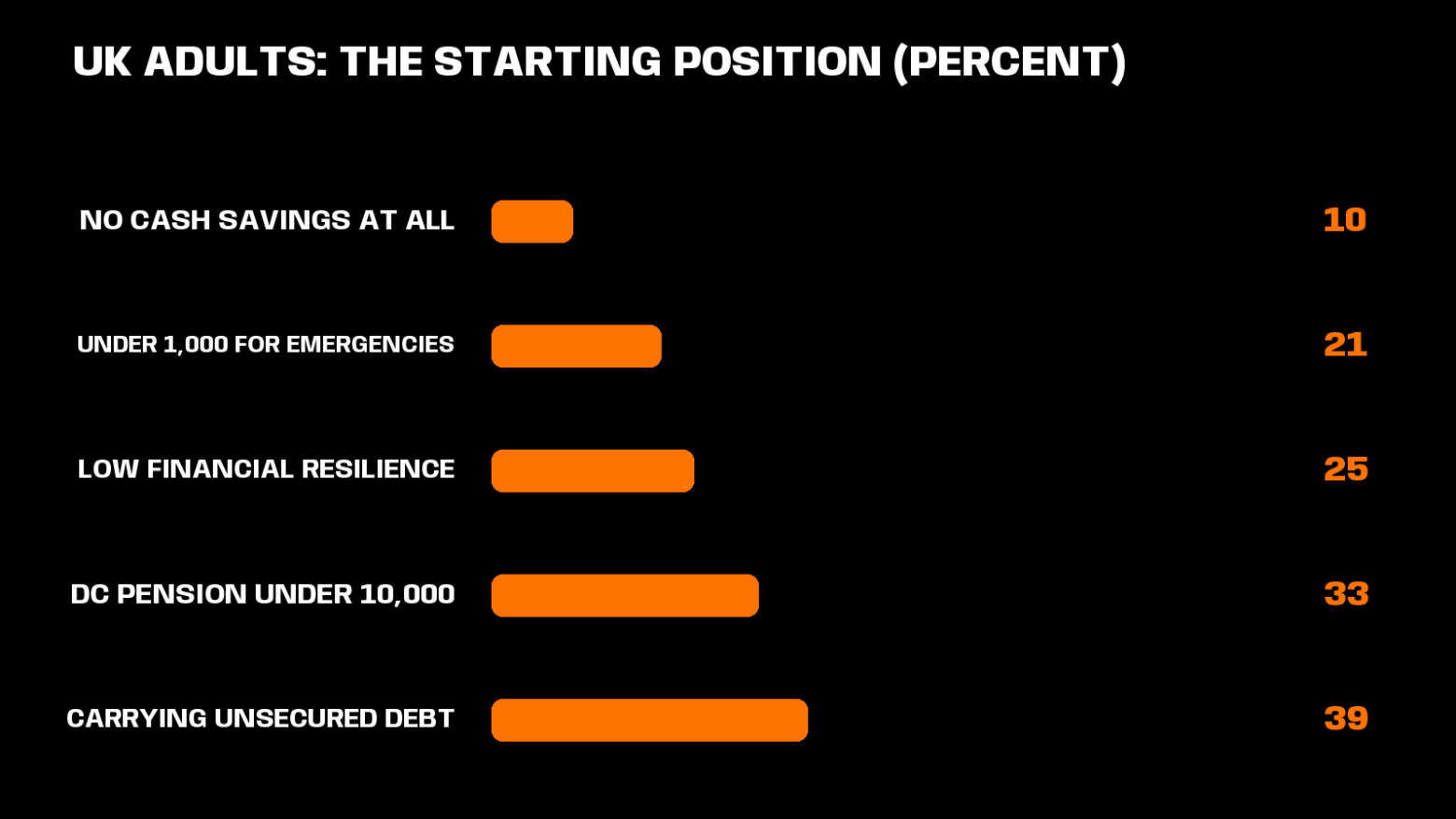
Percentage of UK adults in each position, from the FCA Financial Lives survey. Most men are not behind, they are average.
6. Invest the Surplus Simply
Only once the four steps above are done does investing become the right use of a spare pound. The mechanism that matters is not stock picking, it is automation and time. Set a standing order for the day after payday so investing happens before spending, not after it.
What it fixes: cash quietly losing purchasing power while you wait to feel ready. The tax wrapper is the free part. The overall ISA allowance is 20,000 pounds for the 2026/27 tax year [7].
Standout: automation beats intention by a measurable margin. In the Save More Tomorrow programme designed by Richard Thaler and Shlomo Benartzi, participants who pre committed to escalating contributions raised their savings rate from 3.5 percent to 13.6 percent over 40 months, and 78 percent were still enrolled four pay rises later [8].
Watch-out: investments can fall as well as rise, and this step needs years rather than months. Money you might need inside five years belongs in step five, not here.
7. Raise the Ceiling
At some point optimisation stops working and the number itself has to grow. Skills, a role change, a qualification or a second income stream are slower than cutting subscriptions, but they are the only lever without a floor. Most men over invest in the first and avoid the second.
What it fixes: the situation where the budget is already tight and there is nothing left to trim. You cannot save your way out of an income problem, and pretending otherwise burns years.
Standout: it compounds like nothing else, because a permanent pay rise raises every future contribution at once. The behaviour rather than the arithmetic is the hard part, which is Morgan Housel’s central point in The Psychology of Money: “Doing well with money isn’t necessarily about what you know. It’s about how you behave” [9].
Watch-out: it is the slowest step and the easiest to use as a reason to delay the other six. Do it alongside them, never instead of them.
Why Do Men Struggle to Talk About Money?
Because roughly half of us still do not find it comfortable, and silence keeps bad numbers hidden. Money and Pensions Service research across more than 12,000 UK adults found 44 percent of adults feel comfortable talking to friends about money, with men at 50 percent and women at 39 percent [10].
Men are slightly ahead on that measure, which is worth stating plainly rather than repeating the usual claim. The problem is what the other half of the figure means. Half of men do not discuss it, which means no external reference point for whether a salary, a rate or a pension contribution is normal.
The practical fix is narrow. You do not need to discuss your finances broadly, you need one person you can ask a factual question, and one place to check a number. Getting that in place is a discipline matter more than a money matter, which our guide to self discipline for men covers directly.
What Is Happening to Cash ISAs in 2027?
The cash ISA allowance is being cut, and it affects working age men specifically. In the Autumn Budget 2025 the Chancellor confirmed that from 6 April 2027 the amount you can put into a cash ISA each year falls from 20,000 pounds to 12,000 pounds for those under 65, while people aged 65 and over keep the full 20,000 pounds [11].
The overall ISA allowance stays at 20,000 pounds. The 8,000 pound difference can still be used, but only in a stocks and shares ISA, which is the stated intention behind the change [11].
What that means in practice is simple. The 2026/27 tax year is the last one in which an under 65 can put a full 20,000 pounds into cash, so if a large cash holding is part of your plan, the timing now matters in a way it did not before.
How Many Pension Pots Have You Lost?
Probably at least one, if you have changed jobs more than twice. Research by the Pensions Policy Institute found around 3.3 million lost pension pots in the UK holding 31.1 billion pounds, at an average of 9,470 pounds per pot, up from 26.6 billion pounds in 2022 [12].
That average is the point. A lost pot is not a rounding error, it is roughly a year of decent contributions sitting somewhere you have forgotten. Tracing them is a single afternoon of admin with a genuine four figure payoff.
The government’s Pension Tracing Service will find the provider from an old employer’s name. Consolidating is a separate decision with real trade offs, including losing valuable guarantees on older schemes, so find them first and decide second. Doing that consistently is a routine problem, and our guide to daily habits for men covers how the small recurring admin actually gets done.
FAQ
How much should a man have saved by 30?
There is no credible universal figure, and any article giving you one is guessing. The useful targets are behavioural rather than absolute, being three months of essential outgoings in cash, no debt above roughly 8 percent, and the full employer pension match claimed. Hitting those three at any age puts you ahead of a quarter of UK adults.
Should I pay off my mortgage or invest?
It depends on your mortgage rate against your expected return, and on whether you have completed the earlier steps. As a general principle, expensive unsecured debt comes first, then the pension match, then the emergency fund. A low rate mortgage is usually the last thing to overpay, and a high rate one can reasonably jump the queue.
Is it too late to start a pension at 40?
No, and the employer match makes it worth starting immediately regardless of age. You have roughly 20 to 27 years of contributions and growth ahead of you, which is a long horizon by investing standards. What changes with a later start is the contribution rate needed, not whether it is worth doing.
How do I find an old workplace pension?
Use the government’s Pension Tracing Service, which finds the current provider from a former employer’s name, then contact each provider directly with your dates of employment and National Insurance number. Around 3.3 million pots are currently classed as lost, so finding one is a normal outcome rather than a long shot.
What percentage of my salary should I save?
Start with whatever survives a bad month, then raise it. The evidence favours escalation over ambition, because pre committing to increase contributions out of future pay rises produced far higher long run savings rates than asking people to commit more today. A rate you keep beats a rate you abandon in March.
Do I need a financial adviser?
Not for the seven areas in this guide, which are administrative rather than advisory. A regulated adviser earns their fee on the complicated decisions, meaning defined benefit transfers, larger portfolios, inheritance tax and retirement drawdown. For everything before that, MoneyHelper is free and impartial.
What should I do first if I feel behind?
Open your banking app and total the last three months. Not a budget, not an app subscription, just the three figures for money in, fixed costs and the rest. Almost every man who feels behind is reacting to an unknown number rather than a bad one, and the anxiety drops measurably once the figure exists.
Final Recommendation
Do the seven areas in order and refuse to skip ahead, because skipping is what makes men repeat the same year. This week, total three months of statements and open a separate account for a one month buffer. This month, list every debt with its rate and check exactly what your employer will match. This quarter, trace your old pension pots and set one standing order for the day after payday. That is the whole system, and it works at any income because it is a sequence rather than an amount.
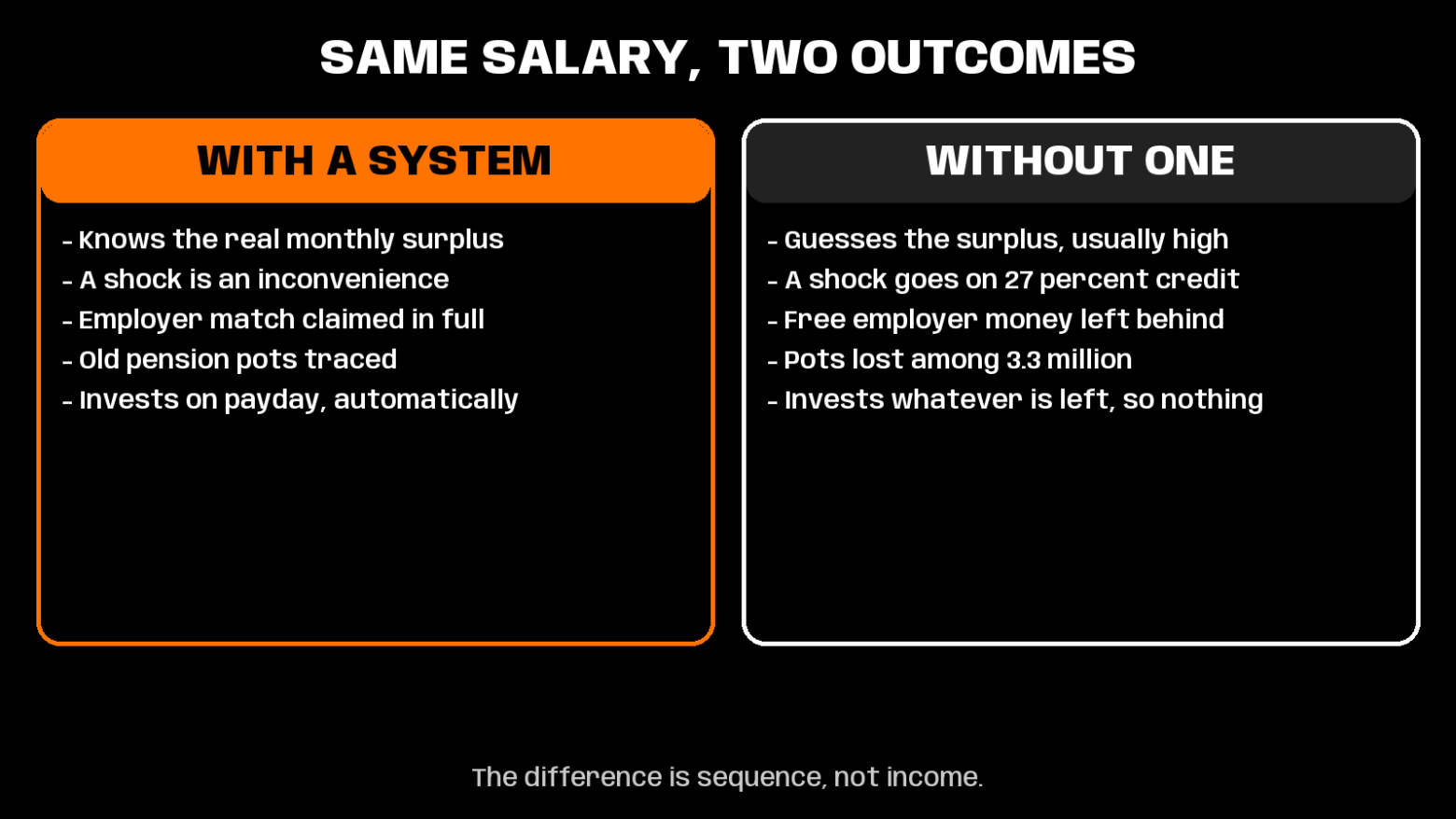
The same salary, two different outcomes. The difference is sequence, not income.
Options for Men to Take Control of Their Money
Most men do not lose control of their money in one bad decision. They lose it across a hundred small ones that nobody was counting, spread over years, with no single moment that felt like a mistake. The information in this guide is not the hard part. Doing step three in March and step five in September, without a system reminding you, is the hard part.
The MenTools app is built around that gap, running money alongside mindset, fitness and nutrition in one challenge system with daily actions, chosen difficulty levels, streaks, progress tracking and an AI coach. The point is not budgeting advice, it is turning a seven step sequence into something with a date attached.
How you can do this today: set the first area as a daily action and total one month of statements tonight, so step one is finished before the week is.
Wins on cost: one subscription covers the habit side of money, fitness and mindset together rather than three separate apps.
Wins on time: the structure, levels and tracking already exist, so nothing needs designing before you start.
Wins on practicality: it works around shift patterns, travel and family, which is where a rigid budgeting programme usually fails first.
Watch-out: it is a behaviour and consistency tool, not a budgeting app, a bank feed or financial advice. If you need product recommendations or a regulated opinion on your pension, this supports that work rather than replacing it.
Money discipline also tends to collapse on the weeks a man is running on empty, because long days with nothing left in the tank are where the takeaway and the impulse purchase win, and a one a day multivitamin may help cover the simple daily foundation underneath the behaviour work. For the wider set of guides built for men, see the MenTools money hub. One quarter of doing these in order will move you further than another five years of meaning to.
Last updated: 2026-08-26 v1.0
Disclaimer: This guide is for informational purposes only and does not constitute medical or psychological advice. Speak with a qualified professional before making significant changes if you have a medical or mental health condition.
References
- [1] Financial Conduct Authority. More people have bank accounts but one in ten have no cash savings, Financial Lives survey. FCA, May 2025. Link
- [2] Money and Pensions Service. Just 4 in 10 adults feel comfortable talking to friends about money. MaPS, 2025. Link
- [3] NimbleFins. Average credit card interest rate and APR in the UK, May 2026. Link
- [4] Bank of England. Bank Rate maintained at 3.75 percent, July 2026 Monetary Policy Summary and Minutes. Link
- [5] Low Incomes Tax Reform Group. Pensions auto enrolment contributions. LITRG. Link
- [6] MoneyHelper. Emergency savings, how much is enough. MoneyHelper. Link
- [7] Yorkshire Building Society. What is the ISA allowance for 2026/27. YBS. Link
- [8] Benartzi S, Thaler RH. Save More Tomorrow, using behavioral economics to increase employee saving. Journal of Political Economy, 2004. Link
- [9] Housel M. The Psychology of Money, 2020, quoted in 18 wealth lessons from The Psychology of Money. Sloww. Link
- [10] Money and Pensions Service MoneyView 2025, reported in Women less likely than men to feel comfortable talking about money with friends. LBC, September 2025. Link
- [11] MoneySavingExpert. Autumn Budget 2025, cash ISA limit cut to 12,000 pounds for under 65s. MSE, November 2025. Link
- [12] Pensions Policy Institute. Briefing Note 138, Lost Pensions 2024. PPI, October 2024. Link