
MEN: How to Become More Self-Aware as a Man: 7 Practical Ways
Quick Answer
Self-awareness improves when you change what you ask and where you look. Swap why questions for what questions, name the feeling in one word, write for ten minutes and read it back later, check your actual data rather than your memory, ask three people one specific question, sit with no input, and review it all monthly.
**Jump to:** The 7 steps at a glance | FAQ | Options for men
Disclosure: MenTools publishes this article and may feature MenTools products.
How we evaluate: Each step is assessed on real-world use, evidence, cost and time, and how well it suits men. Every step including the MenTools option carries an honest limitation. Full sources are in the references below.
The 7 Steps at a Glance
| Step | Best for | Watch-out | Time |
|---|---|---|---|
| Swap why for what | Men who overthink and get nowhere | Feels blunt and unsatisfying at first | 2 min |
| Name the feeling in one word | Men who only ever feel fine or annoyed | One word is not the whole answer | 30 sec |
| Write, then read it back later | Men whose insights never survive the week | Small average effects, needs repeating | 10 min |
| Check the data, not your memory | Men certain they hardly drink or scroll | Numbers say what, never why | 5 min weekly |
| Ask three people one question | Men with no outside view at all | Depends entirely on who you ask | Three conversations |
| Sit with no input | Men who have never been bored since 2010 | Slow, and the evidence is mostly on women | 10 min daily |
| Run a monthly review | Men who learn the same lesson twice a year | Easy to skip the month you need it | 20 min monthly |
How We Chose These 7 Steps
We chose steps with real research behind them, that a working man can run without a therapist or a retreat, and that survive a bad week. Each one had to pass three tests: published evidence, a realistic time cost, and a version that fits around a job and a family. Every step carries an honest watch-out, because none of this is a treatment.
Where the research is thin, or drawn mostly from women, we say so rather than dressing it up.
What Self-Awareness Actually Means
Self-awareness is knowing two separate things: what you are actually like, and how you actually land on other people. Organisational psychologist Tasha Eurich splits it into internal self-awareness, meaning how clearly you see your own values, reactions and effect on others, and external self-awareness, meaning how accurately you understand how others see you on those same dimensions [2].
The two are not the same skill, and being good at one tells you nothing about the other. Eurich’s team, working across four years, ten investigations and almost 5,000 people, found virtually no relationship between internal and external self-awareness [2]. Plenty of men are deeply introspective and still have no idea how they come across in a meeting.
The size of the gap is the part most men underestimate. Roughly 95 percent of people believe they are self-aware, while Eurich’s team estimated that only 10 to 15 percent actually met their criteria [2]. She is explicit that 10 to 15 percent is an estimate rather than a hard count, which is worth stating plainly.
The wider research agrees that we are poor judges of ourselves. Ethan Zell and Zlatan Krizan pooled 22 separate meta-analyses of self-evaluated ability against measured performance and found a mean correlation of .29 [4]. That is a real relationship, not a random one, but it means most of what you believe about your own competence is not tracking your actual competence.
Because the two types are independent, Eurich sorts people into four archetypes [13]. Seekers are low on both and do not yet know who they are or how their team sees them. Introspectors are clear on who they are but never test that view against feedback. Pleasers are so focused on how they appear that they lose track of what actually matters to them. The aware are high on both, and get there by seeking out other people’s opinions rather than by thinking harder.
Work out which one you are before you pick a step, because the fix is different for each. An introspector who journals more is making his strong side stronger and his blind side no better.
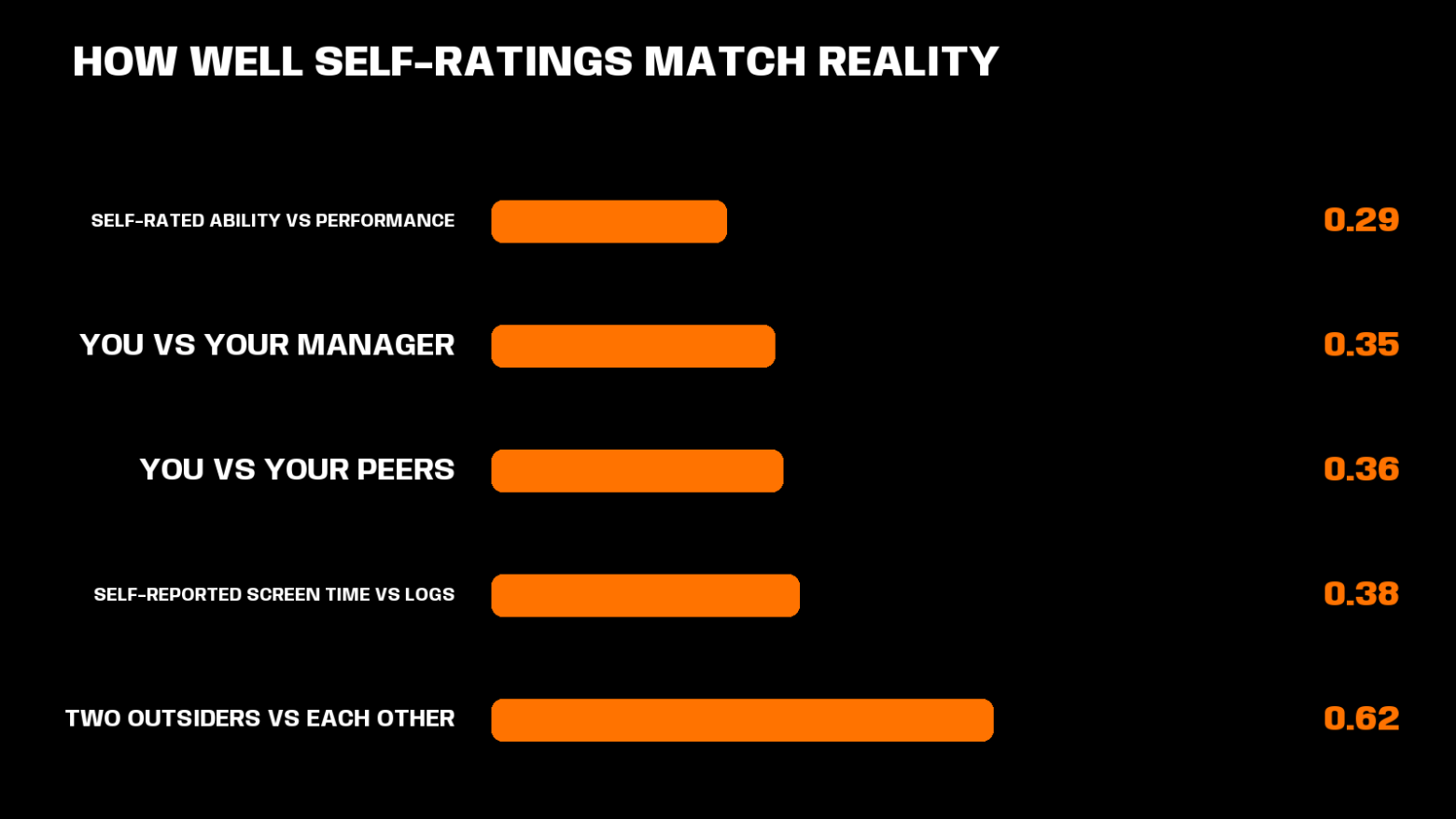
Correlations run from 0 to 1. Two outsiders agree with each other far more than you agree with either of them.
Why This Matters More for Men
Men run with less outside input and fewer routine check-ins, so the gap between self-image and reality has more room to grow. England’s first Men’s Health Strategy, published on 19 November 2025, states plainly that men can be less likely to seek help and more likely to suffer in silence, and notes there is evidence men have lower health literacy than women [1].
The consequences are not abstract. That same strategy records that men accounted for 3 out of 4 people who died by suicide in 2024, and that suicide remains one of the leading causes of death for men under 50 [1]. Noticing your own state earlier is not a soft skill in that context.
There is also a supply problem with where men get their self-knowledge. Movember’s report on young men’s health in a digital world, cited in the strategy, found 61 percent of young men watch male influencers discussing politics, wealth, gender, self-improvement and fitness. Men who follow that content were less likely to rate mental health as important to success (45 percent compared with 55 percent) and reported feeling worthless more often (27 percent compared with 23 percent) [1].
Bupa’s Wellbeing Index 2025, published in February 2025, adds the practical blockage: 30 percent of men said they did not know where to go for advice on their mental health, only 24 percent would talk to a friend about it, and over a third (37 percent) said they had hidden a mental health issue from their partner [10]. Dr Naveen Puri of Bupa put the pattern this way: “We know that men tend to suffer in silence but it’s incredibly important to seek support for any physical or mental health condition you may be experiencing. We see male patients all the time who say they wished they’d taken control on their health sooner” [10].
1. Swap Why for What
Stop asking why you are like this and start asking what is actually happening. Why questions send you looking for causes you cannot see, and your brain invents plausible ones. What questions point you at observable facts, which is the raw material self-awareness is actually made of.
What to do: Take the question you keep circling and rewrite it as a what. Not why am I so short with everyone, but what happened in the two hours before I snapped, and what did I do next.
Best for: Men who have thought about a problem for months and understand it beautifully without anything changing.
Why it works: Eurich’s team analysed interviews with people who scored highly on self-awareness and found that the word why appeared fewer than 150 times while what appeared over 1,000 times [3]. The experimental evidence points the same way. In work by Hixon and Swann, students asked to reflect on why they were a certain type of person resisted negative feedback about themselves, while students asked what type of person they were became more receptive to the same information [3]. British students who wrote about why they felt discouraged after a failed test showed increased depression both immediately and twelve hours later [3].
Watch-out: It feels blunt and slightly unsatisfying, because you are giving up the story and keeping only the facts. It is also not a licence to stop thinking about causes forever, just to stop leading with them. If the answer to a what question is genuinely painful, this step surfaces it faster than a why question ever would.
2. Name the Feeling in One Word
Once a day, put a single accurate word on your current state. Not fine, not stressed by default. Flat, wound up, resentful, restless, relieved. The word does not fix anything on its own, but it converts a vague physical state into something you can act on.
What to do: Set one prompt on your phone at a fixed time. Answer in one word, then add three words on what caused it if you can. Keep the record.
Best for: Men whose entire emotional vocabulary at work is good, busy or knackered.
Why it works: Putting a label on a feeling changes how the brain handles it. In an fMRI study published in Psychological Science, Matthew Lieberman and colleagues found that affect labelling, compared with other ways of processing the same images, reduced activity in the amygdala and other limbic regions while increasing activity in the right ventrolateral prefrontal cortex [7]. The naming is not decoration. It is part of the regulation.
Watch-out: One word is a starting point, not a diagnosis, and it can become a tick-box exercise inside a fortnight if you always reach for the same three labels. It is also genuinely harder for some men than the research implies. Difficulty putting emotions into words is well documented in men and is thought to be shaped by how men are socialised to restrict emotional expression, so expect the first two weeks to feel clumsy rather than revealing.
3. Write for Ten Minutes, Then Read It Back a Week Later
Write freely for ten minutes about whatever is loudest, with no editing. The self-awareness does not come from the writing. It comes from reading it back seven days later, when you can see the pattern you could not see while you were inside it.
What to do: Ten minutes, one page, no rereading it that night. Diarise a slot a week later to read the last four entries in one sitting and write one line on what repeats.
Best for: Men who have genuine insights and then lose them completely by Wednesday.
Why it works: James Pennebaker’s work found that expressive writing increased people’s use of causal and insight words such as consider and know, which indicates they were building actual links between events rather than just venting [12]. Joanne Frattaroli’s meta-analysis of experimental disclosure found a small but real average effect (r = .075) and that sessions longer than 15 minutes outperformed shorter ones [11].
Watch-out: Those effects are small on average, and writing can slide into circling the same feelings without ever reaching a fact. The read-back is the part that does the work, so if you only ever do the writing half you are journalling rather than becoming more self-aware. Cap it, end each entry with one observable fact, and stop if you finish more agitated than you started.
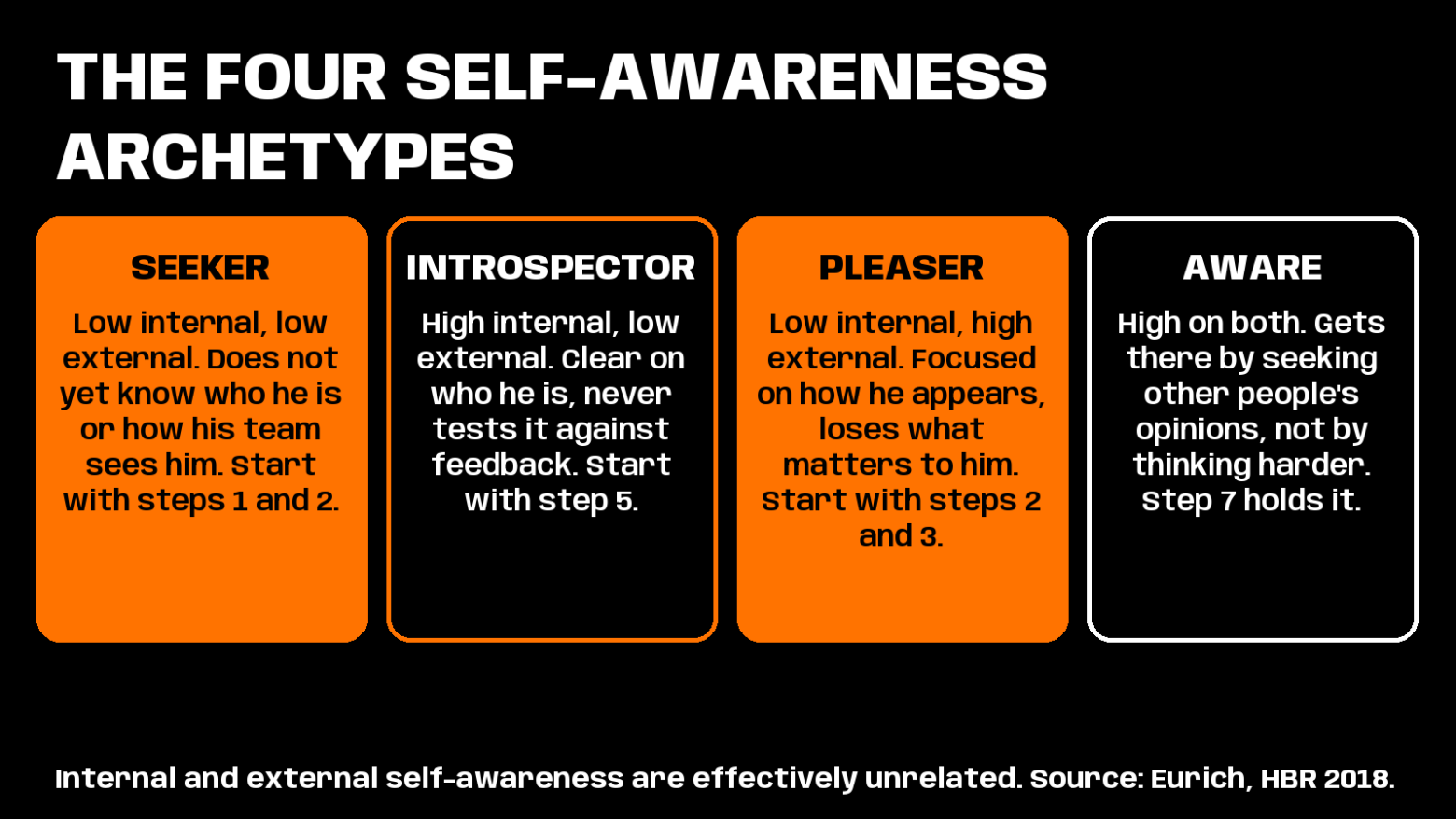
Most men are strong on one axis and blind on the other. Knowing which one you are tells you where to start.
4. Check the Data Instead of Your Memory
Look at the numbers you already generate before you trust your impression of yourself. Screen time, bank statements, sleep and training logs, calendar history. Every one of those is a record of what you actually did rather than what you meant to do. Your memory of your own behaviour is systematically flattering, and the logs are not.
What to do: Pick one behaviour you have an opinion about, write down your estimate first, then check the actual figure. Do one a week. Keep both numbers.
Best for: Men confident they barely drink, hardly scroll, or train most weeks.
Why it works: The gap is measurable. Daniel Parry and colleagues, in a meta-analysis of 106 effect sizes published in Nature Human Behaviour, found self-reported digital media use correlated only moderately with logged use, with a mean correlation of 0.38, and concluded that self-reports should not be treated as suitable substitutes for logs [6]. Their results, in their words, “raise concerns about the validity of findings relying solely on self-reported measures of media use” [6]. If your recall of your own phone use is that unreliable, your recall of your own temper is unlikely to be better.
Watch-out: Numbers tell you what happened and never why, and it is easy to turn this step into a spreadsheet hobby that produces no behaviour change at all. Data also has blind spots, because the behaviours that matter most (how you speak to people under pressure) do not log themselves. Pair this step with step five.
5. Ask Three People One Specific Question
Get an outside view, because internal reflection cannot produce it. Pick three people who see you in different settings, ask one narrow question, and say nothing while they answer. This is the single fastest way to find the blind spot you have been carrying for years.
What to do: Use one question, phrased specifically: what is one thing I do that makes me harder to work with, or harder to live with. Ask a colleague, a friend and your partner. Write down the answers verbatim. Do not defend anything.
Best for: Men who have never once been told directly how they come across.
Why it works: Outside raters agree with each other far more than they agree with you. Harris and Schaubroeck’s meta-analysis found peer and supervisor ratings correlated at .62, while self-supervisor agreement was only .35 and self-peer agreement .36 [5]. Two outsiders are describing something you cannot see. Eurich found that the most self-aware people actively encouraged honesty and sought out what she calls loving critics, then checked in with others after receiving hard feedback rather than retreating [2].
Watch-out: The answers are only as good as the people you ask, and asking someone who wants to please you produces nothing. It is also uncomfortable in a way the other six steps are not, and the temptation to explain yourself mid-answer will be strong. Ask once, thank them, and sit with it for a week before you respond.
6. Sit With No Input for Ten Minutes
Spend ten minutes a day with nothing coming in. No phone, no podcast, no radio, no driving. The point is not relaxation and it is not emptying your head. It is rebuilding the capacity to notice your own state before something louder overwrites it, which is the raw ability every other step on this list depends on.
What to do: Ten minutes, seated, eyes open or shut, attention on the breath or the body. A guided session is fine. Same time each day beats a longer session done occasionally.
Best for: Men who have not been genuinely bored or unstimulated in over a decade.
Why it works: Training attention inwards measurably improves how well people read their own bodily signals. A 2025 meta-analysis in Scientific Reports by Isaac Treves and colleagues pooled 29 randomised controlled trials with 2,191 participants and found mindfulness training produced a small-to-medium improvement in self-reported interoception (g = 0.31, 95 percent CI 0.21 to 0.42) [8]. Noticing tension, tiredness or agitation earlier is what makes the other six steps possible.
Watch-out: That is a modest effect, and the evidence base skews heavily female, with 77.8 percent of participants in that meta-analysis being women [8]. Read the finding as promising rather than settled for men specifically. It is also the slowest step here, so treat it as the foundation rather than the fix and expect nothing dramatic in week one.
7. Run a Twenty Minute Review Once a Month
Once a month, compare what you said you would do with what you actually did. Same four questions, same day, twenty minutes. This is the step that converts scattered noticing into an accurate picture, because a pattern only shows up across weeks.
What to do: Four questions. What did I say mattered this month. What does my calendar and spending say mattered. What did other people tell me. What is the one thing I am changing next month.
Best for: Men who keep learning the same lesson about themselves twice a year.
Why it works: Self-awareness responds to structured training rather than good intentions. Anna Sutton, Helen Williams and Christopher Allinson ran a longitudinal workplace study using a switching-replications design, measuring self-attentiveness and job well-being at three points across six weeks, and found self-awareness was positively associated with job-related well-being and was improved by the training [9]. A repeating review is the cheapest version of that structure.
Watch-out: The month you most need this review is the month you will skip it, because a bad month is exactly what you do not want to look at. It also fails quietly if you only ever review intentions against feelings rather than against the calendar, the logs and what people actually told you. Book it as a recurring appointment, not a good habit.
Common Mistakes Men Make With Self-Awareness
The biggest mistake is assuming more thinking equals more insight. Eurich’s research found the opposite: people who scored high on self-reflection were “more stressed, depressed and anxious, less satisfied with their jobs and relationships, more self-absorbed” and felt less in control of their lives [3]. Anthony Grant’s work found that people with greater insight had stronger relationships and better well-being, but that there was no relationship between introspection and insight at all [3].
The second mistake is doing only the internal half. Because internal and external self-awareness are effectively unrelated, a man can journal for two years and still be the person nobody wants on the project [2]. Steps four and five exist to break that.
The third is treating one good conversation or one honest weekend as the finish. Self-awareness behaves like fitness rather than like a realisation. It decays when you stop, which is the whole argument for step seven.
How Long Does It Take to Become More Self-Aware?
Expect a noticeable change within two to four weeks on the fast steps and a genuine shift in accuracy across three to six months. Swapping why for what and naming the feeling both work the day you start. The read-back, the data check and the monthly review need repetition before they show you anything, because their entire value is in the pattern across weeks rather than any single entry.
When to Get Support Rather Than Another Technique
Speak to a GP if low mood, anxiety or anger has been present most days for more than two weeks, if you are using alcohol to manage your state, or if the honest answer to any of the questions above worries you. None of the seven steps here is a treatment, and self-awareness work is not a substitute for professional help. If you are in crisis in the UK, Samaritans can be reached free on 116 123 at any hour.
FAQ
Can you become more self-aware on your own?
Partly. Internal self-awareness responds well to solo work such as writing, labelling and reviewing your own data. External self-awareness, meaning how you actually come across, cannot be generated alone, because the information exists only in other people. Any plan without at least one honest outside source will stall halfway.
Why do I overthink myself without ever learning anything?
Because reflection and insight are different things, and the research finds no relationship between how much people introspect and how much insight they end up with. Circling why questions produces invented explanations that feel true. Switching to what questions and checking against real data is what turns thinking into information.
What is the difference between self-awareness and overthinking?
Self-awareness ends in an observation you can act on. Overthinking ends where it started, usually with a story about your own character. The practical test is whether the thinking produced a specific fact and a next action within twenty minutes. If it did not, you were ruminating rather than reflecting.
Are men less self-aware than women?
The research does not support a simple yes. What UK evidence does show is that men get less outside input, are less likely to seek help, and are less likely to discuss their health, all of which remove the feedback that self-awareness depends on. The gap is more about information flow than about capacity.
How do I ask for honest feedback without it turning into an argument?
Ask one narrow question rather than an open invitation, tell the person you want the uncomfortable version, and commit to saying nothing but thank you. Write the answer down word for word and respond a week later. Most of these conversations go badly because the asker starts defending mid-sentence.
Can an app make me more self-aware?
It can run the repetition, which is where most men fail, by prompting the daily label, the writing slot and the monthly review, and by keeping the record you later read back. What it cannot do is give you the outside view or replace professional support if your mood is the real issue. Treat it as the structure, not the insight.
Does personality testing help?
It gives you shared language and a starting hypothesis, which is useful. It does not tell you how you actually behave under pressure or how you land on other people, and self-report questionnaires inherit the same accuracy problem as any other self-assessment. Use one as a conversation starter, then verify against behaviour and feedback.
Final Recommendation
Start with two steps, not seven. Swap why for what in every conversation you have with yourself, and put one accurate word on your state once a day. Add the ten minute write in week two and the read-back in week three. Both of those are free, and between them they cover the whole internal side of this.
In month two, run one data check a week and have the three feedback conversations, which will be the most uncomfortable and most useful thing on this list. Book the monthly review before you need it. If low mood or anger has been constant for a fortnight, that is information too, and the next step is a GP rather than an eighth technique.
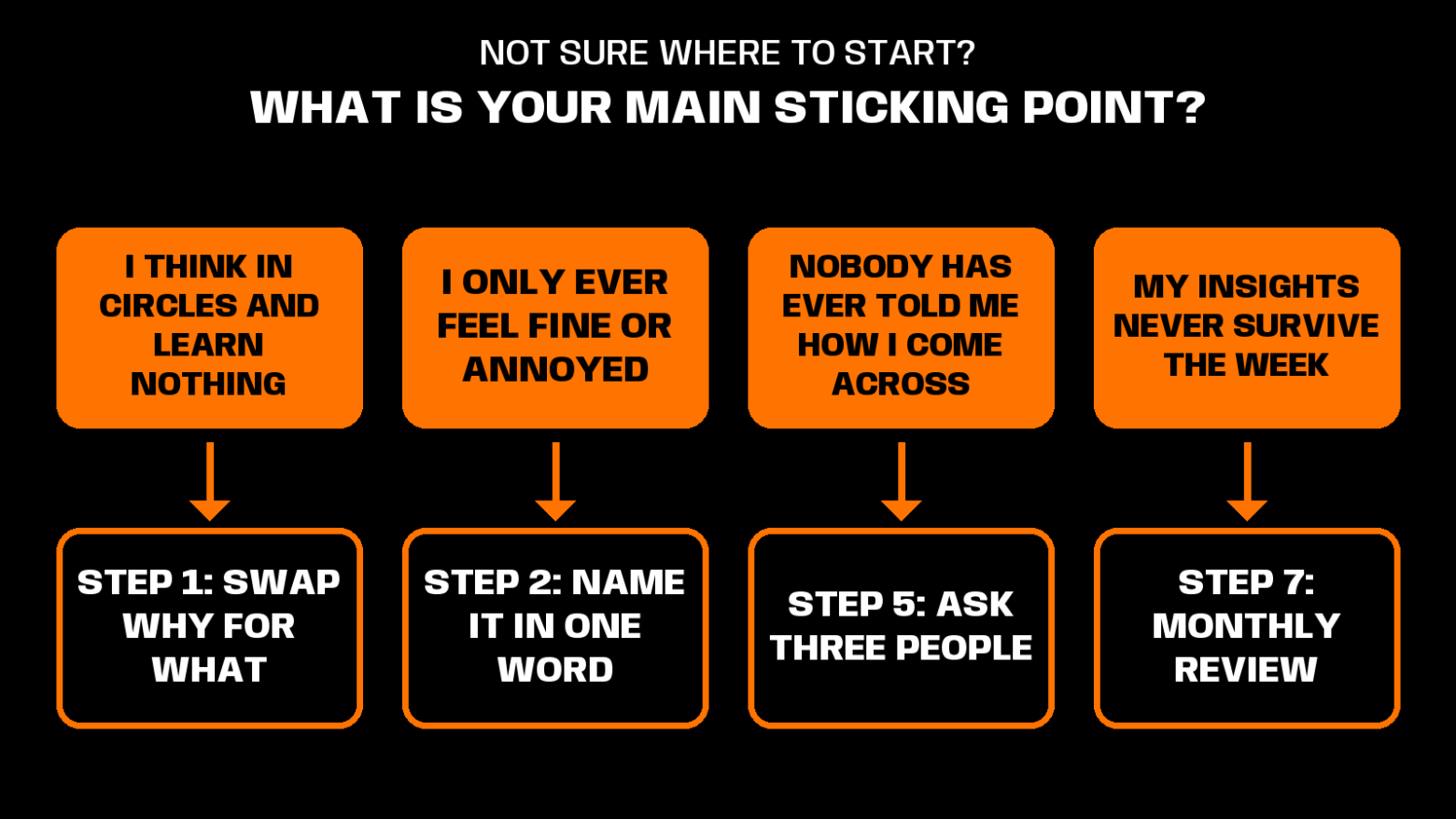
Start where your actual blind spot is, not where the work sounds most impressive.
Options for Men to Take Action
Most men do not need another definition of self-awareness. They need the daily one-word check to still happen on the Thursday everything is going wrong, and the monthly review to happen in the month they would rather not look. This work fails at the point of repetition, not the point of understanding.
The MenTools app runs this as one challenge system rather than seven separate intentions, with daily actions, chosen difficulty levels, journals, reminders timed to the moment it matters, progress tracking and an AI coach for the weeks it slips. Men tend to keep the habits they can see a record of, and a record is exactly what step three and step seven need.
How you can do this today: set the one-word check as a daily action at a fixed time, and log tonight’s before bed.
Wins on cost: one subscription covers the mindset, fitness and habit sides together rather than three separate tools.
Wins on time: the structure, levels and tracking already exist, so there is nothing to design before you start.
Wins on practicality: it runs around shifts, travel and a full working week, which is where a fixed daily practice usually breaks first.
Watch-out: it is a behaviour tool, not therapy and not an outside view. It will keep the reps going, but it cannot have the three feedback conversations for you, and it does not replace professional help if your mood is the underlying problem.
Noticing your own state accurately is harder on four hours of sleep and a long week, so a one a day multivitamin may help cover the simple daily foundation underneath all seven steps. If the thinking itself is what keeps looping, our guide to how to stop overthinking as a man deals with that directly, and how a man becomes more confident covers what tends to happen once the self-picture gets accurate. More built for men sits in the MenTools awareness hub. Two steps, run for a month, will tell you more than another year of thinking about it.
Last updated: 2026-09-10 v1.0
Disclaimer: This guide is for informational purposes only and does not constitute medical or psychological advice. Speak with a qualified professional before making significant changes if you have a medical or mental health condition.
References
- [1] Department of Health and Social Care. Men’s health, a strategic vision for England. Published 19 November 2025, CP 1432. Link
- [2] Eurich T. What self-awareness really is (and how to cultivate it). Harvard Business Review, 4 January 2018. Link
- [3] Eurich T. The right way to be introspective (yes, there is a wrong way). TED Ideas, 2017. Link
- [4] Zell E, Krizan Z. Do people have insight into their abilities? A metasynthesis. Perspectives on Psychological Science, 2014;9(2):111-125. Link
- [5] Harris MM, Schaubroeck J. A meta-analysis of self-supervisor, self-peer, and peer-supervisor ratings. Personnel Psychology, 1988;41(1):43-62. Link
- [6] Parry DA, Davidson BI, Sewall CJR, Fisher JT, Mieczkowski H, Quintana DS. A systematic review and meta-analysis of discrepancies between logged and self-reported digital media use. Nature Human Behaviour, 2021;5(11):1535-1547. Link
- [7] Lieberman MD, Eisenberger NI, Crockett MJ, Tom SM, Pfeifer JH, Way BM. Putting feelings into words, affect labeling disrupts amygdala activity in response to affective stimuli. Psychological Science, 2007;18(5):421-428. Link
- [8] Treves IN, Chen YY, Wilson CL, Verdonk C, Qina’au J, Pustejovsky JE, Goldberg SB, Mehling W, Schuman-Olivier Z, Khalsa SS. A meta-analysis of the effects of mindfulness meditation training on self-reported interoception. Scientific Reports, 2025. Link
- [9] Sutton A, Williams HM, Allinson CW. A longitudinal, mixed method evaluation of self-awareness training in the workplace. European Journal of Training and Development, 2015;39(7):610-627. Link
- [10] Bupa. Wellbeing Index 2025, lifting the lid on men’s health. February 2025. Link
- [11] Frattaroli J. Experimental disclosure and its moderators, a meta-analysis. Psychological Bulletin, 2006;132(6):823-865. Link
- [12] Pennebaker JW, Chung CK. Expressive writing, connections to physical and mental health. Link
- [13] Eurich T. The four self-awareness archetypes. Harvard Business Review, January 2018. Link