
MEN: Meal Prep vs Eating Out: What Actually Works for Busy Men?
Quick Answer
Meal prep wins on cost, portion control and calories. Eating out wins on time, flexibility and not needing you to plan anything. For most busy men the right answer is not one or the other, it is prepping three weekday meals so the other four can be whatever the week throws at you.
**Jump to:** Both at a glance | FAQ | Options for men
Disclosure: MenTools publishes this article and may feature MenTools products.
How we evaluate: Each option is assessed on real-world use, evidence, cost and time, and how well it suits men. Every option including the MenTools option carries an honest limitation. Full sources are in the references below.
Meal Prep vs Eating Out at a Glance
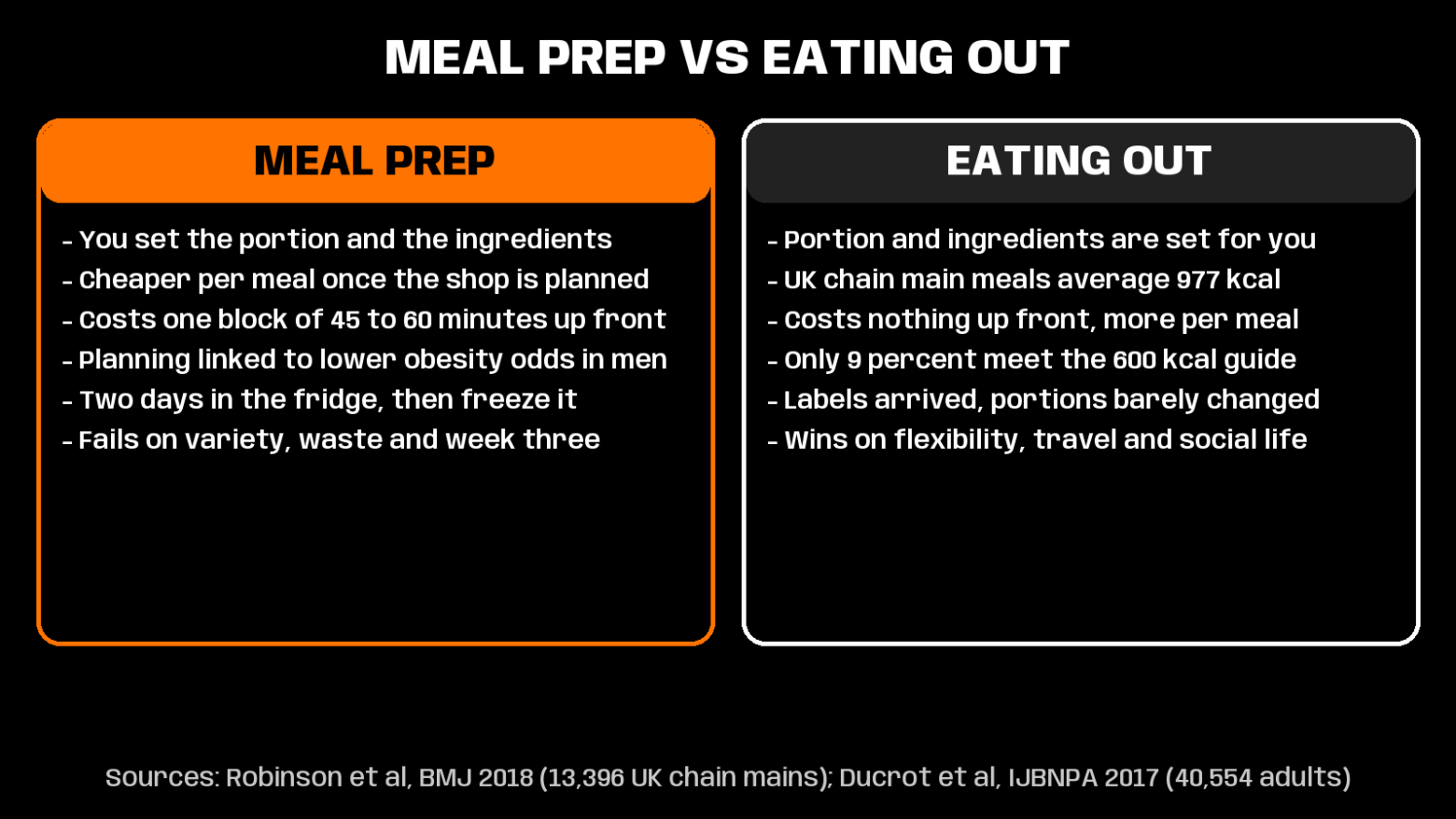
The two options side by side, including where each one genuinely fails.
| Option | What it rests on | Best for | Standout | Watch-out |
|---|---|---|---|---|
| Meal prep | You deciding the portion and the ingredients in advance | Repeatable weekday meals when the week is busy | Removes the decision at the moment you are least able to make it | Front-loads the effort into one block you have to keep showing up for |
| Eating out | Someone else deciding the portion and the ingredients | Occasions, travel, social life and genuinely unplanned days | Zero setup, zero washing up, works anywhere | UK chain main meals average 977 kcal and only 9 percent meet the 600 kcal guide |
How We Compared Them
We compared the two on seven criteria that change how a working week actually runs, not on which one sounds more disciplined. Every criterion had to be something you could measure or notice within a month, because a comparison you cannot test on yourself is just an opinion with a table around it.
Those seven are cost per meal, calorie control, time cost, how well each one survives a bad week, variety, waste, and whether the effect holds up in the research rather than only in theory. Both options carry honest limitations below. Meal prep has a failure rate that most articles on this quietly skip, and eating out does some things better than home cooking ever will.
It is worth knowing where you are starting from, because most men are starting further back than they think. In the 2005 UK Time Use Survey, 60 percent of men spent any time cooking across a full 24 hour period, which means two in five did none at all [8]. This comparison is rarely a choice between two established habits. It is usually a choice between one habit and one you would have to build.
1. Meal Prep: What It Actually Is
Meal prep is deciding what you will eat, buying for it, and cooking some or all of it before the day you eat it. It is not a diet and it does not require containers stacked like a supply depot. It suits any man whose weekday decisions get made in a hurry, badly, at around six in the evening.
What it is: A planning behaviour first and a cooking behaviour second. The cooking is the visible part, but the part that changes your intake is deciding in advance, while you are calm, what the week is going to look like.
Who it is for: The man whose problem is not knowledge but timing. He knows what a decent meal looks like. He just keeps arriving at the decision with no food in the house and no capacity left to think.
Standout: The planning half has real evidence behind it, and it is separable from the cooking. In a study of 40,554 French adults published in the International Journal of Behavioral Nutrition and Physical Activity, Pauline Ducrot and colleagues found that 57.4 percent of participants planned meals, and that planners were significantly more likely to sit in the top quarter for overall food variety, with an odds ratio of 1.25 [1]. The same pattern held for vegetable variety at 1.21 and for adherence to national dietary guidelines at 1.13 [1]. Among men specifically, meal planning was associated with lower odds of obesity, odds ratio 0.81 [1]. That is an association rather than proof of cause, and the authors say so plainly, but it is the strongest evidence either side of this comparison has.
Watch-out: It fails on variety, on waste and on week three. You are eating the same thing repeatedly by design, which is fine on Tuesday and grim by Thursday, and the whole system collapses the first Sunday you skip. It also assumes you have a fridge, containers, an hour, and a week predictable enough to plan. Shift workers and men who travel for work often do not have three of those four.
2. Eating Out: What It Actually Is
Eating out is any meal prepared outside your home, which includes restaurants, cafes, chains, work canteens, meal deals and takeaways eaten on your own sofa. It costs you no planning and no time. It suits occasions, travel and any day that genuinely went sideways.
What it is: Outsourcing the decision and the labour. In exchange you accept someone else’s portion size, someone else’s cooking fat and someone else’s idea of what a normal serving looks like.
Who it is for: The man whose week has no fixed shape, and any man on the days that were never going to be planned. It is also the honest answer for anyone who does not want to spend a Sunday cooking and would rather adjust elsewhere.
Standout: It is the only option that survives a completely unpredictable week, and it is a normal part of life rather than a failure of discipline. It is also the default in Britain now rather than the exception. Latest National Diet and Nutrition Survey data covering 2019 to 2023 shows 12 percent of the calories UK adults consume come from food prepared outside the home [2].
Watch-out: The portions are the problem, not the food. In the largest analysis of its kind, published in the BMJ, Eric Robinson and colleagues at the University of Liverpool assessed 13,396 main meals across 27 large UK restaurant chains. The mean energy content was 977 kcal. Full service restaurant mains averaged 1,033 kcal against 751 kcal in fast food chains, a gap of 268 kcal, and only 9 percent of all meals met the public health recommendation of 600 kcal for a main while 47 percent were excessive [3]. Robinson put it bluntly. “Only one in ten of the meals we surveyed could be considered a healthy number of calories” [4]. He also noted the analysis probably underestimates the real total, because it excluded drinks, starters, desserts and sides [4].
Which One Actually Costs Less?
Meal prep, on almost any weekday comparison, but the gap is smaller than the internet claims and it depends on what you cook. Cooking at home moves you from paying for food plus labour plus rent plus margin to paying for food. That is the whole mechanism, and it is why the saving is real.
The scale is visible in national spending. Office for National Statistics figures for April 2024 to March 2025 put average total UK household spending at £676.60 a week [5]. Restaurants and hotels account for 7 percent of that, still below the 9 percent share households were spending before the pandemic [5]. It is the category most men can move without touching anything else in their budget.
The honest complication is that cooking at home does not automatically make food cheap. The Food Foundation’s Broken Plate 2025 report found that more healthy foods are nearly three times as expensive per calorie as less healthy foods, and that the most deprived fifth of households would need to spend 45 percent of their disposable income to afford the government recommended healthy diet [6]. Meal prep saves money against a takeaway. It does not save money against a man who was already living on cheap calories.
Which One Wins on Calories?
Meal prep, and it is not close, because portion size is the single variable that changes most and it is the one you hand over entirely when you eat out. You are not fighting willpower in a restaurant. You are receiving a plate that was built to feel like value.
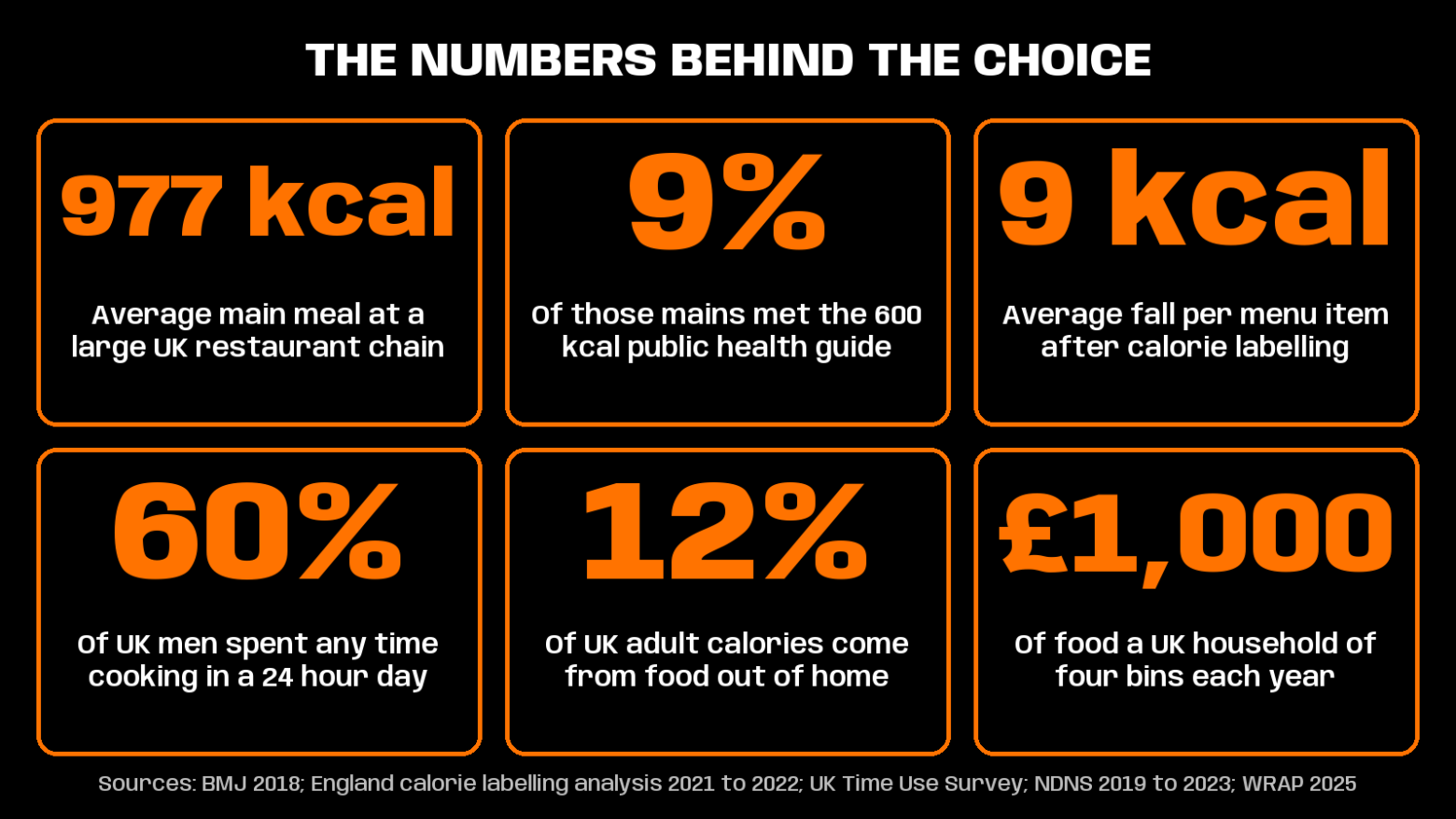
The numbers that decide this comparison, from UK chain menus, national diet data and household waste figures.
The scale of it is easy to underestimate. In the same BMJ analysis, 89 percent of full service main dishes and 83 percent of fast food main dishes exceeded the 600 kcal recommendation [4]. That is the normal menu, not the indulgent corner of it.
England made calorie labelling mandatory for large out of home businesses on 6 April 2022, which helps you choose but has barely moved the menus. A pre and post analysis of 78 chains and 31,045 menu items, comparing September 2021 with September 2022, found mean energy content fell by just 9 kcal per item, a drop of 2.0 percent, and that the change came almost entirely from swapping items in and out rather than reformulating them. Withdrawn dishes averaged 458 kcal and newly added ones 434 kcal, while dishes available across both periods went from 437 kcal to 439 kcal [7]. Labelling gave you information. It did not give you smaller meals.
Prepping does not require you to eat less food, which is why it works. It requires you to decide the amount once, in a kitchen, while you are not hungry, instead of at a table when you are.
Which One Actually Costs You More Time?
Eating out wins on time in the moment and loses it across a week, but the honest answer is that most men are not currently spending the time either way. The comparison people imagine is one hour of prep against zero. The real comparison is one planned hour against several unplanned twenty minute trips.
British men are not heavy cooks to start with. Analysing 4,214 adults in the 2005 UK Time Use Survey, Jean Adams and colleagues found that 60 percent of men spent any time at all cooking during a 24 hour period, against 85 percent of women, and that only 33 percent of men managed 30 continuous minutes of cooking, against 60 percent of women [8]. Their conclusion was direct. “Gender was a stronger determinant of time spent cooking than other socio-demographic variables” [8].
That matters for how you read this comparison. If you currently cook almost nothing, the realistic first move is not a full week of prepped meals. It is one cooking block that covers three dinners, which is a change from roughly zero rather than a change from a system you already run.
| Criteria | Meal prep | Eating out | Which one wins |
|---|---|---|---|
| Cost per meal | Lower, once the shop is planned | Higher, you pay for labour and premises | Meal prep |
| Portion control | You set it in advance | Set for you, averaging 977 kcal a main | Meal prep |
| Time on the day | Near zero, it is already cooked | Near zero, but travel and waiting add up | Draw |
| Time up front | One block of 45 to 60 minutes | None | Eating out |
| Survives a chaotic week | Poorly, one missed Sunday breaks it | Completely, that is its whole function | Eating out |
| Variety | Low by design | High | Eating out |
| Food waste risk | Real, if you over buy or over cook | Low for you, you buy one portion | Eating out |
Does Meal Prep Actually Work, or Does It Just Sound Right?
The planning part has decent evidence, the cooking part has weaker evidence than most people assume, and being honest about that difference is the only way this comparison stays useful. Cooking at home is treated as self evidently healthy. The research is more cautious.
In a systematic review of 38 observational studies published in Appetite, Susanna Mills and colleagues examined the determinants and outcomes of home cooking and concluded that the potential positive associations between cooking, diet and health require further confirmation, with the evidence base limited by its reliance on cross-sectional studies [9]. Cooking at home is not a health intervention on its own. What you cook still decides the outcome.
The national numbers make that point for you. Only 4 percent of UK adults meet the recommended 30 grams of fibre a day, and men aged 19 to 64 average 66 grams of red and processed meat daily, with 27 percent of them going over 90 grams [2]. None of that is caused by eating out. A man can cook every meal at home and still land exactly there.
Set that against the planning findings and a clear picture emerges. The gain is not in the act of cooking. It is in having decided in advance, which is exactly the part most men skip when they buy containers and call it a system.
What Actually Goes Wrong With Meal Prep
Three things, in this order. Men over buy, men over cook, and men ignore the food safety rules that decide whether the food is still worth eating on Wednesday. Each one is fixable and none of them is about motivation.
Over buying is expensive and it is national. WRAP figures published in July 2025 estimate that 4.4 million tonnes of edible food is thrown away from UK homes each year [10]. That costs an average household of four around £1,000 annually, and works out at roughly three meals a week per person going in the bin [10]. Prepping badly is one of the fastest ways to join that statistic, because you buy for an ambitious week and eat like a real one.
The safety rules are simple and worth following exactly. NHS guidance is to cool cooked food as quickly as possible and get it into the fridge within two hours, splitting it into smaller portions so it cools faster, use chilled leftovers within two days, and reheat only once, until it is steaming hot all the way through [11]. Rice and pasta are the two to be strictest with. If Wednesday is the problem, freeze Wednesday’s portion on Sunday rather than hoping.
What Most Busy Men Should Actually Do
Prep three weekday meals and leave the rest open. That is the version that survives contact with a real week, because it gives you the cost and portion benefits of prepping on the days you are least able to think, without pretending your Friday is predictable.
The reason it works is that it fails safely. A seven day prep plan has one point of failure and a bad Sunday takes the whole week with it. A three meal plan can lose a day and still be a three meal plan. It also keeps eating out where it belongs, as something you chose, rather than as the thing that happens when the plan collapses.
The arithmetic is worth seeing. Three chain mains at the UK average of 977 kcal comes to 2,931 kcal, while three home portions built to the 600 kcal public health guide comes to 1,800 [3]. That is a difference of over 1,100 calories a week from three decisions, not from willpower applied twenty-one times.
The other half is keeping a record, because the honest problem is rarely the cooking. Men who write the block down and tick it off tend to still be running it in month two, while men relying on intent tend to lose it in the first genuinely bad week, and the difference is visible long before either of them notices it. Nobody spots the plan quietly stopping in week three unless something is keeping score. A notebook works. A note on your phone works. A tracking app works. What matters is that the week you skipped is visible to you, rather than something you find out about a month later. For the wider set of behaviours this sits inside, see our guide to simple nutrition habits for busy men, and for the planning block itself, our guide to how to plan your week as a man covers where to put the hour.
Pick Meal Prep If, Pick Eating Out If
Pick meal prep if your week has a repeating shape, if your money is leaving in twelve pound increments you cannot account for, if your portions are the thing that has drifted, or if your weekday decisions are consistently made at the point of maximum hunger and minimum patience. Those are the four situations where it pays immediately.
Pick eating out if your week genuinely has no shape, if you travel, if you work shifts that move, or if cooking is the one thing you know you will not do and you would rather change portion size and frequency instead. Choosing this deliberately and ordering better is a real strategy. Choosing it by default at seven in the evening is not, and that is the only version worth avoiding.
FAQ
Is meal prep actually cheaper than eating out?
Almost always per meal, because you stop paying for labour, premises and margin. The size of the saving depends on what you cook. Home cooking beats a takeaway comfortably, but it does not automatically beat a diet already built on cheap calories, since healthier foods cost substantially more per calorie in the UK.
How many days of meal prep can I safely keep in the fridge?
Two. NHS guidance is to cool cooked food and refrigerate it within two hours, then use it within two days, reheating only once until it is steaming hot. Anything you want for day three or beyond should go into the freezer on the day you cook it, not after it has already sat in the fridge.
How long should meal prep take for one man?
Between 45 and 60 minutes for three weekday dinners, if you cook things that share an oven and a hob. The time goes up sharply when you cook three different meals rather than three portions of two components. Keep the components simple and let the variety come from what you add at the end.
Will I get bored eating the same prepped meals?
Yes, and planning for that is the difference between a system that lasts and one that lasts nine days. Prep the base rather than the finished meal, so the same protein and grain become different meals with a different sauce, salad or spice. Boredom is the most common reason meal prep stops, not effort.
Can I eat out and still keep my intake under control?
Yes, by deciding before you arrive rather than at the table. Calorie labelling is mandatory for large chains in England, so the information is there, and the useful move is choosing the main while you are not yet hungry and treating starters, sides and drinks as separate decisions rather than defaults.
Is a meal delivery service the same as meal prep?
It removes the shopping and the planning, which are the two parts with the best evidence behind them, and keeps the cooking, which has the weakest. It is a reasonable middle option on cost and time, but it does less for the decide in advance mechanism than a written plan and a normal shop.
What should I do in weeks when prep is impossible?
Drop to one component rather than to nothing. Cooking a single tray of protein on any evening covers three lunches and takes under 40 minutes, and it keeps the habit alive through the weeks that would otherwise end it. Going from three meals to zero is what makes restarting feel like starting again.
Final Recommendation
Stop treating this as a character test. Meal prep is a cost and portion tool, eating out is a flexibility tool, and a man running a real week needs both. Prep three weekday meals, keep the food safety rules tight, order deliberately on the other days, and write down whether you actually did it. That combination beats a perfect seven day plan you abandon in week three, and it is the version still running at Christmas.
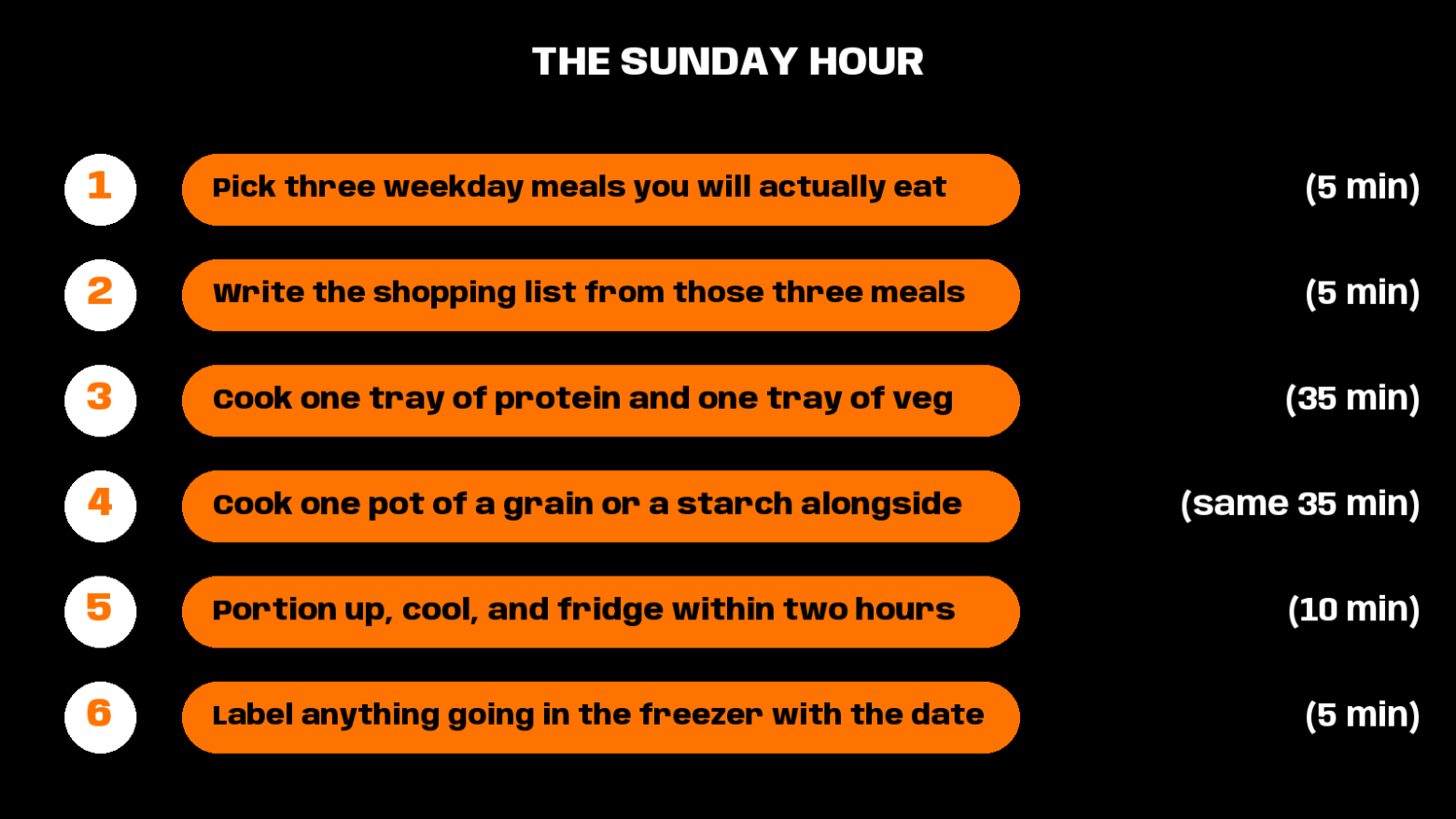
The Sunday hour, broken into six steps with realistic timings.
Options For Men to Take Action
Most men do not fail at this because they picked the wrong side of the comparison. They fail because nothing in the week reminds them that Sunday is the hour deciding Tuesday, and by the time they notice, three weeks of unplanned evenings have already happened. Knowing that prepping wins on cost and calories is worth very little without something that keeps the block in the diary.
The MenTools app runs nutrition alongside mindset, fitness and money in one challenge system, with daily actions, chosen difficulty levels, reminders timed to the moment the decision is actually made, streaks, progress tracking and an AI coach. The value is the prompt and the record, not more information about food.
How you can do this today: put a 60 minute block in Sunday, set it as a repeating action, and log the first one this week so the pattern exists before motivation has a say.
Wins on cost: one subscription covers the habit side of food, training and money rather than three separate tools.
Wins on time: the structure, levels and tracking are already built, so there is nothing to design before you start.
Wins on practicality: it works around shifts, travel and family meals, which is exactly where a rigid seven day meal plan fails first.
Watch-out: it is a behaviour tool, not a meal planner, a recipe app or a calorie tracker. If you need a personalised plan for a medical condition, it supports that work rather than replacing it.
On the weeks the cooking slips, and there will be some, a one a day multivitamin may help cover the simple daily foundation underneath it. If you want the specific food rather than the comparison, our guide to what men should eat to stay lean and energised covers that side. For more built for men, see the MenTools nutrition hub. Three prepped meals a week, held for three months, will do more than a perfect plan you follow for nine days.
Last updated: 2026-09-15 v1.0
Disclaimer: This guide is for informational purposes only and does not constitute medical or psychological advice. Speak with a qualified professional before making significant changes if you have a medical or mental health condition.
References
- [1] Ducrot P, Mejean C, Aroumougame V, Ibanez G, Alles B, Kesse-Guyot E, Hercberg S, Peneau S. Meal planning is associated with food variety, diet quality and body weight status in a large sample of French adults. International Journal of Behavioral Nutrition and Physical Activity, 2017. Link
- [2] The Food Foundation. UK still failing to meet basic dietary guidelines, analysis of National Diet and Nutrition Survey data 2019 to 2023. Link
- [3] Robinson E, Jones A, Whitelock V, Mead BR, Haynes A. (Over)eating out at major UK restaurant chains, observational study of energy content of main meals. BMJ, 2018. Link
- [4] University of Liverpool. Calories in popular restaurant chain meals excessive warn experts, 13 December 2018. Link
- [5] Office for National Statistics. Family spending in the UK, April 2024 to March 2025. Link
- [6] The Food Foundation. The Broken Plate 2025, the state of the nation’s food system. Link
- [7] Changes in energy content of menu items at out-of-home food outlets in England after calorie labelling policy implementation, a pre-post analysis 2021 to 2022. Link
- [8] Adams J, Goffe L, Adamson AJ, Halligan J, O’Brien N, Purves R, Stead M, Stocken D, White M. Prevalence and socio-demographic correlates of time spent cooking by adults in the 2005 UK Time Use Survey. Appetite, 2015. Link
- [9] Mills S, White M, Brown H, Wrieden W, Kwasnicka D, Halligan J, Robalino S, Adams J. Health and social determinants and outcomes of home cooking, a systematic review of observational studies. Appetite, 2017. Link
- [10] WRAP. UK food waste and food surplus, key facts, July 2025. Link
- [11] NHS inform. Preparing and cooking food safely. Link