
MEN: 7 Money Mistakes Men Make in Their 30s
Quick Answer
The seven that cost most are spending every pay rise, leaving your pension on the auto enrolment minimum, borrowing the maximum the bank offers, running no protection once people depend on you, holding long term money in cash, abandoning old pension pots, and never claiming the tax relief you are owed. Six of the seven are fixed by one decision.
**Jump to:** The 7 at a glance | How we chose | FAQ | Options for men
Disclosure: MenTools publishes this article and may feature MenTools products.
How we evaluate: Each mistake is assessed on real-world use, evidence, cost and time, and how well it suits men. Every mistake including the MenTools option carries an honest limitation. Full sources are in the references below.
The 7 at a Glance
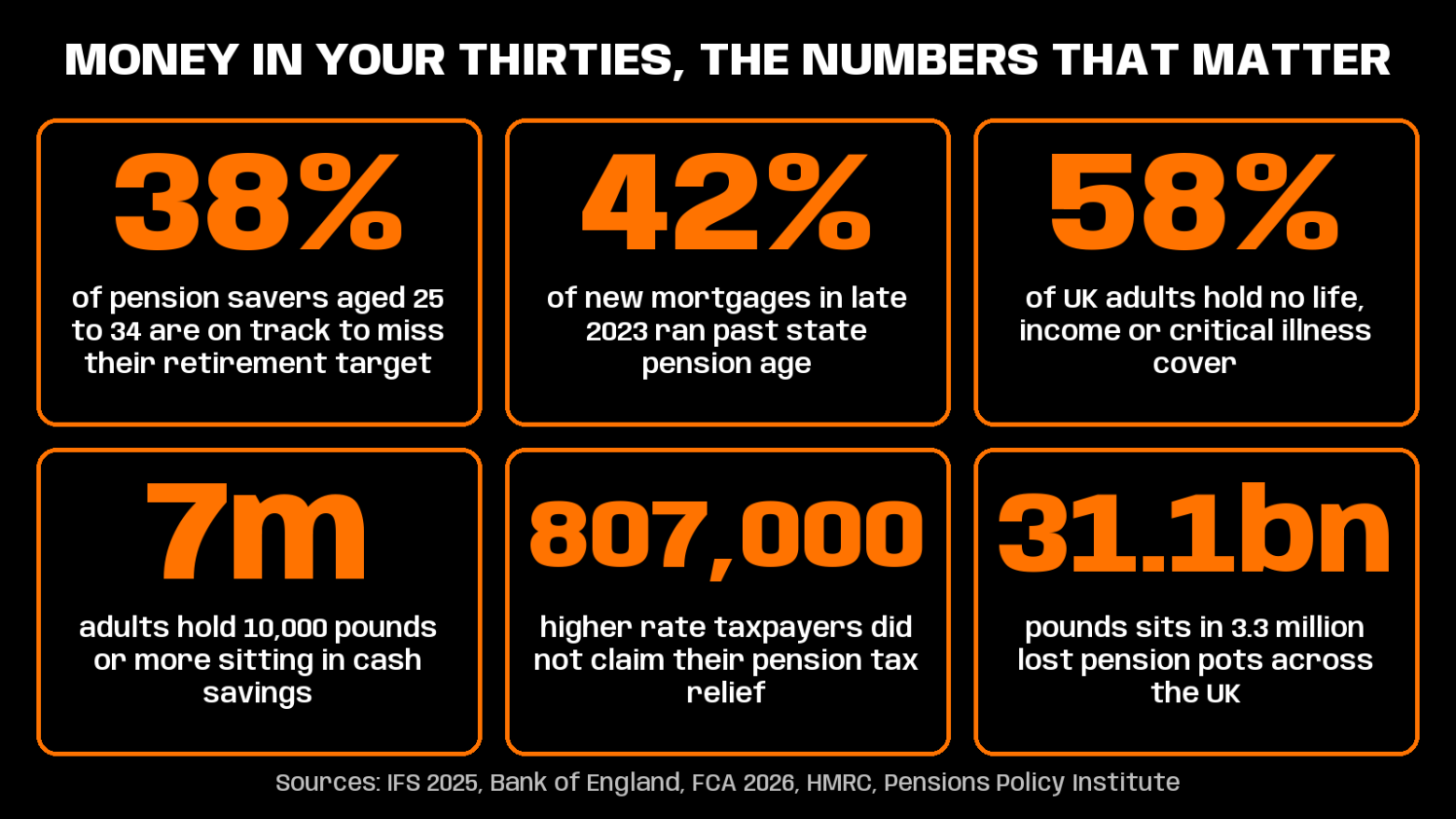
Six numbers that explain why the 30s are the decade these mistakes get expensive.
| Mistake | Who it hits | What it costs | The fix | Watch-out |
|---|---|---|---|---|
| 1. Spending every pay rise | Men earning far more than at 25 | The whole gap between earning more and having more | Commit a share of the next rise before it lands | Has to be decided in advance, not on payday |
| 2. Staying on the pension minimum | Men who never changed the default | 38 percent of savers aged 25 to 34 are off target | Add one percentage point now | Locked away until at least 55 |
| 3. Borrowing the bank maximum | Men buying at the top of an affordability check | A mortgage that outlives your working life | Borrow against one income, shortest term | A shorter term costs more each month |
| 4. No protection with dependants | Men with a mortgage and young children | The entire plan if you stop earning | Price term cover while young and well | A real monthly cost for a risk that may not land |
| 5. Long term money in cash | Disciplined savers using the wrong account | Twenty years of growth on money you will not touch | Split the pot by when you need it | Investments fall, and cash suits short horizons |
| 6. Pots left at old jobs | Men who have changed employer three times | An average lost pot of 9,470 pounds | Trace and list every pot in one hour | Consolidating can lose valuable old guarantees |
| 7. Unclaimed higher rate relief | Men who crossed the 40 percent band | 1,756 pounds a year on average | Claim it, and backdate four years | Only applies to relief at source schemes |
How We Chose These 7
Every mistake here had to clear three tests. It had to be specific to the 30s rather than general money advice, the cost had to be quantifiable from published UK data, and it had to be fixable by one decision or one hour of admin. That rules out most of what gets called a money mistake.
We also ordered them by how quietly they happen. The Financial Conduct Authority found one in four UK adults has low financial resilience, meaning missed payments, struggling to keep up, or no savings to fall back on [1]. None of the seven below feels like a mistake at the time, which is precisely why they survive a decade.
This is general information rather than financial advice, and it names no products, funds or providers. MoneyHelper is free, impartial and government backed if you want guidance on your own position. For the order these decisions sit in, our complete money guide for men sets out the sequence.
1. Spending Every Pay Rise Before You Notice
Your 30s are the decade your income climbs fastest and your net worth often does not. The mistake is not extravagance, it is the absence of a decision. The rise lands, spending expands to meet it within a month or two, and the surplus never reaches an account you leave alone. One instruction, given before the money arrives, fixes it.
What it is: lifestyle creep. Each promotion, bonus or job move lifts both income and baseline spending, so the gap between them stays roughly where it was at 25.
Who it hits: the man earning considerably more than he did five years ago who could not say where the extra went.
What it costs: the Office for National Statistics put median full time earnings at 39,039 pounds a year in April 2025 [2]. Over the same period the household saving ratio fell to 8.9 percent in the first quarter of 2026, and the ONS attributes that fall to a drop in non pension saving [3]. Money is moving through households rather than into them.
The fix: decide the share of the next rise that leaves your account before it arrives. The evidence for pre committing is unusually strong. In the Save More Tomorrow programme, Benartzi and Thaler lifted participants average savings rate from 3.5 percent to 13.6 percent across roughly 40 months purely by allocating future pay rises in advance [4]. You can hold that instruction in a calendar entry, a note beside your standing order, or a habit tracker such as the MenTools app if you want the prompt to arrive on its own. The instruction matters far more than where it lives.
The men who actually hold this tend to be the ones who wrote the instruction down in the same week the rise was confirmed, rather than the ones who intended to sort it out at the end of the month.
Watch-out: it only works if you decide before the higher figure hits your account. Once you have had two months at the new level, that level is your baseline and the rise has already gone.
2. Leaving Your Pension on the Auto Enrolment Minimum
Auto enrolment was built as a floor, not a plan. The default is eight percent of a band of your salary rather than eight percent of your salary, and most men never touch it. In your 30s that is the most expensive default you own, because this is the decade where each extra pound has the longest time to work.
What it is: the minimum total contribution under auto enrolment is 8 percent of qualifying earnings, meaning the slice of pay between 6,240 pounds and 50,270 pounds a year, with at least 3 of those percentage points coming from your employer [5].
Who it hits: the man who was enrolled automatically, never opted out, and has never looked at the rate since.
What it costs: the Institute for Fiscal Studies projects that 38 percent of private sector employees aged 25 to 34 saving into a defined contribution pension are on course to miss their target replacement rate, and 13 percent to fall short of the Pensions and Lifetime Savings Association minimum retirement living standard [5]. The report is direct about why the timing matters, noting that the effects of reform “on pension adequacy for older working-age adults are smaller, as they have fewer years before retirement to save more” [5].
The fix: add one percentage point to your contribution today, then add another with every pay rise. Check whether your employer matches above the minimum, because an unclaimed match is a pay cut you agreed to.
Watch-out: pension money is locked until at least 55, and the normal minimum pension age rises to 57 on 6 April 2028 [6]. If you have expensive debt or no cash buffer, deal with those first, because a pension you cannot access will not cover a broken boiler. Our list of money habits every man should build covers that order in detail.
3. Borrowing the Maximum the Bank Will Lend
An affordability check tells you the largest loan a lender will approve, not the largest loan you should take. The mistake in your 30s is treating that ceiling as the target, then stretching the term until the monthly figure works. That quietly moves the final years of the mortgage into your retirement.
What it is: taking the top of the affordability range on a 30, 35 or 40 year term so the monthly payment fits the offer.
Who it hits: first time buyers and second steppers in their 30s, who are the fastest growing group borrowing into retirement.
What it costs: Bank of England figures released under freedom of information to Sir Steve Webb of LCP showed 42 percent of new mortgages in the final quarter of 2023, some 91,394 loans, ran past state pension age, up from 38 percent a year earlier and 31 percent in the same quarter of 2021 [7]. In that one quarter, 30,943 of those loans went to borrowers aged 30 to 39, and across three years more than a million new mortgages were written to end after state pension age [7].
Sir Steve Webb, a former pensions minister and now a partner at LCP, was blunt about it: “The challenge of getting on the housing ladder is forcing large numbers of young home buyers to gamble with their retirement prospects by taking on ultra-long mortgages” [7].
The fix: borrow against the payment your household could still make on one income, and take the shortest term that payment allows. Where a long term is the only realistic route, overpay when you can rather than treating the term as settled.
Watch-out: a shorter term costs more every month, and for plenty of men a longer term with regular overpayments is the only way onto the ladder at all. The mistake is not the long term itself, it is never revisiting it once your income rises.
4. Running No Protection Once People Depend on You
In your 20s a gap in cover costs you nothing. In your 30s, with a mortgage and often children sitting on one or two incomes, the same gap is the entire plan. The mistake is filing this under paperwork for later, when cover is cheapest and easiest to get precisely while you are young and well.
What it is: pure protection means term life cover, income protection, critical illness cover and whole of life policies, plus the will that decides who gets what.
Who it hits: the man with a mortgage, a partner and young children whose plan quietly depends on him staying healthy.
What it costs: the FCA Pure Protection Market Study interim findings, published in January 2026, found that 58 percent of people hold no pure protection product, and that 59 percent of those have never considered their protection needs [8]. Money and Pensions Service research puts the share of UK adults with no will at 56 percent [9]. The FCA attributes the gap mainly to consumers not being aware of the need and not being prompted to consider it, with ability to pay one factor among several [8].
The fix: price term life cover to run to the end of the mortgage, check what death in service and company sick pay your employer already provides so you only buy the gap, and write a will.
Watch-out: protection is a real monthly cost against a risk that probably will not materialise, which is exactly why men drop it after a year. Buy the gap rather than the maximum, and review it when the mortgage falls or another child arrives.
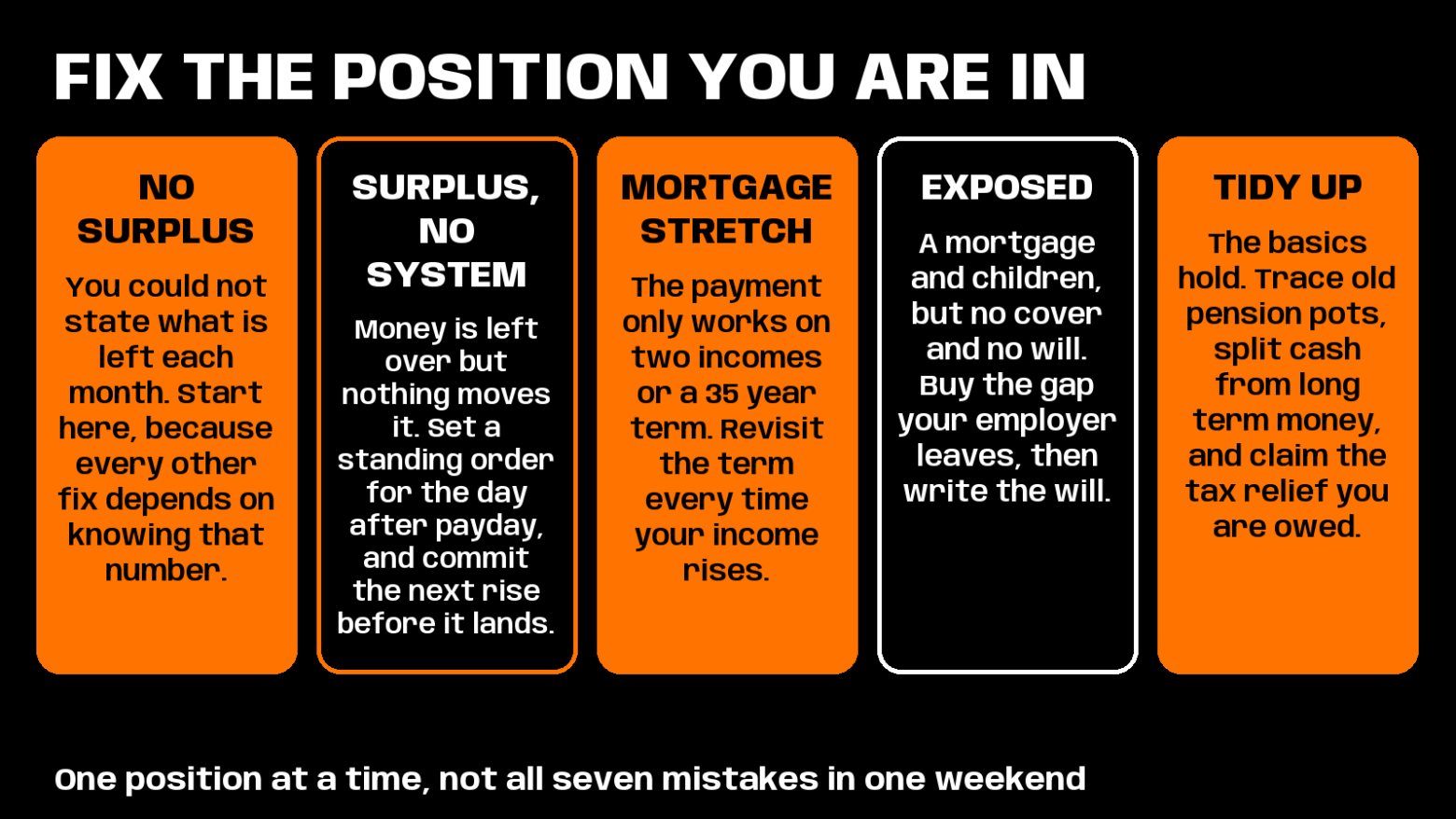
Find the position you are actually in, then fix that one rather than all seven at once.
5. Holding Long Term Money in Cash
Cash is the right home for money you might need inside about five years and the wrong home for money you will not touch for twenty. The mistake in your 30s is saving diligently into the wrong account, then reading the interest as safety rather than as a slow, near certain loss of buying power.
What it is: keeping a long horizon pot, whether that is retirement money, a child future or money with no date attached, in an ordinary savings account or a cash ISA.
Who it hits: the disciplined saver, which is what makes this one so hard to spot. Nothing about it feels like a mistake.
What it costs: the FCA estimates around 7 million UK adults hold 10,000 pounds or more in cash savings and could benefit from investing some of it [10]. From April 2026 firms can offer targeted support, a new tier of help that sits between generic information and full regulated advice, aimed squarely at that group [10].
There is a deadline attached now as well. At the Autumn Budget 2025 the government kept the total ISA allowance at 20,000 pounds but cut the cash ISA limit to 12,000 pounds a year for savers under 65 from 6 April 2027, with over 65s keeping the full 20,000 pounds [11]. If your default has been to fill a cash ISA every April, that default expires.
The fix: split your money by when you need it rather than by how safe it feels. Buffer and any known cost inside five years stays in cash, and everything with a longer horizon gets a longer home.
Watch-out: investments fall as well as rise, and money you may need in three years belongs in cash whatever the long run numbers say. This is general information rather than a view on your own position, and MoneyHelper or a regulated adviser is the right place for that.
6. Leaving a Pension Pot Behind at Every Job Move
Your 30s are usually the decade of the most job moves, and in the UK each move hands you a new pension with a new provider. The mistake is not failing to consolidate, it is losing sight of the pots altogether, so part of your retirement money sits in schemes that no longer have a current address for you.
What it is: a pot from a former employer you can no longer trace, most often because you moved house and never told the provider.
Who it hits: the man who has changed employer three or four times since his first proper job.
What it costs: the Pensions Policy Institute estimates 3.3 million lost pension pots in the UK holding 31.1 billion pounds, up from 26.6 billion pounds in 2022, with an average lost pot of 9,470 pounds [12]. The IFS describes the mechanism plainly, noting that a new pot at each change of employer “fragments retirement savings, making them easier to lose track of and unduly hard to manage well” [5].
The fix: list every employer since your first job, request a statement from each scheme, and use the government free pension contact details service for any you cannot find. One hour, once, and you have the full picture.
Watch-out: do not wait for pensions dashboards to do this for you. Schemes face a connection deadline of 31 October 2026, but the service is not expected to reach the public until the 2027/28 financial year at the earliest [13]. Consolidating is also not automatically right, because some older schemes carry guarantees worth more than the convenience of one login.
7. Never Claiming the Tax Relief You Are Already Owed
Cross into the 40 percent tax band, pay into a relief at source pension, and the scheme adds only basic rate relief. The remaining 20 points are yours, but they are not automatic. You have to ask. In your 30s, when many men cross that threshold for the first time, this is money left behind year after year.
What it is: relief at source schemes reclaim 20 percent for you. Higher and additional rate taxpayers have to claim the rest through self assessment or by contacting HMRC directly.
Who it hits: the man whose salary crossed roughly 50,270 pounds in the last few years and who has never filed a tax return.
What it costs: HMRC figures obtained under freedom of information by Sir Steve Webb of LCP indicate that 807,000 higher rate taxpayers and 19,000 additional rate taxpayers did not claim in 2023/24, worth an average of 1,756 pounds and 2,195 pounds each and around a billion pounds in total [14].
Webb tied it directly to frozen thresholds: “With more and more people being dragged into higher rates of income tax, it is increasingly important that they claim all the tax relief to which they are entitled” [14].
The fix: find out whether your workplace scheme uses relief at source or net pay. If it is relief at source and you pay higher rate tax, claim, and backdate up to four tax years while you are there.
Watch-out: it does not apply to everyone. If your scheme runs on net pay or salary sacrifice, the full relief is already applied and there is nothing to claim, so check before you spend an evening on it.
Which Mistake Should You Fix First?
The one that matches the position you are actually in, and only that one. Most men in their 30s sit in one of five positions: no surplus, where you could not state what is left each month; surplus but no system, where money is left over and nothing moves it; mortgage stretch, where the payment only works on two incomes or a long term; exposed, where a mortgage and children sit behind no cover and no will; and tidy up, where the basics hold and the admin does not.
Find yours and fix that. No surplus starts at mistake one, surplus with no system starts at the pay rise rule, mortgage stretch is mistake three, exposed is mistake four, and tidy up is mistakes six and seven. Exposed jumps the queue if it applies to you, because it is the only position on the list where the downside is not recoverable.
Trying to clear all seven in one weekend is the most reliable way to clear none. Each behaviour needs its own repetitions in its own context, so starting four at once splits your consistency without shortening any single timeline. Our guide to money habits every man should build covers the mechanics of making one of them stick.
Why Do These Mistakes Cluster in Your 30s?
Because this is the decade when income, commitments and dependants all arrive at once, and no single event forces you to review the defaults. Every one of the seven is a default left running: the enrolment rate, the mortgage term, the savings account, the missing policy, the old pot, the unclaimed relief.
The other reason is that the 30s reward and punish the same behaviour. Time is your largest asset, which is why the IFS calls out the cost of delay so directly, and it is also what makes doing nothing feel harmless [5]. A default you never chose is still a decision, and in your 30s it compounds for longer than any decision you will make later.
FAQ
Is 35 too late to start a pension?
No. Starting at 35 still leaves roughly three decades of contributions and growth before a normal retirement age, and the employer contribution is available from your first payslip. A later start needs a higher rate to reach the same place, which is the real cost of delay rather than the outcome being out of reach.
How much should a man have saved by 35?
There is no credible single figure, because it depends on income, housing costs and dependants. A more useful test is whether you hold one month of essential spending in cash, no debt above roughly 8 percent, and a pension contribution above the auto enrolment minimum. Those three answers tell you more than any target number.
Should I overpay the mortgage or pay into the pension?
Compare the mortgage rate against the total return on a pension contribution, including the employer match and your tax relief. A match plus higher rate relief is very hard for an overpayment to beat, but pension money is locked away and overpayments reduce a payment you have to make every month.
Do I need life insurance if my employer gives death in service?
Usually yes, for two reasons. Death in service is typically a multiple of salary rather than an amount matched to your mortgage and children, and it disappears the day you leave that job. Work out the shortfall against your actual liabilities and buy that gap rather than the full amount.
How do I find an old pension I have lost?
Start with your own records, then contact each former employer scheme with your national insurance number and dates of employment. If you cannot identify the provider, the government runs a free service that supplies scheme contact details. Expect a few weeks for statements to arrive rather than an instant answer.
Is a cash ISA still worth it?
For short horizon money and for any interest that would otherwise be taxed, yes. The change to note is that from 6 April 2027 savers under 65 will be able to put 12,000 pounds a year into a cash ISA rather than the full 20,000 pounds, so the shelter for long term cash narrows.
What is a realistic savings rate in your 30s?
The rate you can hold through a bad month, escalated with every pay rise, beats an ambitious rate you abandon in February. Start at whatever survives an unexpected bill, then raise it on schedule rather than on enthusiasm. Consistency compounds and intentions do not.
Final Recommendation
Pick the mistake that matches your stage and fix that one properly. If you only do one thing after reading this, decide now what share of your next pay rise leaves your account before it arrives, and write that instruction down where you will see it. It costs nothing today and it is the only fix on the list that gets more valuable the earlier you make it.
Then work through the rest at roughly one a month. Seven fixes spread over seven months will beat seven attempted in one week every time, and by this stage the difference shows up as money rather than intentions.
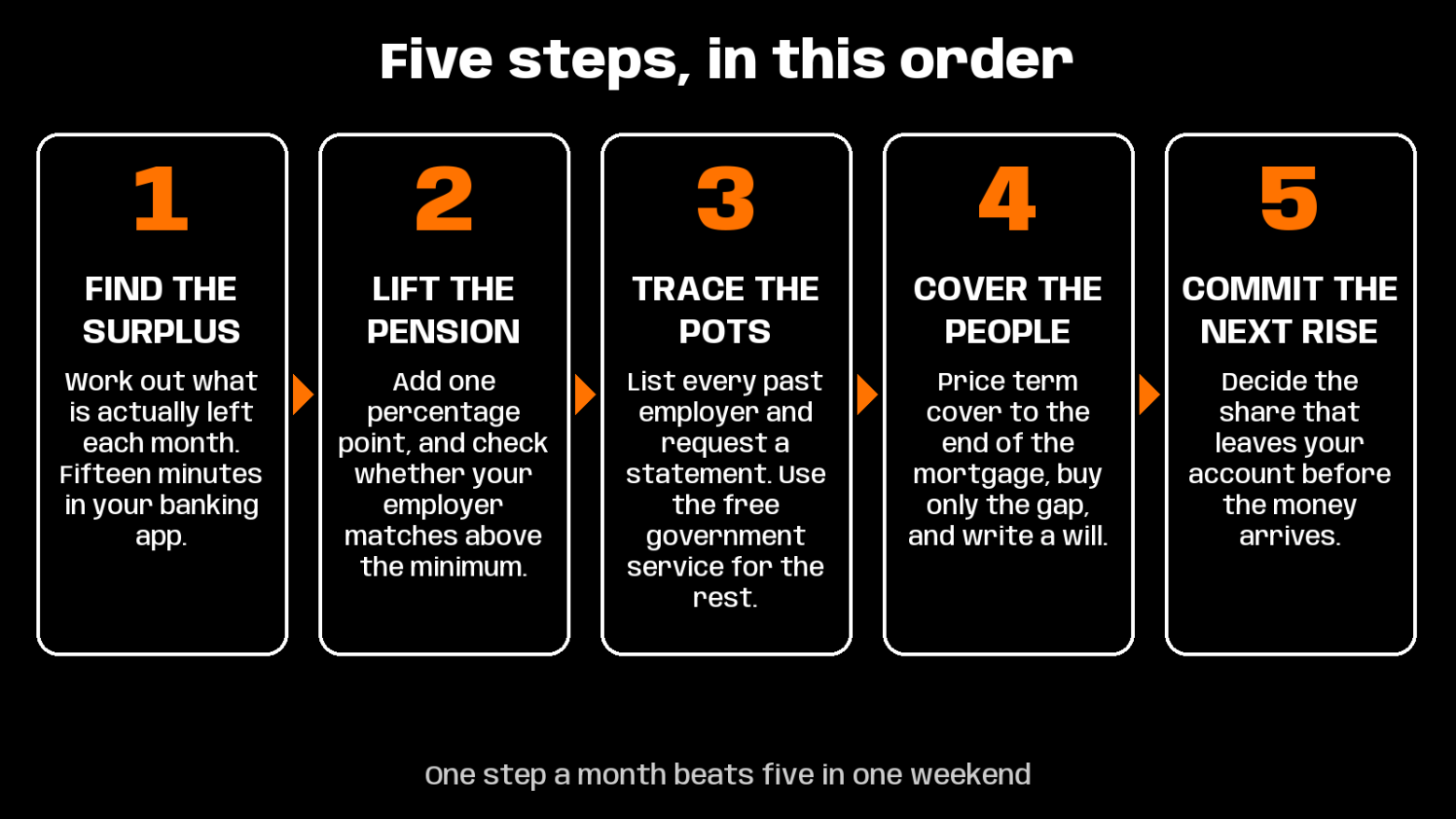
Five steps, in this order, over five months rather than one weekend.
Options for Men to Fix These Money Mistakes
Most men in their 30s do not need more information about money. They need something that makes step three happen in November when they last thought about it in September. These fixes are unusually easy to forget because they are annual or one off rather than daily, so nothing nags you when you stop.
The MenTools app runs money alongside mindset, fitness and nutrition in one challenge system, with daily actions, chosen difficulty levels, reminders at the point a task should fire, streaks, progress tracking and an AI coach. The point is putting a date and a prompt against a decision that otherwise only exists as an intention.
How you can do this today: set step one as a recurring action, then find your real monthly surplus tonight so the first repetition is already logged.
Wins on cost: one subscription covers the habit side of money, training and mindset instead of three separate tools.
Wins on time: the structure, levels and tracking already exist, so there is nothing to design before you start.
Wins on practicality: it fits shift patterns, travel and young children, which is where a rigid monthly money routine usually breaks first.
Watch-out: it is a behaviour and consistency tool, not a budgeting app, a bank feed or financial advice. If you need a regulated view on your pension or your protection, this supports that work rather than replacing it.
Money discipline also tends to fail on the weeks a man is running on empty, because long days with nothing left are exactly when the unplanned spend wins, and a one a day multivitamin may help cover the simple daily foundation underneath the behaviour work. For more built for men, see the MenTools money hub. One fix, made properly this month, will do more for the next thirty years than another year of reading lists like this one.
Last updated: 2026-09-16 v1.0
Disclaimer: This guide is for informational purposes only and does not constitute medical or psychological advice. Speak with a qualified professional before making significant changes if you have a medical or mental health condition.
References
- [1] Financial Conduct Authority. More people have bank accounts but one in ten have no cash savings, Financial Lives survey. FCA, May 2025. Link
- [2] Office for National Statistics. Employee earnings in the UK, 2025. ONS, 23 October 2025. Link
- [3] Office for National Statistics. GDP quarterly national accounts, UK, January to March 2026. ONS, 2026. Link
- [4] Benartzi S, Thaler RH. Save More Tomorrow, using behavioral economics to increase employee saving. Journal of Political Economy, 2004. Link
- [5] Cribb J, Emmerson C, Karjalainen H, O Brien L. The Pensions Review, final recommendations. Institute for Fiscal Studies, July 2025. Link
- [6] HM Revenue and Customs. Increasing Normal Minimum Pension Age. GOV.UK. Link
- [7] Bank of England data obtained under the Freedom of Information Act by Sir Steve Webb of LCP, reported as Shocking number of ultra long mortgages due to run past state pension age, 2024. Link
- [8] Financial Conduct Authority. MS24/1 Pure Protection Market Study, interim findings and consumer research. FCA, January 2026. Link
- [9] Money and Pensions Service. Over half of UK adults do not have a will. MaPS, 2025. Link
- [10] Financial Conduct Authority. Millions of people set to get extra help with investments and pensions decisions. FCA, 11 December 2025. Link
- [11] Which. Cash ISA annual allowance slashed to 12,000 pounds, what you need to know. Which, 2025. Link
- [12] Pensions Policy Institute. Briefing Note 138, Lost Pensions 2024. PPI, October 2024. Link
- [13] Pensions Dashboards Programme. Progress update report. PDP. Link
- [14] HMRC figures obtained under the Freedom of Information Act by Sir Steve Webb of LCP, reported in Pension tax relief, high earners missing out. MoneyWeek, 2025. Link