No products in the cart.
Return To Shop
MEN: Discipline vs Motivation: Which Actually Gets Men Through?
Quick Answer
Neither wins alone. Motivation gets a man started, but it fades: only 19 percent of New Year pledges lasted two years [1]. What lasts is structure, meaning habits, plans and a setup that removes temptation, and that is a large part of how self-controlled people succeed [2][3]. Use motivation to begin and structure to continue.
**Jump to:** The verdict | The evidence | FAQ | Options for men
Disclosure: MenTools publishes this article and may feature MenTools products.
How we evaluate: Each option is assessed on real-world use, evidence, cost and time, and how well it suits men. Every option including the MenTools option carries an honest limitation. Full sources are in the references below.
Discipline vs Motivation at a Glance
Discipline and motivation do different jobs, so the honest answer is not a single winner. Motivation is the reason that gets you moving. Discipline, as researchers measure it, is the ability to act on a goal when an urge pulls the other way. We found no trial that pits one against the other, so the table compares them on the separate evidence that exists [4][5][6][1].
| What matters | Discipline | Motivation | Edge |
|---|---|---|---|
| Best for | Men who start well but get pulled off by temptation, tiredness or boredom | Men who cannot get started, or whose goal feels like someone else’s | Depends on the problem |
| What it really is | Acting on a goal when an urge pulls the other way, mostly by shaping your situation [3] | The reason you want it, strongest when the goal is your own [6][7] | Different jobs |
| Best evidence | Childhood self-control predicted health, money and crime outcomes to age 32 in 1,000 people [5] | Autonomous motivation was linked to exercise across 66 studies [6] | Both real |
| Getting started | Helps, but does not supply the reason | Valuing the goal tended to predict early adoption [6] | Motivation |
| Lasting past a few weeks | Helps most once it becomes habit and setup [2] | Fades alone, only 19% of pledges lasted two years [1] | Discipline, as structure |
| Survives a flat day | Yes, if the plan does not need a good mood | No, it goes up and down moment by moment [8] | Discipline |
| Main watch-out | Pure willpower is weaker than it sounds, and a 23 lab test found the empty tank effect close to zero [9] | Waiting to feel like it costs you days | Neither works alone |
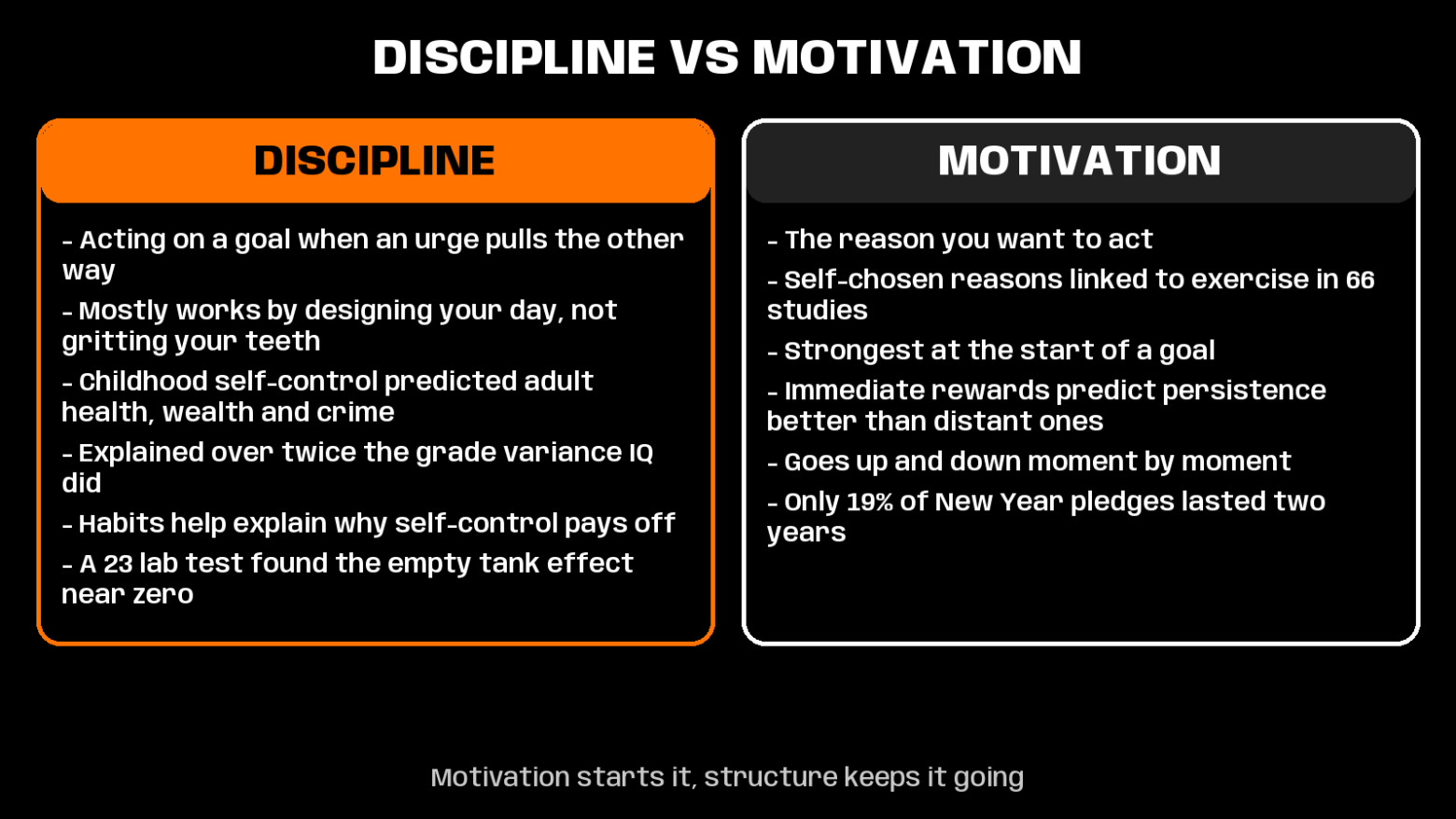
Discipline carries you through, motivation gets you going.
How We Compared Them
We compared the two on peer-reviewed studies, meta-analyses and the researchers’ own published words, judging how well each helps a man start, keep going and recover from a bad day. Where a finding is correlational, self-reported or drawn from students rather than working men, we say so [4][10][6].
Three limits apply throughout. First, discipline is not one thing in the research, and most studies measure trait self-control with questionnaires, which shows who succeeds rather than what they do in the moment. Second, most motivation studies are descriptive. Third, few samples are men in their thirties [10][6].
The popular line that discipline beats motivation is overstated, and so is its opposite. Any article naming a proven winner is overreaching.
1. Discipline: What It Actually Is
Discipline means acting on a goal when a competing urge pulls the other way, such as training when you are tired or working with your phone in reach. It suits men whose problem is not wanting the result but doing the work. Its standout strength is a strong record of predicting real life outcomes [4][5].
In a study of 140 eighth-grade students, self-discipline measured in the autumn “accounted for more than twice as much variance as IQ in final grades” [4]. Following 1,000 children from birth to the age of 32, researchers found that childhood self-control predicted physical health, personal finances and criminal offending outcomes, and in 500 sibling pairs the sibling with lower self-control had poorer outcomes [5].
Across a meta-analysis of 102 studies and 32,648 people, the effect of self-control on behaviour was “small to medium” [10]. That is a real effect, not a magic one.
Watch-out: the word hides what people actually do. The same meta-analysis found that the effects of self-control “varied dramatically across life domains” [10]. The two studies above followed eighth-grade students and children into adulthood [4][5], so the size of the effect for a working man is an estimate.
2. Motivation: What It Actually Is
Motivation is the reason you want to act, and it comes in kinds. Autonomous motivation means you act because you value the goal or enjoy it. Controlled motivation means you act from pressure, guilt or reward. It suits men who cannot get started, or whose goal feels borrowed from someone else. Its standout strength is that the autonomous kind predicts who keeps exercising [6].
A systematic review of 66 empirical studies found “consistent support for a positive relation between more autonomous forms of motivation and exercise,” with intrinsic motivation “more predictive of long-term exercise adherence” [6]. Ryan and Deci, who developed self-determination theory, argue that three needs, competence, autonomy and relatedness, “yield enhanced self-motivation” when they are satisfied [7].
Watch-out: motivation is a feeling, and feelings move. The behaviour scientist BJ Fogg wrote that “My research showed that motivation could be unreliable, going up and down moment by moment” [8]. The review is also limited: “The majority of studies have employed descriptive (i.e., non-experimental) designs” [6], so it shows a link, not proof of cause.
Which Gets You Started?
Motivation gets you started. Exercise research shows a trend for valuing the goal for its own sake to predict early adoption, and immediate enjoyment predicts persistence better than far-off payoffs do. Discipline can push a start, but it does not supply the reason to begin [6][11].
Woolley and Fishbach found that “the presence of immediate rewards is a stronger predictor of persistence in goal-related activities than the presence of delayed rewards” [11]. In their New Year resolution study, enjoyment predicted who was still going, while the promised long-term benefit did not [11].
They draw a neat line between the two jobs: delayed rewards “may motivate goal setting and the intentions to pursue long-term goals,” but immediate rewards are what track actual persistence [11]. In plain terms, pick the version of the goal you want to do today.
Which Lasts Past the First Few Weeks?
Neither lasts alone, but structure outlasts a feeling. In a two year study of 200 New Year resolvers, 77 percent kept their pledge for a week and only 19 percent for two years. Those who succeeded reported using significantly more stimulus control, reinforcement and willpower, so by their own account willpower and control of the cues around them both played a part [1].
The drop is steepest early. One week in, 77 percent had kept their resolutions, falling to 55 percent after one month, 43 percent after three months and 40 percent after six months [12]. Even among the resolvers who succeeded, 53 percent slipped at least once, and the average was 14 slips over the two years [1].
Resolvers named what hurt most: “paucity of willpower and failure of stimulus control” [1]. These are the resolvers’ own judgements, but they point the same way as the later research. Willpower and setup both mattered, and a slip was normal rather than fatal.
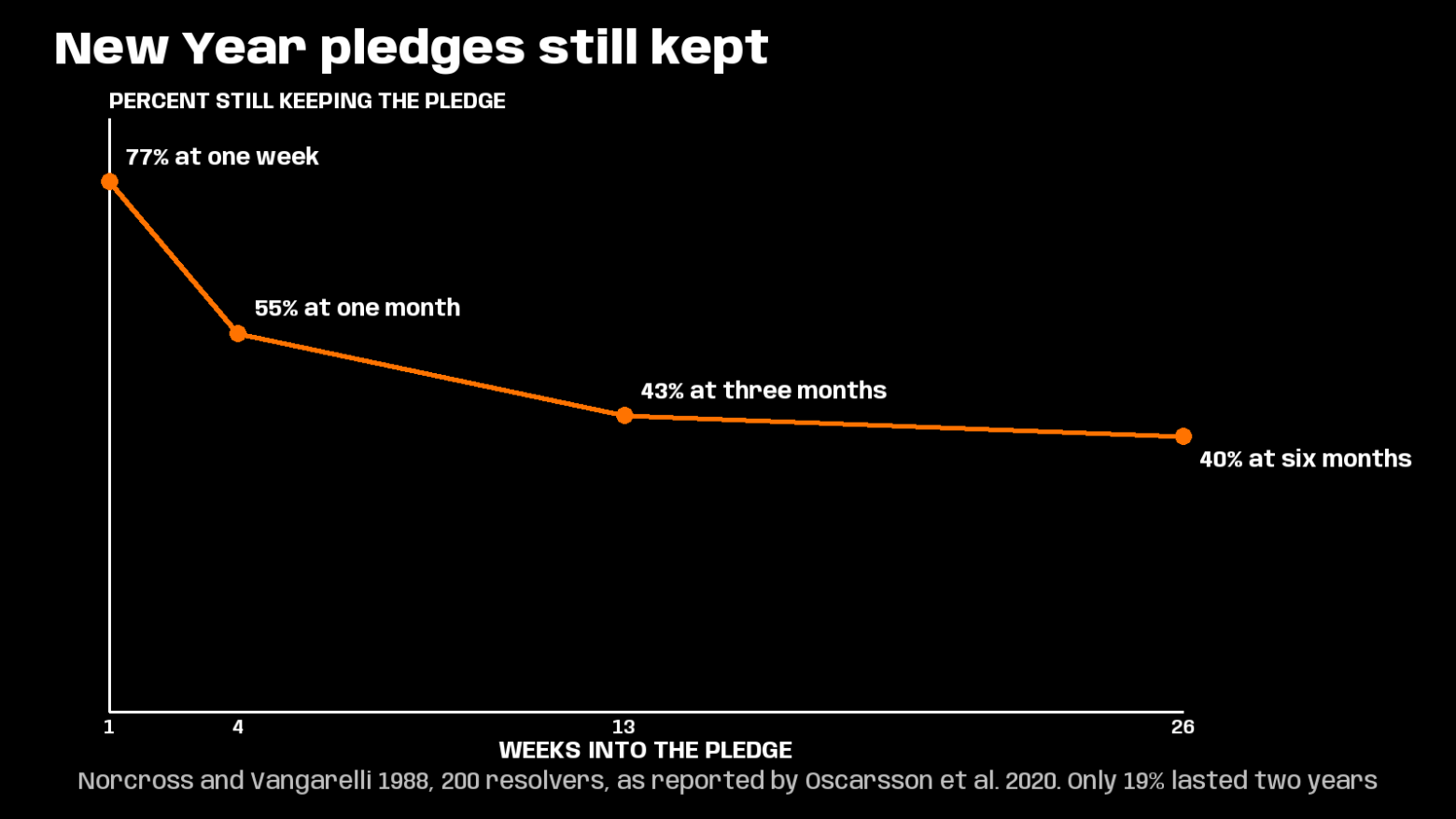
Most of the drop in New Year pledges comes in the first month.
Does Willpower Run Out?
Not in the way the popular story says. The idea that willpower is a tank that empties was tested in 23 laboratories with 2,141 people, and the effect was close to zero (d = 0.04). That does not mean effort is free. It means the ego depletion excuse is a weak reason to skip tonight’s session [9].
The model being tested held that self-control is “conceptualized as a limited resource that becomes depleted after a period of exertion resulting in self-control failure” [9]. A single replication task cannot prove tiredness never matters, but it does cast doubt on the tank picture.
What a man believes may matter more. In a longitudinal student study, believing willpower is not a limited resource “predicted better self-regulation” for students facing high demands, with less procrastination and unhealthy eating [13]. It is a sample of students, so treat it as a lead, not a rule.
What Do Self-Controlled People Actually Do?
They mostly avoid the fight. Studies find that people with better self-control report less, not more, effortful inhibition in daily life, and that habits explain part of why they succeed. In practice, discipline means designing your day so that you need less willpower, not gritting your teeth harder [2][3].
Galla and Duckworth put it directly: “Conventional wisdom holds that self-control is used to effortfully inhibit maladaptive impulses, yet this view conflicts with emerging evidence that self-control is associated with less inhibition in daily life” [2]. Across six studies and 2,274 people, habits helped explain the link between self-control and positive outcomes [2].
A meta-analysis agrees: associations between self-control and behaviour were “significantly stronger for automatic (as compared to controlled) behavior” [10]. In a week long beeper study of 205 adults with 7,827 desire reports, urges that clashed with other goals tended “to elicit resistance, with uneven success” [14]. Effort alone loses some rounds.
Duckworth, Gendler and Gross describe the alternative: “enacting self-control isn’t always difficult, particularly when it takes the form of proactively choosing or changing situations in ways that weaken undesirable impulses or potentiate desirable ones” [3]. Our guide to self-discipline for men turns that into daily rules.
Where Each Falls Short
Discipline falls short when it relies on effort alone, because temptation and tiredness win some rounds and slips are normal. Motivation falls short because it rises and falls, so a plan that waits for the feeling loses days. Both are weaker than the setup around them [1][8][14].
Even a clever motivational design fades. In a field trial, bundling tempting audiobooks with gym visits raised visits by 51 percent and 29 percent in the two treatment groups at first, “but treatment effects declined over time” [15]. Afterwards, 61 percent of participants chose to pay for gym-only access, which the authors read as demand for a commitment device, a structure built around motivation [15].
The evidence for discipline has its own gap. Most of it is correlational, and the best studies show self-control paying off through habits and situations rather than raw effort [4][2]. Our guide to staying motivated for men covers what keeps the feeling going.
How to Make Both Work Harder
Use motivation to choose the goal and the first step, then hand the work to structure. Make the reason your own, add a reward you get now, shrink the first version, and change the room so the urge is weaker. Each move cuts how much willpower the day demands [6][11][3].
Fogg’s own version is blunt: “If it was small, I had no excuse not to do it” [8]. A small, fixed action does not need a good mood. It runs on the cue, which is exactly what the habit research says carries a goal past the early weeks [2].
If your plan keeps collapsing, our guide to why habits fail after two weeks shows where it usually breaks.
Pick Discipline If, Pick Motivation If
Lean on motivation if your problem is starting, and lean on discipline, meaning structure, if your problem is carrying on. Pick motivation when the goal feels like someone else’s. Pick discipline when you start strong and fade, or when temptation keeps winning the evening [6][2][3].
If you never get started, find a reason that is yours, because valuing the goal tended to predict early adoption [6]. If you start strong and then fade, build a habit on a fixed cue, because habits help explain why self-control pays off [2].
If temptation keeps winning, change the room, not your mind [3]. If the task feels like a chore, add a reward you get now, because immediate rewards predicted persistence better than distant ones [11]. Most men need all four, in sequence.
FAQ
Is discipline more important than motivation?
Neither is more important on its own. Motivation supplies the reason to start, and discipline, mostly through habits and setup, carries you through the weeks when the feeling fades. Self-control predicted adult outcomes in 1,000 people [5], while autonomous motivation was linked to exercise across 66 studies [6].
Why does motivation fade so fast?
Motivation is a feeling, and feelings change. BJ Fogg wrote that it can go “up and down moment by moment” [8]. In one two year study, 77 percent of resolvers kept their pledge for a week, but only 19 percent kept it for two years [1].
Does willpower run out during the day?
The evidence is weak. A 23 laboratory replication of the ego depletion effect found a tiny result (d = 0.04) that could not be told apart from zero [9]. That does not make willpower free, so it is still smart to avoid needless temptations.
Can I build discipline if I do not have it?
Yes, mostly by building habits and changing your surroundings. Studies find people with better self-control rely on beneficial habits and less effortful inhibition [2], and situation changes can weaken an urge before it grows [3]. Start with one small action on a fixed cue.
What should I do on a day I have no motivation?
Do the smallest version of the habit. Fogg found that if an action was small, he had “no excuse not to do it” [8]. A fixed cue and a tiny action do not need a good mood, so the day still counts.
Is self-discipline the same as having good habits?
Not quite, but they are closely linked. Self-control is the capacity to act on long-term goals, and habits are one way it pays off. In six studies of 2,274 people, habits helped explain the link between self-control and positive outcomes [2].
Final Recommendation
Use motivation to start and structure to keep going. Valuing the goal tends to predict who begins exercising and enjoying it who keeps going [6], and habits and situation design help explain how self-controlled people succeed [2][3]. Successful resolvers still reported using willpower, but not on its own, and slips were normal even for them [1].
Pick one goal you actually want, shrink the first version, give it a fixed cue and add a reward you get today. Expect the first month to be the hardest, because that is where most pledges drop [12].
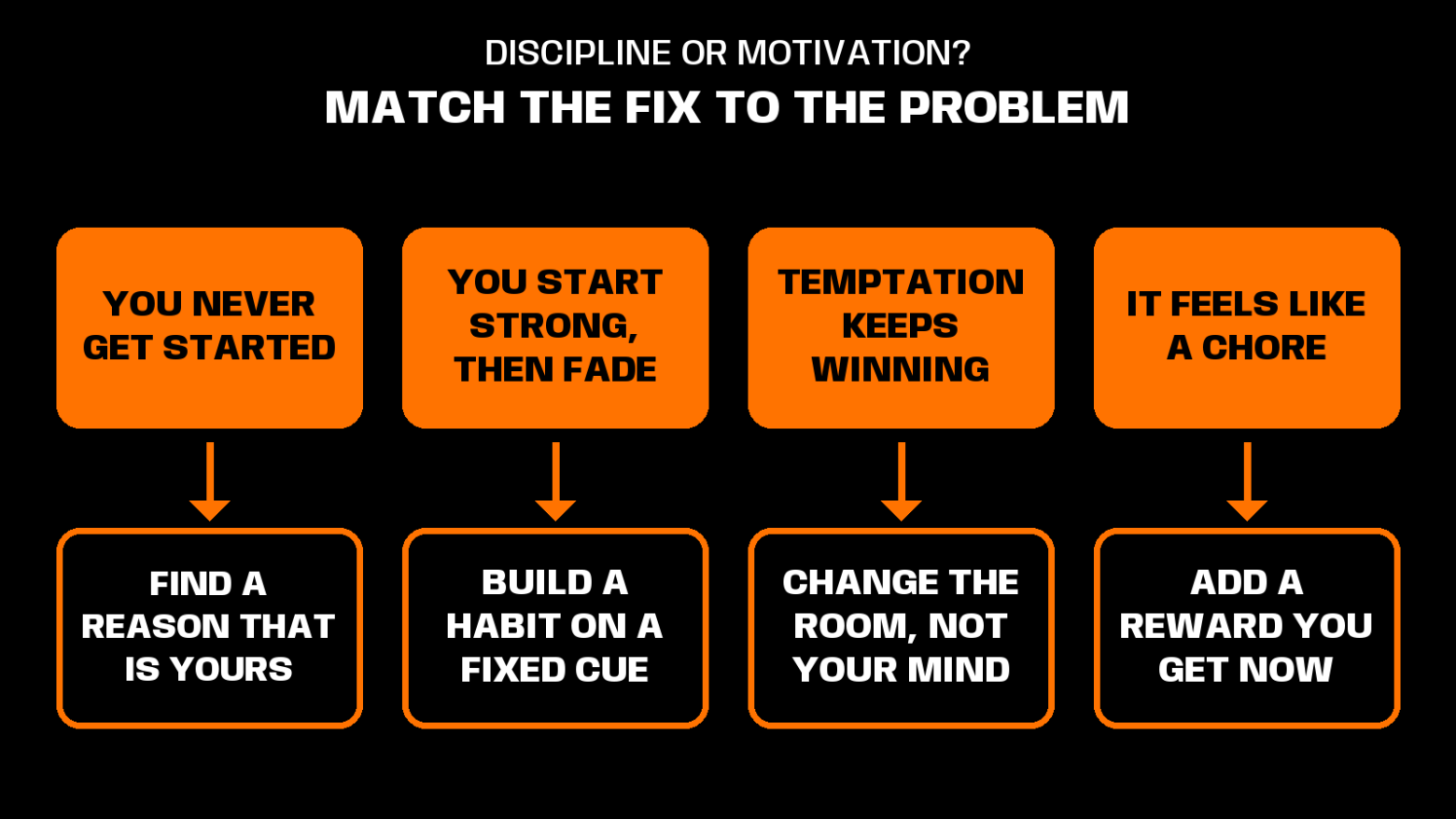
Match the fix to the problem, not to your mood.
Options for Men to Take Action
Most men try to run discipline and motivation with willpower alone: a goal, a mood and good intentions. Nothing makes the start easy, nothing records the streak, and by week three there is no way to tell whether the habit is growing or quietly fading.
The MenTools app runs this as a system. It offers challenges across mindset, fitness, nutrition and money, with beginner to advanced levels, daily actions, reminders, progress tracking and an AI coach. For this question, it gives you a reason to start in a challenge you pick yourself, and a structure that carries you when the feeling drops.
How you can do this today: choose one challenge you actually care about, start at the beginner level, and log the daily action at the same point each day for the next four weeks, since the steepest drop in pledges came in the first month [12].
Wins on cost: one subscription covers training, mindset and nutrition goals together, instead of a habit tracker, a fitness app and a journal paid for separately.
Wins on time: the levels are already built from easy to hard, so you do not have to design your own plan or research how to pace it.
Wins on practicality: logging a daily action takes seconds and fits around work, travel and family, which is where most good intentions fall apart.
Watch-out: the app structures and reminds, but it cannot give you a reason to want the goal. If the goal is not yours, fix that first.
Good routines hold up better when the basics underneath them are covered, so a one a day multivitamin may help as a simple daily foundation, and it is an easy action to attach to breakfast. For more built for men on staying driven, the MenTools motivation hub collects it in one place. Start small, set up the room, and let structure do the carrying.
Last updated: 2026-10-29 v1.0
Disclaimer: This guide is for informational purposes only and does not constitute medical or psychological advice. Speak with a qualified professional before making significant changes if you have a medical or mental health condition.
References
- [1] Norcross JC, Vangarelli DJ. The resolution solution, longitudinal examination of New Year’s change attempts. Journal of Substance Abuse, 1988;1(2):127-134. Link
- [2] Galla BM, Duckworth AL. More than resisting temptation, beneficial habits mediate the relationship between self-control and positive life outcomes. Journal of Personality and Social Psychology, 2015, pages 508-525. Link
- [3] Duckworth AL, Gendler TS, Gross JJ. Situational strategies for self-control. Perspectives on Psychological Science, 2016, pages 35-55. Link
- [4] Duckworth AL, Seligman MEP. Self-discipline outdoes IQ in predicting academic performance of adolescents. Psychological Science, 2005, pages 939-944. Link
- [5] Moffitt TE, Arseneault L, Belsky D, et al. A gradient of childhood self-control predicts health, wealth, and public safety. Proceedings of the National Academy of Sciences, 2011, pages 2693-2698. Link
- [6] Teixeira PJ, Carraca EV, Markland D, Silva MN, Ryan RM. Exercise, physical activity, and self-determination theory, a systematic review. International Journal of Behavioral Nutrition and Physical Activity, 2012;9:78. Link
- [7] Ryan RM, Deci EL. Self-determination theory and the facilitation of intrinsic motivation, social development, and well-being. American Psychologist, 2000, pages 68-78. Link
- [8] Fogg BJ. How I cracked the code for creating habits. ACE ProSource, Behavior Change Special Issue. Link
- [9] Hagger MS, Chatzisarantis NLD, Alberts H, et al. A multilab preregistered replication of the ego-depletion effect. Perspectives on Psychological Science, 2016, pages 546-573. Link
- [10] de Ridder DTD, Lensvelt-Mulders G, Finkenauer C, Stok FM, Baumeister RF. Taking stock of self-control, a meta-analysis of how trait self-control relates to a wide range of behaviors. Personality and Social Psychology Review, 2012, pages 76-99. Link
- [11] Woolley K, Fishbach A. Immediate rewards predict adherence to long-term goals. Personality and Social Psychology Bulletin, 2017, pages 151-162. Link
- [12] Oscarsson M, Carlbring P, Andersson G, Rozental A. A large-scale experiment on New Year’s resolutions, approach-oriented goals are more successful than avoidance-oriented goals. PLoS One, 2020;15(12):e0234097. Link
- [13] Job V, Walton GM, Bernecker K, Dweck CS. Implicit theories about willpower predict self-regulation and grades in everyday life. Journal of Personality and Social Psychology, 2015, pages 637-647. Link
- [14] Hofmann W, Baumeister RF, Forster G, Vohs KD. Everyday temptations, an experience sampling study of desire, conflict, and self-control. Journal of Personality and Social Psychology, 2012, pages 1318-1335. Link
- [15] Milkman KL, Minson JA, Volpp KG. Holding the Hunger Games hostage at the gym, an evaluation of temptation bundling. Management Science, 2014, pages 283-299. Link