No products in the cart.
Return To Shop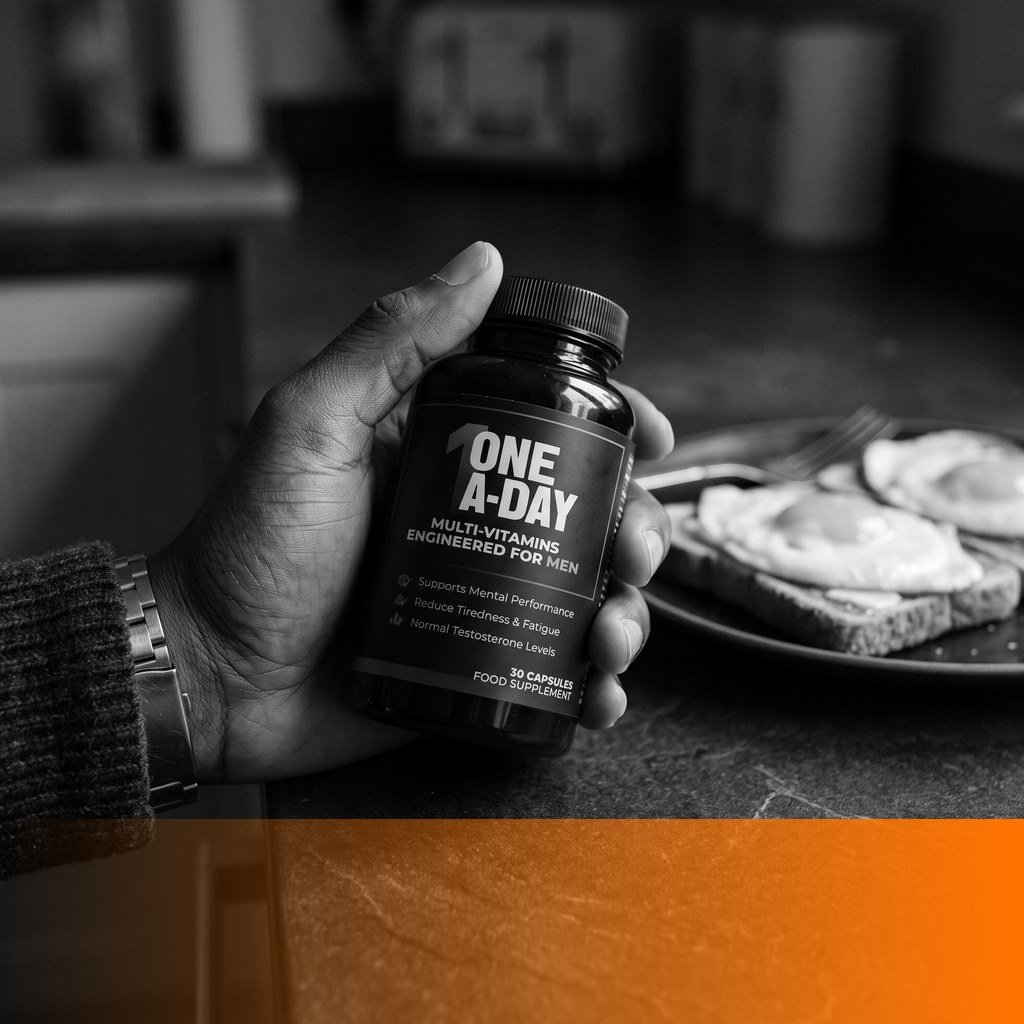
MEN: Do You Need to Take a Multivitamin With Food?
Quick Answer
For most multivitamins, yes. Take it with a meal that contains some fat. Vitamins D, E and K are fat-soluble, and in one trial the same vitamin D3 dose reached a 32% higher peak in the blood when taken with a fat-containing breakfast than with a fat-free one. The NHS also advises taking iron with or soon after food to reduce side effects.[4][12]
The meal does not have to be large or rich. Eggs, yoghurt, milk, nuts or buttered toast with breakfast give the fat-soluble vitamins something to travel with, while the B vitamins and vitamin C dissolve in water rather than fat.[6]
Key points:
- A vitamin D3 dose taken with a meal containing fat reached a 32% higher peak in the blood than one taken with a fat-free meal, in a trial of 50 healthy adults.[4]
- Vitamin E taken with water alone, or with a low-fat cereal breakfast, gave low blood levels; buttered toast with 17.5g of fat gave the highest.[6]
- If your multivitamin contains iron, the NHS says tea, coffee and milk make iron harder to absorb, and taking iron with or soon after food reduces the chance of side effects.[12]
- The meal you never skip matters more than the time on the clock.
Jump to: Every way to take it, compared | What the studies actually show | What a multivitamin can legally claim
Supplements are foods, not medicines. They are designed to support normal health and nutrient status alongside a balanced lifestyle, not to diagnose, treat, prevent, or cure any medical condition.
Disclosure: MenTools publishes this article and sells MenTools One-A-Day Multivitamin.
How we evaluate: We assess mineral form quality, dose versus NRV, authorised health claims, and male-specific design. Full sources are listed in the references below.
Every Way to Take a Multivitamin, Compared
We compared nine common ways men take a multivitamin, from black coffee on the way out of the door to a capsule with the evening meal, against the absorption studies and NHS guidance. Every option has a real watch-out, including our own product’s directions.[4][5][12]
| How you take it | What the evidence says | Suits a man who | Watch-out |
|---|---|---|---|
| With a breakfast that has some fat | A fat-containing breakfast gave a 32% higher peak of vitamin D3 than a fat-free one | Eats eggs, yoghurt, milk, nuts or buttered toast most mornings | A rushed morning with no breakfast is also a missed dose |
| With black coffee and nothing else | No fat for vitamins D, E and K to travel with | Never eats before late morning and will otherwise forget | Coffee and tea make iron harder to absorb, if your multivitamin contains it |
| On an empty stomach with water | Vitamin E taken with water alone gave low blood levels in a small study | Has been told by a pharmacist to take a specific product this way | Iron tablets can make you feel sick, and the NHS advises taking them with or soon after food |
| With lunch | Any meal with some fat does the same job as breakfast | Skips breakfast but always stops for lunch | The tub is at home and lunch is at work, so keep a week’s supply in your desk or bag |
| With the largest meal of the day | Blood vitamin D rose by an average of 56.7% over two to three months after patients moved their dose to it | Sees his evening meal as the anchor of the day | That study had 17 patients and no comparison group, so treat the number with caution |
| With a protein shake after training | Depends on the shake: water and powder carry little fat, milk or nut butter carry more | Trains at the same time most days | Rest days have no shake, so the dose drifts |
| A multivitamin with iron, taken with tea | The NHS says tea, coffee and milk make it harder to absorb iron | Has been advised to take iron | The NHS says most people get the nutrients they need from a varied and balanced diet, so check whether you need iron in a multivitamin at all |
| A multivitamin with calcium carbonate | Most calcium supplements should be taken with meals; calcium citrate can be taken at any time | Wants calcium in the same tablet | The calcium form is on the label, so read it before you decide when to take it |
| MenTools One-A-Day, one capsule with breakfast and water | Contains vitamins D3, E and K2, which are fat-soluble; iron-free formulation, so the NHS advice on tea, coffee and iron does not apply | Wants one vegan, iron-free capsule taken at the same meal every day | Our directions say breakfast and water; if your breakfast is a coffee, its vitamins D, E and K go down with little or no fat, so take it with your first proper meal instead |
Read the watch-out column first. The difference between these options is mostly about fat and habit: a capsule taken with a real meal every day beats a perfectly timed one you remember three days a week.[4][6] Our own directions are written for a man who eats breakfast, and if that is not you, move the capsule to the meal you never skip.[15]
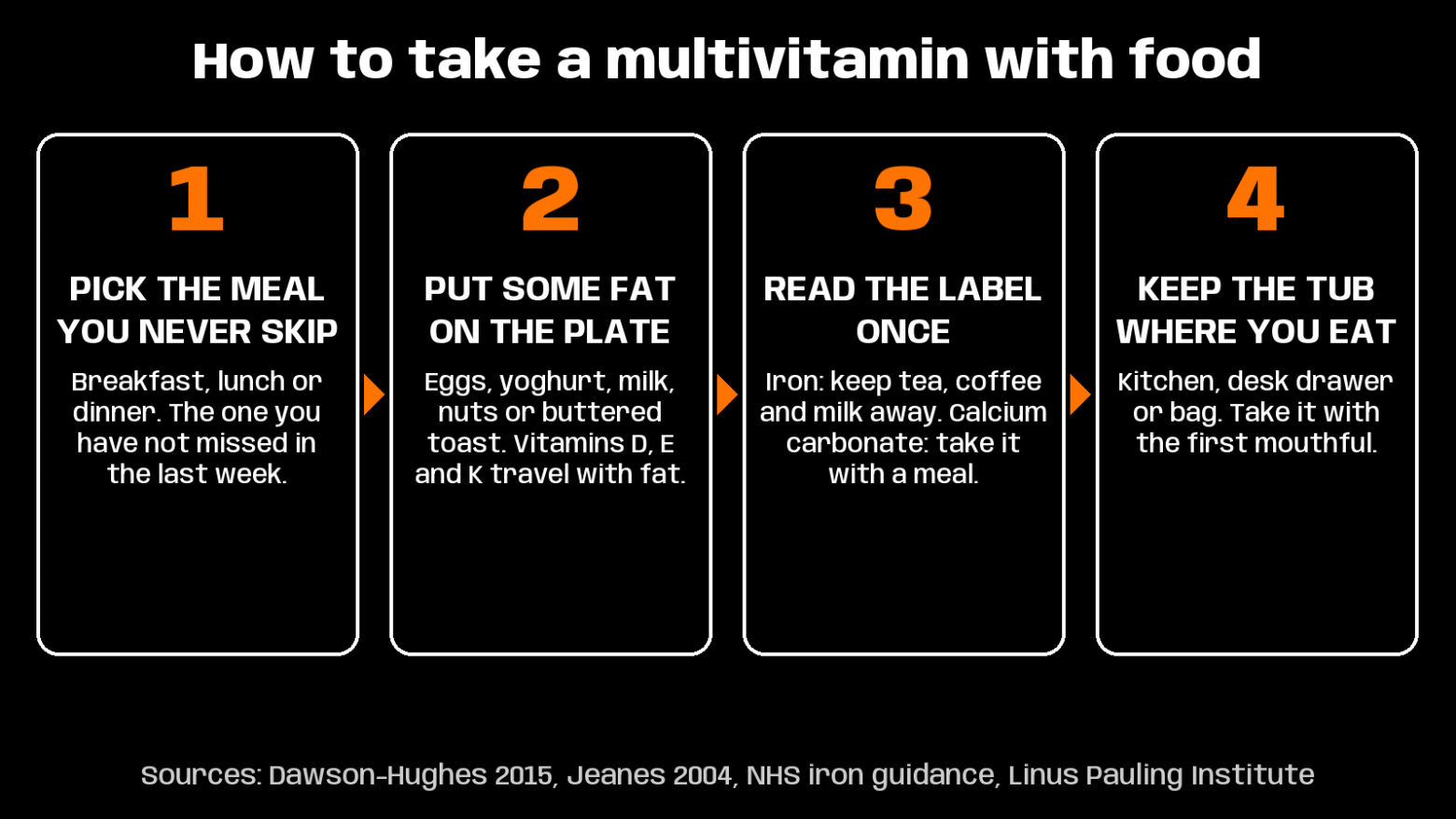
The routine that works is the one attached to a meal you already eat.
What the Studies Actually Show
Why do some vitamins need food to be absorbed?
Vitamins D, E and K dissolve in fat, not water. Vitamin E absorption needs fat in the meal, and vitamin K is absorbed in the small intestine by a mechanism that needs bile salts.[6][7]
The B vitamins and vitamin C dissolve in water instead. The NHS notes that vitamin C and several B vitamins, including thiamin, riboflavin, niacin and pantothenic acid, cannot be stored in the body, so you need them every day, whatever meal you take them with.[10][11]
How much difference does fat in the meal make to vitamin D?
In a 2015 trial, 50 healthy older men and women took a single 50,000 IU vitamin D3 dose with breakfast after a 12-hour fast. Those whose breakfast had 30% of its calories from fat reached a peak blood vitamin D3 level 32% higher than those whose breakfast was fat-free.[4]
The type of fat made no measurable difference. Breakfasts with mostly monounsaturated fat and mostly polyunsaturated fat gave similar results, so olive oil, butter, eggs and nuts all count.[4]
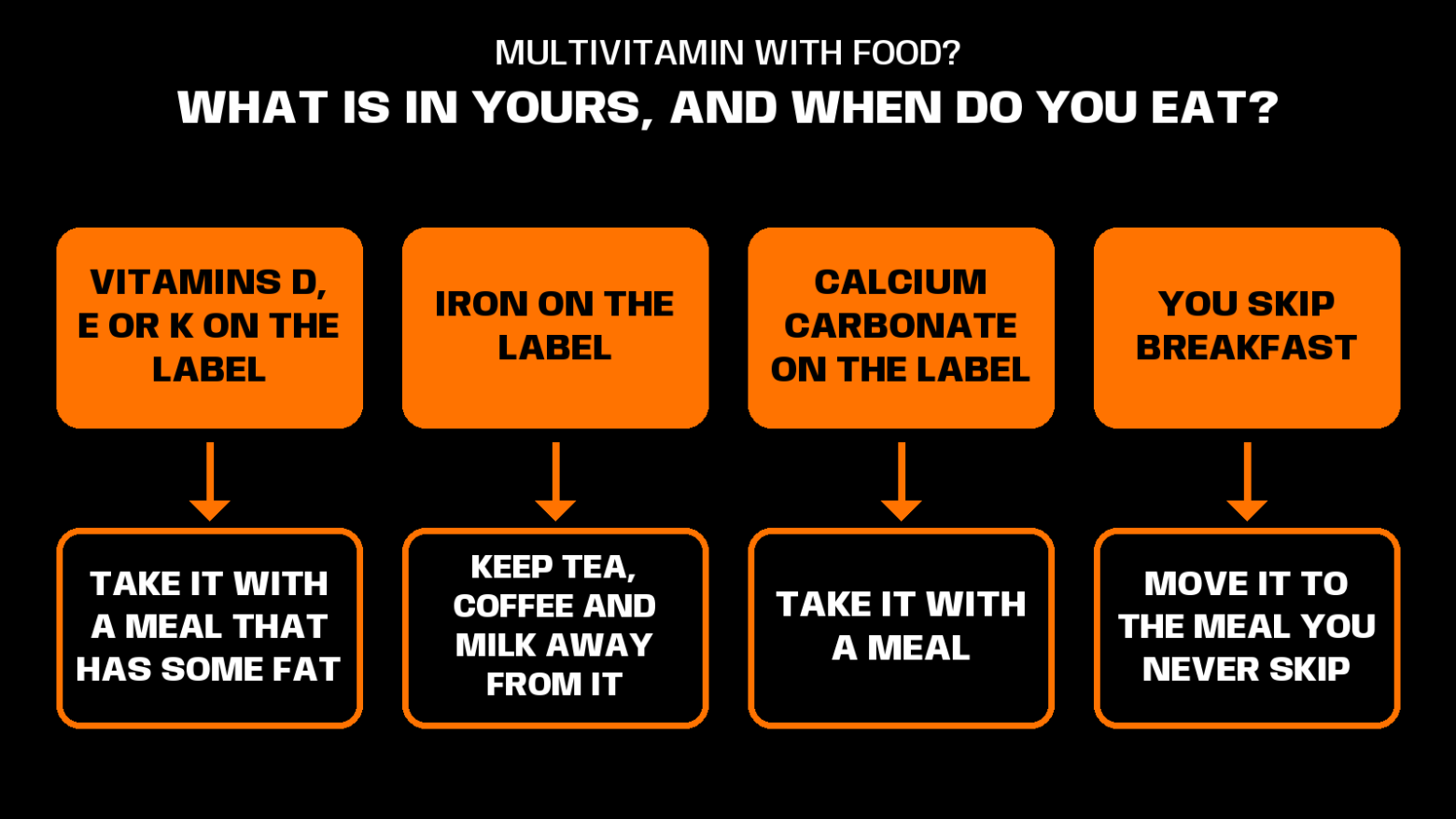
Read your label, then match the dose to a meal.
Does taking it with your largest meal matter?
One small study suggests the meal itself matters. At the Cleveland Clinic, 17 patients whose vitamin D levels had not responded to supplements were told to take the same dose with their largest meal, and their average blood vitamin D rose from 30.5 to 47.2 ng/mL over two to three months, an average rise of 56.7%.[5]
The limits are real. There were 17 patients, 13 of them women, an average age of 64.5 and no comparison group, so this tells you the direction rather than the size of the effect for a man in his 30s. It does agree with the 50-person trial on the main point: vitamin D goes down better with a meal than without one.[4][5]
What about vitamin E and vitamin K?
A crossover study gave eight people a vitamin E capsule four ways: with buttered toast (17.5g fat), cereal with full-fat milk (17.5g fat), cereal with semi-skimmed milk (2.7g fat) and water alone. Blood levels were significantly higher with the buttered toast than with the low-fat cereal or water, and low after both of those.[6]
Vitamin K follows the same rule, because it is absorbed with the help of bile salts in the small intestine.[7] The NHS adds that vitamins E and K that the body does not need straight away are stored for later, so you do not need them in your diet every day, which is why one missed meal is not worth worrying about.[8][9]
Why do some men feel sick taking a multivitamin without food?
Minerals are the usual reason. Nausea and a bad taste were the most frequent side effects reported in zinc trials, and the NHS lists feeling sick, tummy pain and heartburn among the side effects of iron tablets, with the advice to take them with or soon after food.[12][13]
If a multivitamin makes you feel queasy, the first thing to change is when you take it, not whether. If it still happens with a meal, speak with a pharmacist about the product.
Does the time of day matter more than the meal?
The research above is about food, not the clock. None of the studies compared morning with evening; they compared a meal containing fat with no fat, or a large meal with the dose taken some other way.[4][5][6]
Habit is the bigger risk for most men. Across 2019 to 2023, 18% of UK adults aged 19 to 64 had low vitamin D status, rising to 31% from January to March, and a supplement counts on the days you take it, not the days it sits in the cupboard.[16] The NHS asks everyone to consider 10 micrograms of vitamin D a day during autumn and winter.[3]
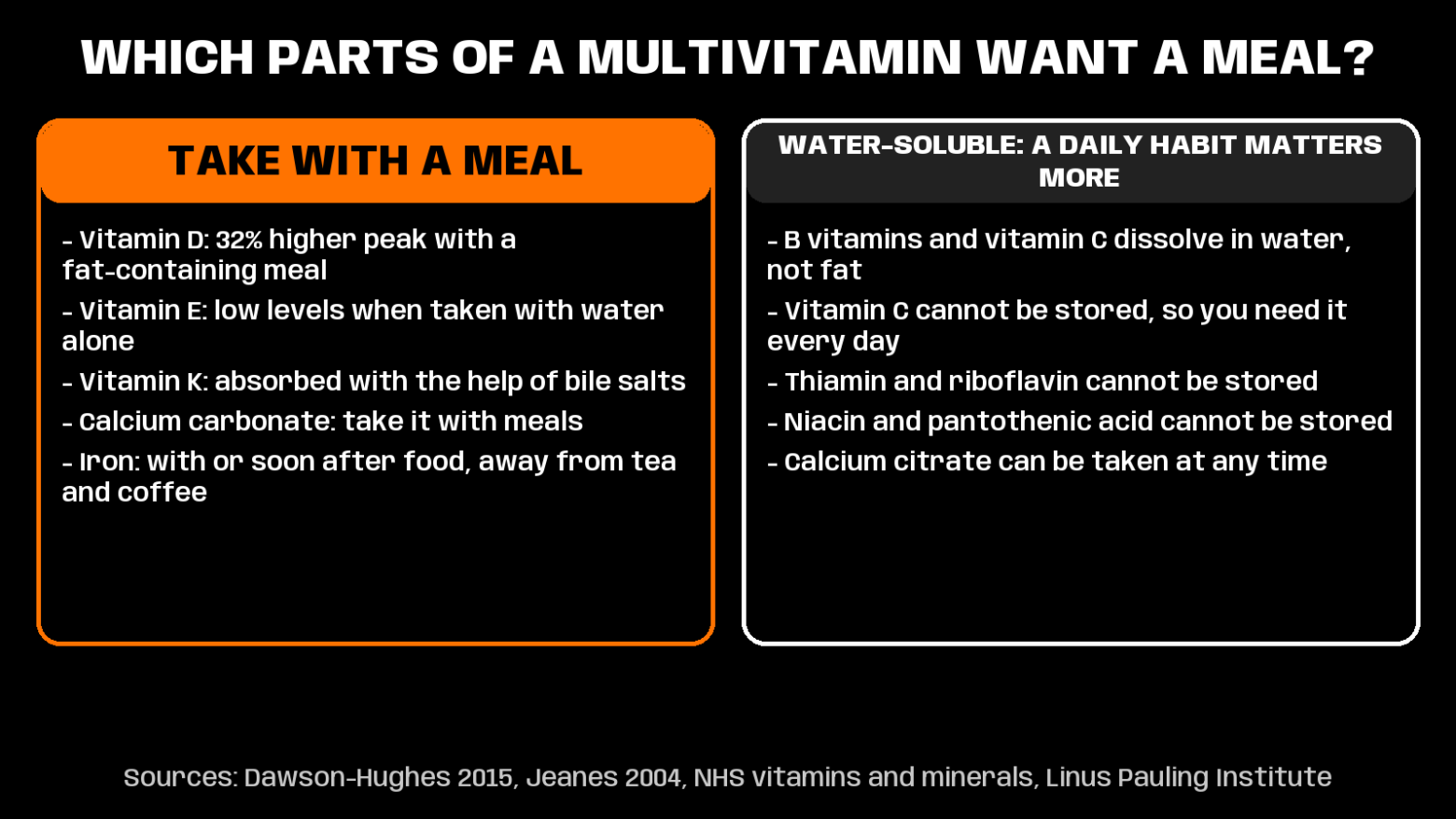
Fat-soluble vitamins want a meal. Water-soluble ones want a daily habit.
What a Multivitamin Can Legally Claim
In Great Britain, health claims on food supplements must come from the GB Nutrition and Health Claims Register, which holds the authorised wording and the conditions of use for each claim.[1] Taking a multivitamin with food changes how much of a nutrient you absorb; it does not create a new claim or make an authorised one stronger.
MenTools One-A-Day carries 11 authorised health claims in total, each of which appears in the register in the exact wording below.[1] This is the full list of what the product is allowed to say it does:
- Pantothenic acid contributes to normal mental performance.
- Zinc and iodine contribute to normal cognitive function.
- Zinc contributes to the maintenance of normal testosterone levels.
- Vitamins B2, B3, B6, B12, vitamin C and magnesium contribute to the reduction of tiredness and fatigue.
- Magnesium contributes to normal psychological function.
- Vitamin D and vitamin K contribute to the maintenance of normal bones.
- Vitamin D contributes to normal muscle function.
- Vitamin D, vitamin C, selenium and zinc contribute to the normal function of the immune system.
- Selenium contributes to normal spermatogenesis.
- Vitamin C, vitamin E and selenium contribute to the protection of cells from oxidative stress.
- Biotin contributes to the maintenance of normal hair and skin.
None of those lines says a nutrient does more when taken with a meal, at breakfast or at night. Each describes a nutrient doing its normal job, and any pack that promises more than that has left the register behind.
FAQ
Is it bad to take a multivitamin on an empty stomach?
It is not dangerous for most men, but it is a weaker way to take one. Vitamins D, E and K need fat in the gut to be absorbed, and in a small study vitamin E taken with water alone gave low blood levels. Iron can also make you feel sick, and the NHS advises taking it with or soon after food.[6][12]
How much fat does the meal need?
Not much. In the vitamin D study the meal had 30% of its calories from fat, and in the vitamin E study the higher-fat breakfasts held 17.5g of fat. Eggs, yoghurt, milk, nuts or buttered toast with breakfast are enough to count.[4][6]
Can I take my multivitamin with coffee?
Coffee on its own gives the fat-soluble vitamins nothing to travel with, so have it with food. If your multivitamin contains iron, the NHS says tea, coffee and milk make it harder for the body to absorb iron, so keep those away from the dose.[12]
Is morning or evening better for a multivitamin?
The meal matters more than the clock. Take it with whichever meal you eat every day and that has some fat in it. In one small clinic study, moving a vitamin D dose to the largest meal of the day was followed by a 56.7% average rise in blood vitamin D over two to three months.[5]
What if I forget and take it later without food?
Take it with your next meal rather than doubling up the next day. Do not exceed the stated recommended daily dose. Vitamins D, E and K are stored by the body, so one dose with a later meal still counts.[8][9]
I am on TRT or prescription medication. Does it matter when I take a multivitamin?
If you are on TRT or any prescribed medication, speak with your prescribing doctor before adding any supplement. MenTools products are nutritional supplements designed to support general health and normal nutrient status, not medicines and not a replacement for medical treatment.
Are food supplements medicines?
No. Food supplements are foods in law, not medicines. They are designed to support normal health and nutrient status alongside a balanced lifestyle, not to diagnose, treat, prevent, or cure any medical condition.
Final Recommendation
Take your multivitamin with a meal that has some fat in it, and make it the meal you never skip. For most men that is breakfast with eggs, yoghurt, milk or buttered toast, but lunch or dinner does the same job.[4][6] The NHS also says most people should get all the nutrients they need from a varied and balanced diet, so the meal itself is doing most of the work.[2]
Then read the label once. If it contains iron, keep tea, coffee and milk away from the dose; if it contains calcium carbonate, it belongs with a meal.[12][14] If it makes you feel sick even with food, speak with a pharmacist.
MenTools One-A-Day is one option and its directions have a clear limitation: they assume you eat breakfast. If your morning is a coffee, take it with your first proper meal instead.[15] For what a multivitamin does in the first place, read our guide to what a men’s multivitamin does, and for the winter numbers, our guide to vitamin D for men in the UK.
Options For Men to Take Action
Most men who stop taking a multivitamin do not decide to stop. The tub lives in a kitchen cupboard, breakfast becomes a coffee in the car, and a month later it is half full.
MenTools One-A-Day is built around one set moment: one capsule per day, high in vitamin D, with chelated minerals such as zinc and magnesium bisglycinate, active B-vitamin forms and no iron, in a vegan capsule. The nutrition archive covers the meals that do most of the work, and the MenTools challenges help you build a habit of eating a proper breakfast and getting outdoors in daylight.
How you can do this today: pick the one meal you have not skipped in the last week, put the tub where that meal happens, and take the capsule with the first mouthful.
Wins on cost: a capsule taken with a meal every day is a capsule you paid for and used, not one sitting in the cupboard.
Wins on time: no timing rules, no gaps between doses and no second tub to remember; one capsule, one meal.
Wins on practicality: one capsule fits in a wallet pill pouch or a desk drawer, so it travels to the meal on work days, training days and trips away.
The right time to take a multivitamin is the meal you already eat, every day, with a little fat on the plate.
Last updated: 2026-10-30 v1.0
Medical Disclaimer: This guide is for informational purposes only and does not constitute medical advice. Always speak with your doctor or another qualified healthcare professional before starting any new supplement or programme if you have medical conditions or take prescription medication.
Supplement Notice: Food supplements should not be used as a substitute for a varied and balanced diet and a healthy lifestyle. Do not exceed the stated recommended daily dose. Keep out of reach of children.
References
- [1] Department of Health and Social Care. Great Britain nutrition and health claims (NHC) register. GOV.UK. https://www.gov.uk/government/publications/great-britain-nutrition-and-health-claims-nhc-register
- [2] NHS. Vitamins and minerals. NHS. https://www.nhs.uk/conditions/vitamins-and-minerals/
- [3] NHS. Vitamins and minerals, Vitamin D. NHS. https://www.nhs.uk/conditions/vitamins-and-minerals/vitamin-d/
- [4] Dawson-Hughes B, Harris SS, Lichtenstein AH, Dolnikowski G, Palermo NJ, Rasmussen H. Single-dose vitamin D3 absorption trial comparing a fat-free meal with meals containing fat. Journal of the Academy of Nutrition and Dietetics, 2015. doi:10.1016/j.jand.2014.09.014. https://pubmed.ncbi.nlm.nih.gov/25441954/
- [5] Mulligan GB, Licata A. Taking vitamin D with the largest meal improves absorption and results in higher serum levels of 25-hydroxyvitamin D. Journal of Bone and Mineral Research, 2010. doi:10.1002/jbmr.67. https://pubmed.ncbi.nlm.nih.gov/20200983/
- [6] Jeanes YM, Hall WL, Ellard S, Lee E, Lodge JK. The absorption of vitamin E is influenced by the amount of fat in a meal and the food matrix. British Journal of Nutrition, 2004. doi:10.1079/bjn20041249. https://pubmed.ncbi.nlm.nih.gov/15522126/
- [7] Linus Pauling Institute, Oregon State University. Micronutrient Information Center, Vitamin K. https://lpi.oregonstate.edu/mic/vitamins/vitamin-K
- [8] NHS. Vitamins and minerals, Vitamin E. NHS. https://www.nhs.uk/conditions/vitamins-and-minerals/vitamin-e/
- [9] NHS. Vitamins and minerals, Vitamin K. NHS. https://www.nhs.uk/conditions/vitamins-and-minerals/vitamin-k/
- [10] NHS. Vitamins and minerals, Vitamin C. NHS. https://www.nhs.uk/conditions/vitamins-and-minerals/vitamin-c/
- [11] NHS. Vitamins and minerals, B vitamins and folic acid. NHS. https://www.nhs.uk/conditions/vitamins-and-minerals/vitamin-b/
- [12] NHS. Iron deficiency anaemia, Treatment. NHS. https://www.nhs.uk/conditions/iron-deficiency-anaemia/treatment/
- [13] Linus Pauling Institute, Oregon State University. Micronutrient Information Center, Zinc. https://lpi.oregonstate.edu/mic/minerals/zinc
- [14] Linus Pauling Institute, Oregon State University. Micronutrient Information Center, Calcium. https://lpi.oregonstate.edu/mic/minerals/calcium
- [15] MenTools. One-A-Day Multivitamin, product page, directions and ingredient panel. https://www.mentools.co/product/one-a-day-multi-vitamin/
- [16] University of Cambridge, Epidemiology Unit. NDNS 2019 to 2023 findings. Blog, 12 June 2025. https://www.epi.ims.cam.ac.uk/blog/2025/06/12/ndns-2019-2023-dietary-deficiencies/