No products in the cart.
Return To Shop
MEN: Breathwork vs Meditation: Which Settles a Man’s Stress Faster?
Quick Answer
Breathwork, for most men, and mostly on speed. In the only trial to run the two against each other for a month, five minutes a day of exhale focused breathing beat mindfulness meditation on both mood and resting breathing rate [1]. Meditation has the older and larger evidence base [3]. Breathwork asks less of your day and starts working sooner, which is usually what decides whether a man is still doing it in week three.
**Jump to:** At a glance | The evidence | FAQ | Options for men
Disclosure: MenTools publishes this article and may feature MenTools products.
How we evaluate: Each option is assessed on real-world use, evidence, cost and time, and how well it suits men. Every option including the MenTools option carries an honest limitation. Full sources are in the references below.
Breathwork vs Meditation at a Glance
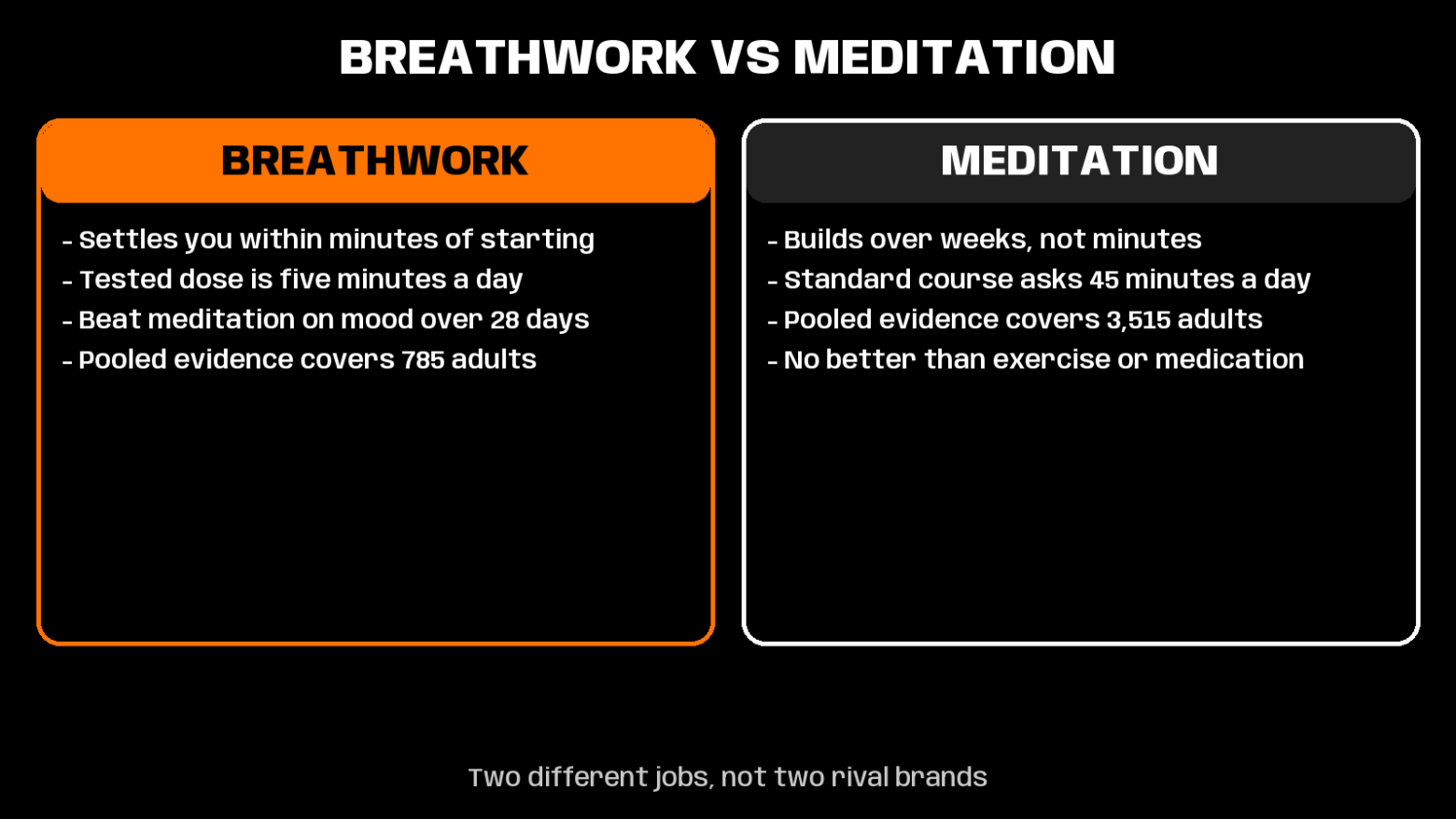
Two different jobs, not two rival brands of the same thing.
Both are real interventions with real published trials behind them, and they are usually sold as interchangeable. They are not. One of them changes your physiology in the next ninety seconds and the other trains something slowly over weeks.
The table below is the honest version of the comparison, with the figure and the source attached to each line rather than the usual vague claim that both are good for you.
| What matters | Breathwork | Meditation |
|---|---|---|
| Tested daily dose | Five minutes [1] | Forty five minutes in the standard course [7] |
| Time before you feel it | Within minutes [4] | Weeks [3] |
| Pooled effect size | 0.35 on stress across 12 trials [2] | 0.38 on anxiety at eight weeks across 47 trials [3] |
| Size of the evidence base | 785 adults [2] | 3,515 adults [3] |
| Head to head result | Won on mood and breathing rate [1] | Lost on both [1] |
| Main watch-out | The intense styles are not for everyone | Adverse events reported in 8.3 percent of studied practitioners [6] |
How We Compared Them
On five things a man can actually check before he commits. How fast it works, how much of your day it costs, how strong the published evidence is, how it performed when the two were tested directly against each other, and what can go wrong. Anything else is preference.
We have deliberately left out which one feels more profound. That question has no measurable answer, and it is the question that keeps men reading about this instead of doing either.
1. Breathwork: What It Actually Is
Deliberately changing the pattern, rate or depth of your breathing to shift how aroused your body is. The version with the best record is unglamorous, which is slowing to roughly six breaths a minute with the exhale longer than the inhale, for about five minutes [4].
It works because breathing is one of the few parts of your autonomic system you can drive on purpose. Slowing it lines your breathing rhythm up with the natural oscillation in your blood pressure control system, which produces the largest heart rate response for the least effort [4].
The wider category also includes box breathing, cyclic hyperventilation with breath retention, and the various branded programmes built on them. Those are not the same thing and they do not carry the same evidence. Our breakdown of what the breathwork trials actually found separates the tested versions from the marketed ones.
Honest limitation: most of the measured effect happens while you are doing it. Evidence that five minutes a day permanently lifts your resting baseline is much weaker than the claims made for it [2].
2. Meditation: What It Actually Is
Training attention on purpose, usually by returning it to a chosen anchor every time it wanders. Mindfulness meditation is the version almost all of the research covers, and the standard clinical format is an eight week course with weekly classes of around two and a half hours, an all day retreat, and forty five minutes of home practice a day [7].
That is a serious commitment, and it is the dose the good results were produced at. The ten minute app session most men actually do is a different and largely untested product.
The payoff is broader. Meditation is not aimed at the next ninety seconds, it is aimed at your relationship with your own attention, which is why it keeps appearing in trials for pain and low mood rather than only for stress [3].
Honest limitation: the same review that found those effects also found no advantage over other active treatments, which is a meaningful ceiling on what you should expect from it [3].
Which One Settles You Faster?
Breathwork, and it is not close on this dimension. Slow breathing shifts measurable parasympathetic activity during the practice itself [4], which means the thing you want is happening while you are sitting there rather than arriving in week six.
Meditation is not designed to do that. Its effects in the pooled data were measured at eight weeks and at three to six months [3], because those are the timescales it operates on. Judging it by how you feel after one ten minute session is judging the wrong outcome.
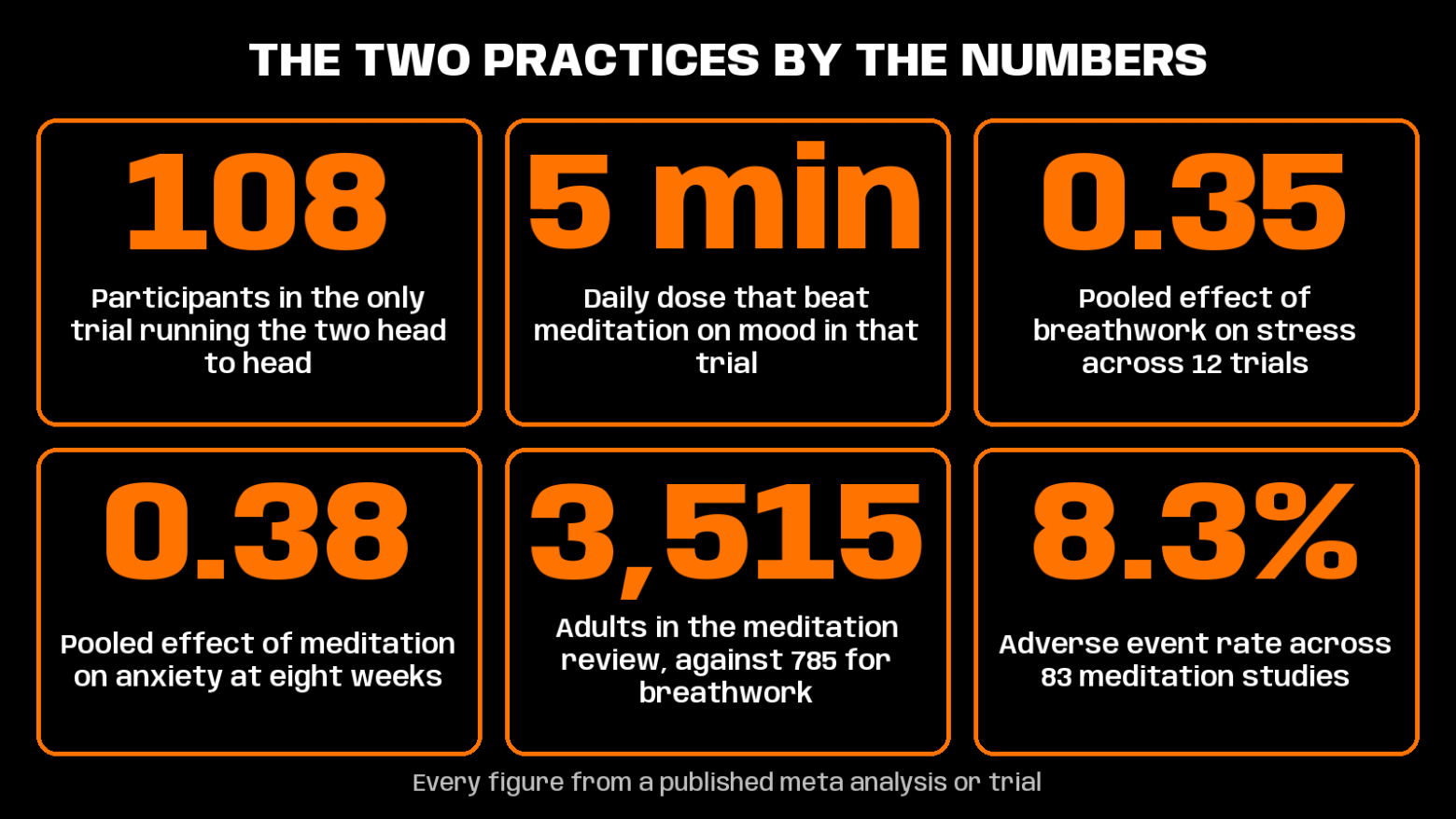
Every figure here is from a published meta analysis or trial, not an estimate.
The practical reading is that these two sit at different points on the same problem. If your stress arrives in spikes before meetings, difficult conversations and bad news, the fast tool is the relevant one.
Which One Has the Stronger Evidence?
Meditation, on volume and maturity. Goyal and colleagues pooled 47 randomised trials covering 3,515 participants and found mindfulness meditation improved anxiety with an effect size of 0.38 at eight weeks, falling to 0.22 by three to six months, depression at 0.30 falling to 0.23, and pain at 0.33 [3].
The same review carried the finding most meditation content leaves out. The authors state plainly that “We found no evidence that meditation programs were better than any active treatment (ie, drugs, exercise, and other behavioral therapies)” [3]. It beat doing nothing in particular. It did not beat going for a run.
Breathwork’s evidence base is younger and smaller. Fincham and colleagues pooled 12 randomised controlled trials in 785 adults and found a small to medium reduction in self reported stress at a pooled effect size of 0.35, with anxiety at 0.32 and depressive symptoms at 0.40 [2].
Read that with the authors’ own caveat attached. They report that “Most studies were deemed as being at moderate risk of bias” and call for better designs to avoid what they describe as “a miscalibration between hype and evidence” [2]. That is an unusually honest line from the researchers whose own result is the one being quoted everywhere.
So the effect sizes are close. The confidence behind them is not equal, and meditation has had four decades longer to accumulate trials.
What the Head to Head Trial Actually Found
This is the part that settles the argument for most men, because it is the only study that ran the two side by side under the same conditions. Balban and colleagues at Stanford randomised 108 people across four arms, three breathing practices and one mindfulness meditation control, at five minutes a day for twenty eight days [1].
The finding was direct. The authors report that “Breathwork, especially the exhale-focused cyclic sighing, produces greater improvement in mood and reduction in respiratory rate compared with mindfulness meditation” [1].
Note what was being compared. Five minutes of meditation against five minutes of breathing. At equal time, breathing won. That is not the same claim as breathwork beating a full eight week course, and nobody has run that trial.
Note the arms too. Twenty four people were in the meditation condition and thirty in the cyclic sighing condition [1], which are small groups. It is one good trial, not a settled literature.
Which One Costs You Less Time?
Breathwork, by a margin large enough to change the decision on its own. The tested breathwork dose is five minutes a day [1]. The tested meditation dose is the eight week course, which is forty five minutes of home practice a day, weekly classes of around two and a half hours, and a full day retreat [7].
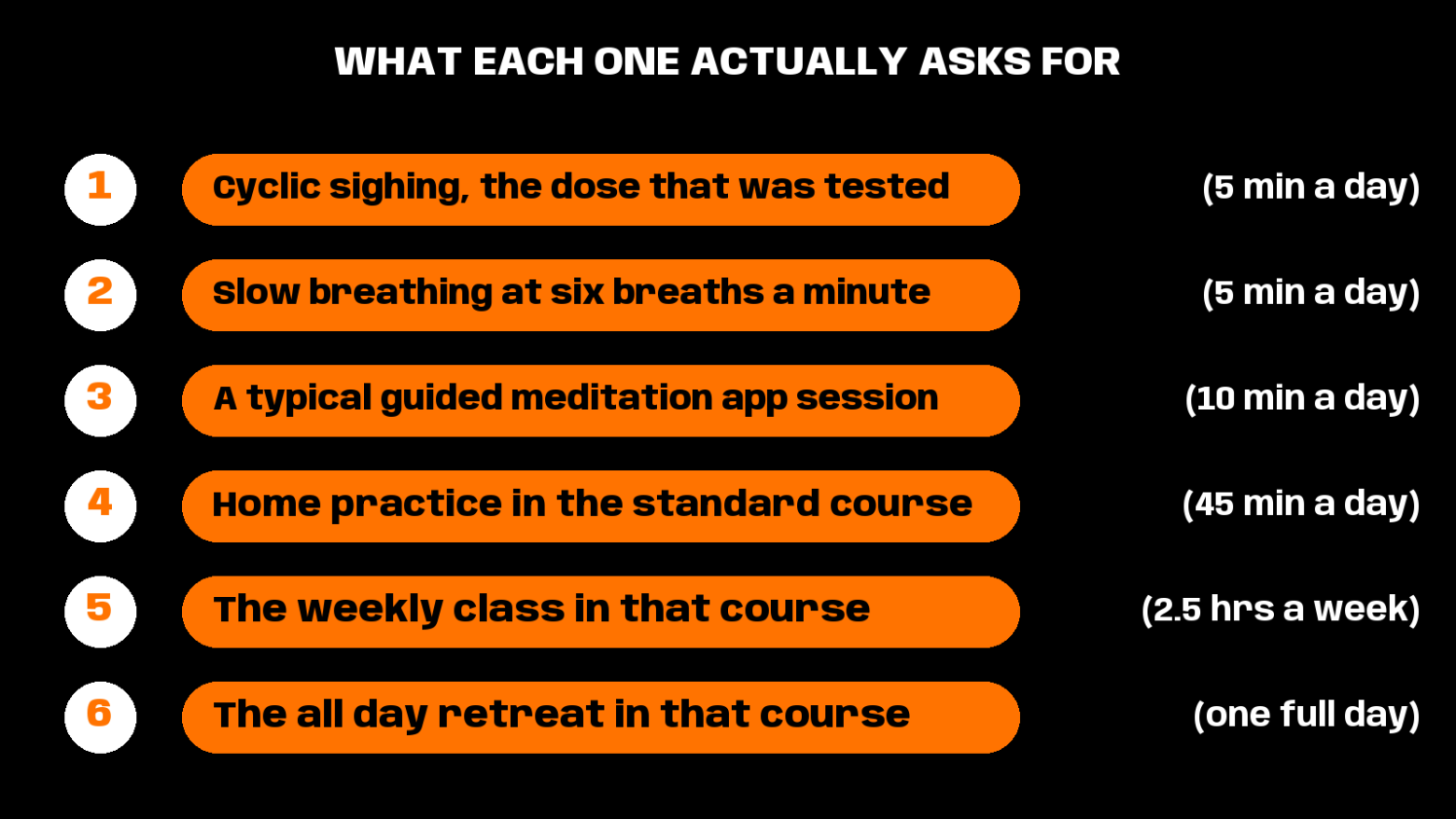
The dose each one was tested at, rather than the dose that fits your diary.
Run the arithmetic across the course and it is roughly two and a half hours of breathing across a month against more than sixty hours for the full meditation programme. Those are not competing options for a man with a job and children.
The honest middle ground is that the ten minute app session sits between the two and has been tested at neither dose. It may well help. It is not what the 47 trial review measured [3].
What Goes Wrong With Each One
Both fail quietly rather than dramatically, and they fail in different ways. Breathwork disappears because nothing about it creates its own reminder, so it survives the good weeks and vanishes in the first busy one.
Meditation fails on expectation. Men start at ten minutes, judge it against the results produced at forty five [7], conclude it does not work for them, and stop. The dose mismatch does most of the damage.
Meditation also has a side that gets left out of the marketing. Farias and colleagues reviewed 83 studies covering 6,703 people who had meditated and found adverse events at an overall prevalence of 8.3 percent, most commonly anxiety at 33 percent of reports, depression at 27 percent and cognitive anomalies at 25 percent [6]. That rate sits in the same range as other psychological interventions rather than being alarming, and it matters because meditation is usually presented as risk free.
On the breathwork side the risk sits entirely with the intense styles. Breath retention and cyclic hyperventilation can cause fainting, and they are a poor idea for anyone with a heart or respiratory condition, uncontrolled blood pressure or epilepsy. Slow breathing with a long exhale carries almost none of that.
Neither is a treatment. If stress or low mood has run for weeks and is affecting your work, sleep or relationships, that is a GP conversation, and the NHS stress pages set out the routes in [8].
Pick Breathwork If, Pick Meditation If
Pick breathwork if you want something that works on the day you start, if five minutes is genuinely all you will protect, if your stress arrives in identifiable spikes, or if you have tried meditation twice and quietly abandoned it both times. It is also the better first move if you need proof before you will commit, because you get a result inside the first session [4].
Pick meditation if you have sat with the practice before and did not hate it, if you can hold twenty minutes or more a day, if what bothers you is your attention rather than your arousal, or if you want the broader outcomes the longer trials measured [3]. Take it seriously enough to approach the tested dose [7], or accept that you are running a version nobody has measured.
If you want the strongest tested option of all and will tolerate a sensor, heart rate variability biofeedback produced a between group effect of 0.83 across 24 studies and 484 participants [5], which is larger than either practice on its own. It also costs money and needs coaching, which is why it is a third answer rather than the default one.
Both sit inside the same larger picture, and what nervous system regulation actually means sets out where each one fits. If you have been reading about the nerve rather than the practice, the evidence on vagus nerve exercises covers what holds up.
FAQ
Is breathwork better than meditation?
For speed and for time cost, yes. At an equal five minutes a day for twenty eight days, exhale focused breathing produced greater improvement in mood and a greater drop in respiratory rate than mindfulness meditation [1]. On the size and maturity of the evidence base, meditation is ahead with 47 trials and 3,515 participants [3].
Can you do breathwork and meditation together?
Yes, and it is the sensible order for most men. Use two to five minutes of slow breathing to bring your arousal down first, then sit, because trying to meditate while wound up is what makes early attempts feel pointless [4]. Nobody has trialled the combination, so treat that as reasoning rather than a measured result.
Which is better for anxiety?
The pooled figures are close. Breathwork reduced anxiety at an effect size of 0.32 across its trials [2], mindfulness meditation at 0.38 at eight weeks, falling to 0.22 by three to six months [3]. Neither treats an anxiety disorder, and neither was better than existing active treatments [3].
How long before either one works?
Breathwork does something measurable during the session itself [4]. Meditation was measured at eight weeks and at three to six months [3], so give it a month at a real dose before deciding. Judging meditation after a fortnight of ten minute sessions tells you nothing.
Is ten minutes of meditation a day enough?
It is untested at that dose. The results in the large review came from courses asking forty five minutes a day plus weekly classes [7]. Ten minutes may help, and it is honest to say we do not have the evidence that it delivers what those trials showed [3].
Which type of breathwork has the best evidence?
Slow breathing with a longer exhale, at roughly six breaths a minute [4], and the cyclic sighing version of it that won the head to head trial [1]. The intense retention and hyperventilation styles are less tested and carry more risk.
Does meditation have any downsides?
It can. Across 83 studies covering 6,703 practitioners, adverse events were reported at an overall prevalence of 8.3 percent, most often anxiety, low mood and cognitive effects [6]. That is comparable with other psychological interventions, and worth knowing before you commit to a long retreat.
Which one should a complete beginner start with?
Breathwork. It needs no instruction, no app and no course, it gives you a result in the first session [4], and it costs five minutes. Move to meditation once the five minutes is genuinely automatic, if you still want the broader outcomes [3].
Final Recommendation
Start with five minutes of slow breathing, exhale longer than the inhale, at a fixed point in your day. It won the only direct comparison we have at equal time [1], it is free, and you will know within a week whether you will keep it.
Add meditation later, and only at a dose that resembles what was actually tested [7]. If twenty minutes a day is not realistic for the next three months, be honest that you are running a version nobody has measured rather than pretending the ten minute session is the thing the research describes [3].
Do not run both badly at once. One practice held for three months beats two practices abandoned in three weeks, and that is the only part of this comparison that reliably decides the outcome.
Options for Men to Take Action
The problem with both of these is never the technique. It is that a five minute practice creates no reminder of its own, so it quietly disappears in the first week that goes wrong, and the next thing a man reaches for is a different technique rather than the same one done consistently.
The MenTools app runs this as a challenge alongside mindset, fitness, nutrition and money, with daily actions, levels you choose, reminders timed to when the practice should happen, streak and progress tracking, and an AI coach. Its job here is narrow, which is keeping five minutes in place long enough for you to judge it fairly.
How you can do this today: attach the breathing to something already fixed in your day, such as the moment you sit down in the car, rather than to a time you hope to be free.
Wins on cost: one subscription covers the stress, sleep and training sides together, which is less than a single eight week course.
Wins on time: the structure and the tracking already exist, so there is nothing to design before you start.
Wins on practicality: five minutes survives shift work, travel and young children, which is exactly where a forty five minute practice breaks first.
Watch-out: it is a behaviour and consistency tool, not a therapist, a sensor or a treatment. If the caution section above applies to you, it supports the medical route rather than replacing it.
Steady energy is what makes a daily practice easy to hold, and the weeks a man is running on empty are the weeks it goes first, so a one a day multivitamin may help cover the simple daily foundation underneath the behaviour work. For more built for men on this topic, see the MenTools mindfulness hub. Give whichever one you pick a full month before you decide it has earned its place.
Last updated: 2026-10-01 v1.0
Disclaimer: This guide is for informational purposes only and does not constitute medical or psychological advice. Speak with a qualified professional before making significant changes if you have a medical or mental health condition.
References
- [1] Balban MY, Neri E, Kogon MM, Weed L, Nouriani B, Jo B, Holl G, Zeitzer JM, Spiegel D, Huberman AD. Brief structured respiration practices enhance mood and reduce physiological arousal. Cell Reports Medicine, 2023;4(1):100895. Published 10 January 2023. Link
- [2] Fincham GW, Strauss C, Montero-Marin J, Cavanagh K. Effect of breathwork on stress and mental health, a meta-analysis of randomised-controlled trials. Scientific Reports, 2023;13:432. Published 9 January 2023. Link
- [3] Goyal M, Singh S, Sibinga EMS, Gould NF, Rowland-Seymour A, Sharma R, Berger Z, Sleicher D, Maron DD, Shihab HM, Ranasinghe PD, Linn S, Saha S, Bass EB, Haythornthwaite JA. Meditation programmes for psychological stress and well-being, a systematic review and meta-analysis. JAMA Internal Medicine, 2014;174(3):357-368. Link
- [4] Zaccaro A, Piarulli A, Laurino M, Garbella E, Menicucci D, Neri B, Gemignani A. How breath-control can change your life, a systematic review on psycho-physiological correlates of slow breathing. Frontiers in Human Neuroscience, 2018;12:353. Link
- [5] Goessl VC, Curtiss JE, Hofmann SG. The effect of heart rate variability biofeedback training on stress and anxiety, a meta-analysis. Psychological Medicine, 2017;47(15):2578-2586. Link
- [6] Farias M, Maraldi E, Wallenkampf KC, Lucchetti G. Adverse events in meditation practices and meditation-based therapies, a systematic review. Acta Psychiatrica Scandinavica, 2020;142(5):374-393. Link
- [7] UMass Memorial Health, Center for Mindfulness. Mindfulness-Based Stress Reduction, course structure and time commitment. Link
- [8] National Health Service. Stress. NHS. Link