
No products in the cart.
Return To Shop
MEN: Do Vagus Nerve Exercises Actually Work?
Quick Answer
Some do. Slow breathing with a long exhale has the strongest evidence and reliably shifts the markers we can measure. Cold water on the face has decent short-term evidence. Humming, gargling, ear massage and the eye-movement resets are largely untested. The clip-on devices have not been shown to move the vagal marker they are sold on.
**Jump to:** Technique by technique | Does it work | FAQ | Options for men
Disclosure: MenTools publishes this article and may feature MenTools products.
How we evaluate: Each technique is assessed on real-world use, evidence, cost and time, and how well it suits men. Every technique including the MenTools option carries an honest limitation. Full sources are in the references below.
The Numbers Worth Knowing
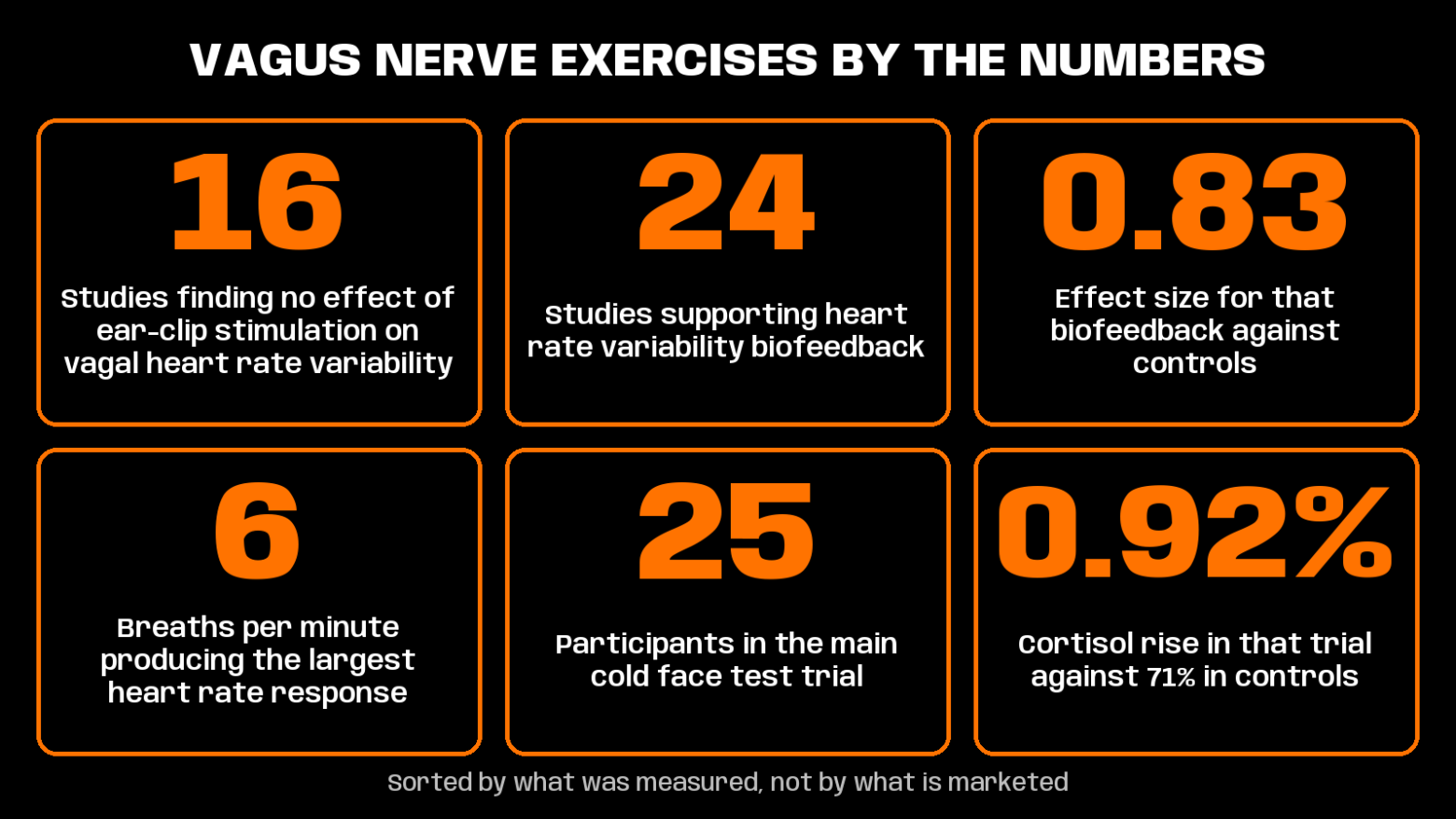
Six measured figures that sort the proven techniques from the marketed ones.
Almost every claim in this area traces back to one measurement, which is heart rate variability. It is the standard stand-in for vagal activity, and understanding that it is a stand-in rather than a direct reading is the thing that makes the rest of this readable.
The table below sorts the popular techniques by what has actually been tested, rather than by how often they appear on your feed.
| Technique | Evidence | What it reliably does | Watch-out |
|---|---|---|---|
| Slow breathing, long exhale | Strong | Raises heart rate variability during practice | Effect is mostly while you do it |
| HRV biofeedback | Strong | Large reduction in stress and anxiety | Needs a sensor and coaching |
| Cold water on the face | Moderate | Slows heart rate, blunts a cortisol rise | One small trial, mostly young women |
| Humming, gargling, singing | Weak | Small autonomic shifts in small studies | Not shown to change vagal tone |
| Ear-clip stimulation devices | Weak | Nothing reliable on vagal heart rate variability | 16 studies found no effect |
| Eye-movement resets | None | Untested | No published trials to judge |
Do Vagus Nerve Exercises Actually Work?
Some of them, and the split is not the one social media suggests. The techniques that work are the boring ones that slow your breathing down, and the techniques that have spread fastest are the ones with the least evidence behind them.
The clearest example is the device category. Wolf and colleagues ran a living Bayesian meta-analysis of 16 studies on transcutaneous auricular vagus nerve stimulation, the ear-clip approach, and found no effect on vagally mediated heart rate variability [1]. That is the exact marker these devices are sold on.
A 2025 narrative review reached a similar place on evidence quality, concluding that “the overall quality of the evidence base is limited. Most studies had small sample sizes…outcome measures and stimulation parameters were heterogeneous”, with overall confidence in efficacy rated low to moderate [2].
Slow breathing sits at the other end. A systematic review of slow breathing found consistent increases in parasympathetic activity and reductions in subjective stress, with the largest heart rate response at around six breaths a minute [3].
What the Vagus Nerve Actually Does
It is the main nerve of your parasympathetic nervous system, running from the brainstem down to the chest and abdomen, and most of its traffic is sensory information travelling up to the brain rather than instructions travelling down. It is a two-way reporting line between your organs and your head, not a switch.
That matters for how you read the claims. Techniques that change something the nerve reports on, such as your breathing rate or the temperature of your face, have a plausible route to an effect. Techniques that claim to tone or reset the nerve itself are describing something that has not been demonstrated.
The nerve is also not the cause of stress or anxiety. It is one part of the system that regulates arousal, which our guide to what nervous system regulation actually means sets out in full.
Why You Cannot Measure Your Own Vagal Tone
Because vagal tone is not directly measurable outside a laboratory, and what your watch reports is an inference from your heart rhythm. Heart rate variability is the accepted proxy, and the standard methodological guidance treats it as exactly that, with recommendations on how it should be recorded and reported before any conclusion is drawn [4].
Your resting figure also moves with sleep, alcohol, illness, training load and the time of day. A single reading tells you almost nothing, which is why men who check it every morning usually end up adding a stressor rather than removing one.
Treat it as a weekly trend if you use it at all. If a technique only works according to a number that swings twenty percent on a bad night’s sleep, you are measuring the night, not the technique.

The one technique with strong evidence, in the order you actually do it.
Does Slow Breathing Work?
Yes, and it is the best supported technique in this category. Breathing is one of the few autonomic functions you can drive on purpose, and slowing it to around six breaths a minute lines your breathing rhythm up with the natural oscillation in your blood pressure control system, which produces the largest heart rate swing for the least effort [3].
The longer exhale is doing the work. Heart rate rises slightly as you breathe in and falls as you breathe out, so making the out-breath the longest part of the cycle spends more time in the slower phase.
The stronger version, if you will use a sensor, is heart rate variability biofeedback. Across 24 studies and 484 participants it produced a large effect on stress and anxiety against control conditions, with a between-group effect size of 0.83 [5]. Our breakdown of what the breathwork trials actually found covers the dose and the limits.
Does Cold Water on the Face Work?
Short-term, yes, and the mechanism is well understood. Cold on the face triggers a reflex that slows the heart, which is the same response that fires when you put your face in cold water.
The most relevant trial is small. Richer and colleagues applied a cooling mask for two minutes before a stress task and found the cold group had a maximum cortisol rise of 0.92 percent against 71.49 percent in the control group, along with better heart rate recovery between stress phases [6].
Read that with its limits attached. The final analysis covered 25 participants with a mean age of 20 and 82 percent of them were women, so applying it directly to a 35 year old man is a reasonable guess rather than a demonstrated result [6].
As a practical tool it is still worth having. Cold water on the face for thirty seconds is free, takes no skill, and does something measurable within a minute, which is more than most of the list can claim.
Do Humming, Gargling and Ear Massage Work?
Probably a little, and the evidence is thin enough that honesty is the only sensible position. Small studies of humming, chanting and singing show changes in autonomic markers, but these are short, small and rarely controlled well enough to separate the technique from the relaxation that comes with it.
Gargling appears in clinical practice for a different reason entirely, as one of several manoeuvres used to slow a racing heart in specific cardiac situations. That is a real vagal effect in a medical context, and it is not evidence that gargling in your bathroom changes your baseline.
The fair summary is that these are pleasant, harmless and unproven. If humming helps you, keep humming. Do not expect it to do what five minutes of slow breathing does.
Do the Clip-On Devices Work?
Not on the measure they are marketed on. The pooled evidence across 16 studies found no effect of ear-clip vagus nerve stimulation on vagally mediated heart rate variability [1], and the 2025 review of the wider field rated confidence in efficacy as low to moderate on the back of small, heterogeneous studies [2].
This is different from saying the technology is worthless. Implanted and clinical vagus nerve stimulation is an established treatment in specific conditions, delivered under medical supervision. The consumer ear clip is not that.
If you are choosing where to put your money, the sensor-plus-coaching route has the stronger published record [5], and the free route has almost as much evidence behind it.
What About Resetting the Vagus Nerve?
There is nothing to reset, and that framing is where most of the misinformation lives. The nerve does not switch off and need restarting. What changes is your level of arousal, and some techniques lower it.
Jonathan Jarry of McGill University’s Office for Science and Society put the eye-movement version of this claim plainly, noting that “simple eye movements would be a healthcare revolution if they worked” and that they need to show their worth before being proclaimed effective [8].
The test to apply to anything you see is simple. Ask what was measured, in how many people, against what comparison. Most reset content fails at the first question. For the techniques that do pass, the seven methods with real evidence covers the order to add them in.
Who Should Be Careful
Anyone with a heart condition, and anyone tempted by the extreme end of cold exposure. Cold water immersion is a different proposition from cold water on the face, and cold shock affects breathing and heart rhythm, so it is not something to experiment with alone or in open water.
Skip the intense breath-retention practices if you have a heart or respiratory condition, uncontrolled blood pressure, or epilepsy. Slow breathing with a long exhale is low risk for most healthy men.
None of this is a substitute for medical advice on symptoms that have run for weeks. The NHS stress pages set out the routes in [7].
FAQ
How do you stimulate the vagus nerve at home?
Slow your breathing to roughly six breaths a minute with the exhale longer than the inhale, for about five minutes. That is the technique with the strongest evidence for raising heart rate variability during practice [3]. Cold water on the face for thirty seconds is a reasonable second option.
How long does it take to improve vagal tone?
The measurable change is mostly during practice rather than at rest. Slow breathing raises heart rate variability while you are doing it [3], and evidence that a few minutes a day permanently lifts your resting baseline is much weaker than the claims made for it. Judge it on how you feel over four weeks.
Are vagus nerve devices worth buying?
On current evidence, no. A meta-analysis of 16 studies found no effect of ear-clip stimulation on vagally mediated heart rate variability [1], and a 2025 review rated confidence in efficacy as low to moderate [2]. A heart rate variability biofeedback setup has a far stronger published record [5].
Can you damage your vagus nerve with these exercises?
Not with slow breathing or cold water on the face. The risks sit with the extremes, which are breath retention and full cold water immersion, both of which can cause fainting or dangerous heart rhythms in susceptible people. Do neither alone or in water.
Is humming actually good for the vagus nerve?
The evidence is weak. Small studies of humming and chanting show autonomic changes, but they are short, small and hard to separate from ordinary relaxation. It is harmless and it is not a substitute for the paced breathing that has been properly tested.
Does a cold shower do the same as cold water on the face?
Not quite. The face-cooling reflex is triggered by cold on the face specifically, which is what the trial tested [6]. A full cold shower adds a large cold shock response on top, which is a different and more demanding stimulus.
Why does my heart rate variability keep changing?
Because it moves with sleep, alcohol, illness, training and time of day. That is normal, and it is why the standard guidance treats it as a measure needing careful recording and interpretation rather than a daily score [4]. Read it weekly or not at all.
Is the vagus nerve the cause of my anxiety?
No. It is one part of the system that regulates arousal, not the origin of anxiety, and stimulating it does not treat an anxiety disorder. If anxiety has run for weeks or is affecting your work or relationships, that is a GP conversation [7].
Final Recommendation
Do the slow breathing and ignore the rest until it is running. Five minutes a day, exhale longer than the inhale, at roughly six breaths a minute, at a fixed point in your day. It costs nothing, it has the best evidence in this category, and it needs no device.
Add cold water on the face when you need something faster, which is thirty seconds at the sink before a difficult conversation. If you want the strongest version and will tolerate the kit, heart rate variability biofeedback is the option with the largest published effect [5]. Leave the ear clips, the eye-movement resets and the toning routines until somebody tests them properly.

Start from what you actually want, not from what the algorithm showed you.
Options for Men Who Want This to Stick
The techniques that work here are free and take five minutes, which is exactly why they get abandoned. Nothing about a breathing practice creates its own reminder, so it quietly disappears in the first busy week and the next thing a man tries is a device.
The MenTools app runs this as a challenge alongside mindset, fitness, nutrition and money, with daily actions, levels you choose, reminders timed to when the practice should happen, streak and progress tracking, and an AI coach. Its job here is narrow, which is keeping a five minute practice in place long enough to be worth judging.
How you can do this today: set the breathing as a daily action attached to something already fixed in your day, rather than to a time you hope to be free.
Wins on cost: one subscription covers the stress, sleep and training sides together, which is less than a single vagus device that the evidence does not support.
Wins on time: the structure and tracking already exist, so there is nothing to design before you start.
Wins on practicality: five minutes survives shift work, travel and young children, which is where longer routines break first.
Watch-out: it is a behaviour and consistency tool, not a sensor, a diagnosis or a treatment. If the section on caution applies to you, it supports the medical route rather than replacing it.
Steady energy is what makes a daily practice easy to hold, and it is hardest to keep going in the weeks a man is running on empty, so a one a day multivitamin may help cover the simple daily foundation underneath the behaviour work. For more built for men on this topic, see the MenTools mindfulness hub. Give the five minutes a month before you decide whether it has earned its place.
Last updated: 2026-09-30 v1.0
Disclaimer: This guide is for informational purposes only and does not constitute medical or psychological advice. Speak with a qualified professional before making significant changes if you have a medical or mental health condition.
References
- [1] Wolf V, Kühnel A, Teckentrup V, Koenig J, Kroemer NB. Does transcutaneous auricular vagus nerve stimulation affect vagally mediated heart rate variability? A living and interactive Bayesian meta-analysis. Psychophysiology, 2021;58(11):e13933. Link
- [2] Matsuoka M, Yamaguchi T, Fujiwara T. Transcutaneous auricular vagus nerve stimulation in healthy individuals, stroke, and Parkinson’s disease, a narrative review of safety, parameters, and efficacy. Frontiers in Physiology, 2025. Link
- [3] Zaccaro A, Piarulli A, Laurino M, Garbella E, Menicucci D, Neri B, Gemignani A. How breath-control can change your life, a systematic review on psycho-physiological correlates of slow breathing. Frontiers in Human Neuroscience, 2018;12:353. Link
- [4] Laborde S, Mosley E, Thayer JF. Heart rate variability and cardiac vagal tone in psychophysiological research, recommendations for experiment planning, data analysis, and data reporting. Frontiers in Psychology, 2017;8:213. Link
- [5] Goessl VC, Curtiss JE, Hofmann SG. The effect of heart rate variability biofeedback training on stress and anxiety, a meta-analysis. Psychological Medicine, 2017;47(15):2578-2586. Link
- [6] Richer R, Zenkner J, Küderle A, Rohleder N, Eskofier BM. Vagus activation by Cold Face Test reduces acute psychosocial stress responses. Scientific Reports, 2022;12:19270. Link
- [7] National Health Service. Stress. NHS. Link
- [8] Jarry J. Resetting the hype around the vagus nerve. McGill University Office for Science and Society, 13 May 2022. Link
