No products in the cart.
Return To Shop
MEN: Does Breathwork Actually Lower Stress? What the Evidence Shows
Quick Answer
Yes, modestly. Pooling 12 randomised controlled trials in 785 adults, breathwork lowered self-reported stress against control conditions with a small to medium effect. It is a real result rather than a large one, the study quality is mixed, and the most tested version is about five minutes a day of slow breathing with a longer exhale than inhale.
**Jump to:** The numbers | Does it work | FAQ | Options for men
Disclosure: MenTools publishes this article and may feature MenTools products.
How we evaluate: Each practice is assessed on real-world use, evidence, cost and time, and how well it suits men. Every practice including the MenTools option carries an honest limitation. Full sources are in the references below.
What the Trials Measured at a Glance

Every bar is a pooled effect size from a published meta-analysis, not an estimate.
An effect size is a way of saying how far the treated group moved compared with the control group. Roughly, 0.2 is small, 0.5 is moderate and 0.8 is large. Holding that scale in mind is the difference between reading this evidence honestly and reading a supplement advert.
The table below is the short version of what has actually been tested, and what each finding does and does not cover.
| What was tested | What the trials found | Strength | What it does not show |
|---|---|---|---|
| Breathwork vs control, stress | Effect size 0.35 across 12 trials | Small to medium | Not tested against therapy or medication |
| Breathwork vs control, anxiety | Effect size 0.32 across 20 trials | Small to medium | Self-reported, not clinical diagnosis |
| Breathwork vs control, low mood | Effect size 0.40 across 18 trials | Small to medium | Not a treatment for clinical depression |
| Cyclic sighing vs meditation | Better mood gain over 1 month | Single trial, 108 people | One study, needs replication |
| HRV biofeedback vs control | Effect size 0.83 across 24 trials | Large | Needs a sensor and coaching |
Does Breathwork Actually Lower Stress?
Yes, and the best available answer comes from one pooled analysis rather than any single study. Fincham and colleagues combined 12 randomised controlled trials covering 785 adults and found breathwork was associated with lower self-reported stress than control conditions, with an effect size of 0.35 and a confidence interval running from 0.14 to 0.55 [1].
That confidence interval matters more than the headline. Because the whole range sits on the beneficial side of zero, the direction of the finding is reasonably secure. Because the range is wide, the exact size of the benefit is not.
The same analysis looked at two other outcomes. Across 20 trials, anxiety improved with an effect size of 0.32, and across 18 trials, depressive symptoms improved with an effect size of 0.40 [1]. Three separate findings pointing the same way is more persuasive than any one of them alone.
How Good Is the Evidence, Honestly?
Mixed, and the authors say so themselves. Of the 12 stress trials, three were scored as being at high risk of bias and the remaining nine were scored as having some concerns [1]. None were scored as low risk. That is a normal picture for behavioural research and it is still a real limitation.
The hardest problem is blinding. You cannot give someone a placebo breathing exercise without them noticing, so part of any measured benefit is expectation rather than physiology. This is why self-reported outcomes move more easily than measured ones.
The research team put the point plainly, writing that “we urge caution and advocate for nuanced research approaches with low risk-of-bias study designs to avoid a miscalibration between hype and evidence” [1]. That sentence is the fairest one-line summary of this whole field.
Which Type of Breathwork Works Best?
On current evidence, the exhale-focused kind. Balban and colleagues ran 108 people through a month of daily five minute practice, randomly assigned to cyclic sighing, box breathing, cyclic hyperventilation with retention, or mindfulness meditation. Cyclic sighing, which means a double inhale through the nose followed by a long slow exhale, produced the greatest improvement in mood and the largest reduction in resting breathing rate [2].
Cyclic sighing is also the easiest of the four to do badly and still benefit from. There is no counting pattern to hold and no retention to time, which matters if you are doing it in a car park before a meeting rather than on a mat.
One trial is not a settled answer. It is the best direct comparison currently published, and it happens to point at the simplest technique, which is a convenient result worth staying slightly sceptical about.
Why Slow Breathing Does Anything at All
Because breathing rate is one of the few autonomic functions you can drive deliberately, and slowing it changes the balance between your two nervous system branches. A systematic review of slow breathing research found consistent increases in parasympathetic activity and reductions in subjective stress, alongside measurable shifts in brain electrical activity [3].
The specific number that keeps appearing is around six breaths a minute. At roughly that rate the rhythm of your breathing lines up with the natural oscillation in your blood pressure control system, which produces the largest swing in heart rate variability for the least effort [3].
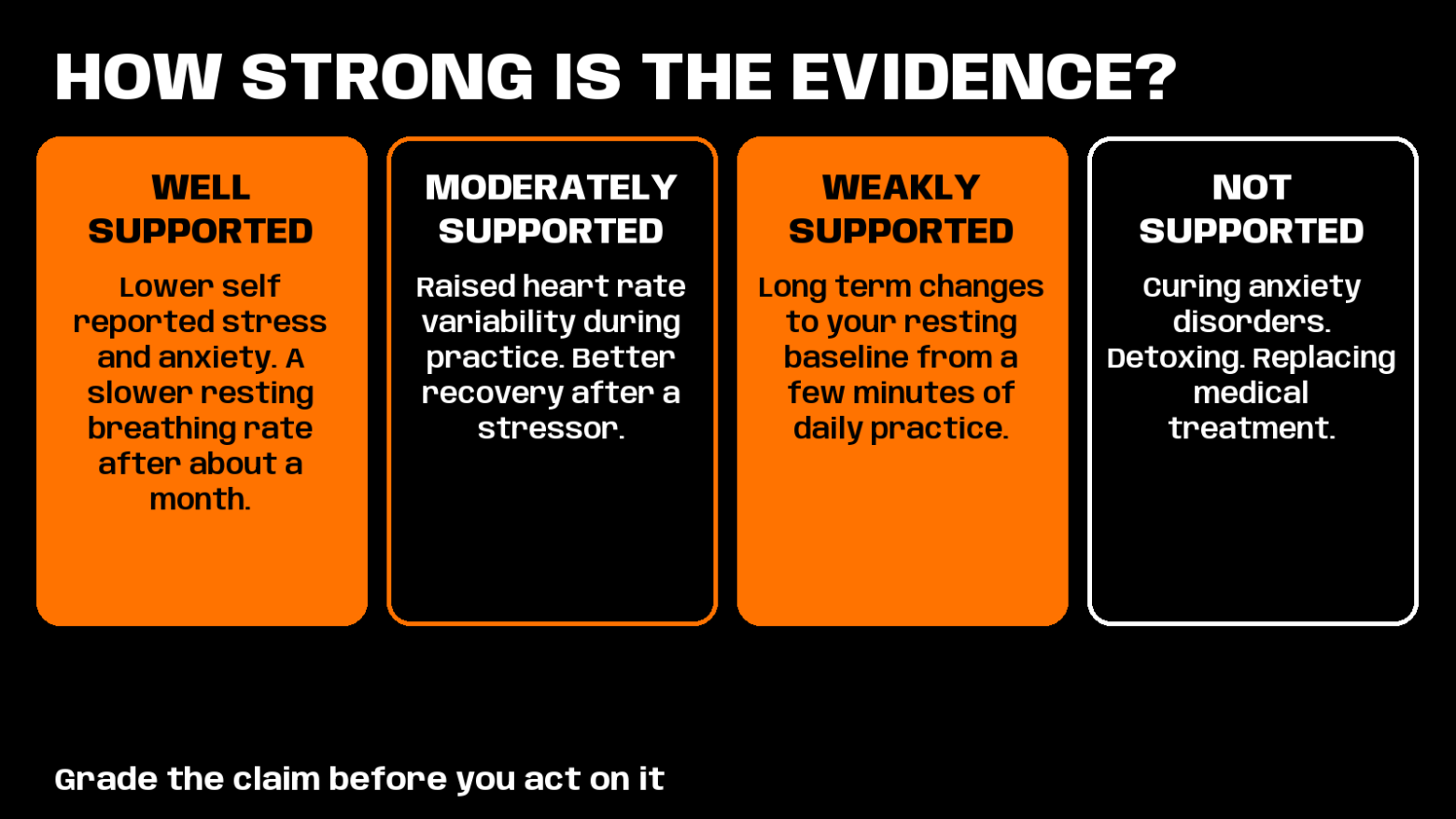
Read any breathwork claim against this scale before you act on it.
Long exhales matter for the same reason. Heart rate rises slightly as you breathe in and falls as you breathe out, so lengthening the out-breath spends more of each cycle in the slower phase. That is the mechanism behind the physiological sigh, and it is why the instruction is almost always to make the exhale longer than the inhale.
None of this means breathing is uniquely effective. It means it is unusually accessible, because it needs no equipment, no privacy and no prior skill.
What Breathwork Does Not Do
It does not cure anxiety disorders, it does not detoxify anything, and it does not replace treatment for a diagnosed condition. The trials above measured symptom scores in mostly non-clinical adults over weeks, which is a much narrower claim than the one usually made for it online.
It also does not reliably change your baseline. Most of the measured benefit shows up during and shortly after practice. Evidence that a few minutes a day permanently raises resting vagal activity in healthy adults is far weaker than the marketing suggests, and our guide to what nervous system regulation actually means sets out where that line sits.
The honest framing is that breathwork is a good acute tool with a modest cumulative effect. Treat it as something that changes the next twenty minutes reliably and the next twelve months gently.
Is Breathwork Better Than Meditation?
For short daily practice aimed at mood and arousal, the one head-to-head trial favours breathwork. In the Balban study, five minutes of daily breathwork produced greater mood improvement and a greater drop in breathing rate than an equivalent five minutes of mindfulness meditation over the same month [2].
That is a narrow comparison rather than a verdict on meditation. It tested one month, one duration and one set of outcomes, in people who were mostly new to both.
The practical read is that breathwork has a lower barrier to entry. It gives a physical signal within a minute, which is what keeps men doing it in week two, whereas meditation asks you to tolerate a few weeks of feeling like nothing is happening.
How Long Before You Notice Anything?
Something within one session, and anything cumulative over about four weeks. A single round of slow breathing with long exhales usually drops heart rate and physical tension inside two to three minutes, which you can feel without measuring.
The month is where the studies sit. Both the pooled trials and the head-to-head comparison used programmes of several weeks, with the Balban trial running daily five minute sessions across a month before measuring the difference [2].
If you want the stronger version and are willing to use a sensor, heart rate variability biofeedback is the most effective format tested. Across 24 studies and 484 participants, it produced a large effect on stress and anxiety compared with control conditions, with a between-group effect size of 0.83 [4]. The trade-off is equipment and coaching, which is exactly why fewer men stick with it.
Who Should Be Careful
Anyone doing the intense styles rather than the slow ones. Cyclic hyperventilation, breath retention and similar high-ventilation practices deliberately alter blood carbon dioxide and can cause dizziness, tingling and fainting. Never do them in water, while driving, or standing up.
Slow breathing with a long exhale carries very little risk for most healthy men. If you have a heart or respiratory condition, uncontrolled blood pressure, or epilepsy, take the intense practices off the list and check the slow ones with a clinician first.
Breathwork is also not the right first move for symptoms that have run for weeks without an obvious cause. The NHS stress pages set out the routes in, and none of them require you to have tried breathing exercises first [5].
FAQ
How many minutes of breathwork a day is enough?
Five minutes is the dose most trials used. The month-long comparison of four practices gave every group five minutes a day, and that was enough to separate them on mood and breathing rate [2]. Longer sessions have not been shown to be reliably better, so consistency matters more than duration.
Is breathwork just a placebo?
Not entirely, but expectation is part of it. You cannot blind someone to a breathing exercise, so trials cannot fully separate the physiology from the belief. The measured drops in breathing rate and the shifts in heart rate variability are objective, which is the part that is hardest to explain by expectation alone [2][3].
What is the best breathing pattern for stress?
Make the exhale longer than the inhale and aim for roughly six breaths a minute. Around that rate the breathing rhythm matches the body’s blood pressure control cycle and produces the largest heart rate response for the least effort [3]. A four second inhale and a six second exhale gets most men close enough.
Does box breathing work as well as cyclic sighing?
It worked, but less well in the one direct comparison. Box breathing improved mood over the month, and cyclic sighing improved it more, alongside a bigger reduction in resting breathing rate [2]. Box breathing suits men who prefer a fixed count, which is a real advantage if it is the one you will actually do.
Can breathwork replace therapy or medication?
No. The trials measured symptom scores in mostly non-clinical adults against passive or active controls, not against therapy or medication [1]. Treat it as something that sits alongside treatment, and speak to a GP before changing anything you have been prescribed.
Why do I feel dizzy when I do breathing exercises?
Usually because you are breathing too hard rather than too slowly. Fast or deep over-breathing lowers carbon dioxide and causes light-headedness and tingling. Slow the rate, make the exhale the longest part, and stop if it continues.
Does breathwork raise your heart rate variability permanently?
The reliable change is during practice rather than at rest. Slow breathing raises heart rate variability while you are doing it [3], and the evidence that short daily practice permanently lifts your resting baseline is much weaker than the claims made for it.
How is breathwork different from taking a deep breath?
A single deep breath is one event, and breathwork is a paced pattern held for minutes. The pacing is what produces the effect, because it is the sustained rate and the longer exhale that shift the autonomic balance, not the size of any one breath [3].
Final Recommendation
Do five minutes a day of cyclic sighing, and judge it after four weeks rather than after one session. Double inhale through the nose, long slow exhale through the mouth, repeated for five minutes at a fixed point in your day. It is the practice with the best direct evidence and the lowest barrier to doing it badly and still benefiting.
Expect a modest, real result. If you want the larger effect and will tolerate the kit, heart rate variability biofeedback is the stronger option on the evidence. If breathing is the only thing you change and nothing has shifted in a month, the problem is probably load rather than technique, and the seven methods that reset an overactive stress system covers what to add next.
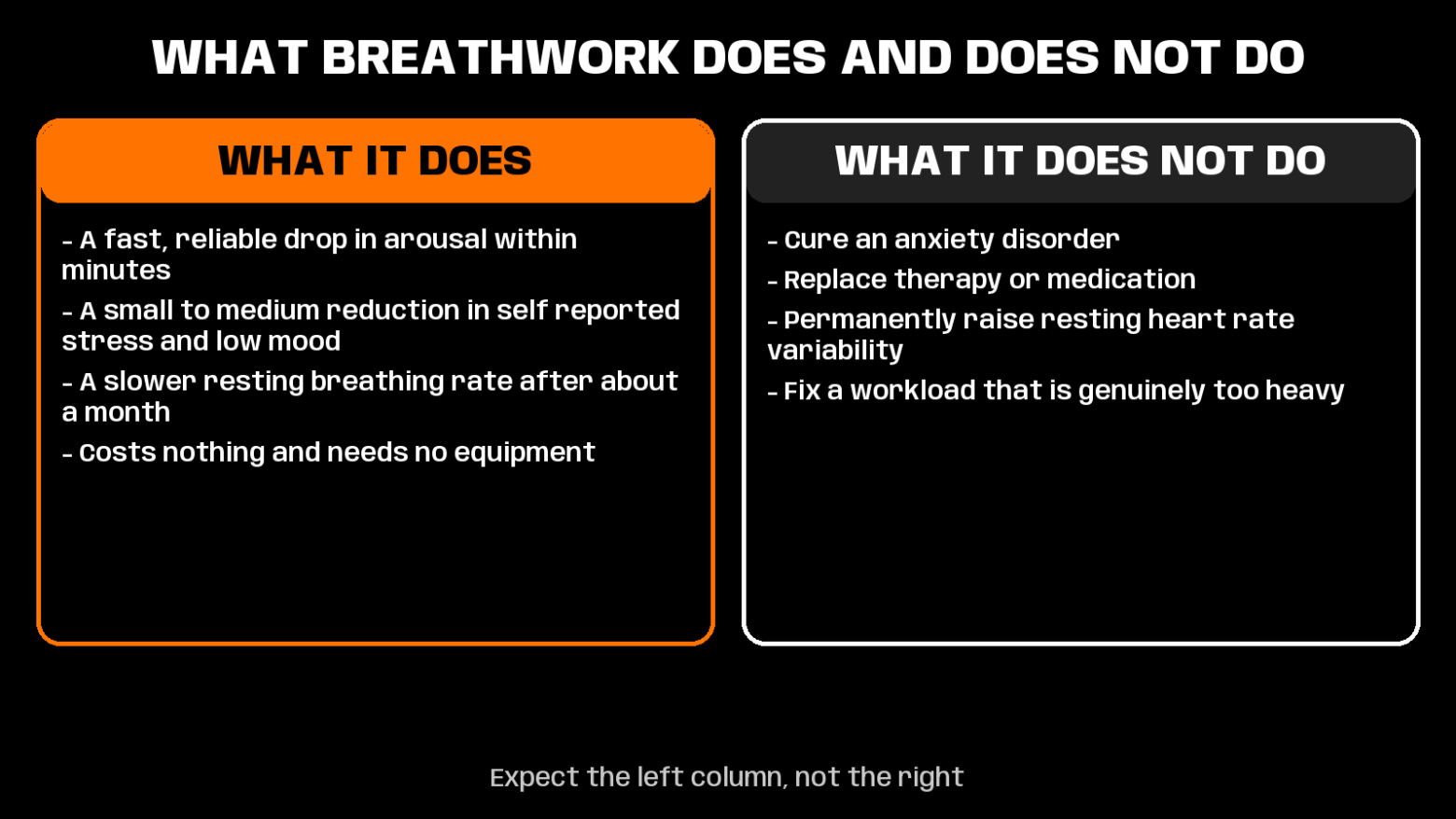
Use it for the left-hand column and it delivers. Expect the right-hand column and it disappoints.
Options for Men Who Want This to Stick
Most men who try breathwork are not short of information. They are short of the thing that puts five minutes in the same place every day for a month, which is the only version the trials actually tested.
The MenTools app runs this as a challenge alongside mindset, fitness, nutrition and money, with daily actions, levels you choose, reminders timed to when the practice should happen, streak and progress tracking, and an AI coach. Its job here is narrow, which is holding a five minute practice in place long enough for you to judge it fairly.
How you can do this today: set the practice as a daily action at a fixed time, and pick the time by what is already reliable in your day rather than what sounds ideal.
Wins on cost: one subscription covers the stress, sleep and training sides together rather than a separate app for each.
Wins on time: the structure already exists, so there is nothing to design before you start.
Wins on practicality: five minutes survives shift work, travel and young children, which is where longer routines break first.
Watch-out: it is a behaviour and consistency tool, not a breathwork course, a sensor or a treatment. If the section on caution applies to you, it supports the medical route rather than replacing it.
Steady energy is what makes a daily practice easy to keep, and it is hardest to hold together in the weeks a man is running on empty, so a one a day multivitamin may help cover the simple daily foundation underneath the behaviour work. For more built for men on this topic, see the MenTools mindfulness hub. Give the five minutes four weeks before you decide whether it earns its place.
Last updated: 2026-09-29 v1.0
Disclaimer: This guide is for informational purposes only and does not constitute medical or psychological advice. Speak with a qualified professional before making significant changes if you have a medical or mental health condition.
References
- [1] Fincham GW, Strauss C, Montero-Marin J, Cavanagh K. Effect of breathwork on stress and mental health, a meta-analysis of randomised-controlled trials. Scientific Reports, 2023;13:432. Published 9 January 2023. Link
- [2] Balban MY, Neri E, Kogon MM, Weed L, Nouriani B, Jo B, Holl G, Zeitzer JM, Spiegel D, Huberman AD. Brief structured respiration practices enhance mood and reduce physiological arousal. Cell Reports Medicine, 2023;4(1):100895. Published 10 January 2023. Link
- [3] Zaccaro A, Piarulli A, Laurino M, Garbella E, Menicucci D, Neri B, Gemignani A. How breath-control can change your life, a systematic review on psycho-physiological correlates of slow breathing. Frontiers in Human Neuroscience, 2018;12:353. Link
- [4] Goessl VC, Curtiss JE, Hofmann SG. The effect of heart rate variability biofeedback training on stress and anxiety, a meta-analysis. Psychological Medicine, 2017;47(15):2578-2586. Link
- [5] National Health Service. Stress. NHS. Link