No products in the cart.
Return To Shop
MEN: What Is Decision Fatigue, and How Do Men Avoid It?
Quick Answer
Decision fatigue is the idea that the quality of your choices drops after a long run of decisions [1]. Field studies of judges and clinicians show choices drifting as sessions wear on [2][3], but large lab replications found little or no effect [4][5]. Make your biggest calls early, set defaults for small ones and take real breaks.
**Jump to:** At a glance | What it is | The evidence | Is it a myth? | 35,000 decisions | Signs | How to avoid it | FAQ | Options for men
Disclosure: MenTools publishes this article and may feature MenTools products.
How we evaluate: Each step is assessed on real-world use, evidence, cost and time, and how well it suits men. Every step including the MenTools option carries an honest limitation. Full sources are in the references below.
Decision Fatigue at a Glance
Decision fatigue is a real pattern in some field data and a weak effect in the lab, so the honest answer sits between the hype and the dismissal. This guide covers what the term means, the studies behind it, the replications that challenged it and the steps worth taking either way. The table gives the short answers first, with the evidence behind each one.
| Question | Short answer | What the evidence shows |
|---|---|---|
| What is decision fatigue? | Worse choices after many choices | Defined as an impaired ability to decide and control behaviour after repeated decisions [1] |
| Is there evidence in real jobs? | Yes, in several field studies | Favourable parole rulings fell from about 65 percent to nearly zero within each session [2] |
| Does it hold up in the lab? | Mostly no | 23 labs and 2,141 people found an effect of d = 0.04, close to zero [4] |
| Is the newest evidence for it? | No | 231,076 calls handled by 174 nurses showed no credible evidence of decision fatigue [6] |
| Do breaks help? | Yes, in the field data | Pupils scored higher after a 20 to 30 minute break [7] |
| Do you make 35,000 decisions a day? | Unproven | The cited source is a newspaper article, not a research study [1] |
| What should a man do about it? | Protect the hours you think best | Big calls early, defaults for small ones, real breaks and enough sleep |
What Is Decision Fatigue?
Decision fatigue is the idea that making many decisions in a row wears down your ability to make the next one well. A 2020 concept analysis defines it as “the impaired ability to make decisions and control behavior as a consequence of repeated acts of decision-making” [1]. In practice, a man who has decided all day tends to drift towards the easy option.
The idea grew out of the strength model of self-control, which treats self-control like a muscle that tires with use [1]. The tired state is called ego depletion, and decision fatigue is described as one way it shows up [1]. The authors note the concept is still young and that its use has lacked clarity [1].
According to the same analysis, people with decision fatigue “demonstrate an impaired ability to make trade-offs, prefer a passive role in the decision- making process, and often make choices that seem impulsive or irrational” [1]. Put simply, you weigh options less carefully, you let someone else decide or you take whatever is quickest.
That last point matters most for men with full days. The pattern is not one dramatic mistake. It is a run of small defaults, like the takeaway, the postponed conversation or the email you reply to without reading properly.
What Is the Evidence That Decision Fatigue Is Real?
The strongest support comes from field studies of professionals making back-to-back decisions. Judges granted fewer favourable parole rulings as each session wore on [2], primary care clinicians prescribed more antibiotics later in clinic sessions [3] and flu vaccination rates fell through the day [8]. Each study is observational, so it shows a pattern, not proof of the cause.
The best known study followed experienced judges through sequential parole hearings split by two daily food breaks. Favourable rulings dropped gradually from about 65 percent to nearly zero within each session, then returned abruptly to about 65 percent after a break [2]. The authors wrote that their findings suggest “judicial rulings can be swayed by extraneous variables that should have no bearing on legal decisions” [2].
Medicine shows similar drift. Across 21,867 visits for respiratory infections to 204 clinicians, the odds of an antibiotic prescription were 1.26 times higher in the fourth hour of a session than in the first [3]. The authors called this “consistent with the hypothesis that decision fatigue progressively impairs clinicians’ ability to resist ordering inappropriate treatments” [3].
In 96,291 patients across 11 primary care practices, flu vaccination rates were about 44 percent from 8am to 10am and fell to 32.0 percent by 4pm [8]. Among 848 appointments with 8 orthopaedic surgeons, patients seen near the end of a shift were 33 percentage points less likely to be scheduled for an operation than those seen first [9].
Routine standards slip too. Across 4,157 caregivers in 35 hospitals and more than 13.7 million hand hygiene opportunities, compliance fell by 8.7 percentage points from the start to the end of a typical 12 hour shift [10]. Longer breaks between shifts lifted compliance afterwards [10].
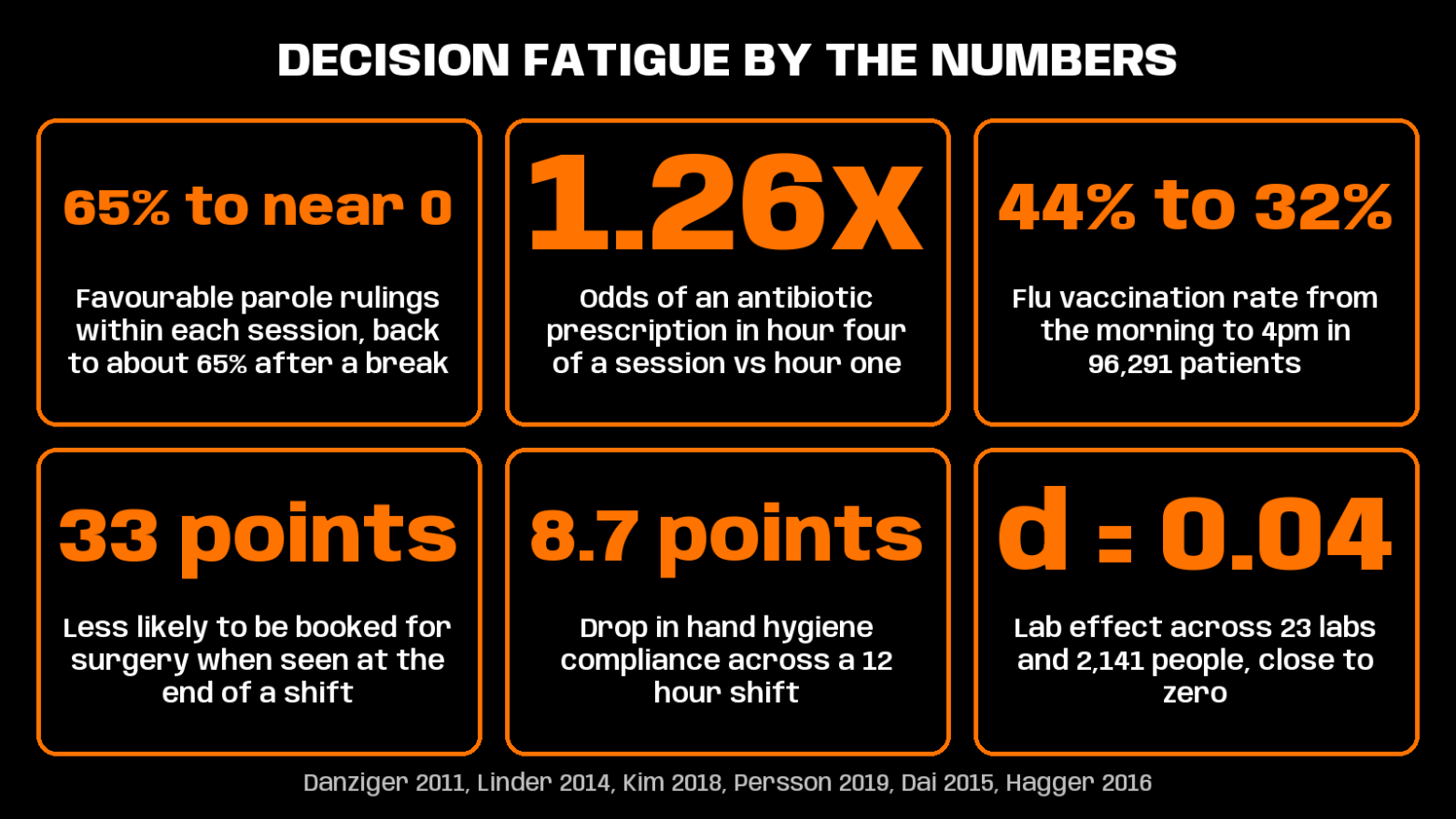
What the field studies found, and what the large lab replication found.
Is Decision Fatigue a Myth?
Not quite a myth, but much weaker than its reputation. Two large preregistered lab projects found little or no depletion effect [4][5], and a 2025 field study of 231,076 calls found no credible evidence for decision fatigue [6]. The field patterns are real, but time of day, case order and plain tiredness can explain much of them.
The first replication ran the same protocol in 23 labs with 2,141 participants and found an effect size of d = 0.04, with a 95 percent confidence interval that included zero [4]. A second project across 36 labs and 3,531 people found a nonsignificant d = 0.06, and its data were 4 times more likely under no effect than under the expected one [5].
The newest field test was designed to avoid the old traps. Researchers in Sweden studied 231,076 phone calls handled by 174 specialised nurses on a national triage line, comparing nurses at the end of a shift with nurses who had just started [6]. Their verdict was blunt: “no credible evidence for decision fatigue was found” [6].
They also explain why earlier studies may have overstated it. In their pilot data, time of day produced a pattern that “could be interpreted as decision fatigue”, but the authors judged it risky because patient mix changes through the day [6]. Later work has questioned that reading of the parole data [9], including a published letter titled “Overlooked factors in the analysis of parole decisions”, from researchers at the Israeli courts and the US Federal Judicial Center [11].
One finding is worth keeping. In the 36 lab study, exploratory tests suggested the effect was larger in people who reported more fatigue [5]. So the useful takeaway is not that every choice drains a tank. It is that a tired man, at the end of a long run of demanding work, tends to make lazier calls.
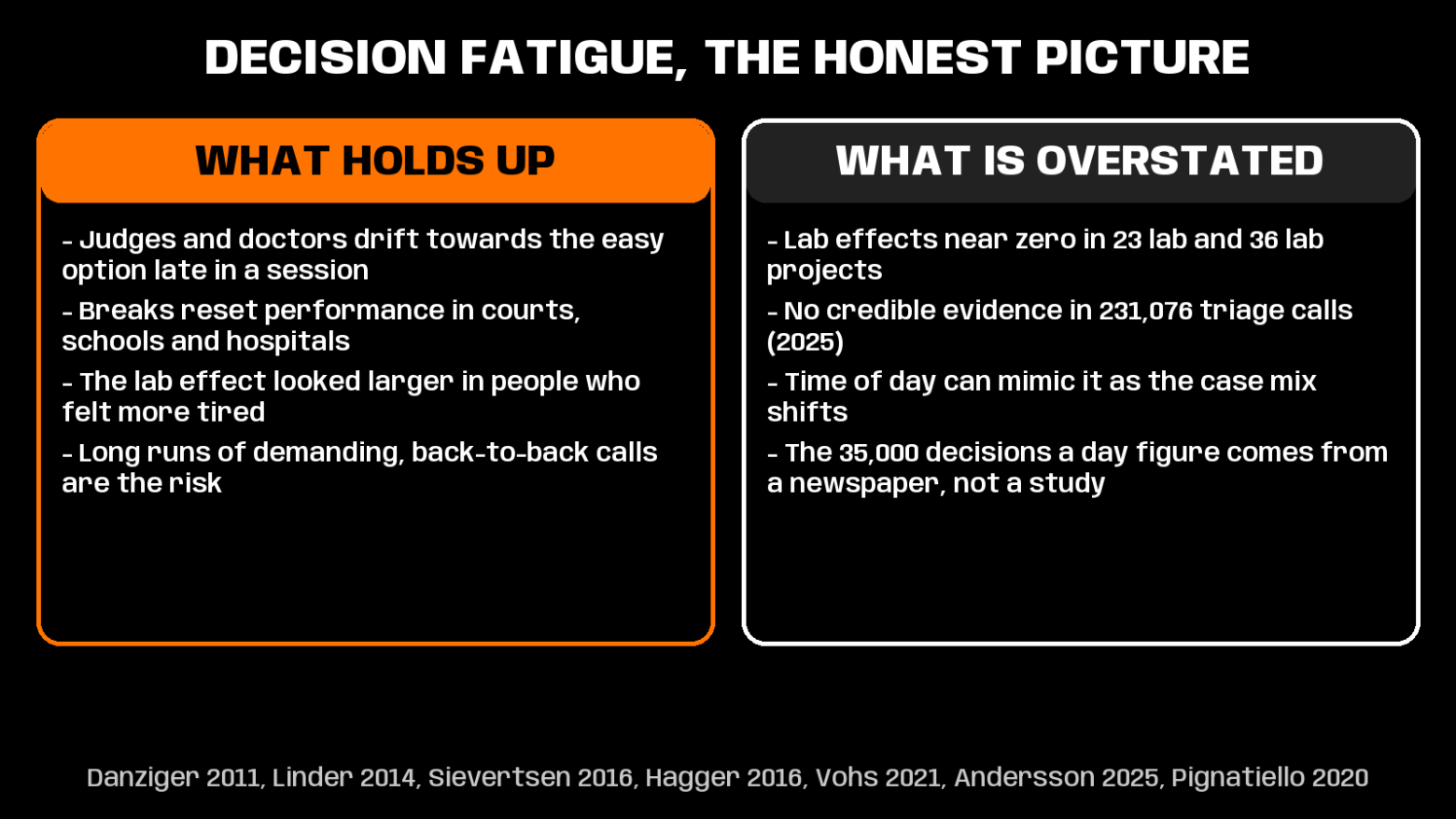
What holds up about decision fatigue, and what has been overstated.
Do You Really Make 35,000 Decisions a Day?
Nobody has measured it. The figure is widely repeated, including in the 2020 concept analysis, which states that “It is estimated that an American adult makes 35,000 decisions a day” [1]. The source it cites is a 2016 Wall Street Journal article, a newspaper piece rather than a research study [1]. Treat the number as a slogan, not a statistic.
This matters because the big number makes decision fatigue sound inevitable. If every blink were a decision, no routine could protect you. The field studies point to something narrower and more useful: long runs of effortful, back-to-back judgements, like a judge’s docket, a clinic list or a 12 hour shift [2][3][10].
Most of a man’s day is not like that. Choosing a shirt, a coffee or a route to work costs very little. The decisions worth protecting are the ones that need you to weigh trade-offs, which is one of the three features the concept analysis lists [1].
What Are the Signs of Decision Fatigue in Men?
The signs are behavioural, not medical. The concept analysis lists three: struggling to weigh trade-offs, preferring a passive role and making choices that seem impulsive [1]. Field studies add a fourth, drifting towards the safe default, like a judge denying parole or a surgeon choosing not to operate [2][9]. Spot these late in a long day, then change the setup.
In daily life that looks familiar. You put off a decision you would have made in the morning, you say yes to whatever is put in front of you or you buy the first thing you see. Researchers describe the default pull as making people “more prone to choosing the status quo” [9].
There is a simpler explanation worth ruling out first. Plain tiredness and lack of sleep also hurt judgement, and the concept analysis lists sleep deprivation and physiological fatigue among the causes [1]. If the signs show up every day, look at your sleep before you blame your decisions. Our guide to sleep debt covers what short nights cost.
Beliefs play a part too. In a set of studies, people who saw willpower as unlimited did not show reduced self-control after a demanding task [12]. A man who expects to crash after a hard day may give himself permission to.
How Do Men Avoid Decision Fatigue?
Arrange your day so the decisions that matter happen when you think best. Make big calls early, set defaults for small ones, take real breaks, batch the rest and protect your sleep. These steps help whether decision fatigue is a distinct effect or ordinary tiredness, because parole rulings recovered after breaks [2] and pupils scored higher earlier in the day and after a break [7].
**Step 1: make the big calls early.** Put the decisions that need trade-offs into the first hours of your working day. Vaccination rates were about 44 percent in the morning and 32.0 percent by 4pm [8], and pupils scored 0.9 percent of a standard deviation lower for every hour later they sat a test [7].
**Step 2: set defaults for small choices.** Decide once, then stop deciding. Barack Obama explained his grey or blue suits to the writer Michael Lewis: “I’m trying to pare down decisions. I don’t want to make decisions about what I’m eating or wearing. Because I have too many other decisions to make” [13]. Fixed meals, a set gym slot and a standard reply to routine requests all work the same way.
Defaults also cut the pull of distractions. Our guide to intentional friction covers how adding small barriers removes choices you never wanted to make.
**Step 3: take real breaks.** A 20 to 30 minute break lifted pupils’ test scores by 1.7 percent of a standard deviation [7]. Favourable parole rulings returned to about 65 percent after each food break [2], and longer breaks between hospital shifts improved hand hygiene compliance [10].
**Step 4: batch and time-box decisions.** Group similar choices into one slot instead of answering them as they arrive. The antibiotic study’s authors suggested remedies including “modified schedules, shorter sessions, mandatory breaks, or snacks” [3]. Our guide on how men manage their time better shows how to build those blocks into a week.
**Step 5: protect sleep and food.** Sleep deprivation and physiological fatigue are listed among the causes of impaired decisions [1], and the judges’ sessions reset after food breaks [2]. A man running on short nights and skipped meals will make worse calls by mid-afternoon, whatever the theory.
Hold the plan lightly on one point. The lab evidence is weak [4][5], so do not treat every evening as a write-off. Expect to think a bit less sharply late in the day, and build around it.
FAQ
Is decision fatigue the same as being tired?
Not exactly, but they overlap. The concept analysis says decision fatigue can come with mental fatigue, but it also covers trouble regulating emotions [1]. In a 36 lab study, the effect looked larger in people who reported more fatigue [5]. In everyday life, separating the two is hard, so treat rest as part of the fix.
Does eating help with decision fatigue?
Possibly, though the evidence is indirect. Favourable parole rulings returned to about 65 percent after the judges’ food breaks [2], and the antibiotic study’s authors listed snacks among possible remedies [3]. No study here isolates food from rest, so take the break and eat sensibly.
How long does it take to recover from decision fatigue?
A short break seems to help. In Danish schools, a 20 to 30 minute break improved average test scores [7]. In hospitals, longer breaks between shifts lifted hand hygiene compliance afterwards [10]. For a run of long days, a full night’s sleep matters more than a coffee.
Does wearing the same clothes every day really help?
It removes a decision, but no study here tests it directly. Barack Obama said he wore only grey or blue suits to pare down decisions [13]. The broader point is sound: settle trivial choices once so your attention is free for the ones with real trade-offs.
Is decision fatigue a medical condition?
No. It is a psychology concept, not a diagnosis, and the concept analysis calls it “a relatively nascent concept” [1]. If you feel constantly drained, struggle to decide anything or your mood is low for weeks, speak to your GP rather than putting it down to decision fatigue.
Do some men suffer from it more than others?
Beliefs seem to matter. People who saw willpower as unlimited did not show reduced self-control after a demanding task [12]. Workload matters too: the drop in hand hygiene compliance across a shift was larger when work was more intense [10]. Long, dense days are the risk, not personality.
Final Recommendation
Treat decision fatigue as a useful warning rather than settled science. The field patterns are real [2][3][8], the lab effect is close to zero [4][5] and the newest field test found no credible evidence for it [6]. Either way, the fix is the same: decide the big things early, settle small things once and take proper breaks.
If your judgement feels off every day, check your sleep first, because sleep deprivation is implicated in impaired decision-making [1], then look at your workload.
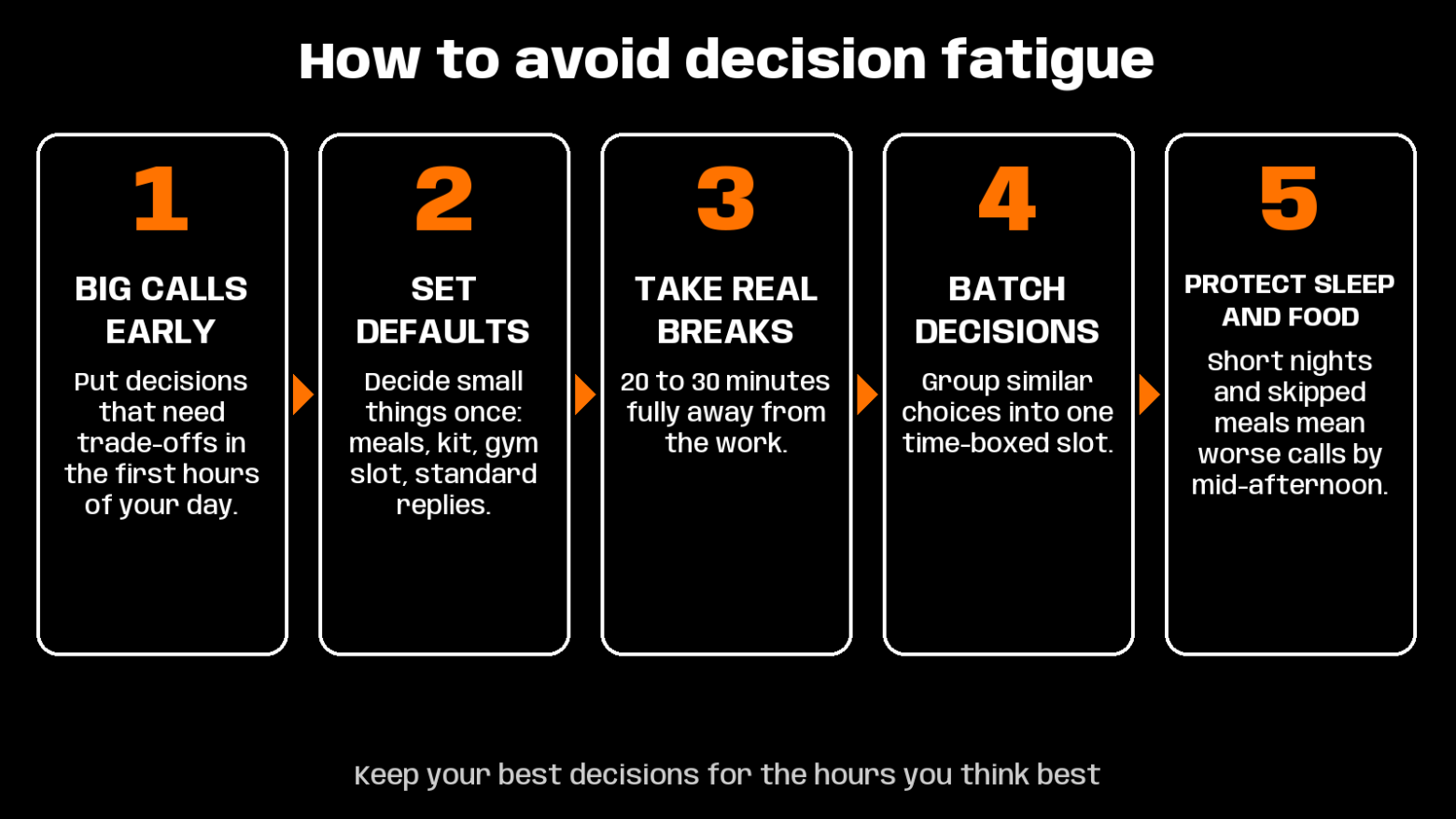
Five steps to keep your best decisions for the hours you think best.
Options for Men to Take Action
Most men do not make bad calls because they lack judgement. They make them because the day has no structure, the big decision lands at 6pm and every small choice is made fresh, over and over.
The MenTools app runs challenges across mindset, fitness, nutrition and money, with levels you choose, daily actions, streak and progress tracking, journals and an AI coach. For this guide, its job is turning your defaults into daily actions, so the routine decides and you do not have to.
How you can do this today: pick one default, such as a fixed morning block for your biggest decision, add it as a daily action at the easiest level and track it for two weeks.
Wins on cost: one subscription covers habit tracking, journals and coaching, instead of several apps.
Wins on time: the challenges are already built, so you spend your energy on the decisions that matter rather than designing a system.
Wins on practicality: each action takes minutes and fits around work, shifts and family, and the streak makes a missed day obvious.
Watch-out: the app prompts and tracks, but it cannot tell you which decisions matter most or make them for you. It records what you log, so the judgement is still yours.
Steady energy underpins clear thinking, so a one a day multivitamin may help cover the simple daily foundation under a long working day. For more on structuring your time, the MenTools time management hub collects everything in one place. Decide less, and decide better.
Last updated: 2026-11-10 v1.0
Disclaimer: This guide is for informational purposes only and does not constitute medical or psychological advice. Speak with a qualified professional before making significant changes if you have a medical or mental health condition.
References
- [1] Pignatiello GA, Martin RJ, Hickman RL Jr. Decision fatigue, a conceptual analysis. Journal of Health Psychology, 2020;25(1):123-135. Link
- [2] Danziger S, Levav J, Avnaim-Pesso L. Extraneous factors in judicial decisions. Proceedings of the National Academy of Sciences, 2011;108(17):6889-6892. Link
- [3] Linder JA, Doctor JN, Friedberg MW, et al. Time of day and the decision to prescribe antibiotics. JAMA Internal Medicine, 2014;174(12):2029-2031. Link
- [4] Hagger MS, Chatzisarantis NLD, Alberts H, et al. A multilab preregistered replication of the ego-depletion effect. Perspectives on Psychological Science, 2016;11(4):546-573. Link
- [5] Vohs KD, Schmeichel BJ, Lohmann S, et al. A multisite preregistered paradigmatic test of the ego-depletion effect. Psychological Science, 2021;32(10):1566-1581. Link
- [6] Andersson D, Lindberg M, Tinghog G, Persson E. No evidence for decision fatigue using large-scale field data from healthcare. Communications Psychology, 2025;3:32. Link
- [7] Sievertsen HH, Gino F, Piovesan M. Cognitive fatigue influences students’ performance on standardized tests. Proceedings of the National Academy of Sciences, 2016;113(10):2621-2624. Link
- [8] Kim RH, Day SC, Small DS, et al. Variations in influenza vaccination by clinic appointment time and an active choice intervention in the electronic health record to increase influenza vaccination. JAMA Network Open, 2018;1(5):e181770. Link
- [9] Persson E, Barrafrem K, Meunier A, Tinghog G. The effect of decision fatigue on surgeons’ clinical decision making. Health Economics, 2019;28(10):1194-1203. Link
- [10] Dai H, Milkman KL, Hofmann DA, Staats BR. The impact of time at work and time off from work on rule compliance, the case of hand hygiene in health care. Journal of Applied Psychology, 2015;100(3):846-862. Link
- [11] Weinshall-Margel K, Shapard J. Overlooked factors in the analysis of parole decisions. Proceedings of the National Academy of Sciences, 2011;108(42):E833. Link
- [12] Job V, Dweck CS, Walton GM. Ego depletion, is it all in your head? Implicit theories about willpower affect self-regulation. Psychological Science, 2010;21(11):1686-1693. Link
- [13] Lewis M. Obama’s Way. Vanity Fair, October 2012. Link