No products in the cart.
Return To Shop
MEN: Does a Dopamine Detox Actually Work, or Is It a Myth?
Quick Answer
The chemistry is a myth and the behaviour change is real. Avoiding stimulation does not lower or reset your dopamine [1][2]. Taking a deliberate break from one compulsive habit can still help, because it removes the cue that keeps the habit firing. A month off Facebook improved well-being in a 2,743 person study [6].
**Jump to:** The verdict | The evidence | FAQ | Options for men
Disclosure: MenTools publishes this article and may feature MenTools products.
How we evaluate: Each recommendation is assessed on real-world use, evidence, cost and time, and how well it suits men. Every recommendation including the MenTools option carries an honest limitation. Full sources are in the references below.
Dopamine Detox at a Glance
Most of what is sold as a dopamine detox fails on the science, and one part of it holds up well. The claims about draining, lowering or resetting dopamine have no support [1][2]. The claim that a planned break from one specific habit can weaken it has decent evidence behind it, as long as you target the cue and not your brain chemistry [3][6][8].
| Claim | Verdict | What the evidence shows | Watch-out |
|---|---|---|---|
| A detox lowers your dopamine | Myth | Dopamine does not fall when you avoid stimulation [1] | Your brain needs it to move and sleep [3] |
| A day of nothing resets your brain | Myth | No trial shows a 24 hour reset [2] | Boredom is not a treatment |
| Breaks from one habit can help | Supported | A month off Facebook raised well-being 0.09 SD [6] | Small effect, and studies are mixed [5] |
| Removing the cue works | Supported | A pause screen cut app openings 57 percent [8] | Works only on the habit you target |
| A month off resets reward | Clinical view | Used by a Stanford addiction psychiatrist [4] | Not safe for alcohol, benzo or opioid withdrawal [4] |
What Is a Dopamine Detox Supposed to Do?
A dopamine detox is a period of avoiding stimulating things, usually phones, social media, games, junk food and sometimes conversation, in the belief that it lowers dopamine and makes ordinary life feel rewarding again. The popular version treats dopamine as a fuel tank you have overfilled. That belief is where the trend goes wrong [1][2].
The term grew out of a 2019 idea from California psychologist Cameron Sepah, who called it dopamine fasting. He meant it as a behavioural method rather than a chemical one. As he put it, “Dopamine is just a mechanism that explains how addictions can become reinforced, and makes for a catchy title. The title’s not to be taken literally” [1].
Sepah named six compulsive behaviours his method was aimed at: emotional eating, excessive internet use and gaming, gambling and shopping, porn and masturbation, thrill and novelty seeking, and recreational drugs [1]. Avoiding eye contact, talking or music was never part of the original idea. Those extreme versions came later, from social media.
Can You Actually Lower or Reset Your Dopamine?
No. Dopamine rises in response to rewards, but it does not drop when you avoid stimulating activities, so a fast does not lower it. Harvard Health put it plainly, noting that dopamine “doesn’t actually decrease when you avoid overstimulating activities” [1]. Neurons keep producing it whatever you do with your weekend.
Neuroscientists interviewed by The Scientist were blunter. Stephanie Borgland at the University of Calgary said, “Dopamine fasting is probably not going to really do anything for you” [2]. Talia Lerner at Northwestern added that the name “is a weird, catchy thing that rubs scientists the wrong way” [2].
Part of the problem is that dopamine is not one switch. The human brain has roughly 400,000 to 600,000 dopamine neurons out of more than 80 billion, working through five receptor subtypes, with different jobs in different regions [2]. Cleveland Clinic psychologist Susan Albers points out that “We need dopamine in every system in our body” [3].
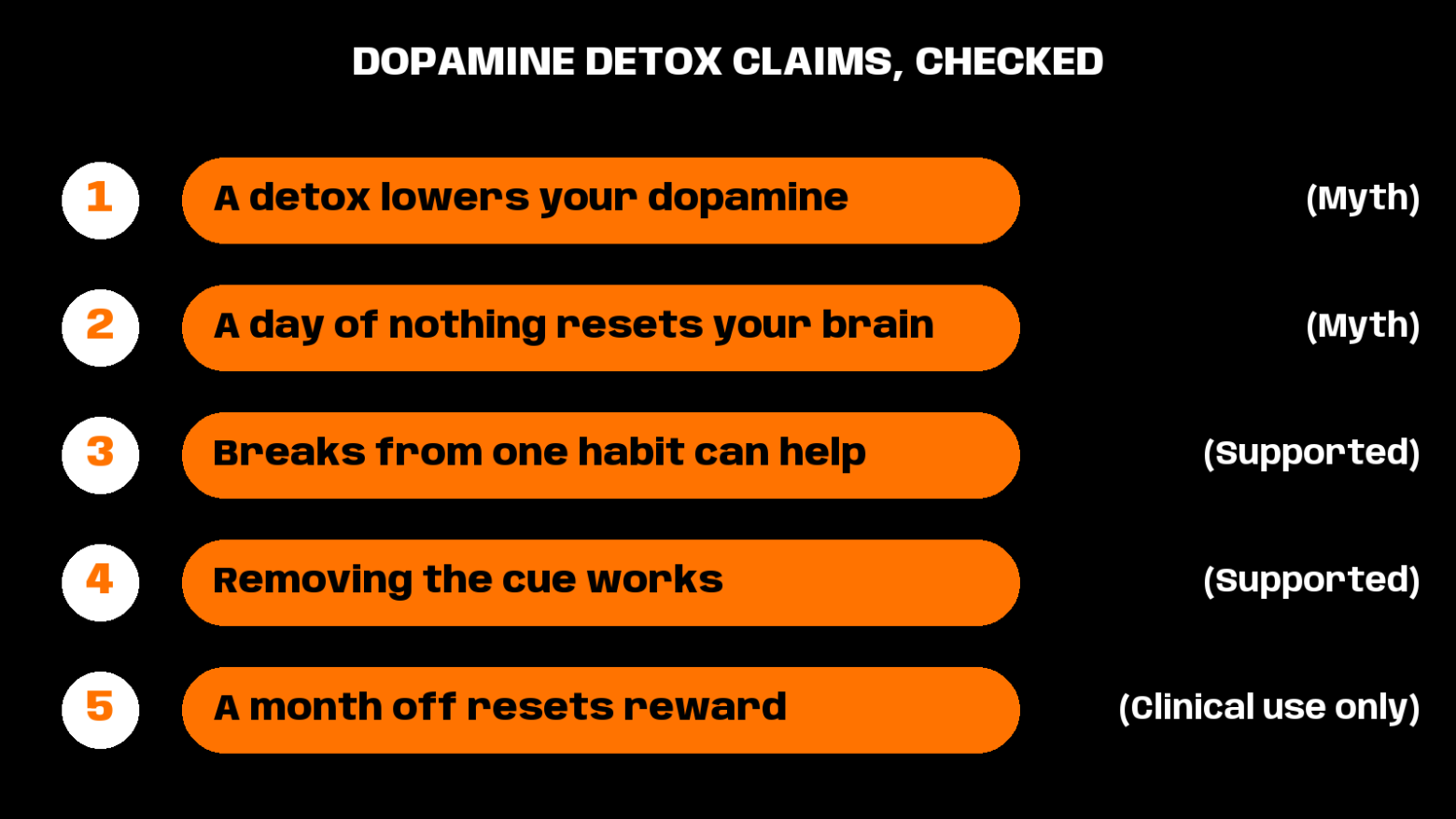
Two claims fail on the science, two hold up, and one belongs with a clinician.
Is Dopamine the Pleasure Chemical?
Not really, and that is the second myth inside the trend. Research led by Kent Berridge and Terry Robinson at the University of Michigan shows dopamine mainly drives wanting, the pull towards a reward, rather than liking, the pleasure of having it [10]. That is why you can keep scrolling long after it stopped being enjoyable.
Dopamine is clearly involved in screen habits. A 1998 brain imaging study in Nature found evidence of dopamine release in the striatum while volunteers played a video game, and the size of the release tracked how well they were scoring [9]. The release is real. What is not real is the idea that a quiet day drains it.
The wanting and liking split also explains why the detox feels like it works. When you stop a habit, the craving fades over time because the cue stops being paired with the reward. That is learning, not a chemical tank refilling, and learning can be targeted directly.
Do Digital Detox Studies Show Any Benefit?
Some do, but the overall picture is mixed. A 2022 systematic review by Radtke and colleagues covered 21 studies, 12 of them randomised trials, with 3,625 participants and breaks lasting from 24 hours to four weeks. Some found benefits, others found no effect, and some found negative effects on well-being [5].
The strongest single result came from economists at Stanford and New York University. Allcott and colleagues recruited 2,743 Facebook users and randomly paid part of the eligible group to deactivate for four weeks. It freed up about 60 minutes a day, and subjective well-being improved by 0.09 standard deviations [6].
That number needs context. The authors estimated it at about 25 to 40 percent of the effect of psychological interventions such as self-help therapy and group training [6]. It is a real gain, not a transformation, and nothing in the study relied on dopamine.
The detail that matters most for men is what happened afterwards. Deactivation caused a large and persistent fall in Facebook use after the experiment ended, and people valued the platform less [6]. The break worked by changing the habit and the perceived reward, which is exactly what Sepah said his method was for.
Why Do Men Feel Better After a Break, Then?
Because the break removes the trigger, frees up time and lets the craving fade. A 2025 trial in PNAS Nexus blocked mobile internet on 467 adults’ phones for two weeks. Daily screen time fell from 314 to 161 minutes, and 91 percent improved on at least one measure of attention, mental health or well-being [7].
The first weeks are usually the hardest part. Stanford psychiatrist Anna Lembke, who asks patients to give up their main compulsion for a month, says they “feel horrible in the first two weeks” [4]. She tells them plainly, “I warn them that they are going to feel worse before they feel better” [4].
That rough patch is often mistaken for proof that a detox is flushing something out. It is closer to withdrawal from a habit. Lembke describes the usual symptoms of withdrawal from any addictive behaviour as anxiety, irritability, insomnia, dysphoria and craving [4], which tend to ease if the break holds.
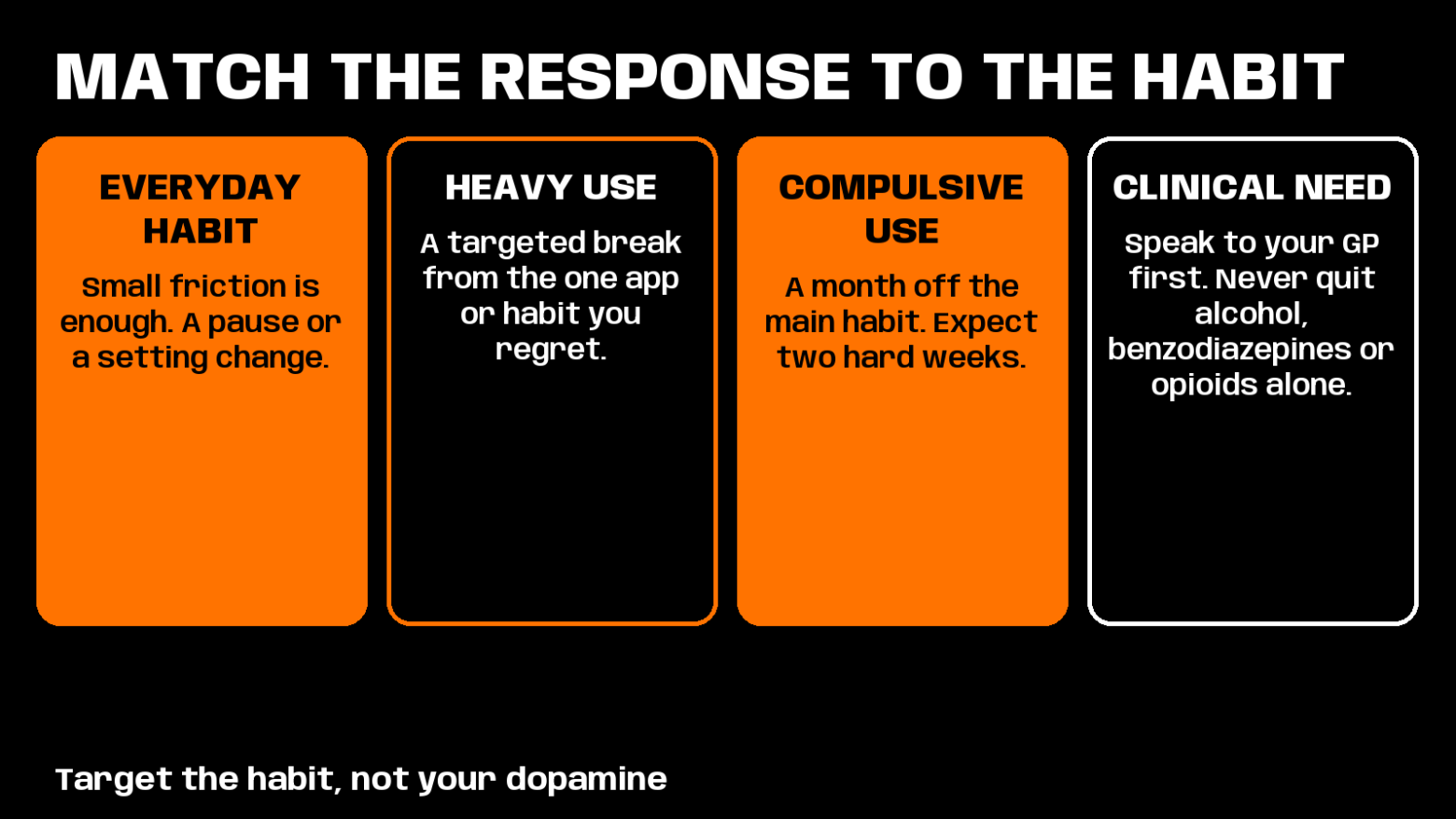
Match the response to the habit, not to a trend.
When Is a Month Off Worth Trying?
When one habit has clearly taken over and cutting back keeps failing. Lembke’s view from clinic is that moderation rarely works at first. “It’s much harder in real life to go from using a lot to using less than it is to go from using a lot to using none,” she told NPR [4]. A full month off resets the habit, then you decide what returns.
She is equally clear about the limits. “I would never do this in somebody who is at risk for life-threatening withdrawal from alcohol or benzos or opioids,” Lembke said [4]. She also would not recommend it for someone with a very severe addiction who had repeatedly failed to stop alone [4]. In those cases, start with your GP.
For screens, games, porn or junk food, a month off one habit is low risk and easy to judge. Pick the single habit you regret most, not everything at once. Cutting every pleasure together is the version that collapses by Wednesday and teaches you that you lack willpower, which is the wrong lesson.
What Works Better Than a Dopamine Detox?
Targeting the cue for one habit works better than avoiding stimulation in general. This is stimulus control, a standard technique from cognitive behavioural therapy and the real core of Sepah’s idea [1]. In a 2023 PNAS study of the one sec app, a short pause before opening a chosen app cut actual openings by 57 percent over six weeks [8].
The same study found that 36 percent of attempts to open a target app ended with the user closing it once the pause appeared [8]. That is a large change in behaviour from a few seconds of delay, with no weekend of staring at a wall required. It is the idea behind intentional friction, which makes the habit you want less of slightly harder to start.
Albers describes the skill underneath all of this as learning, often with a therapist’s help, “to be comfortable with uncomfortable feelings” [3]. Most compulsive scrolling starts as a way out of boredom, stress or tiredness. The break gives you room to notice that, and the noticing is what lasts.
Plan for the change to take weeks rather than a weekend. Lally and colleagues found that a new daily behaviour took a median of 66 days to become automatic, with a range of 18 to 254 days [11]. If the target habit is the phone, how long it takes to rebuild your attention span sets out the timeline in detail.
Is a Dopamine Detox Harmful?
The mild versions are not harmful, but the extreme ones can backfire. Harvard Health warned that some followers were cutting out conversation, eye contact and exercise, which means “depriving themselves of healthy things, for no reason, based on faulty science” [1]. Removing human contact was never part of the original method.
The bigger risk is the wrong conclusion. A man who fails a strict detox often decides he has no discipline, when the plan was simply badly designed. Neuroscientist Nandakumar Narayanan at the University of Iowa also warned that “There are dangers in messing with this system” [2], which is a reason to change behaviour, not to chase brain chemistry.
There is also a practical cost to the phone being nearby during any break. Ward and colleagues found that the mere presence of your own smartphone on the desk reduced available working memory, even when it was switched off [12]. A detox with the phone still on the table is fighting the cue all day.
FAQ
Is dopamine detox a real thing?
As a chemical reset, no. Dopamine does not fall when you avoid stimulation, so you cannot detox from it [1]. As a planned break from one compulsive habit, yes, it is a real behavioural method. Its creator says the name was a catchy title and was never meant to be taken literally [1].
How long should a dopamine detox last?
For one stubborn habit, about a month. Stanford psychiatrist Anna Lembke asks patients to stop their main compulsion for a month and warns that the first two weeks feel worse [4]. Shorter breaks can still help, and the Facebook study found benefits after four weeks [6].
What should you not do during a dopamine detox?
Do not cut out healthy things such as exercise, sleep, conversation or time outdoors. Harvard Health warned that the extreme versions deprive people of good habits for no reason [1]. Stop only the one habit you are targeting, and replace it with something you actually want more of.
Does a dopamine detox help with porn or gaming?
A structured break can help with both, and both were on the original list of target behaviours [1]. Video games do trigger dopamine release in the striatum [9], but the benefit of a break comes from breaking the cue and reward pairing, not from lowering dopamine. Severe compulsive use deserves professional support.
Why do I feel worse during a dopamine detox?
You are likely in withdrawal from the habit, not flushing anything out. Lembke says patients feel horrible in the first two weeks and lists anxiety, irritability, insomnia, dysphoria and craving as common symptoms [4]. These usually ease if the break holds, so judge it at four weeks, not four days.
Can a dopamine detox improve focus?
A targeted break from phone use can. In a 467 person trial, two weeks without mobile internet cut daily screen time from 314 to 161 minutes, and 91 percent improved on at least one measure including attention [7]. The gain came from less distraction rather than from a dopamine change.
Is it safe to do a dopamine detox from alcohol?
Not on your own if you drink heavily or daily. Lembke said she would never ask someone at risk of life-threatening withdrawal from alcohol, benzodiazepines or opioids to stop abruptly without support [4]. Speak to your GP first. Screens, games and junk food are the low-risk targets.
Final Recommendation
Drop the dopamine story and keep the method underneath it. You cannot lower or reset your dopamine by avoiding stimulation [1][2]. You can weaken one compulsive habit by cutting its cue for a few weeks, which is what the break studies actually measured [6][7][8].
Choose one habit, not your whole life. Put a barrier in front of it, expect two hard weeks, judge the result at four and give the new default about two months to stick [4][11]. If the habit involves alcohol or prescription drugs, or keeps beating you, take it to your GP.
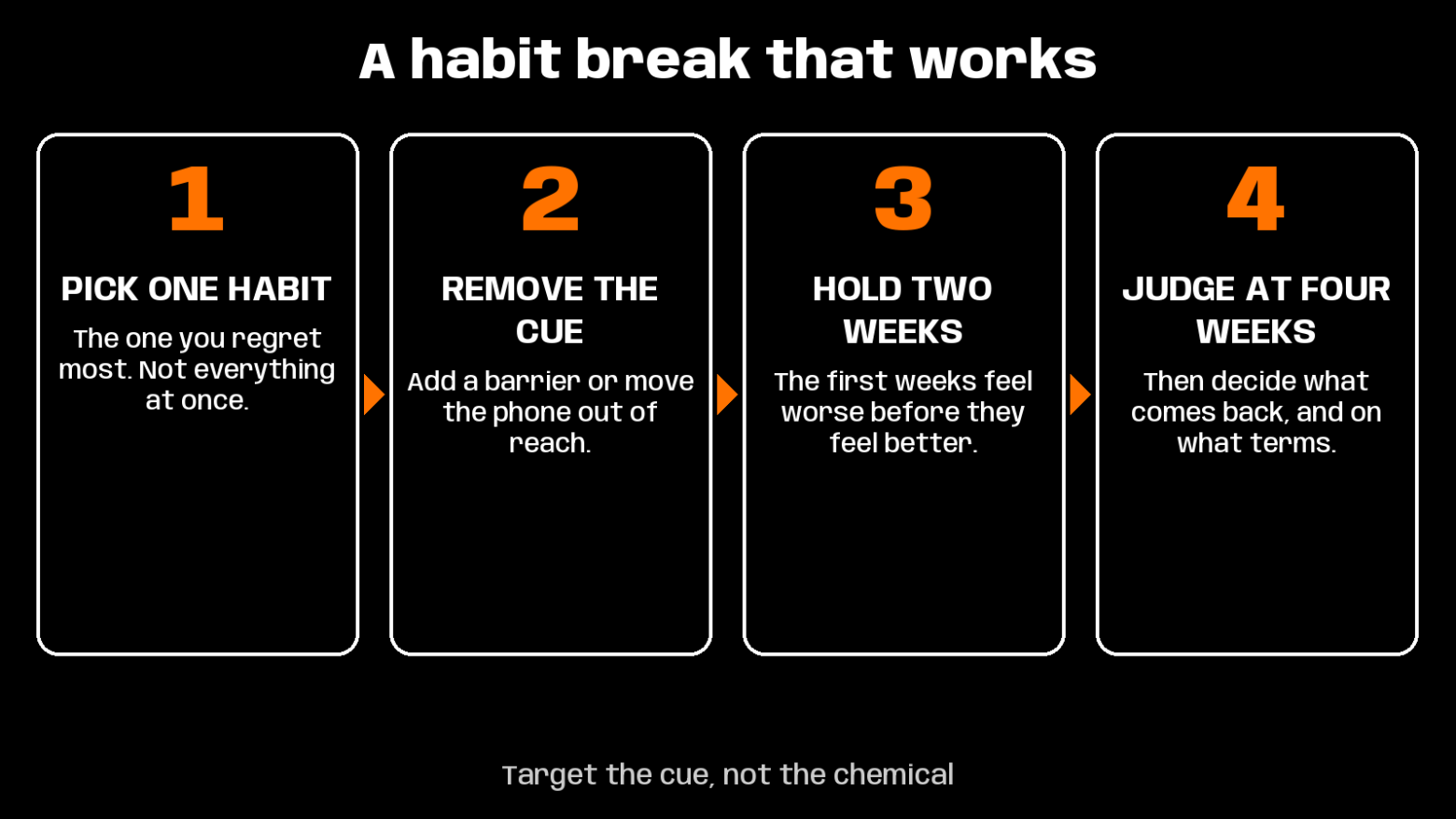
Target the cue, not the chemical, and judge it at four weeks.
Options for Men to Take Action
Most men try a dopamine detox the same way. They cut everything on a Sunday, feel flat and restless by Tuesday and are back on the phone by Thursday, because nothing replaced the habit and nothing tracked whether the break was holding.
The MenTools app runs focus as a challenge alongside mindset, fitness, nutrition and money, with daily actions, levels you choose, reminders, streak and progress tracking, and an AI coach. Its job here is narrow, which is keeping one replacement habit in place each day while the old one fades.
How you can do this today: pick the one habit you regret most, decide what you will do instead when the urge hits and log that replacement as your daily action.
Wins on cost: one subscription covers focus, sleep and training together, instead of a blocker, a meditation app and a habit tracker paid for separately.
Wins on time: the challenge structure already exists, so the month starts today rather than after a weekend of planning.
Wins on practicality: a daily action takes minutes and fits around work and family, which is where strict detox plans usually break.
Watch-out: it is a habit and consistency tool, not a phone blocker or a treatment for addiction. It will not stop you opening an app, so pair it with at least one real barrier on the phone itself.
Restless, flat first weeks are harder to get through on poor sleep and a patchy diet, so a one a day multivitamin may help cover the simple daily foundation underneath the behaviour work. For more built for men on attention and the phone, see the MenTools focus hub, and if porn is the habit in question, what porn does to the brain covers that evidence. If the phone is the target, the 7 day plan for breaking the scrolling habit is a practical first week. The habit changes when the cue does, and a month is long enough to prove it.
Last updated: 2026-10-08 v1.0
Disclaimer: This guide is for informational purposes only and does not constitute medical or psychological advice. Speak with a qualified professional before making significant changes if you have a medical or mental health condition.
References
- [1] Grinspoon P. Dopamine fasting, misunderstanding science spawns a maladaptive fad. Harvard Health Publishing, 26 February 2020. Link
- [2] Thomasy H. Debunking the dopamine detox trend. The Scientist, 31 July 2024, updated 31 January 2025. Link
- [3] Cleveland Clinic. What is a dopamine detox and does it work? With psychologist Susan Albers, PsyD. Link
- [4] NPR Life Kit. Break the cycle of addiction with these strategies to keep dopamine in check, with Dr Anna Lembke. 4 April 2022. Link
- [5] Radtke T, Apel T, Schenkel K, Keller J, von Lindern E. Digital detox, an effective solution in the smartphone era? A systematic literature review. Mobile Media and Communication, 2022;10(2):190-215. Link
- [6] Allcott H, Braghieri L, Eichmeyer S, Gentzkow M. The welfare effects of social media. American Economic Review, 2020;110(3):629-676. Link
- [7] Castelo N, Kushlev K, Ward AF, et al. Blocking mobile internet on smartphones improves sustained attention, mental health, and subjective well-being. PNAS Nexus, 2025;4(2):pgaf017. Summary via News Medical. Link
- [8] Grüning DJ, Riedel F, Lorenz-Spreen P. Directing smartphone use through the self-nudge app one sec. Proceedings of the National Academy of Sciences, 2023;120(8):e2213114120. Link
- [9] Koepp MJ, Gunn RN, Lawrence AD, et al. Evidence for striatal dopamine release during a video game. Nature, 1998;393:266-268. Link
- [10] Robinson TE, Berridge KC. The incentive-sensitization theory of addiction 30 years on. Annual Review of Psychology, 2025. Link
- [11] Lally P, van Jaarsveld CHM, Potts HWW, Wardle J. How are habits formed, modelling habit formation in the real world. European Journal of Social Psychology, 2010;40(6):998-1009. Link
- [12] Ward AF, Duke K, Gneezy A, Bos MW. Brain drain, the mere presence of one’s own smartphone reduces available cognitive capacity. Journal of the Association for Consumer Research, 2017;2(2):140-154. Link