No products in the cart.
Return To Shop
MEN: How Long Does It Take to Rebuild Your Attention Span?
Quick Answer
Measurable gains can arrive within days and are clear by two weeks. In one trial, two weeks without mobile internet improved sustained attention by the equivalent of ten years of age related decline [1]. Making that focus permanent takes longer, because the new habits behind it took a median of 66 days to become automatic [7].
**Jump to:** The timeline | The evidence | FAQ | Options for men
Disclosure: MenTools publishes this article and may feature MenTools products.
How we evaluate: Each recommendation is assessed on real-world use, evidence, cost and time, and how well it suits men. Every recommendation including the MenTools option carries an honest limitation. Full sources are in the references below.
Rebuilding Your Attention Span at a Glance
Attention responds quickly and settles slowly. The research points to three stages. The first few days remove the drain, the first two weeks produce a measurable gain, and the following two months turn the change into a default you no longer have to fight for [1][4][7].
| Stage | Timeframe | What the research shows | Watch-out |
|---|---|---|---|
| Remove the drain | Days 1 to 3 | Phone presence alone costs working memory [8] | Feels worse before it feels better |
| First measurable gain | Day 4 to week 2 | Four days of brief training improved attention [4] | Gains fade if the drain returns |
| Clear improvement | Weeks 2 to 4 | Two weeks off mobile internet improved attention [1] | Only 119 of 467 kept the block 10 days [1] |
| New default | Months 2 to 3 | Median 66 days for a habit to become automatic [7] | The range was 18 to 254 days [7] |
Is Your Attention Span Actually Shrinking?
On screens, yes, and the decline is measured rather than assumed. Gloria Mark at the University of California, Irvine has tracked how long people stay on one screen before switching. It was two and a half minutes in 2004, 75 seconds by 2012, and 47 seconds in more recent measurements [2].

Measured screen attention in the workplace, not a guess about anyone’s brain.
That is not the same as your brain losing the ability to focus. The figure measures a habit of switching, in a working environment full of tabs, alerts and messages. Habits can be retrained, which is why the rest of this article is about time rather than damage.
It is also worth killing the most quoted number in this debate. The claim that adults now have an eight second attention span, shorter than a goldfish, has no research behind it, yet a King’s College London survey found 50 percent of UK adults believed it, against 25 percent who knew it was false [9].
How Long Before You Notice a Difference?
Often within the first week. Zeidan and colleagues found that four days of mindfulness training, at 20 minutes a day, improved sustained attention, working memory and executive function compared with a control group [4]. That is one of the quickest published gains for a trained attention skill in healthy adults.
The first few days rarely feel like progress. Removing the constant hits of a phone usually feels restless before it feels calm, because the habit of switching keeps firing for a while after the reward has gone.
The mind also wanders more than most men realise. Killingsworth and Gilbert sampled 2,250 adults through a phone app and found their minds were elsewhere 46.9 percent of the time. Their conclusion was that “a human mind is a wandering mind, and a wandering mind is an unhappy mind” [6].
What Changes After Two Weeks?
This is where the strongest evidence sits. Castelo and colleagues randomised 467 adults, average age 32, to block mobile internet on their phones for two weeks while keeping calls and texts. Sustained attention improved by an amount the authors equated to reversing ten years of age related decline [1].
Attention was one of three gains. The same trial found improvements in mental health and subjective well-being, and 91 percent of participants improved on at least one of the three outcomes [1]. Daily screen time in the blocking group fell from 314 minutes to 161 minutes [1].
Adrian Ward, one of the authors, described the question behind the trial plainly: “Our big question was, are we adapted to deal with constant connection to everything all the time?” [1]. Two weeks with less of that connection was enough to show up on objective tests.
Training works on a similar timescale. Mrazek and colleagues gave students a two week mindfulness course and found it improved working memory capacity and reading comprehension on the GRE while reducing mind wandering, worth an estimated 16 percentile points on the exam [3].
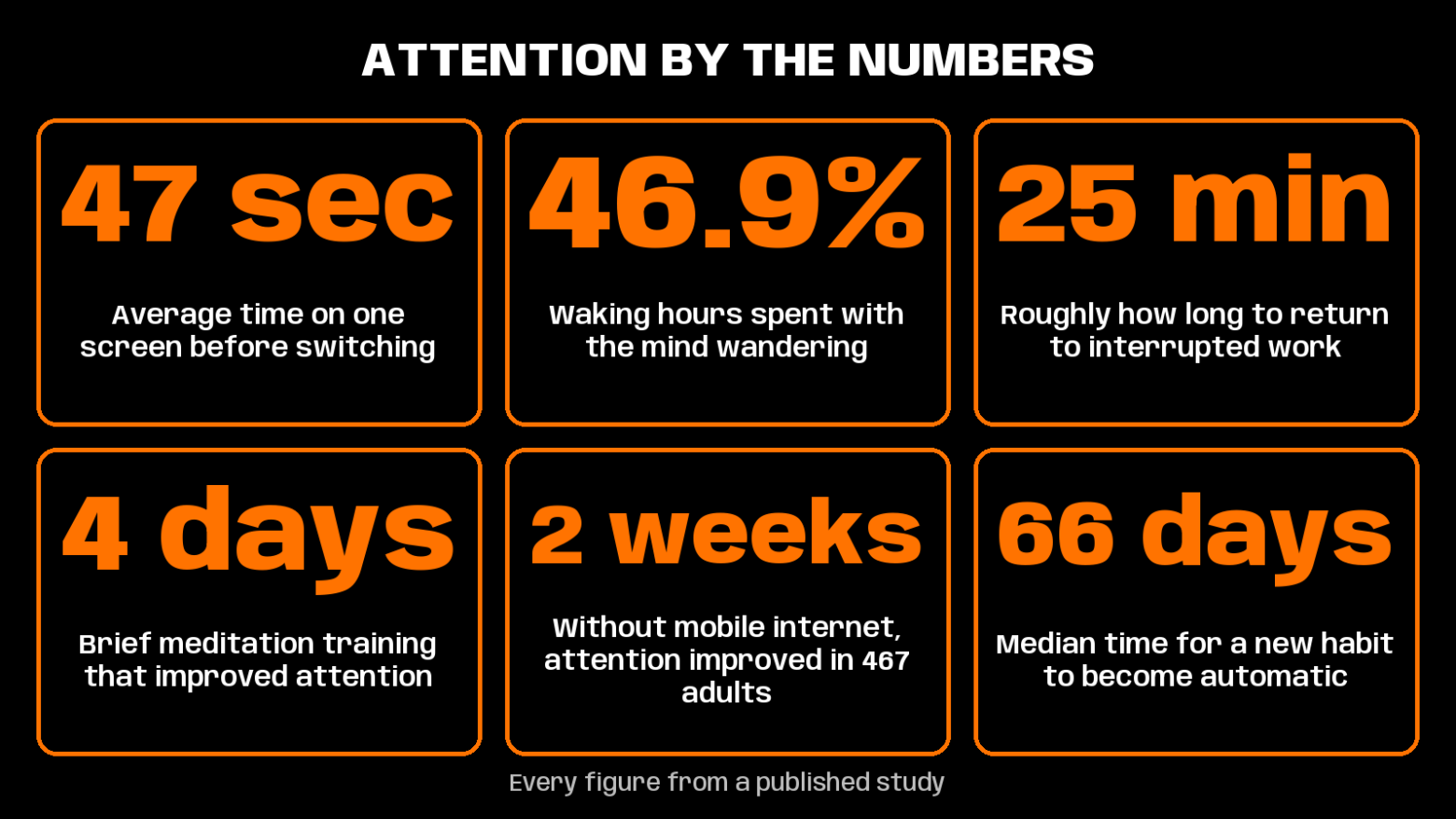
Every figure is from a published study, not an estimate.
Why Does It Take Two Months to Last?
Because the gain comes from new habits, and habits are slow to become automatic. Lally and colleagues followed 96 people adopting a new daily behaviour and found it took a median of 66 days to reach peak automaticity, with individual times ranging from 18 to 254 days [7].
Attention is built from many small habits rather than one. Where the phone sits, whether notifications are on, how you start a work block and what you do when you feel the urge to check. Each one has to become the default before the focus it protects stops needing effort.
Missing a day did not wreck progress in that study [7]. That matters for a man with a job, a family and a phone he cannot simply throw away. A bad day on Thursday does not reset the clock.
What Slows the Recovery Down?
Interruptions do, more than anything else. Mark and colleagues found that 57 percent of workplace working spheres were interrupted, and that people took an average of about 25 minutes to get back to an interrupted task [5]. A day of constant pings never gives attention a stretch long enough to rebuild.
The phone being nearby slows it too, even switched off. Ward and colleagues found that having your own smartphone on the desk reduced available working memory compared with leaving it in another room [8]. You pay a cost just for resisting it.
Adherence is the honest bottleneck. In the two week blocking trial, only 266 of 467 participants installed the blocking app and only 119 kept it running for at least ten days [1]. The benefit depends on staying with it, and most people did not, which is why the setup matters more than the motivation.
That is the idea behind intentional friction, which puts small barriers in front of the uses you regret instead of relying on a break you have to hold by willpower.
How Do You Speed Up the Rebuild?
Remove the biggest drain first, add one short daily training block, and protect longer focus periods as the weeks go on. That order follows the evidence. Removing mobile internet produced gains in two weeks [1], and brief training produced gains in four days [4].
Mark’s own advice is about noticing rather than resisting. She describes the skill as “Meta-awareness means being conscious of what you’re doing as it unfolds, catching yourself in the act, rather than running on autopilot” [2]. Catching the reach for the phone is the rep. Every catch counts.
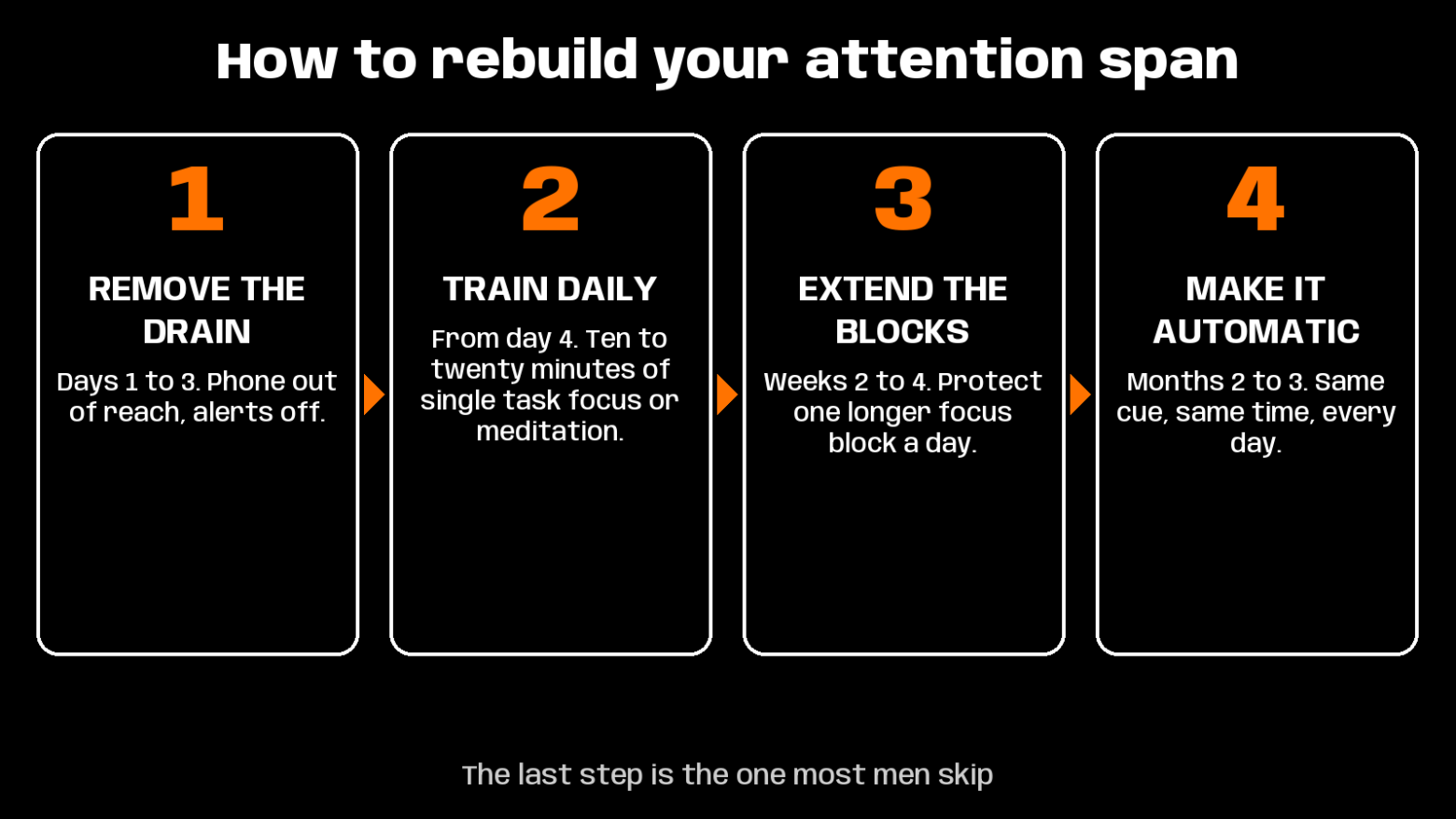
The order follows the evidence, and the last step is the one most men skip.
If the phone is the main drain, the 7 day plan for breaking the scrolling habit covers that first stage in detail. If you are starting from scratch on the training side, the beginner’s guide to focus covers the basics.
FAQ
Can you permanently damage your attention span?
There is no good evidence of permanent damage in healthy adults. The decline in screen attention is a measured habit of switching [2], and the trials above show gains within days to two weeks once the drain is reduced [1][4]. That pattern looks like a trained habit, not a broken capacity.
Is the eight second attention span real?
No. The claim that adults focus for eight seconds, less than a goldfish, has no research behind it. A King’s College London survey still found half of UK adults believed it, against a quarter who knew it was false [9]. Workplace measurements show 47 seconds per screen, which is a habit, not a ceiling [2].
Does a digital detox fix attention span?
A targeted one can. Blocking mobile internet for two weeks while keeping calls and texts improved sustained attention in a 467 person trial [1]. The catch is staying with it, because fewer than half of the people who installed the blocker kept it running for ten days [1].
How long should a focus session be when you start?
Short. Ten to twenty minutes is enough to train the skill, and the four day training study used 20 minute sessions [4]. Lengthen the block once the shorter one feels easy. Starting with a two hour session you cannot finish teaches the opposite lesson.
Does meditation actually improve focus?
Brief training has measured benefits. Four days of 20 minute sessions improved sustained attention and working memory [4], and a two week course improved working memory and reading comprehension while reducing mind wandering [3]. Both studies were small, so treat them as promising rather than settled.
Why can’t I focus even when my phone is away?
Partly habit and partly a wandering mind. People spend 46.9 percent of their waking hours thinking about something other than what they are doing [6], and the urge to switch keeps firing for days after the trigger is gone. If poor focus persists for months alongside low mood or poor sleep, talk to your GP.
Will my attention span drop again if I go back to old habits?
Very likely. The gains in the blocking trial came from changing what people did each day [1], and attention follows the environment it is trained in. That is why the final stage matters. A habit takes a median of 66 days to become automatic [7], and it needs to before you stop thinking about it.
Final Recommendation
Expect to feel a difference within the first week and to see a clear one by the end of the second. Plan for two to three months before the new focus feels normal. Those three numbers, a few days, two weeks and roughly 66 days, come from the trials rather than from optimism [4][1][7].
Start with the drain, not the discipline. Move the phone out of reach, switch off the alerts you do not need and add one short daily focus block. The research suggests that is enough to start the rebuild, and staying with it for two months is what makes it last.
Options for Men to Take Action
Most men know their focus has slipped, try a weekend detox or a new app, and drift back within a fortnight, because nothing is tracking the daily reps or reminding them when the old habit creeps back in.
The MenTools app runs focus as a challenge alongside mindset, fitness, nutrition and money, with daily actions, levels you choose, reminders, streak and progress tracking, and an AI coach. Its job here is narrow, which is keeping one daily focus block in place long enough for the two month window to do its work.
How you can do this today: choose a ten minute focus block at a fixed time, put the phone in another room for it and log it as your daily action.
Wins on cost: one subscription covers focus, sleep and training together, instead of separate blocker, meditation and habit apps.
Wins on time: the challenge structure already exists, so there is nothing to design before you start.
Wins on practicality: a ten minute block fits a commute, a lunch break or the time before the children wake up.
Watch-out: it is a habit and consistency tool, not a phone blocker or a treatment. It will not stop you opening an app, so pair it with at least one real barrier on the phone itself.
A flat afternoon is harder to out-plan than to prevent, and focus is the first thing to go when energy dips, so a one a day multivitamin may help cover the simple daily foundation underneath the behaviour work. For more built for men on attention and the phone, see the MenTools focus hub. Two weeks will show you it works, and two months will make it yours.
Last updated: 2026-10-07 v1.0
Disclaimer: This guide is for informational purposes only and does not constitute medical or psychological advice. Speak with a qualified professional before making significant changes if you have a medical or mental health condition.
References
- [1] Castelo N, Kushlev K, Ward AF, et al. Blocking mobile internet on smartphones improves sustained attention, mental health, and subjective well-being. PNAS Nexus, 2025;4(2):pgaf017. Summary via News Medical. Link
- [2] Dropbox Blog. Behold, the 47 second workday, and how to get your attention span back, with Gloria Mark. Link
- [3] Mrazek MD, Franklin MS, Phillips DT, Baird B, Schooler JW. Mindfulness training improves working memory capacity and GRE performance while reducing mind wandering. Psychological Science, 2013;24(5):776-781. Link
- [4] Zeidan F, Johnson SK, Diamond BJ, David Z, Goolkasian P. Mindfulness meditation improves cognition, evidence of brief mental training. Consciousness and Cognition, 2010;19(2):597-605. Link
- [5] Mark G, Gonzalez VM, Harris J. No task left behind? Examining the nature of fragmented work. Proceedings of CHI 2005, ACM, 321-330. Link
- [6] Killingsworth MA, Gilbert DT. A wandering mind is an unhappy mind. Science, 2010;330(6006):932. Link
- [7] Lally P, van Jaarsveld CHM, Potts HWW, Wardle J. How are habits formed, modelling habit formation in the real world. European Journal of Social Psychology, 2010;40(6):998-1009. Link
- [8] Ward AF, Duke K, Gneezy A, Bos MW. Brain drain, the mere presence of one’s own smartphone reduces available cognitive capacity. Journal of the Association for Consumer Research, 2017;2(2):140-154. Link
- [9] King’s College London Policy Institute. Are attention spans really collapsing? Data shows UK public are worried, but also see benefits from technology. February 2022. Link