No products in the cart.
Return To Shop
MEN: How Much Sleep Does a Man Actually Need?
Quick Answer
Most healthy adults, men included, need 7 to 9 hours of sleep a night [1][2], and the AASM and Sleep Research Society set 7 hours as the minimum [3]. Your own number varies: in one study, estimated need in 15 young men ran from 7.29 to 9.26 hours [4]. Regular sleep under 7 hours is linked to poorer health [3].
**Jump to:** Sleep need at a glance | Hours by age | Men vs women | Your own number | How to find it | See a GP | FAQ | Options for men
Disclosure: MenTools publishes this article and may feature MenTools products.
How we evaluate: Each range is assessed on real-world use, evidence, cost and time, and how well it suits men. Every range including the MenTools option carries an honest limitation. Full sources are in the references below.
Sleep Need at a Glance
A man’s sleep need is a range, not a single figure. This guide sets out the official ranges, what research says about individual need, what short and long sleep can signal and how to find your own number. The table gives the short answers first, with the evidence behind each one so you can check it.
| Question | Short answer | What the evidence shows |
|---|---|---|
| How many hours does a man need? | 7 to 9 for most healthy adults | The NHS and the National Sleep Foundation panel both give 7 to 9 hours [1][2] |
| What is the minimum? | 7 hours, on a regular basis | A panel of 15 experts set 7 or more hours for adults aged 18 to 60 [3] |
| Do men need a different amount from women? | The NHS, NSF and AASM give none | Each gives one adult figure, and the short-sleep risk was consistent in men and women [2][3][5] |
| Is the number the same for every man? | No | Estimated need in 15 young men ran from 7.29 to 9.26 hours [4] |
| What does too little cost? | Sharpness first | 14 nights at 6 hours or less gave deficits equal to up to two nights without sleep [6] |
| Is more always better? | No | Long sleep was linked to a 30 percent higher risk of death, an association only [5] |
| Does timing matter? | Yes, as well as hours | Sleep regularity was a stronger predictor of mortality than duration in 60,977 adults [7] |
How Many Hours Does a Man Need at Each Age?
For an adult man the official range is 7 to 9 hours, narrowing to 7 to 8 hours for older adults. The National Sleep Foundation (NSF) panel gave 8 to 10 hours for teenagers, 7 to 9 hours for young adults and adults, and 7 to 8 hours for older adults [2]. The NHS says most healthy adults need around 7 to 9 hours [1].
The NSF panel had 18 members representing 12 stakeholder organisations, and reached its figures with the RAND/UCLA Appropriateness Method [2]. The American Academy of Sleep Medicine (AASM) and Sleep Research Society used a related process. Their panel of 15 experts reviewed 5,314 scientific articles, and its statement covers adults aged 18 to 60 [3].
The AASM line is blunt: “Adults should sleep 7 or more hours per night on a regular basis to promote optimal health” [3]. The NHS is gentler, saying most healthy adults need around 7 to 9 hours a night, “although the exact amount can be different for each person” [1].
What men actually record shortens with age. A meta-analysis of 65 studies of healthy people aged 5 to 102 found that in adults, total sleep time, sleep efficiency and the share of slow-wave sleep all decreased with age [8]. That describes the sleep people get, not the sleep they need, which is why the NSF panel still set a range of 7 to 8 hours for older adults [2].
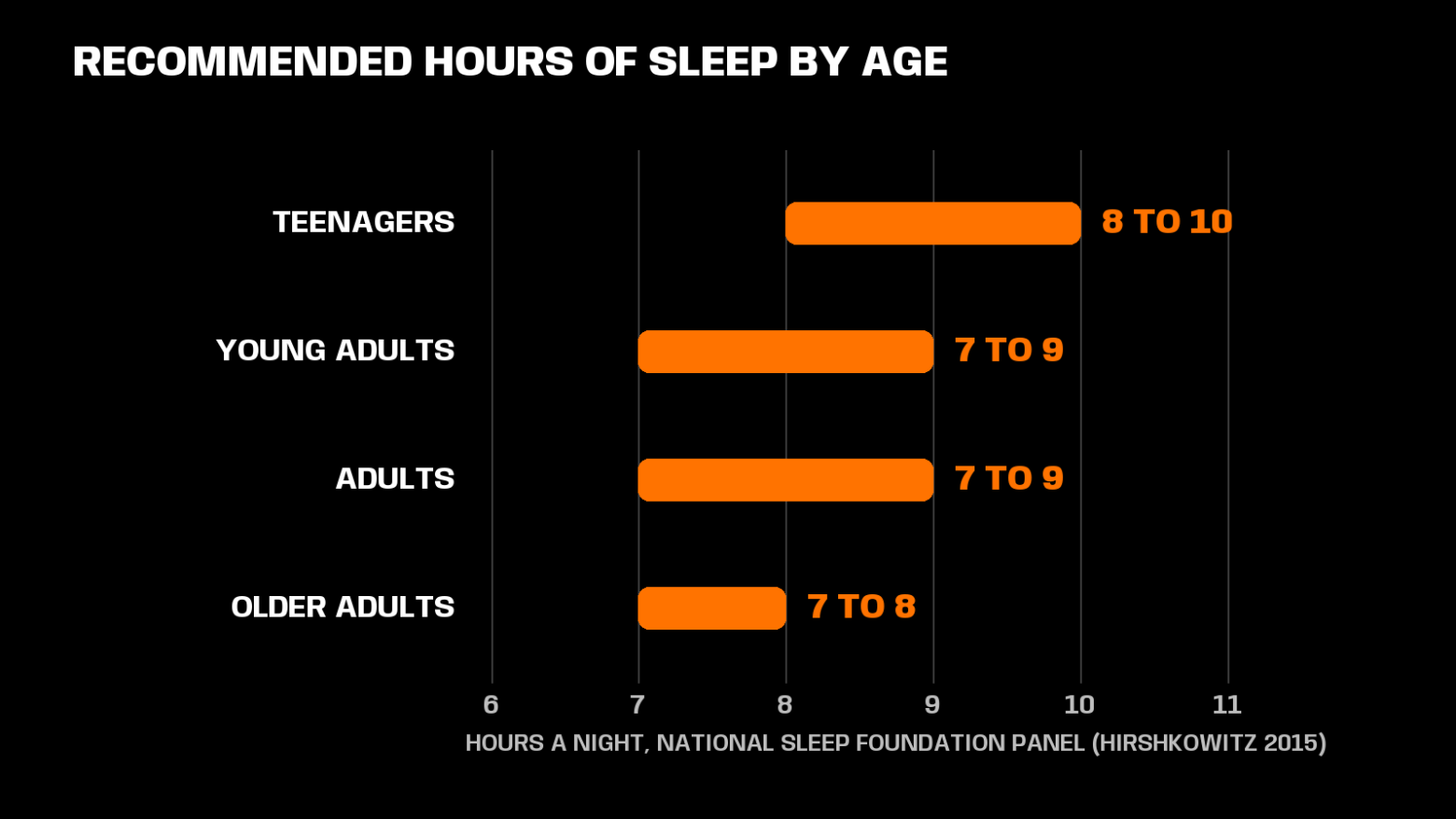
Recommended hours of sleep a night from teenagers to older adults, from the National Sleep Foundation panel.
Do Men Need More or Less Sleep Than Women?
None of the three main guidelines gives men a separate sleep figure. The NSF panel and the AASM panel each set one figure for adults, and the NHS says most healthy adults need 7 to 9 hours [2][3][1]. Where men and women differ is in the sleep they get and how it looks, not in a published hours target.
On time slept, women come out slightly ahead. In American Time Use Survey diaries from working-age adults in 2003 to 2007, women slept more than men overall and at most life stages, and much of the gap was explained by work and family responsibilities [9]. The authors wrote that “The gender gap in sleep time favoring women is relatively small for most comparisons” [9].
On sleep quality, the gap is clearer. In 1,324 people without sleep complaints who spent one night in a lab, women had a higher percentage of sleep time and more slow-wave sleep than men [10]. That tells you how the night looked, not how many hours either sex needs.
The risk side is similar. In a pooled analysis of 15 studies, the link between short sleep and death was consistent in men and women, and the link for long sleep did not differ by gender either [5]. For the wider picture of how men sleep, start with our guide to sleep for men.
Is Your Own Number the Same as the Average?
No. The ranges are averages for healthy adults, and your own need can sit anywhere inside them. The NSF panel wrote that “Sufficient sleep duration requirements vary across the lifespan and from person to person” [2]. The NHS puts it more simply: “Everyone needs different amounts of sleep” [11].
One of the clearest lab tests of how far individuals differ comes from Japan. Sixteen healthy young men aged 20 to 26 were given 12 hours in bed for nine nights, and the researchers estimated each man’s need from where his sleep settled [4]. Estimated need averaged 8.41 hours across the 15 men with an estimate, ranging from 7.29 to 9.26 hours [4].
Across the participants, usual sleep at home averaged 7.37 hours, with a range from 5.82 to 8.89 hours, and 13 of the 15 men with an estimate were sleeping less than their own estimated need [4]. The authors suggested that short sleep in daily life, more than differences in sleep need, drove the gap [4].
Keep the scale in view. This was 16 men with a mean age of 23.4, studied in a lab, so it shows how wide individual need can be, not what yours is [4]. The AASM panel names what drives the spread: “Individual variability in sleep need is influenced by genetic, behavioral, medical, and environmental factors” [3].
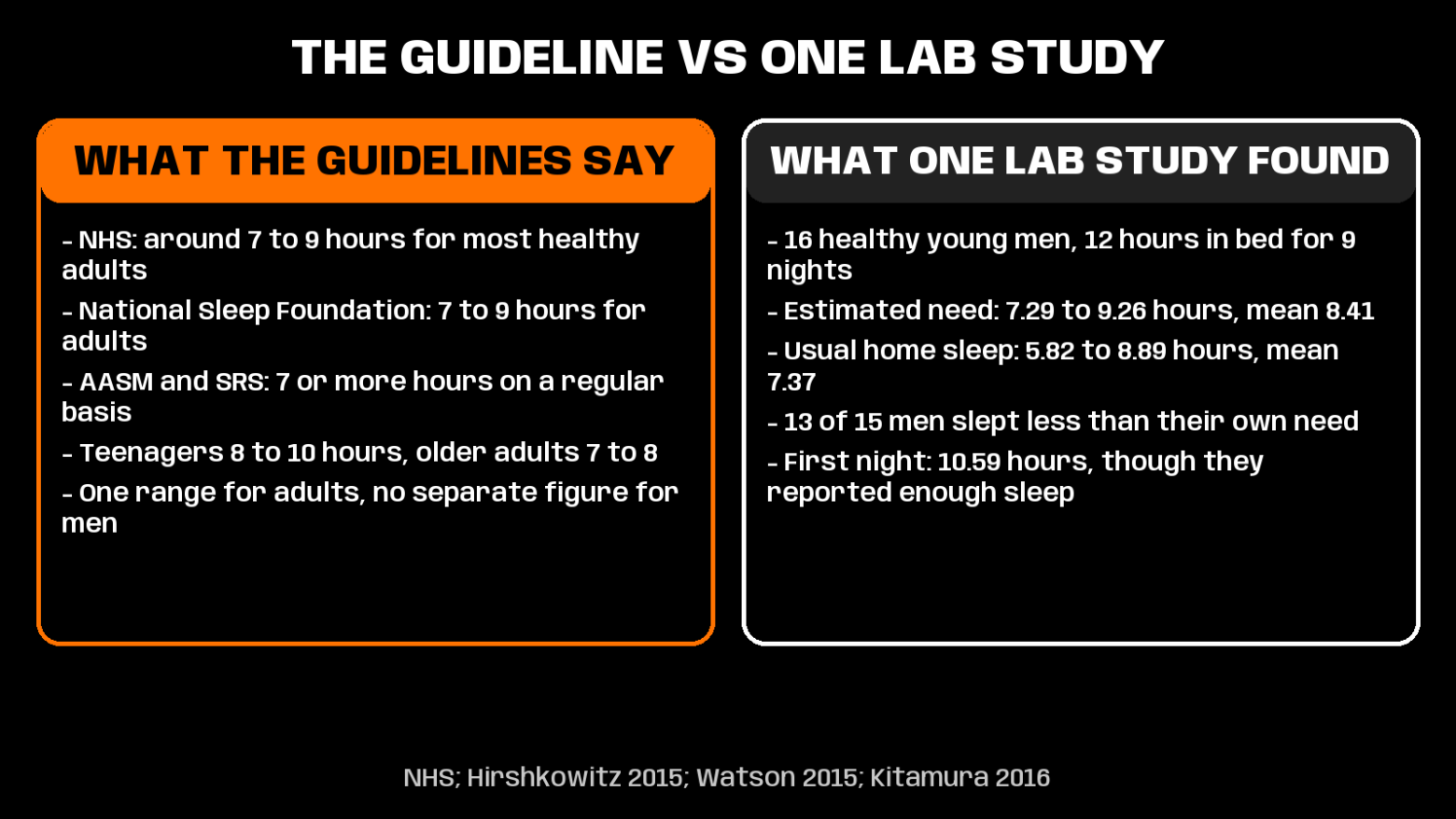
The guideline range and one lab study of individual men, side by side.
What Does Too Little Sleep Do to a Man?
It costs you sharpness first, and you will not feel most of it. In a 14 night lab study, sleeping 6 hours or less a night produced cognitive deficits equal to up to two nights without sleep, while sleepiness ratings rose only a little after the first days [6]. The deficits were cumulative and grew with the dose.
The study put healthy adults aged 21 to 38 on 4, 6 or 8 hours in bed for 14 nights [6]. The authors concluded that “even relatively moderate sleep restriction can seriously impair waking neurobehavioral functions in healthy adults” [6]. Their sleepiness ratings suggested they were largely unaware of how far their performance had slipped [6].
For men, hormones come into it. The authors of a Chicago study noted that “The majority of the daily testosterone release in men occurs during sleep” [12]. In 10 healthy men with a mean age of 24, a week at 5 hours cut daytime testosterone from 18.4 to 16.5 nmol/L, a fall of 10 to 15 percent [12].
That sample was small, young and studied in a lab, so treat it as direction rather than a forecast for you [12]. The AASM adds that sleeping under 7 hours is associated with impaired performance, more errors and a greater risk of accidents [3].
In 15 pooled studies, short sleep was associated with a 12 percent higher risk of death, again as an association only [5]. If you are already running short, our guide to sleep debt covers what it takes to catch up.
Is Sleeping More Than 9 Hours a Warning Sign?
Not by itself. Regularly sleeping more than 9 hours may be appropriate for young adults, people recovering from sleep debt and people with illnesses, and for others it is uncertain whether it carries any risk [3]. A long night after a hard week is normal, but a habit of very long sleep that fits none of those cases is worth a conversation.
The pooled data show why that conversation matters. Across 16 studies with 1,382,999 participants and 112,566 deaths, long sleep was associated with a 30 percent greater risk of death, a risk ratio of 1.30 with a 95 percent confidence interval of 1.22 to 1.38 [5]. The NSF panel adds that “deviating far from the normal range is rare” [2].
Read that as a signal, not a verdict. The same authors say the link may be explained by residual confounding and comorbidities, and that future studies should aim “to answer the question whether sleep duration is a cause or simply a marker of ill-health” [5]. Sleep was self-reported by questionnaire in every study, which limits how far the figures stretch [5].
The practical line comes from the AASM: “People concerned they are sleeping too little or too much should consult their healthcare provider” [3]. If you need well over 9 hours to function for weeks at a time, mention it to your GP rather than guessing.
Does the Time You Sleep Matter as Much as the Hours?
It may matter more than most men assume. In 60,977 UK Biobank adults whose sleep was measured by accelerometers, people in the four most regular fifths had a 20 to 48 percent lower risk of dying during follow-up than people in the least regular fifth [7]. The authors wrote that “Sleep regularity was a stronger predictor of all-cause mortality than sleep duration” [7].
Keep the limits in view. The average age was 62.8 and 55 percent were women, so this is not a study of men in their thirties, and it shows association rather than cause [7]. There were 1,859 deaths over a mean follow-up of 6.30 years [7].
The practical advice from the NHS already points the same way. Its insomnia guidance tells people to “wake up and get out of bed at the same time every day” and not to sleep in after a bad night [11]. Its sleep guide adds that a regular routine helps the body get used to sleeping better [1].
So the sensible target is a number of hours and a steady clock. Choose the hours first, then hold the wake time within a narrow band, weekends included. A lie-in is a poor way to find your number, because in the lab the first long nights were a rebound well above need [4].
Can Some Men Really Get By on Six Hours?
A very small number can, because of rare gene variants, but a habit of six hour nights does not mean you are one of them. The first such variant was found in a small family: two carriers with a DEC2 mutation reported an average 6.25 hours of sleep, against 8.06 hours in non-carriers in the same family [13]. The authors called them “natural short sleepers” [13].
The details matter. The mutation was not found in over 250 control DNA samples, and the sleep times were self-reported [13]. A later study sequenced the same gene in groups of 200 and 217 people, found new variants, and reported one in a single twin of a dizygotic pair, who slept less and had fewer performance lapses during sleep deprivation than the other twin [14].
Both papers describe specific variants in a few people. Neither shows that a man who gets by on six hours has one. The Japanese lab study points the other way: 13 of 15 healthy men were sleeping below their own estimated need without feeling short of sleep [4].
The honest test is how you function, not how long you can run on fumes. If six hours leaves you flat, slower or reliant on caffeine, you are probably short, not special.
How Can You Find Your Own Number?
Use how you feel in the day as the test. The NHS says you may be getting enough sleep if you wake up feeling refreshed, have enough energy to get through the day and can focus on everyday tasks [1]. To find your number, hold a fixed wake time and give yourself a longer window in bed for two weeks, then see where those signs settle.
This is a home version of the Japanese method, not a validated test. In that study men with 12 hours in bed slept 10.59 hours on the first night, then settled to a steady figure by about the fourth night [4]. The first night was a rebound well above their usual sleep, so early nights overstate need [4].
First, fix your wake time and keep it every day, because the NHS advises a set time to get up [11]. Second, move your bedtime so you have about 8 hours in bed, a point inside the 7 to 9 hour range [1][2]. Hold it for two weeks and write down three things each morning: whether you woke refreshed, how your energy held and how well you could focus.
Third, read the pattern after the first week, not the first nights. If you wake before the alarm feeling clear, you are probably near your number.
If waking is still hard and the afternoons drag, add 30 minutes and repeat. If you are sleeping through the alarm and feel groggy, you may be at the top of the range already.
Be honest about the noise. Evening alcohol, late caffeine and a hot room all change how much of your time in bed counts as sleep, so keep them steady during the test. If you keep waking in the night, our guide to waking up at 3am covers the common triggers.
When Should You See a GP About Your Sleep?
See a GP if you have had trouble sleeping for months, if changing your sleeping habits has not helped, or if your sleep is affecting your daily life in a way that makes it hard to cope [11]. The NHS calls trouble that lasts 3 months or longer long-term insomnia [11]. Needing far more than the usual range is also worth raising [3].
Breathing during sleep is the other thing to check. The NHS lists breathing that stops and starts, gasping, snorting or choking noises, waking up a lot and loud snoring among the symptoms of sleep apnoea, and says to see a GP if you always feel very tired during the day [15]. It also says that if someone else has seen the signs, it helps to bring them with you [15].
None of this means a man who sleeps 6.5 hours has a problem. It means that if you have given yourself the hours and still cannot get enough, or you never feel rested, a GP is the right person to look. This guide is general information, not a diagnosis.
FAQ
Is 6 hours of sleep enough for a man?
For most men, no. The AASM panel set 7 or more hours as the adult minimum and linked regular sleep under 7 hours with poorer health, impaired performance and more errors [3]. In a 14 night lab study, 6 hour nights produced deficits equal to up to two nights without sleep [6].
Do men need less sleep as they get older?
Slightly less, at most. The NSF panel gave 7 to 8 hours for older adults against 7 to 9 for younger adults [2]. Recorded sleep time in adults falls with age, but that shows what people get rather than what they need [8]. Do not assume you can drop below 7.
Is 8 hours the right target?
It is a sensible starting point, because it sits inside the 7 to 9 hour range [1]. The estimated average need in 15 young men was 8.41 hours, but the individual figures ran from 7.29 to 9.26 [4]. Your number may sit above or below 8, so test it.
Can a man train himself to need less sleep?
These studies do not show it. In the 14 night study, adults limited to 6 hours or less had growing deficits, yet their sleepiness ratings barely rose after the first days, so feeling used to it is not proof [6]. The short-sleeper variants in these two studies were found in a few people [13][14].
Should I count time in bed or time asleep?
The guidelines speak of hours of sleep, so plan for a little more time in bed than your target. Men given 12 hours in bed slept 10.59 hours on their first night [4], and the pooled mortality studies often could not separate the two [5]. Aim for about 8 hours in bed.
Final Recommendation
Aim for 7 to 9 hours, treat 7 as the floor and find your number inside the range with a fixed wake time and two weeks of notes [1][3]. Judge it by how you wake, how your energy holds and how well you focus [1]. Keep the same wake time all week, because regularity was a stronger predictor of mortality than duration in a UK Biobank study of 60,977 adults [7].
If you have given yourself the hours and still struggle, or you regularly need far more than 9 hours, speak to your GP [11][3].
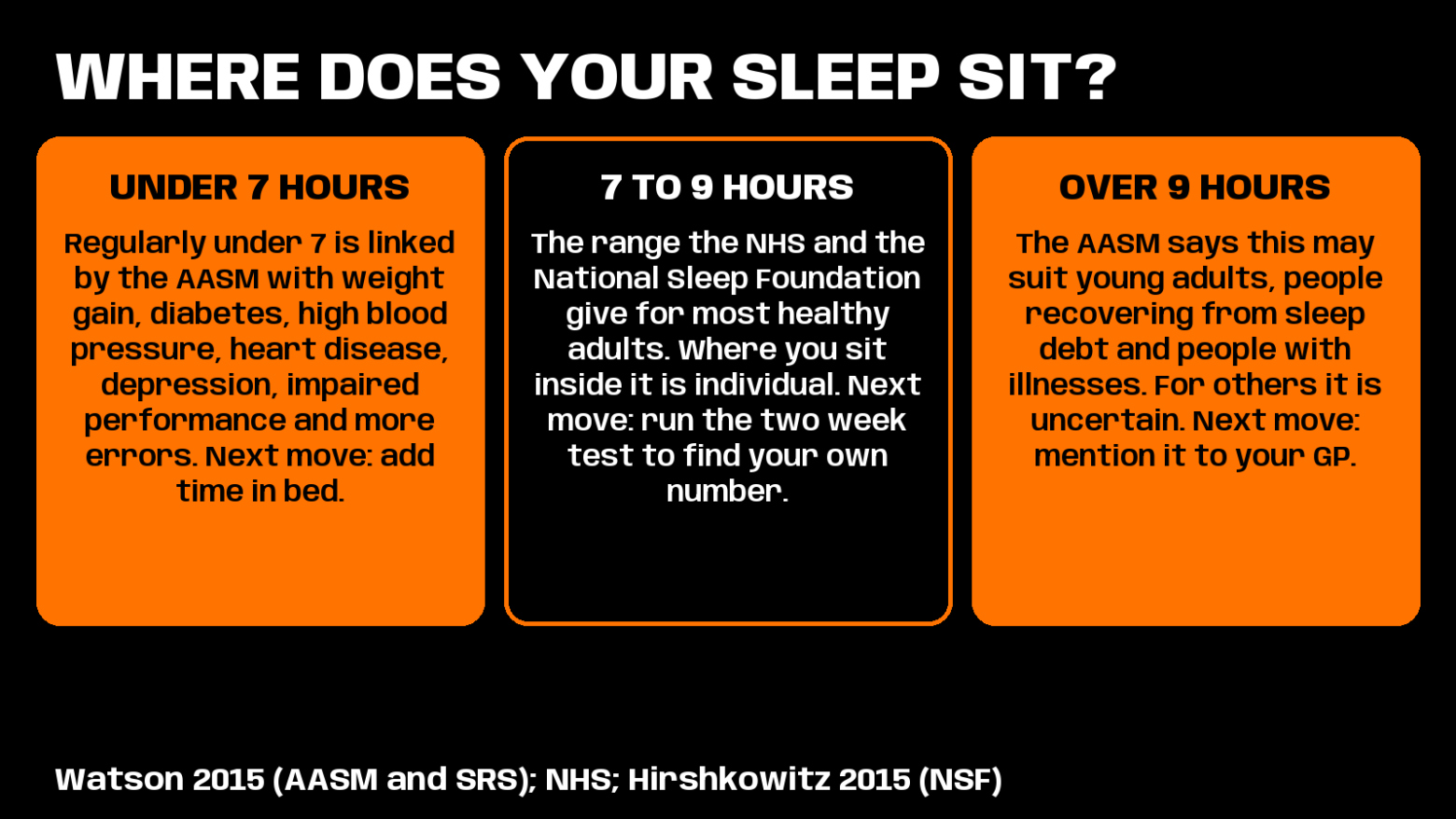
Three zones for adult sleep, and the move that fits each one.
Options for Men to Take Action
Most men do not miss their sleep number because they do not care. They miss it because the plan lives in their head, the bedtime drifts, and nothing shows whether the earlier night is still happening a fortnight later.
The MenTools app runs challenges across mindset, fitness, nutrition and money, with levels you choose, daily actions, streak and progress tracking, journals and an AI coach. For this guide, its job is keeping the two-week test visible: the fixed wake time, the bedtime and the three morning notes.
How you can do this today: set your fixed wake time and a bedtime that gives you about 8 hours in bed, add it as a daily action at the easiest level and track it for two weeks.
Wins on cost: one subscription covers habit tracking, journals and coaching, instead of several apps.
Wins on time: the challenges are already built, so you spend your evening on the routine rather than designing it.
Wins on practicality: each action takes minutes and fits around work, shifts and family, and the streak makes a missed night obvious.
Watch-out: the app tracks and prompts, but it does not measure your sleep or tell you your number. It records what you log, so the morning notes are still yours to write.
Recovery is what a steady routine protects, so a one a day multivitamin may help cover the simple daily foundation underneath it. For more on getting your nights right, the MenTools sleep hub collects everything in one place. Find the number, then keep the clock steady around it.
Last updated: 2026-11-05 v1.0
Disclaimer: This guide is for informational purposes only and does not constitute medical or psychological advice. Speak with a qualified professional before making significant changes if you have a medical or mental health condition.
References
- [1] NHS Every Mind Matters. Sleep problems. National Health Service. Link
- [2] Hirshkowitz M, Whiton K, Albert SM, et al. National Sleep Foundation’s sleep time duration recommendations, methodology and results summary. Sleep Health, 2015;1(1):40-43. Link
- [3] Watson NF, Badr MS, Belenky G, et al. Recommended amount of sleep for a healthy adult, a joint consensus statement of the American Academy of Sleep Medicine and Sleep Research Society. Sleep, 2015;38(6):843-844. Link
- [4] Kitamura S, Katayose Y, Nakazaki K, et al. Estimating individual optimal sleep duration and potential sleep debt. Scientific Reports, 2016;6:35812. Link
- [5] Cappuccio FP, D’Elia L, Strazzullo P, Miller MA. Sleep duration and all-cause mortality, a systematic review and meta-analysis of prospective studies. Sleep, 2010;33(5):585-592. Link
- [6] Van Dongen HPA, Maislin G, Mullington JM, Dinges DF. The cumulative cost of additional wakefulness, dose-response effects on neurobehavioral functions and sleep physiology from chronic sleep restriction and total sleep deprivation. Sleep, 2003;26(2):117-126. Link
- [7] Windred DP, Burns AC, Lane JM, et al. Sleep regularity is a stronger predictor of mortality risk than sleep duration, a prospective cohort study. Sleep, 2024;47(1):zsad253. Link
- [8] Ohayon MM, Carskadon MA, Guilleminault C, Vitiello MV. Meta-analysis of quantitative sleep parameters from childhood to old age in healthy individuals, developing normative sleep values across the human lifespan. Sleep, 2004;27(7):1255-1273. Link
- [9] Burgard SA, Ailshire JA. Gender and time for sleep among U.S. adults. American Sociological Review, 2013;78(1):51-69. Link
- [10] Bixler EO, Papaliaga MN, Vgontzas AN, et al. Women sleep objectively better than men and the sleep of young women is more resilient to external stressors, effects of age and menopause. Journal of Sleep Research, 2009;18(2):221-228. Link
- [11] NHS. Insomnia. National Health Service. Page last reviewed 19 March 2024. Link
- [12] Leproult R, Van Cauter E. Effect of 1 week of sleep restriction on testosterone levels in young healthy men. JAMA, 2011;305(21):2173-2174. Link
- [13] He Y, Jones CR, Fujiki N, et al. The transcriptional repressor DEC2 regulates sleep length in mammals. Science, 2009;325(5942):866-870. Link
- [14] Pellegrino R, Kavakli IH, Goel N, et al. A novel BHLHE41 variant is associated with short sleep and resistance to sleep deprivation in humans. Sleep, 2014;37(8):1327-1336. Link
- [15] NHS. Sleep apnoea. National Health Service. Page last reviewed 11 May 2026. Link