No products in the cart.
Return To Shop
MEN: Why Do Men Wake Up at 3am?
Quick Answer
Waking around 3am falls where the night changes: deep sleep comes early, REM builds later and cortisol starts climbing around 02:00 to 03:00 [1][2]. Brief waking between cycles is normal: in one survey, 35.5 percent of adults woke at least three nights a week [3]. Stress, a late drink, caffeine or a warm room can make it longer [4][5][6][7].
**Jump to:** Causes at a glance | Is it normal? | Why 3am | What to do | FAQ | Options for men
Disclosure: MenTools publishes this article and may feature MenTools products.
How we evaluate: Each cause is assessed on real-world use, evidence, cost and time, and how well it suits men. Every cause including the MenTools option carries an honest limitation. Full sources are in the references below.
The Common Causes at a Glance
Waking at 3am rarely has one cause. This guide groups the evidence into seven common ones, and most of them are things you can change. The table sets out what each feels like, what to change and what the evidence shows, so you can match it to your own nights before reading the detail [1][2][4][5][6][7][8].
| Cause | What it feels like | What to change | What the evidence shows |
|---|---|---|---|
| Normal sleep cycles | A brief waking, then you drift off | Leave it alone and skip the clock | Four to six cycles a night, with brief waking possible between them [1] |
| Early cortisol rise | Alert in the small hours | Keep a fixed wake time | Cortisol began rising around 02:00 to 03:00 in 33 people [2] |
| Stress and worry | A racing mind replaying the day | Write tomorrow’s list before bed | Experimental stress cut deep sleep and REM and raised awakenings in a review of 63 articles [4] |
| Evening alcohol | Out fast, restless later | Drink earlier, or less | REM disruption from about two standard drinks across 27 studies [5] |
| Caffeine | Wired, with thin sleep | Stop at least six hours before bed | 400 mg six hours before bed cut sleep by more than an hour [6] |
| A warm room | Hot, throwing off the covers | Cool, dark room | Heat increased wakefulness and cut deep and REM sleep [7] |
| Needing the toilet | Woken by the urge | Last big drink earlier | Waking for other reasons can trigger the urge too [8] |
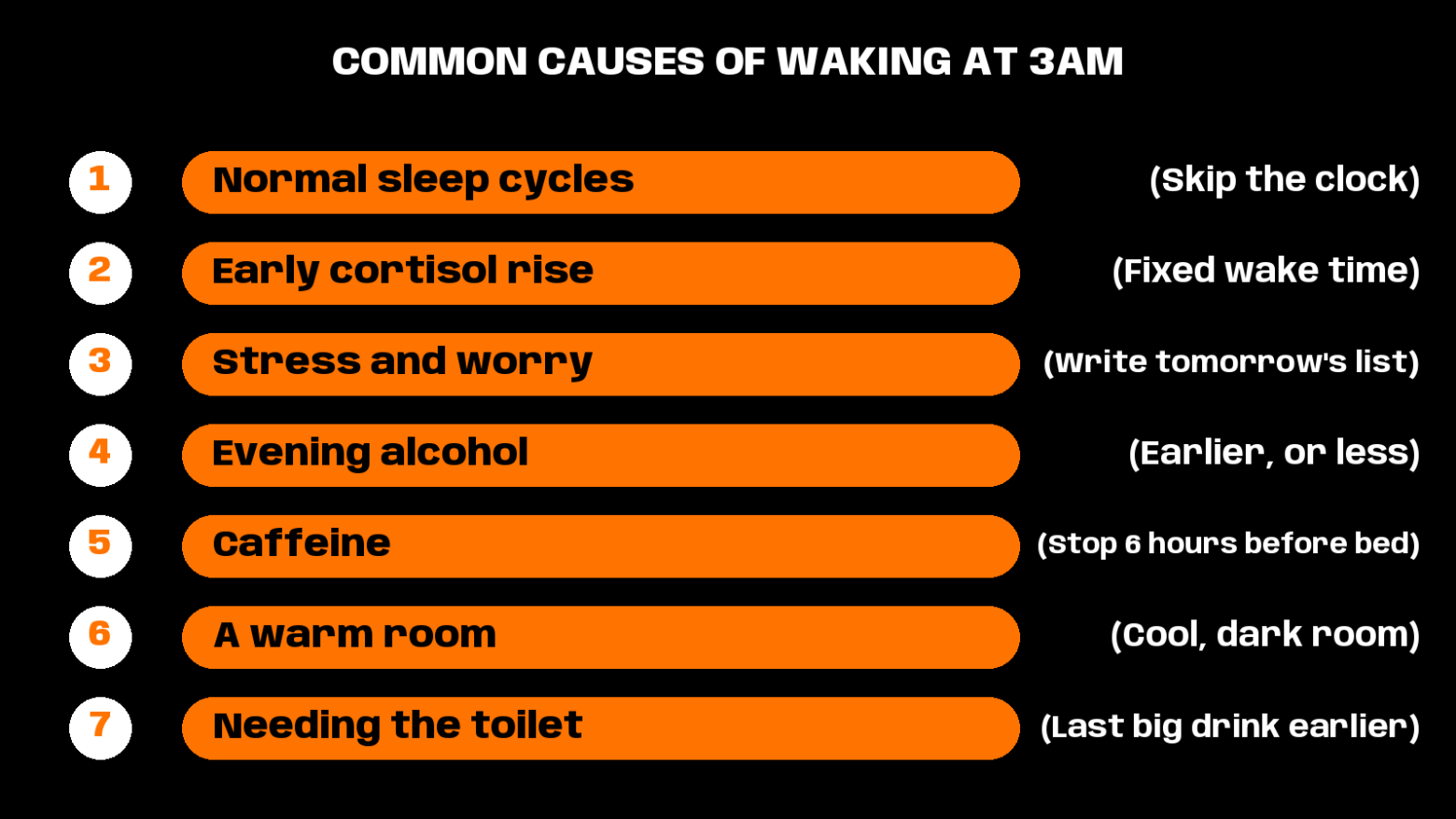
Match your own nights to one cause, then change that one thing first.
Is It Normal to Wake Up in the Night?
Yes. Waking briefly during the night is a normal part of sleep, not a fault. Sleep runs in cycles of 80 to 100 minutes, usually four to six a night, and you may wake up briefly between cycles [1]. In a survey of 8,937 adults in Texas, New York and California, 35.5 percent woke at least three nights a week [3].
The survey authors called nocturnal awakenings “one of the most prevalent sleep disturbances in the general population” [3]. Nightly waking was reported by 23.0 percent of the sample, and by 18.8 percent of men compared with 26.6 percent of women [3].
What separates a normal waking from a problem is getting back to sleep. Of those who woke at least three nights a week, 43 percent had difficulty resuming sleep, and that difficulty came with daytime repercussions in 77 percent of cases [3]. In the absence of other insomnia symptoms, the authors wrote, “nocturnal awakenings alone are unlikely to be associated with daytime impairments” [3].
That is the straight answer for most men. One waking is common, and it only becomes a topic when it keeps happening or leaves you wrecked the next day. For the full picture of sleep, start with our guide to sleep for men, then come back here for the 3am detail.
Why Does It Happen Around 3am?
There is nothing magic about 3am. It is where the pattern of the night changes: deep sleep usually takes more time early in the night, REM sleep takes more later, and cortisol starts its climb towards the morning. In one study of 33 people, cortisol bottomed out around midnight and began rising at roughly 02:00 to 03:00 [2].
The sleep side is well described. The NHLBI says you “usually have more REM sleep later in the night”, and brain activity in REM sleep is similar to brain activity when you are awake [1].
The hormone side is just as clear. In those 33 people cortisol fell to under 50 nmol/l at its lowest and peaked at about 399 nmol/l around 08:30 [2]. The rhythm is driven by the body clock, and one review describes it as peaking “at the habitual sleep-wake transition” [9].
Be clear about what this does and does not show. None of these sources shows that the early cortisol rise wakes a man up on its own. They show the timing: by the second half of the night deep sleep has had its biggest share, REM sleep is building and cortisol is climbing. It is a reasonable guess that a small trigger then tips a brief waking into a long one, but that is a reading of the timing, not a proven mechanism.
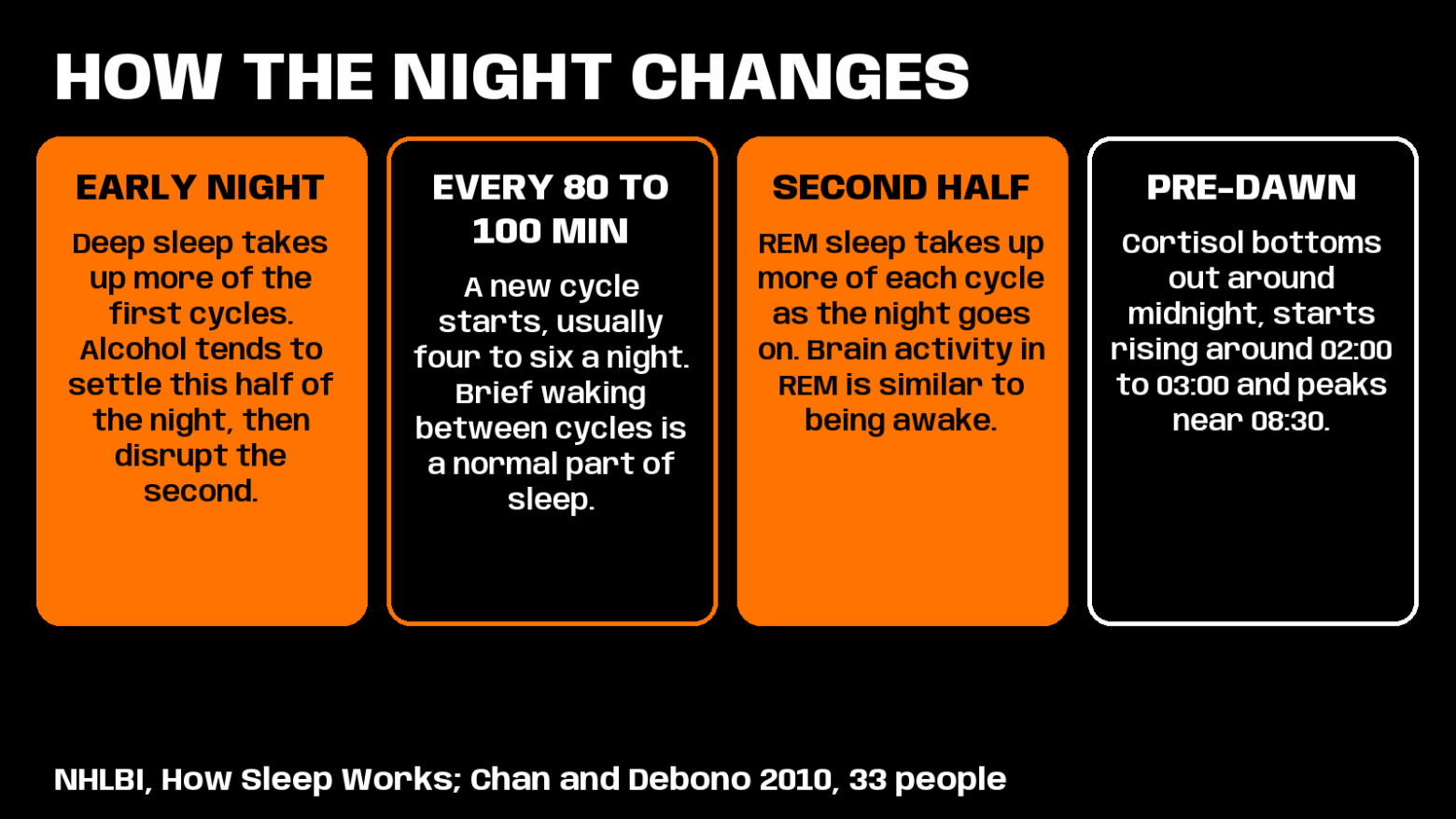
The same night changes character, and the small hours are where REM sleep builds and cortisol starts to rise.
Does Stress Wake You Up at 3am?
It can. Stress is a well-recognised trigger of broken sleep. A systematic review of 63 articles found that experimental stress produced fairly consistent decreases in slow wave sleep, REM sleep and sleep efficiency, and increases in awakenings [4]. The NHS lists stress, anxiety or depression first among the most common causes of insomnia [10].
Why does it feel worse once you are awake? Because worry about being awake can become the thing keeping you awake. Allison Harvey’s cognitive model of insomnia proposes that people who suffer from insomnia “tend to be overly worried about their sleep and about the daytime consequences of not getting enough sleep”, and that this “triggers both autonomic arousal and emotional distress” [11].
Read that as an explanation of the loop, not proof of cause on any single night, because it is a model of how insomnia is maintained rather than a count of men who wake once.
If that wired feeling at night is familiar, our piece on feeling wired but tired goes deeper. The simplest fix has NHS backing: “If you often worry in bed, try making a list of things you need to do the next day before you go to sleep” [12].
Does an Evening Drink Make You Wake Up at 3am?
It can. Alcohol often helps you drop off, but it tends to cost you later in the night. A review of studies in healthy volunteers found that at all doses alcohol gave “a more consolidated first half sleep and an increase in sleep disruption in the second half of sleep” [13]. A 2025 meta-analysis of 27 studies found REM sleep disruption from about two standard drinks [5].
The meta-analysis adds numbers and is honest about its limits. REM disruption showed up at 0.50 grams per kilogram of body weight or less, roughly two standard drinks, and it “progressively worsened with increasing doses of alcohol” [5]. But the effect on total sleep time, sleep efficiency and wake after sleep onset “could not be determined, with large uncertainty” [5].
So the straight answer is that evening alcohol can lighten the second half of the night, and the size of its effect on night waking itself is not settled. The NHS advice is to avoid alcohol, tea and coffee “at least 6 hours before going to bed” [10]. If you keep waking at 3am, run a two week test with no evening drinks before you decide anything else.
Does Caffeine Cause Waking in the Night?
It can, even when the last cup is hours before bed. In a small home study, 400 mg of caffeine taken six hours before bedtime still cut total sleep time by more than an hour compared with placebo [6]. The NHS advises no tea or coffee for at least six hours before going to bed [10].
The study was small, with 12 healthy adults aged 19 to 48, so treat it as a signal rather than a rule [6]. The dose was large, but the authors note that a 16-ounce brewed coffee can hold up to 500 mg [6]. Time awake during sleep also rose, by 8 minutes when caffeine was taken six hours before bed and by 27.6 minutes at three hours [6].
Count back six hours from your bedtime and treat that as your cut-off, so a 6pm coffee before an 11pm bedtime sits inside it.
Can a Warm Room Wake You Up?
Yes, heat is a known sleep disruptor. A review of the thermal environment concluded that in real-life conditions with bedding and clothing, heat exposure increases wakefulness and decreases slow wave sleep and REM sleep [7]. The NHS also lists a room that is too hot or cold among the most common causes of insomnia [10].
The practical move is simple. The NHS suggests a room that is “quiet, dark and cool”, which can mean opening a window if it is safe to do so [12].
Is Needing the Toilet the Cause or the Result?
Sometimes it is the result. Waking at night to pass urine is common, and Oxford Health NHS Foundation Trust says it “is normal for adults to wake once a night to urinate” [8]. The same service describes secondary nocturnal voiding, which is “waking for reasons such as anxiety, pain, or insomnia and emptying your bladder while awake, even if it isn’t full” [8].
So if you wake and then feel the urge, the toilet may be a sign of being awake rather than the reason. Evening fluids and caffeine are among the first things the service says to cut back [8]. Once a night can be normal, but if it bothers you, speak to a healthcare professional, because the cause can be how much you drink, how the bladder behaves, or simply waking for another reason [8].
What Should You Do When You Wake at 3am?
Stay calm, keep the lights low and do not force sleep. If you are still awake after around 20 minutes, get up and sit somewhere comfortable, do something quiet and go back to bed when you feel sleepy [12]. The American Academy of Sleep Medicine adds that it is “especially important to not get on electronics” [14].
That 20 minute rule comes from stimulus control, a core part of cognitive behavioural therapy for insomnia. The AASM guideline says patients should “leave the bed after they have perceived not to sleep within approximately 20 minutes” [15]. The aim is to build “a positive and clear association between the bed and sleep” [15].
Two habits protect the next night. Get up at the same time every day, and do not sleep in after a bad night, both of which are on the NHS basic advice list [10]. If you are tempted to make up for lost sleep, our guide to sleep debt covers catching up on lost sleep.
Should You Check the Time or Your Phone?
No. Checking the clock tends to feed worry, and a phone adds light and temptation. In an experiment with 30 good and 30 poor sleepers, people told to monitor a clock while trying to get to sleep reported more pre-sleep worry and took longer to fall asleep than those who did not [16]. The NHS suggests keeping clocks out of view and the phone face down [12].
Be careful about the scope. That study tested falling asleep at bedtime, not waking at 3am, so applying it to 3am is a reasonable inference rather than a finding. In a second experiment with 38 people with primary insomnia, the clock-monitors overestimated how long it took them to fall asleep more than the comparison group did [16].
The authors wrote that the findings “suggest that clock monitoring may trigger pre-sleep worry and serve to maintain insomnia by fuelling pre-sleep worry and exacerbating misperception of sleep” [16]. That fits Harvey’s model, in which an anxious state drives monitoring of sleep-related threat cues [11]. The AASM guideline likewise says to judge the 20 minutes by how long you feel you have been awake, not by watching the clock [15].
What Works If It Keeps Happening?
Cognitive behavioural therapy for insomnia, known as CBT-I, is the recommended first treatment. The American College of Physicians recommends that all adults with chronic insomnia disorder receive it as the initial treatment [17]. A meta-analysis of 20 trials found it improved wake after sleep onset by about 26 minutes [18].
Those trials covered 1,162 people, with an average age of 56 and 64 percent women, and they used face-to-face therapy, so the numbers may not match a younger man using an online programme [18]. The same analysis reported “Changes seemed to be sustained at later time points”, with no adverse outcomes reported [18].
The NHS says a GP may offer CBT, face to face or through an online self-help programme, to help you “change the thoughts and behaviours that keep you from sleeping” [10]. It also says GPs now rarely prescribe sleeping pills, because they can have serious side effects and you can become dependent on them [10].
When Should You See a GP About Waking Up at 3am?
See a GP if you have had trouble sleeping for months, if changing your habits has not helped, or if it is hard to cope in the day [10]. The NHS calls insomnia that lasts three months or longer long-term insomnia [10]. Also go if your breathing stops and starts or you make gasping, snorting or choking noises in your sleep [19].
The NHS lists loud snoring, gasping, snorting or choking noises and waking up a lot among the symptoms of sleep apnoea, and says to see a GP if you always feel very tired during the day [19]. A partner who has seen the breathing pauses can help, and the NHS suggests bringing them to the appointment [19].
Getting up to the toilet more than you would like is also worth raising with a healthcare professional [8]. This guide is general information, not a diagnosis, and a GP is the right person for anything that worries you.
FAQ
Is waking at 3am a sign of something serious?
Not on its own, in most cases. In a survey of 8,937 adults in three US states, waking at night was common, and without other insomnia symptoms it was unlikely to be associated with daytime problems [3]. See a GP if it runs for months, you gasp or choke in your sleep, or daytime life suffers [10][19].
Why can I not get back to sleep after waking at 3am?
Often because worry takes over once you are awake. Harvey’s model describes an anxious state that drives monitoring of sleep threats [11], and 43 percent of adults who woke at least three nights a week had difficulty resuming sleep [3]. Get up after around 20 minutes and keep the clock out of view [12].
How long should I stay in bed before getting up?
About 20 minutes, judged by feel rather than by checking the time. The NHS says to get up if you are still awake after around 20 minutes [12], and the AASM guideline says to leave the bed once you have perceived not sleeping within approximately 20 minutes [15]. Return to bed when you feel sleepy.
Does waking at 3am every night mean I have insomnia?
Not necessarily. The NHS says you have insomnia if problems such as waking several times a night happen regularly, and calls it long-term when it lasts three months or more [10]. In one survey, people who woke but fell back asleep easily and had no other insomnia symptoms rarely reported daytime impairment [3]. A GP can tell you which applies.
Do sleeping pills stop night waking?
They are rarely the first choice. The NHS says GPs now rarely prescribe sleeping pills for insomnia because of serious side effects and dependence, and pharmacy products may help for only 1 to 2 weeks [10]. CBT-I is the recommended initial treatment for chronic insomnia disorder [17].
Is waking at night more common as men get older?
Nightly waking does rise with age. In a survey across three US states, 34.6 percent of people aged 65 or older woke every night, while waking three to six nights a week was unrelated to age [3]. Overall, 18.8 percent of men woke nightly compared with 26.6 percent of women [3].
Final Recommendation
If you wake at 3am now and then, treat it as normal sleep and do not make it a project. Skip the clock and the phone, get up after around 20 minutes if you are still awake, and fix the trigger that matches your nights, whether that is worry, a late drink, afternoon caffeine or a warm room [12][3]. If it runs for months, see your GP [10].
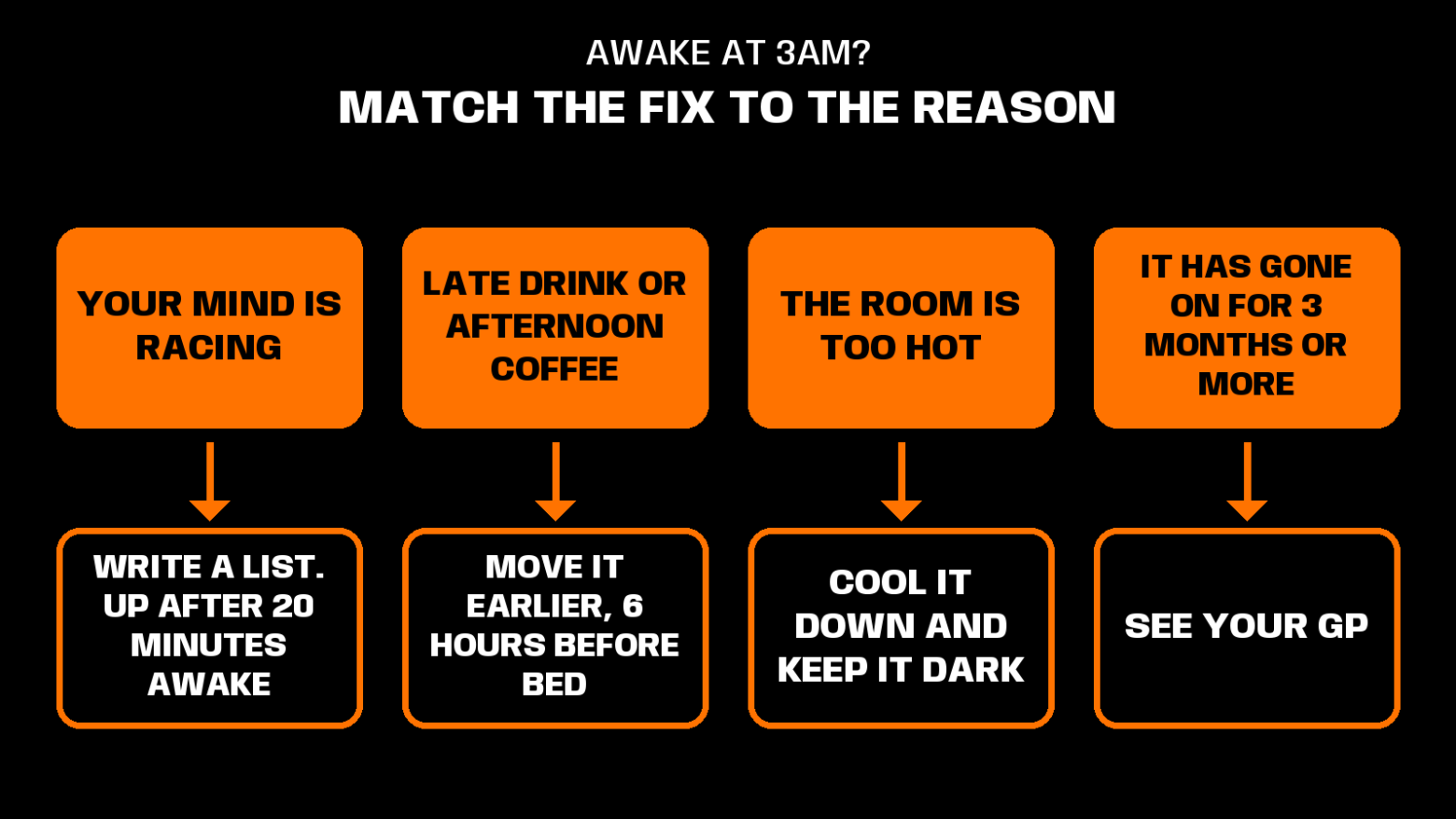
Match the reason you woke to one fix, and see your GP if it keeps happening.
Options for Men to Take Action
Most men do not lose sleep over one bad night. They lose it to a routine that lives in their head, a wind-down that never quite happens and no way to see whether anything is changing.
The MenTools app runs challenges across mindset, fitness, nutrition and money, with levels you choose, daily actions, streak and progress tracking, journals and an AI coach. For the habits in this guide, its job is keeping a small evening routine visible every day, such as writing tomorrow’s list, a fixed phone-down time and an earlier last coffee.
How you can do this today: pick the one trigger from the table that matches your nights, set it as a daily action at the easiest level and track it for two weeks.
Wins on cost: one subscription covers habit tracking, journals and coaching, instead of several apps.
Wins on time: the challenges are already built, so you spend your evening doing the routine rather than designing it.
Wins on practicality: each action takes minutes and fits around work, shifts and family, and the streak makes a missed evening obvious.
Watch-out: it tracks and prompts, but it does not diagnose or treat poor sleep, and it cannot tell you what is causing your waking. If it keeps happening for months, that is a conversation for your GP.
Recovery is what a good routine protects, so a one a day multivitamin may help cover the simple daily foundation underneath it. For more on getting sleep right, the MenTools sleep hub collects everything in one place. Keep the routine small, keep it fixed, and let one waking pass without making it a project.
Last updated: 2026-11-04 v1.0
Disclaimer: This guide is for informational purposes only and does not constitute medical or psychological advice. Speak with a qualified professional before making significant changes if you have a medical or mental health condition.
References
- [1] National Heart, Lung, and Blood Institute. How Sleep Works, Sleep Phases and Stages. NIH, last updated 24 March 2022. Link
- [2] Chan S, Debono M. Replication of cortisol circadian rhythm, new advances in hydrocortisone replacement therapy. Therapeutic Advances in Endocrinology and Metabolism, 2010;1(3):129-138. Link
- [3] Ohayon MM, Krystal A, Roehrs TA, Roth T, Vitiello MV. Using difficulty resuming sleep to define nocturnal awakenings. Sleep Medicine, 2010;11:236-241. Link
- [4] Kim EJ, Dimsdale JE. The effect of psychosocial stress on sleep, a review of polysomnographic evidence. Behavioral Sleep Medicine, 2007;5(4):256-278. Link
- [5] Gardiner C, Weakley J, Burke LM, et al. The effect of alcohol on subsequent sleep in healthy adults, a systematic review and meta-analysis. Sleep Medicine Reviews, 2025;80:102030. Link
- [6] Drake C, Roehrs T, Shambroom J, Roth T. Caffeine effects on sleep taken 0, 3, or 6 hours before going to bed. Journal of Clinical Sleep Medicine, 2013;9(11):1195-1200. Link
- [7] Okamoto-Mizuno K, Mizuno K. Effects of thermal environment on sleep and circadian rhythm. Journal of Physiological Anthropology, 2012;31:14. Link
- [8] Oxford Health NHS Foundation Trust, Bladder and Bowel Service. Understanding nocturia. Page last reviewed 22 September 2025. Link
- [9] O’Byrne NA, Yuen F, Butt WZ, Liu PY. Sleep and circadian regulation of cortisol, a short review. Current Opinion in Endocrine and Metabolic Research, 2021;18:178-186. Link
- [10] NHS. Insomnia. Page last reviewed 19 March 2024. Link
- [11] Harvey AG. A cognitive model of insomnia. Behaviour Research and Therapy, 2002;40(8):869-893. Link
- [12] NHS Every Mind Matters. Fall asleep faster and sleep better. Link
- [13] Ebrahim IO, Shapiro CM, Williams AJ, Fenwick PB. Alcohol and sleep I, effects on normal sleep. Alcoholism, Clinical and Experimental Research, 2013;37(4):539-549. Link
- [14] American Academy of Sleep Medicine, Sleep Education. Healthy Sleep Habits. Link
- [15] Schutte-Rodin S, Broch L, Buysse D, Dorsey C, Sateia M. Clinical guideline for the evaluation and management of chronic insomnia in adults. Journal of Clinical Sleep Medicine, 2008;4(5):487-504. Link
- [16] Tang NKY, Schmidt DA, Harvey AG. Sleeping with the enemy, clock monitoring in the maintenance of insomnia. Journal of Behavior Therapy and Experimental Psychiatry, 2007;38(1):40-55. Link
- [17] Qaseem A, Kansagara D, Forciea MA, Cooke M, Denberg TD. Management of chronic insomnia disorder in adults, a clinical practice guideline from the American College of Physicians. Annals of Internal Medicine, 2016;165(2):125-133. Link
- [18] Trauer JM, Qian MY, Doyle JS, Rajaratnam SMW, Cunnington D. Cognitive behavioral therapy for chronic insomnia, a systematic review and meta-analysis. Annals of Internal Medicine, 2015;163(3):191-204. Link
- [19] NHS. Sleep apnoea. Page last reviewed 11 May 2026. Link