No products in the cart.
Return To Shop
MEN: What Is Sleep Debt, and Can You Actually Repay It?
Quick Answer
Sleep debt is the running gap between the sleep you need and the sleep you get, and you can repay part of it, but not in one lie-in. After a week of 3 to 7 hour nights, people given three full 8 hour nights still had not fully recovered [1]. Clearing 1 hour of debt took about four days [2].
**Jump to:** Sleep debt at a glance | How long recovery takes | How to pay it back | FAQ | Options for men
Disclosure: MenTools publishes this article and may feature MenTools products.
How we evaluate: Each recommendation is assessed on real-world use, evidence, cost and time, and how well it suits men. Every recommendation including the MenTools option carries an honest limitation. Full sources are in the references below.
Sleep Debt at a Glance
Sleep debt is not a number you can read off a chart. It is the running shortfall between the sleep your body needs and the sleep you actually get, and lab research gives a fairly clear picture of how it builds, how it feels and how long it takes to repay. The table sets out the short answers and the evidence behind each one.
| Question | Short answer | What the evidence shows |
|---|---|---|
| What is it? | Sleep need minus sleep got, added up | Habitual sleep averaged 7.37 hours against an estimated need of 8.41 hours in young men [2] |
| How fast does it build? | Within about a week | Lapses rose across seven nights at 4.98 hours, and deficits showed on every task after 14 nights at 4 or 6 hours [3][4] |
| Can you feel it? | Often not | Sleepiness ratings barely changed after the first days while performance kept falling [4] |
| Can a weekend fix it? | Only in part | Weekend sleep totalled only about 1.1 hours above baseline, and insulin sensitivity still fell about 9 to 27 percent [5] |
| How long does recovery take? | Days, not one night | 1 hour of debt took about four days to clear [2] |
| Do naps help? | They help alertness | Naps of 30 to under 60 minutes did best across 22 trials in 291 men [6] |
| What does it do to men? | Hormones and metabolism shift | Daytime testosterone was 10 to 15 percent lower after a week at 5 hours [7] |
What Is Sleep Debt?
Sleep debt is the shortfall between how much sleep you need and how much you get, added up night after night. The NHS says most healthy adults need around 7 to 9 hours, and the American Academy of Sleep Medicine and Sleep Research Society say adults should sleep 7 or more hours a night on a regular basis [8][9]. Every night below your own number adds to the debt.
The consensus statement is blunt: “Adults should sleep 7 or more hours per night on a regular basis to promote optimal health” [9]. The panel of 15 experts linked regular sleep under 7 hours to weight gain, diabetes, high blood pressure, heart disease and depression [9].
Researchers treat the debt as something that accumulates. In one Pennsylvania study, 16 healthy young adults slept an average of 4.98 hours a night for seven nights, and their attention lapses rose across the week [3].
Sleep debt is a different idea from insomnia. The NHS describes insomnia as regularly having problems sleeping [10], while sleep debt describes the shortfall itself, whatever the cause. For the wider picture, start with our sleep for men guide.
How Fast Does Sleep Debt Build?
Faster than most men expect. In a 14 night laboratory study, sleeping 6 hours or less a night produced attention and thinking deficits equal to up to two nights of total sleep deprivation, and the authors describe the deficits as cumulative [4]. A week at about 5 hours was enough to raise attention lapses significantly [3].
That study followed 48 healthy adults aged 21 to 38, randomised to 4, 6 or 8 hours in bed for 14 nights [4]. The authors wrote that “even relatively moderate sleep restriction can seriously impair waking neurobehavioral functions in healthy adults” [4].
Even 7 hours in bed was not free. In a 66 person study, volunteers spent 3, 5, 7 or 9 hours in bed for seven days, and speed on a reaction task fell in the 7 and 5 hour groups before levelling off at a lower level [1]. “These results suggest that the brain adapts to chronic sleep restriction,” the authors wrote, and the adaptation stabilised performance at a reduced level [1].
Can You Feel Sleep Debt?
Not reliably. In the 14 night study above, sleepiness ratings jumped early and then barely moved, even though attention and thinking kept getting worse across the 14 nights [4]. The authors concluded that the ratings suggest “subjects were largely unaware of these increasing cognitive deficits” [4].
The same pattern shows up outside extreme studies. In Japan, 16 healthy young men who reported no sleep problems were given 12 hours in bed for nine nights, and on the first night they slept 10.59 hours on average, more than 3 hours above their habitual sleep [2]. The researchers wrote that “they were experiencing possible sleep loss without being aware of it” [2].
So how do you check? The NHS says how you feel during the day can help you know if you are getting enough sleep, [8]. In the 14 night study, though, sleepiness ratings rose only a little after the first nights while performance kept falling [4], so it is worth counting the hours you actually sleep as well. If you are tired in the day but wired at night, our guide on feeling wired but tired covers that pattern.
How Much Sleep Does a Man Need to Stay Out of Debt?
Most healthy adults need around 7 to 9 hours a night, and the exact figure differs from person to person [8]. Your own number matters more than the average. In one Japanese study, the estimated optimal sleep length for 15 young men averaged 8.41 hours, with a range from 7.29 to 9.26 hours [2].
The men slept 7.37 hours on average at home, and the average potential debt worked out at about 1.04 hours a night [2]. The gap ranged from a surplus of 0.58 hours to a shortfall of 2.73 hours, so the same hours can be enough for one man and short for another [2].
Plenty of men sit below the floor. The CDC lists men among the groups with the highest rates of short sleep, at 37 percent of US men getting under 7 hours in its 2022 survey data [11]. Treat 7 hours as the minimum, and use how you feel during the day to judge whether you need more [8].
What Does Sleep Debt Do to Men Specifically?
In lab studies on young men, short sleep moved hormones and metabolism in the wrong direction. After a week of 5 hour nights, daytime testosterone was 10 to 15 percent lower, and after six nights of 4 hours, glucose tolerance and thyroid-stimulating hormone were lower while evening cortisol was higher [7][12].
In the testosterone study, 10 men aged 24 on average were limited to 5 hours in bed for eight nights. Daytime testosterone averaged 16.5 nmol/L against 18.4 nmol/L when rested, and vigour scores fell from 28 to 19 [7]. The authors’ own summary was cautious: “Daytime testosterone levels were decreased by 10% to 15% in this small convenience sample of young healthy men” [7].
The earlier Chicago study used 11 young men on 4 hours in bed for six nights, and the authors found effects similar to those seen in normal ageing [12]. The authors wrote that “Sleep debt has a harmful impact on carbohydrate metabolism and endocrine function” [12].
Keep the scale in view. Both studies were small, short and used young, healthy volunteers, so they show direction rather than what a few poor weeks do to a 35 year old with a job and kids.
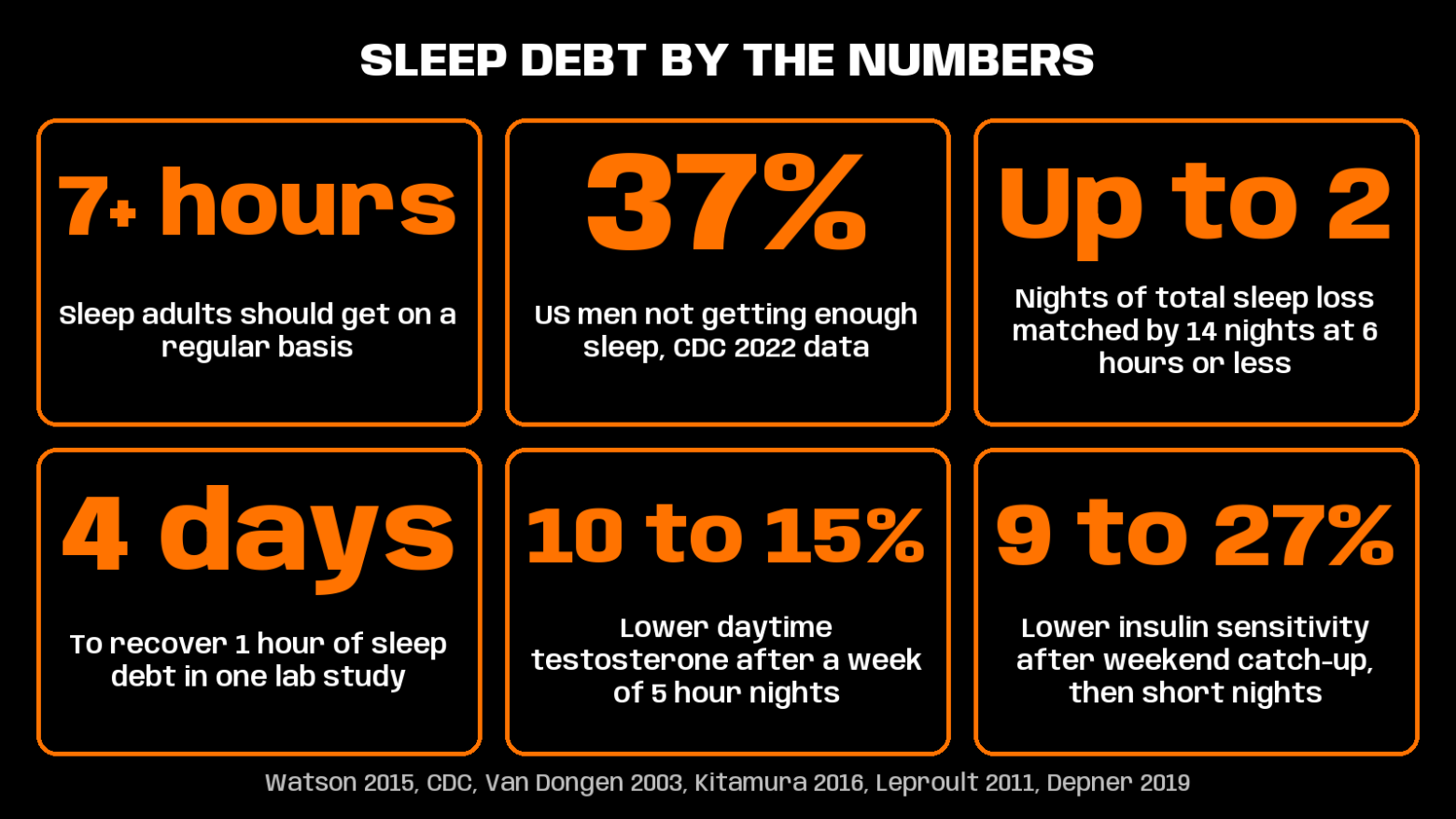
Six numbers from the research on sleep debt.
Can You Repay Sleep Debt at the Weekend?
Only partly. In one controlled laboratory test of the weekend lie-in, people who slept longer on Saturday and Sunday still lost ground once short nights returned. Their insulin sensitivity fell by about 9 to 27 percent during the restricted nights that followed, and their body weight rose, much like people who never had a weekend recovery [5].
The study placed 36 healthy young adults in three groups: 9 hours a night, 5 hours every night, or 5 hours on weekdays with two free nights at the weekend [5]. The weekend group slept only about 1.1 hours more than baseline in total, and their body clock timing was later than at baseline once short nights resumed [5].
The authors concluded that “weekend recovery sleep is not an effective strategy to prevent metabolic dysregulation associated with recurrent insufficient sleep” [5]. In an exploratory comparison, the men slept about 2.1 hours above baseline over the weekend nights, yet their energy intake did not fall back to baseline as the women’s did [5].
Population data paint a slightly kinder picture. In 43,880 adults followed for 13 years, people under 65 who slept short on weekdays but long at weekends had a mortality rate no different from people sleeping 6 to 7 hours every day [13]. In that age group, those sleeping 5 hours or less every day had a 65 percent higher risk of dying over the follow-up (a hazard ratio of 1.65) [13].
The authors added: “Possibly, long weekend sleep may compensate for short weekday sleep” [13]. That study only observed people, so it cannot prove cause.
How Long Does It Take to Recover From Sleep Debt?
Longer than one night. In a Japanese study of young men, 1 hour of potential sleep debt took about four days of extra sleep to clear, and the authors concluded that up to nine days of sufficient sleep opportunity may be needed to eliminate the debt [2]. US lab studies point the same way, with one long night restoring some performance but not all [14].
Banks and colleagues tested one night directly. In 142 adults limited to 4 hours in bed for five nights, attention lapses the next day were broadly lower the longer the recovery night, from 21.3 with no sleep to 5.6 after 10 hours in bed (6 and 8 hours came out about level), against group baselines of 1.7 to 3.4 [14]. Even 10 hours in bed left lapses and sleepiness ratings above baseline, and the authors wrote that “Complete recovery from such sleep restriction may require a longer sleep period during 1 night, and/or multiple nights of recovery sleep” [14].
Several nights is the realistic answer, and how many depends on how deep and how long the debt was. Dinges found that recovery from a week at about 5 hours appeared to need two full nights of sleep [3]. In Belenky’s 66 person study, the 5 and 7 hour groups showed no sign of recovery after three nights of 8 hours, and even the 3 hour group stayed short of full recovery [1].
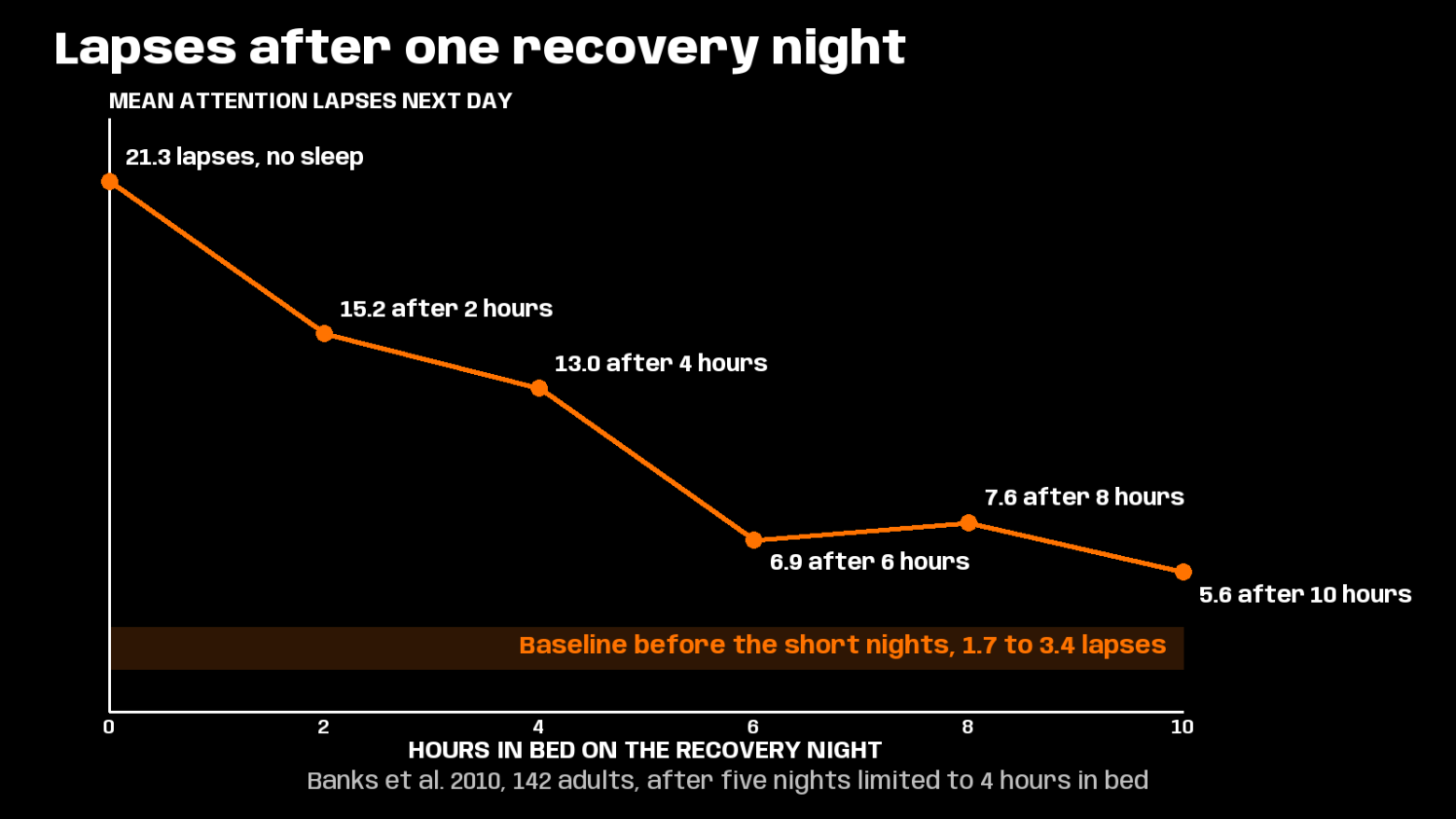
One long night helps, but even 10 hours in bed left lapses above baseline.
Do Naps Count Towards Sleep Debt?
Naps help how you function, though none of the research reviewed here shows that a nap erases a debt. A 2023 meta-analysis of 22 trials in 291 men aged 18 to 35 found that napping improved cognitive and physical performance and cut perceived fatigue, and the benefits were confirmed after partial sleep deprivation [6]. Naps of 30 to under 60 minutes did best [6].
A separate review of 11 studies, nearly all in the laboratory, with 381 people in total, found that naps improved overall cognitive performance, especially alertness, and the authors reported better results from naps taken early in the afternoon [15]. The first review measured sport-related performance, so it may not carry over to every desk day [6].
There are two catches. Sleep inertia, the groggy spell after waking, gave conflicting results in the review, and the NHS advises people with insomnia not to nap during the day [15][10]. If night sleep is already a problem, check that advice before you add a nap.
How Do You Pay Sleep Debt Back Properly?
Add sleep gradually and keep the schedule steady. Extra time in bed over several nights fits the evidence better than one marathon lie-in, because lab recovery took days, not hours [14][2]. Go to bed earlier by enough to close your own gap, hold a fixed wake time, and use the weekend as a top-up rather than the plan [2][10].
How big is the gap? In the Japanese study it averaged about 1 hour a night, but it ran from a small surplus to nearly 3 hours [2]. The NHS advice on insomnia is to wake up and get out of bed at the same time every day and not to sleep in after a bad night’s sleep [10], which points to going to bed earlier rather than getting up later.
Expect a timetable measured in days. If the Japanese ratio holds for you, an hour of debt takes about four days to clear [2], and one long night was not enough after a hard week [14].
Use naps as a patch, not the plan. A nap of 30 to 60 minutes in the early afternoon is the best supported version [6][15], as long as it does not eat into your night sleep.
Repaying debt also means stopping new debt, because weekend recovery sleep did not prevent the metabolic effects of short weeknights in the lab [5]. The fix is a regular bedtime that leaves room for your own number of hours, which for most healthy adults sits between 7 and 9 [8].
When Is It More Than Sleep Debt?
If you have been giving yourself 7 to 9 hours and still feel flat, something other than debt may be involved. The NHS lists breathing that stops and starts, gasping or choking noises and loud snoring among the signs of sleep apnoea, and says to see a GP if you notice them [16]. It also says to see a GP if you have had trouble sleeping for months [10].
Insomnia that lasts 3 months or longer is classed as long-term insomnia [10]. The sleep consensus statement adds that people concerned they are sleeping too little or too much should consult their healthcare provider [9]. A GP can check what is going on.
FAQ
Is one good night enough to clear sleep debt?
Usually not. After five nights at 4 hours, even a 10 hour recovery night left attention lapses and sleepiness above baseline [14]. In Dinges’ week-long study, recovery appeared to need two full nights [3].
Does sleeping in at the weekend mess up my body clock?
Possibly. In the weekend recovery group, body clock timing was later than at baseline once short nights resumed [5]. The NHS advice on insomnia is to keep the same wake time every day and not to sleep in after a bad night’s sleep [10]. Going to bed earlier is the safer way to add sleep.
Is sleeping more than 9 hours bad if I am catching up?
Not necessarily. The sleep consensus statement says regularly sleeping more than 9 hours may be appropriate for young adults, people recovering from sleep debt and people with illnesses [9]. For others, it says it is uncertain whether it is linked to health risk [9]. If you need that much every night for weeks, mention it to your GP.
Is sleep debt the same as insomnia?
No. The NHS describes insomnia as regularly having problems sleeping [10], while sleep debt is the running shortfall between the sleep you need and the sleep you get, whatever the reason. In one study, healthy men who reported no sleep problems still averaged about 1 hour of potential debt [2].
When should I see a GP about my sleep?
See a GP if you have had trouble sleeping for months, or if changing your sleeping habits has not helped [10]. The same goes if you snore loudly or notice gasping or choking noises at night, because the NHS says sleep apnoea can be serious if it is not diagnosed and treated [16].
Final Recommendation
Treat sleep debt as something you pay down over days, not at one weekend sitting. Find your number between 7 and 9 hours, move bedtime earlier to close the gap, keep a steady wake time and stop new debt before you try to clear the old [8][2][10]. The lab evidence says one long night helps but does not finish the job [14].
Expect it to take days: in the Japanese study an hour of debt took about four days to clear, and up to nine days may be needed [2]. If you still feel flat after that, or snoring and long-term trouble sleeping are part of the picture, speak to your GP [10][16].
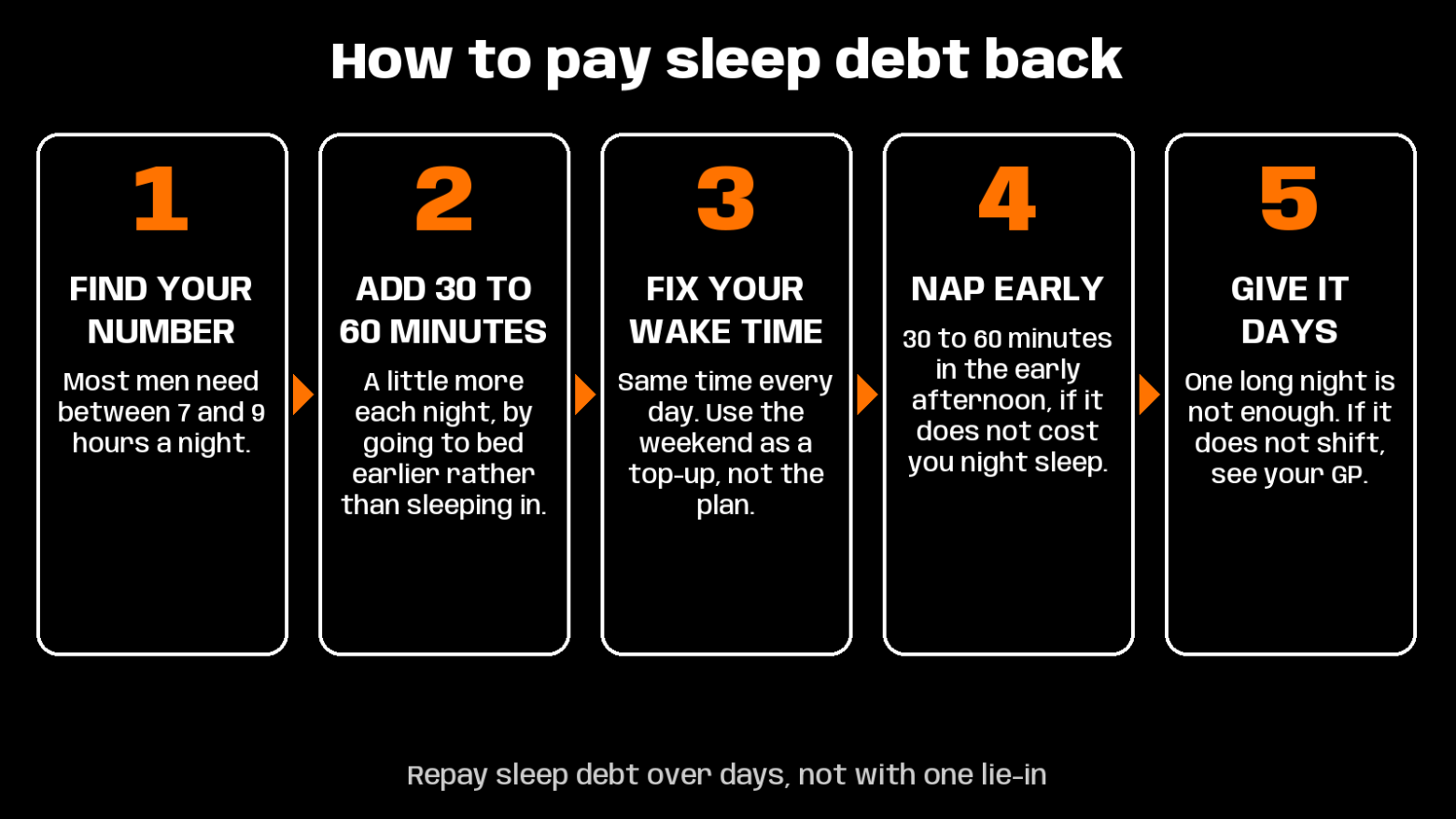
Five steps to pay sleep debt back over days, not one lie-in.
Options for Men to Take Action
Most men do not stay in sleep debt because they do not care about sleep. They stay in it because the plan lives in their head, the late nights creep in unnoticed, and a fortnight later nothing shows whether the earlier bedtime is still happening.
The MenTools app is built on a challenge system, with more than 150 challenge types across mindset, fitness, nutrition and money, levels you choose, daily actions, progress tracking, routines, journals and an AI coach. For repaying sleep debt, its job is the stretch this guide is about: keeping one small change visible across the days the evidence says recovery takes.
How you can do this today: pick one change from this guide, such as an earlier, fixed bedtime, choose the easiest level and use the daily action to keep it in front of you.
Wins on cost: one subscription covers challenges, journals and coaching, instead of several separate apps.
Wins on time: the challenges are already built, so you spend your evenings sleeping rather than designing a system.
Wins on practicality: each daily action takes minutes, which fits around work, family and travel.
Watch-out: the app tracks and prompts, but it cannot put you to bed. Sleep gets paid back in hours, not in taps, and the earlier bedtime is still your call.
Recovery is what the routine is protecting, so a one a day multivitamin may help cover the simple daily foundation underneath it. For more on getting your nights right, the MenTools sleep hub collects everything in one place. Pay it back in small steps, and keep the wake time steady.
Last updated: 2026-11-03 v1.0
Disclaimer: This guide is for informational purposes only and does not constitute medical or psychological advice. Speak with a qualified professional before making significant changes if you have a medical or mental health condition.
References
- [1] Belenky G, Wesensten NJ, Thorne DR, et al. Patterns of performance degradation and restoration during sleep restriction and subsequent recovery, a sleep dose-response study. Journal of Sleep Research, 2003;12(1):1-12. Link
- [2] Kitamura S, Katayose Y, Nakazaki K, et al. Estimating individual optimal sleep duration and potential sleep debt. Scientific Reports, 2016;6:35812. Link
- [3] Dinges DF, Pack F, Williams K, et al. Cumulative sleepiness, mood disturbance, and psychomotor vigilance performance decrements during a week of sleep restricted to 4-5 hours per night. Sleep, 1997;20(4):267-277. Link
- [4] Van Dongen HPA, Maislin G, Mullington JM, Dinges DF. The cumulative cost of additional wakefulness, dose-response effects on neurobehavioral functions and sleep physiology from chronic sleep restriction and total sleep deprivation. Sleep, 2003;26(2):117-126. Link
- [5] Depner CM, Melanson EL, Eckel RH, et al. Ad libitum weekend recovery sleep fails to prevent metabolic dysregulation during a repeating pattern of insufficient sleep and weekend recovery sleep. Current Biology, 2019;29(6):957-967. Link
- [6] Mesas AE, Núñez de Arenas-Arroyo S, Martinez-Vizcaino V, et al. Is daytime napping an effective strategy to improve sport-related cognitive and physical performance and reduce fatigue? A systematic review and meta-analysis of randomised controlled trials. British Journal of Sports Medicine, 2023;57(7):417-426. Link
- [7] Leproult R, Van Cauter E. Effect of 1 week of sleep restriction on testosterone levels in young healthy men. JAMA, 2011;305(21):2173-2174. Link
- [8] NHS Every Mind Matters. Sleep problems. National Health Service. Link
- [9] Watson NF, Badr MS, Belenky G, et al. Recommended amount of sleep for a healthy adult, a joint consensus statement of the American Academy of Sleep Medicine and Sleep Research Society. Sleep, 2015;38(6):843-844. Link
- [10] NHS. Insomnia. National Health Service. Page last reviewed 19 March 2024. Link
- [11] Centers for Disease Control and Prevention. FastStats, Sleep in adults. Page dated 15 May 2024. Link
- [12] Spiegel K, Leproult R, Van Cauter E. Impact of sleep debt on metabolic and endocrine function. The Lancet, 1999;354(9188):1435-1439. Link
- [13] Åkerstedt T, Ghilotti F, Grotta A, et al. Sleep duration and mortality, does weekend sleep matter? Journal of Sleep Research, 2019;28(1):e12712. Link
- [14] Banks S, Van Dongen HPA, Maislin G, Dinges DF. Neurobehavioral dynamics following chronic sleep restriction, dose-response effects of one night for recovery. Sleep, 2010;33(8):1013-1026. Link
- [15] Dutheil F, Danini B, Bagheri R, et al. Effects of a short daytime nap on the cognitive performance, a systematic review and meta-analysis. International Journal of Environmental Research and Public Health, 2021;18(19):10212. Link
- [16] NHS. Sleep apnoea. National Health Service. Page last reviewed 11 May 2026. Link