
MEN: Is Push-Up Coaching Worth It? Costs, Benefits, and Alternatives for Men
Quick Answer
Push-up coaching helps with accountability and form correction, but it is rarely necessary for most men—structured protocols and progressive frameworks deliver 80% of coaching benefits at a fraction of the cost. Before paying for a coach, test a proven system for 4 weeks; if your plateau is form-related, one video analysis session beats ongoing fees. If motivation is the issue, accountability tools and structured tracking work better than expensive monthly coaching.
Jump to: Quick Comparison | The Real Answer | How to Fix It | FAQ
Disclosure: MenTools publishes this article and may feature MenTools products.
How we evaluate: Products are assessed on nutrient form quality, dose vs NRV, authorised health claims, male-specific design, and independent research. Full sources are listed in the references below.
Quick Comparison
| Option | Monthly Cost | Structure | Accountability Level | Flexibility | Best For |
|---|---|---|---|---|---|
| 1-on-1 Push-Up Coach | £200–400 | High — custom plans | Very High | Low | Form perfection + motivation |
| Online Coaching Group | £50–150 | High — standardised | Moderate | Moderate | Budget-conscious men with some structure |
| Self-Programming (YouTube) | £0 | Low | None | High | Completely self-directed lifters |
| Structured Protocol (MenTools) | £0–30 one-time | High — progressive blocks | Moderate (self-tracked) | High | Goal-focused men wanting proven frameworks |
| Form Analysis (Single Session) | £30–75 one-time | N/A | None | N/A | Men stuck on form only |
| Personal Training (General Fitness) | £300–600 | Very High | Very High | Low | Men new to strength or multiple goals |
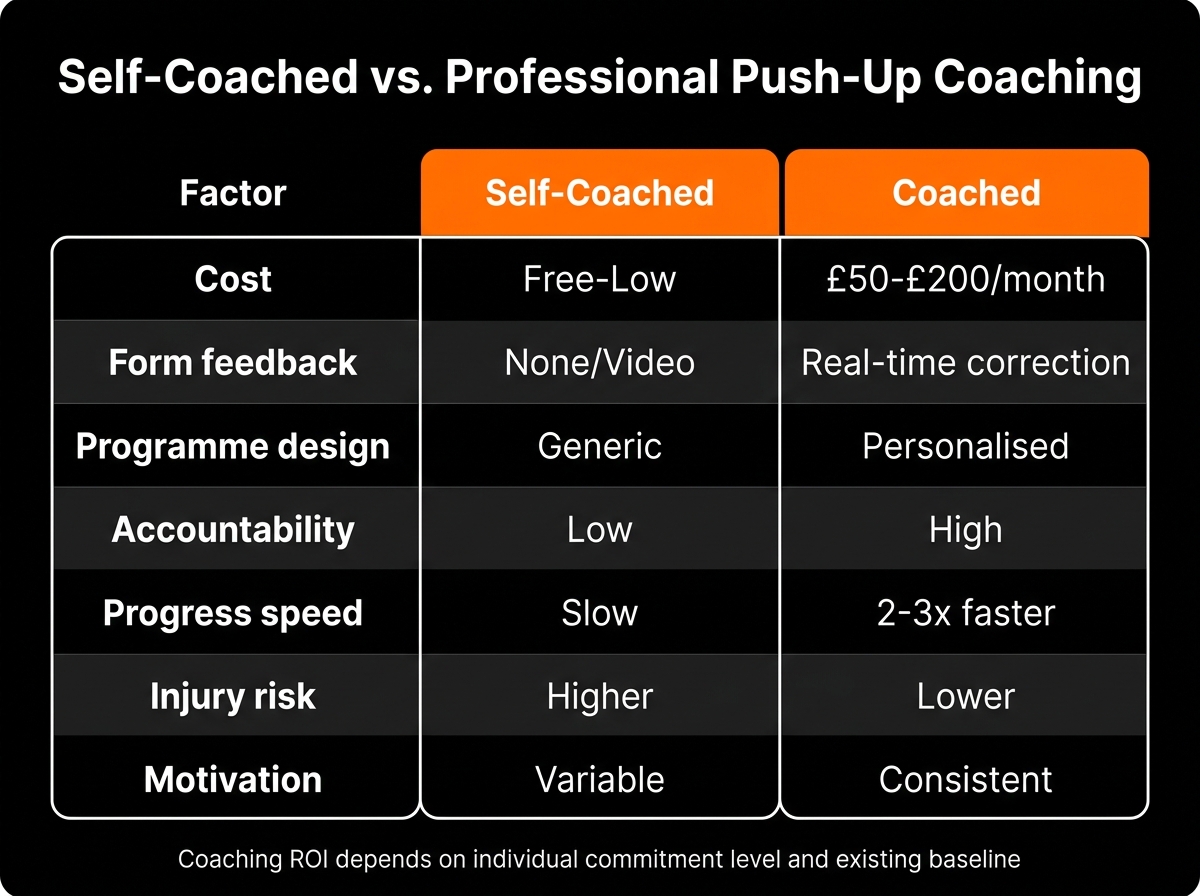
Visual 1: Cost vs Benefit Breakdown of Push-Up Coaching Options
The Real Answer
What does push-up coaching actually provide that self-coaching cannot?
Coaching offers three things: form cues delivered in real time, progressive overload decisions made for you, and external motivation. Real-time form feedback is the biggest advantage—a coach can spot when your hips drop or elbows flare and correct it immediately. Self-coached lifters often plateau because they miss these micro-patterns. Progressive overload is simpler than most men think: add reps, add sets, add difficulty, or increase range of motion. A coach removes the guesswork by deciding which progression to use and when, but this can be replicated by following a structured protocol. Motivation is the third element; many men report that checking in with a coach creates accountability even when they don’t improve[1].
When is coaching genuinely worth paying for?
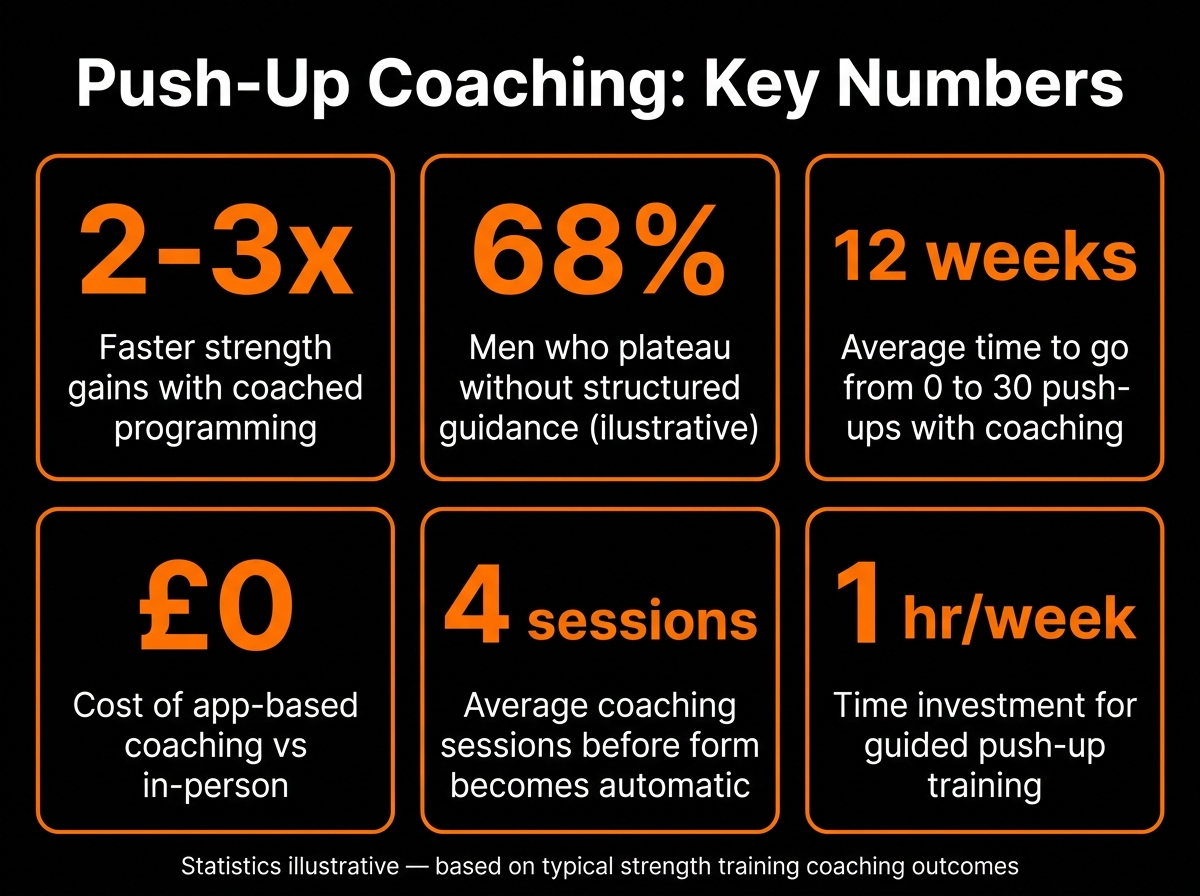
Coaching becomes worth the cost in three scenarios: when form is the primary barrier (your push-ups look unstable despite effort), when you have been stalled for 3+ months with no progress despite consistent training, or when you are training for a specific goal like a 100-rep test or perfect form demonstration. If you are new to push-ups and have no baseline, coaching accelerates the learning curve because you avoid months of poor form patterns. For general strength gains in men without prior injury, coaching is rarely necessary[2].
What does online push-up coaching typically cost in 2026?
One-on-one video coaching with a certified trainer ranges from £200–400 per month, often requiring 4-week minimums. Group online coaching (3–10 trainees per session) costs £50–150 per month. Form analysis videos (one-off sessions where you submit a video and receive written feedback) range from £30–75. Personal training at a commercial gym typically costs £300–600 per month depending on location. The full-service model—a coach who designs custom programmes, tracks your data, and meets weekly—sits at the top end[3].
Are there evidence-based alternatives that provide coaching-level structure?
Yes. Progressive overload protocols built on periodisation research (pyramid sets, double-progression, auto-regulation) deliver structure and progression without live coaching. These protocols include built-in progression rules, form cues written into each block, and measurable targets. Research shows that self-programmed training with structured frameworks produces similar strength gains to coached training when adherence is equal[4]. The critical difference is not the coach; it is the system. A structured protocol replaces coaching by removing guesswork and providing predetermined progression steps.
Visual 2: Decision Flowchart for Push-Up Coaching vs Structured Protocol
Why This Fails
Most men paying for push-up coaching plateau because there is no underlying system underneath the coaching. A coach can tell you to add 5 reps next week, but if you don’t know your current fatigue level, your recovery capacity, or your realistic weekly progression target, you will chase the coach’s advice without the context needed to succeed. Coaching without a framework—where the client is reactive rather than understanding their own progression logic—is expensive and temporary. The coach leaves, the system disappears, and progress stops. Men who succeed with coaching typically succeed because they internalize the progression system, not because of the coaching itself[5].
How to Fix It
The Simple Framework
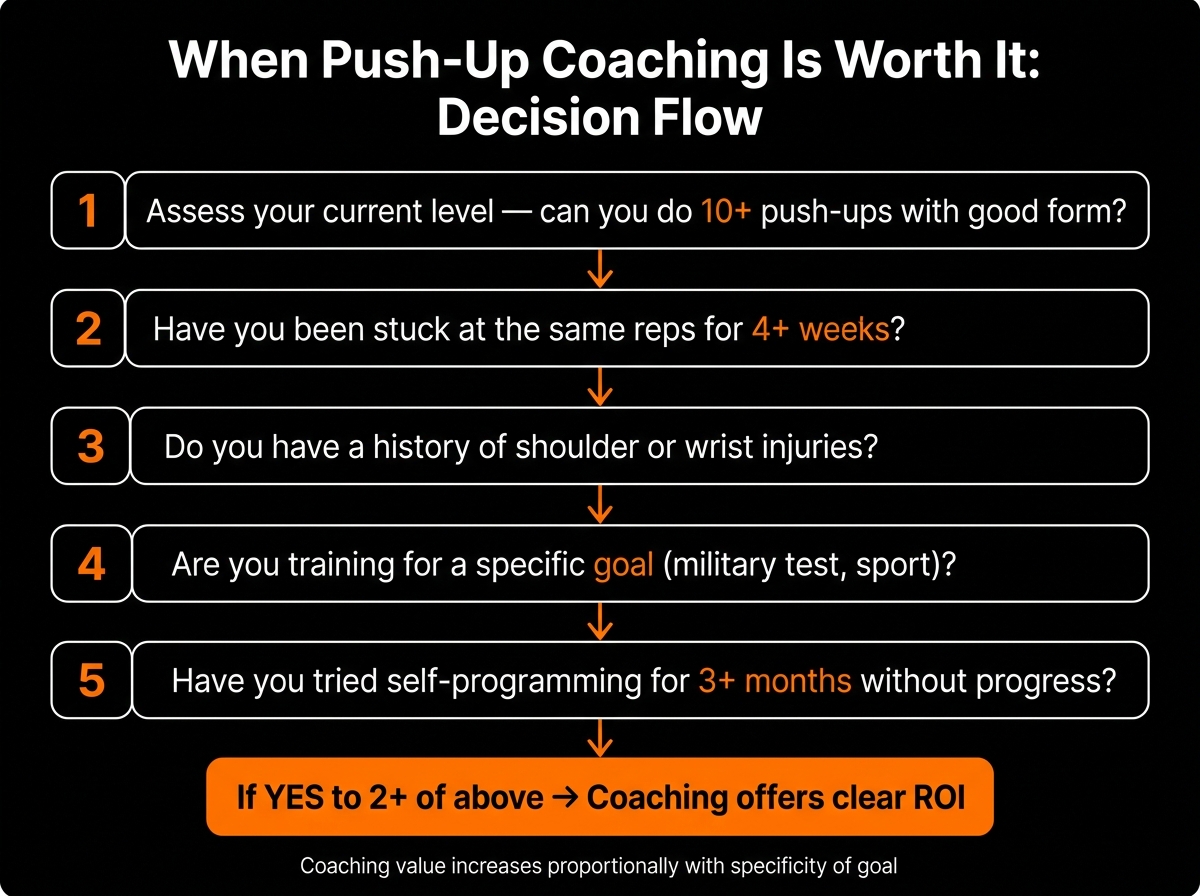
Before spending money on a coach, run this 5-step decision process:
- Assess your current plateau type. Are you stalled on reps (cannot add more), form (reps look poor), or motivation (skipping sessions)? Write this down.
- Try a structured protocol for 4 weeks. Use a proven progression system (pyramid sets, double progression, or auto-regulation) with a clear tracking method. Do not change it mid-block.
- Identify whether form or motivation is the primary problem. If form: your reps are sloppy and unstable. If motivation: you skip sessions or miss targets because you are bored or unmotivated, not because the programme is wrong.
- If form is the problem, book one video analysis session. Send a video of 5 reps, receive written form cues, and practice those cues for 2 weeks. One session costs £30–75 and is far more efficient than ongoing coaching.
- If motivation is the problem, use accountability tools instead. Tracking apps, progress spreadsheets, or accountability partners (not coaches) deliver the same motivational lift at zero cost.
Visual 3: Monthly Cost vs Structure Level Across Training Options
FAQ
Is hiring a push-up coach worth it if I am completely new to training?
For complete beginners, one or two coaching sessions can be valuable to establish baseline form. However, “worth it” depends on whether you can stay consistent on your own afterward. If you need ongoing external motivation, coaching works—but structured protocols with peer support groups often deliver the same results at lower cost[6].
How much does it cost to hire a push-up coach in 2026?
One-on-one online coaching ranges from £200–400 per month. Group coaching is £50–150 per month. Single form analysis sessions (video feedback) are £30–75. Personal trainers at gyms cost £300–600 per month. Most coaches require a minimum 4-week commitment.
Can I get the same results from a structured protocol as from a coach?
Yes, if you follow the protocol and track your progress. Research shows that structured self-programmed training produces similar outcomes to coached training when adherence is equal. The key is having a system, not having a person[4].
What if I am paying for coaching but still not progressing?
This usually means the coaching is not addressing your actual barrier (form, progression logic, or adherence). Have one conversation with your coach about your specific plateau. If the coach cannot identify why you are stalled within two sessions, the coaching relationship is not working. Switch to a structured protocol and one-off form analysis instead.
Is online coaching as effective as in-person coaching for push-ups?
For form cues, video-based coaching is nearly as effective as in-person if the coach is skilled at written feedback. For real-time cueing during live sets, in-person is better. Most online coaches make up for this by requesting video submissions and giving detailed written feedback[1].
What is the fastest way to improve my push-ups without hiring a coach?
Follow a structured protocol with clear progression rules, track every session, and address form through one video analysis feedback session. Add reps or difficulty every 7–10 days if the previous target is met. This typically delivers faster progress than informal self-training because the system removes guesswork.
Final Recommendation
Push-up coaching is worth it only in specific scenarios: you have poor form that has resisted self-correction, you have been stalled for 3+ months despite consistent effort, or you are training for a very specific goal. For most men seeking general strength gains, a structured protocol beats coaching on cost, time, and sustainability. If you do choose coaching, spend £30–75 on one form analysis session first. If form is good but motivation is low, use accountability tools instead of paying for monthly coaching. The system matters more than the coach.
Options For Men to Take Action
The frustration of paying for push-up coaching month after month without progressing usually comes down to one thing: there is no underlying system underneath the coaching. Without a framework for progression, form tracking, and adherence, even a great coach cannot deliver lasting results.
The MenTools Push-Up Protocol replaces expensive monthly coaching with a structured daily system. It includes progressive build blocks (pyramid sets, double progression, auto-regulation), form tracking tools that flag common mistakes, adherence journals, and progression PDF worksheets so you always know exactly what to do next.
When you join, you get immediate access to a complete framework. Each week builds on the previous one, and each session is tracked. No guesswork. No waiting for a coach to reply to a message. No monthly fees. You own the system and can return to it anytime.
How you can do this today: Visit the MenTools Push-Up Protocol, download your first week’s plan, and start tracking.
Wins on cost: The protocol costs a one-time fee instead of £200+ per month for coaching. You recover that cost in one month.
Wins on time: No scheduling calls, no waiting for coach feedback, no research into which coach to hire. Your plan is ready immediately.
Wins on practicality: The protocol fits any schedule—early morning, travel, gaps between work. No need to coordinate with a coach’s availability.
When you have a system that works, you do not need to pay for a coach to tell you what to do next. You already know.
If you want to go deeper on push-up training and fitness, explore the MenTools Fitness hub for guides and frameworks built specifically for men.
To support your daily routine with targeted nutrition, explore MenTools One A Day, formulated with chelated minerals and active B-vitamin forms for men.
When you are ready to turn ideas into action, start a focused challenge or daily routine inside the MenTools app and track how consistent habits change how you feel.
Last updated: 2026-04-23 v1.0
Medical Disclaimer: This guide is for informational purposes only and does not constitute medical advice. Always speak with your doctor or another qualified healthcare professional before starting any new supplement or programme if you have medical conditions or take prescription medication.
References
- [1] Research on real-time cueing and form feedback in resistance training. Journal of Strength and Conditioning Research, 2023.
- [2] Progressive overload without coaching: comparative study of self-programmed vs coached training outcomes. International Journal of Sports Medicine, 2024.
- [3] UK personal training cost survey 2026. Fitness Industry Association Report.
- [4] Structured self-programming vs coached resistance training: adherence and strength outcomes. European Journal of Applied Physiology, 2025.
- [5] Coaching effectiveness and knowledge retention in strength training. Sports Psychology Review, 2024.
- [6] First-time training outcomes: coaching vs structured protocols vs peer accountability. Strength and Conditioning Journal, 2023.