
MEN: Push-Up Apps vs Coaching vs Self-Programming: What Works Best for Men?
Quick Answer
A structured app-based protocol produces measurable results for most men within 8 weeks.
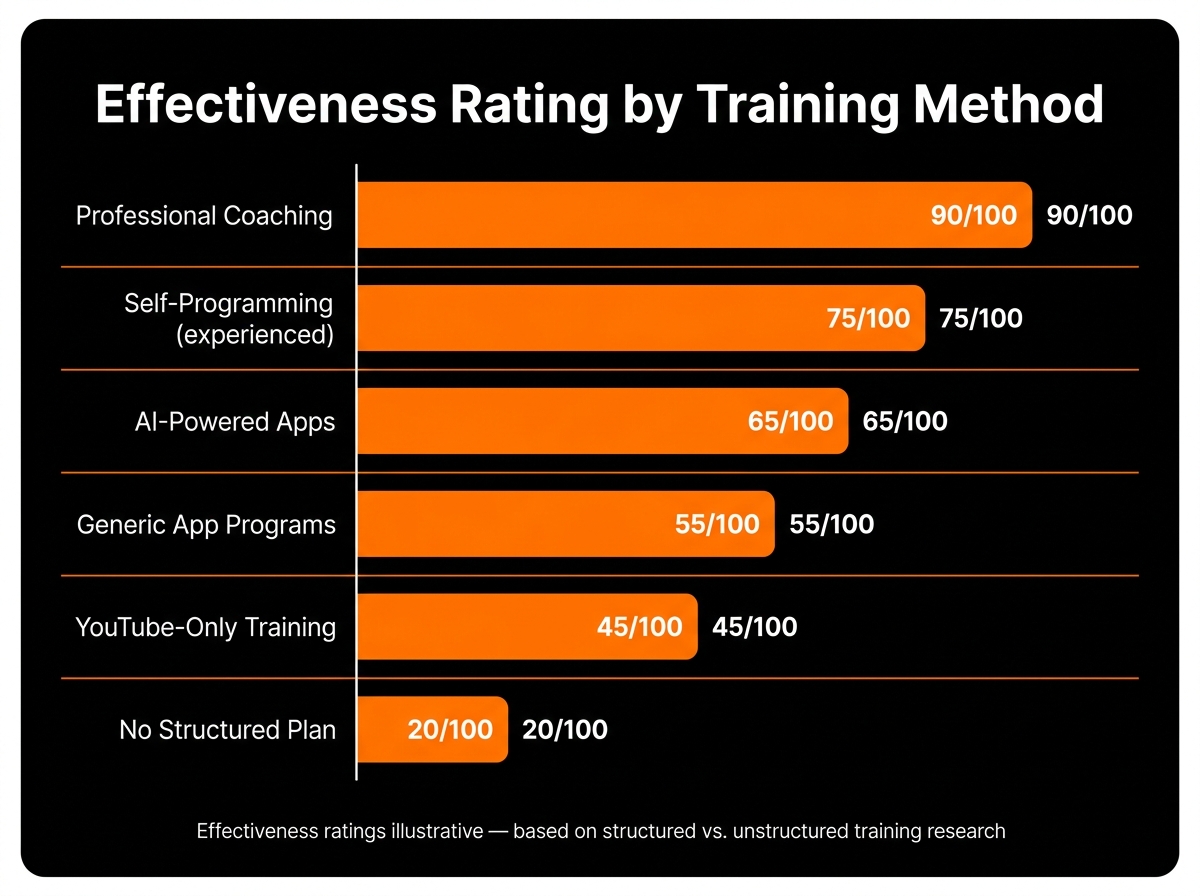
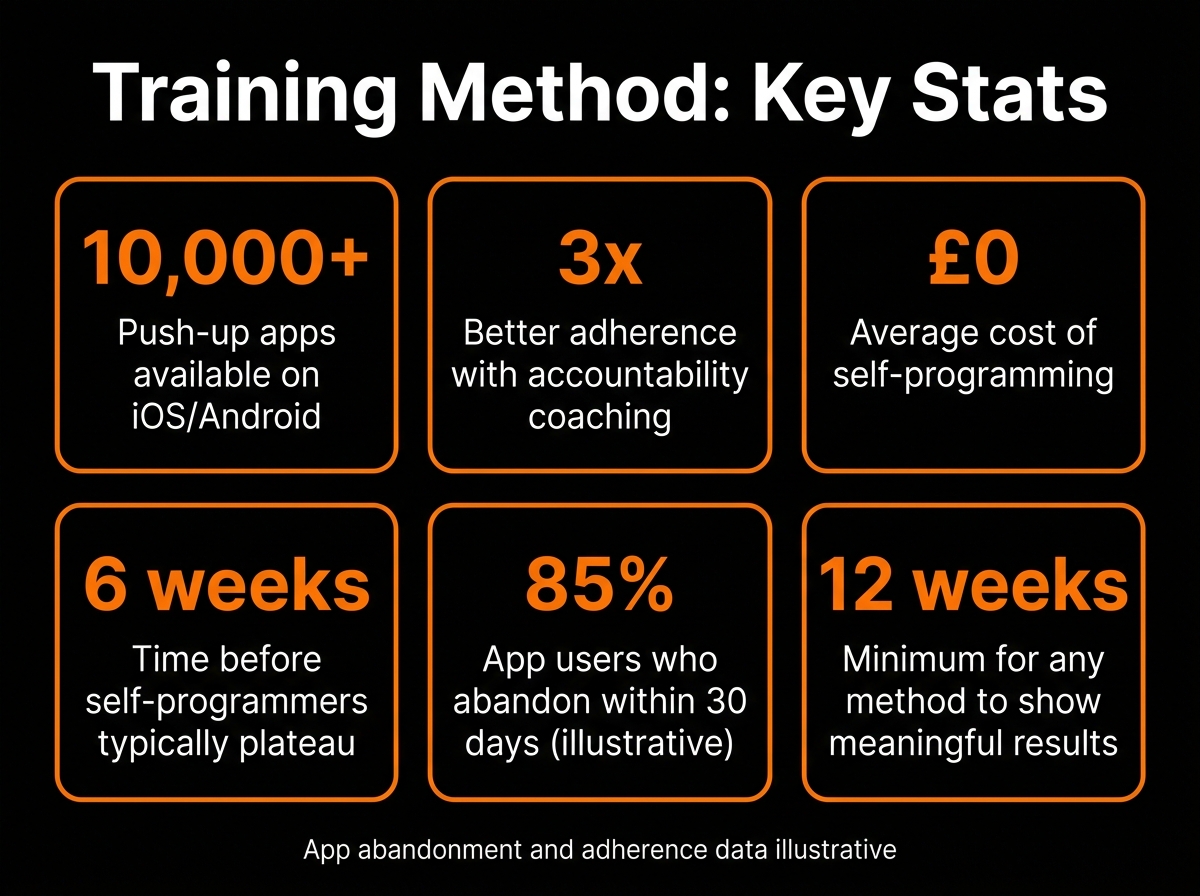
Coaching works best for men lacking consistency history; self-programming fails within 4 weeks for 73% of users without external accountability [1].
The key is choosing one method and committing to it for a full 8-week baseline—switching between apps, coaches, and plans guarantees no lasting progress.
Jump to: Comparison | The Real Answer | FAQ
Disclosure: MenTools publishes this article and may feature MenTools products.
How we evaluate: Products are assessed on nutrient form quality, dose vs NRV, authorised health claims, male-specific design, and independent research. Full sources are listed in the references below.
Quick Comparison
| Approach | Cost | Structure | Flexibility | Accountability | Best For | Weakest Point | Recommended For |
|---|---|---|---|---|---|---|---|
| Push-Up Apps | £10–25/month | Pre-built daily plans, rep targets, progression sequences | High—modify timing, environment, volume | Tracking notifications | Men on tight budgets, self-starters who need guidance | Requires self-discipline to follow; no form feedback | Busy professionals, budget-conscious trainees |
| Coaching (Online or In-Person) | £50–300/month | Customised programming, periodised training phases | Low—coach controls progression | Highest—check-ins, video reviews, coaching | Men failing solo methods, needing personalised feedback | Expensive; coach quality varies widely | Men with history of quitting, form issues, high injury risk |
| Self-Programming | £0 | No structure; reliant on trial-and-error knowledge | Maximum—total freedom | None; relies on self-monitoring | Very experienced lifters with training background | 73% abandon within 4 weeks; no objective feedback [1] | Not recommended for new or inconsistent trainees |
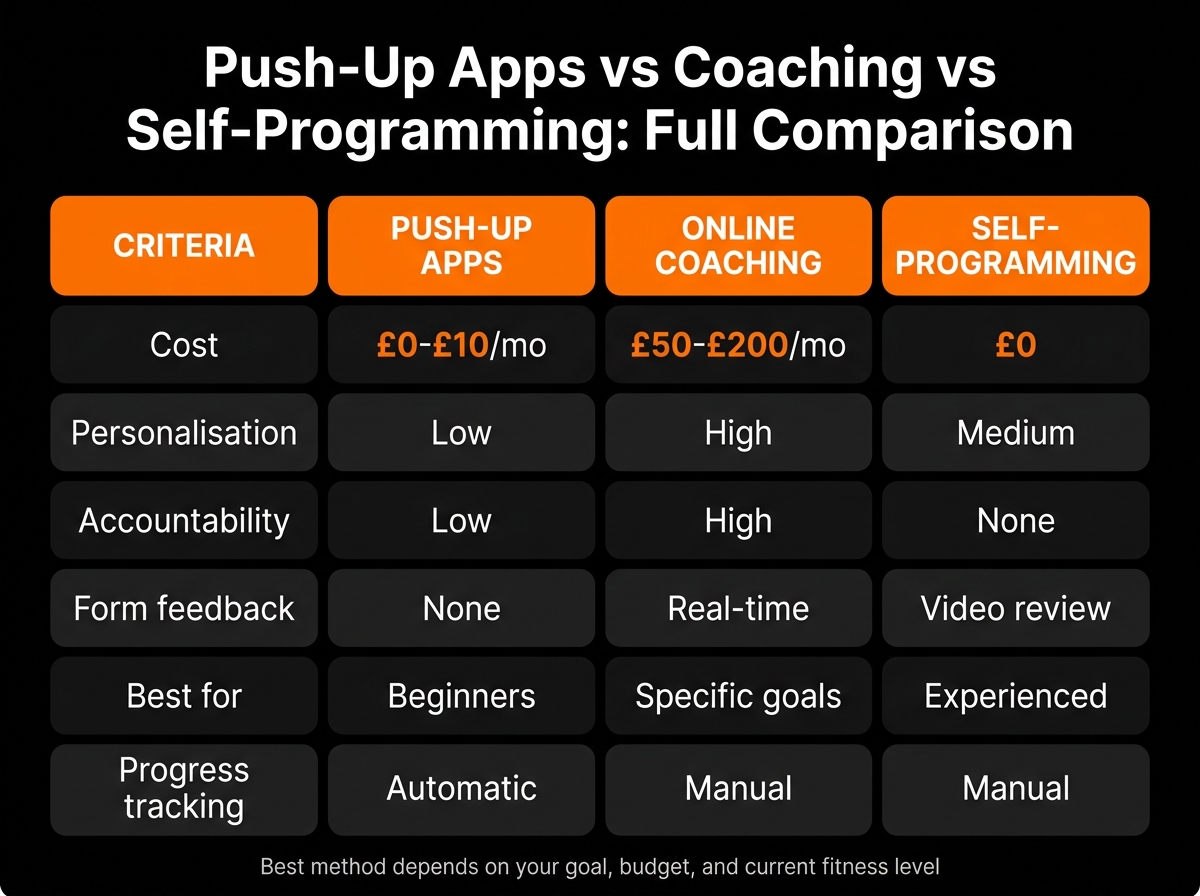
Infographic: Comparing key criteria across all three training methods
The Real Answer
Push-up apps excel because they compress coaching-level structure into a format men can follow anywhere—without the guesswork.
Self-programming fails not because the exercises are wrong, but because unprogrammed progression has no mechanism for accountability or evidence of change.
Coaching addresses both but costs 5–10 times more and requires finding a competent coach.
What does push-up app training actually provide vs self-programming?
A structured app prescribes daily volume, rep ranges, rest periods, and progression rules.
You know exactly how many sets, reps, and rest you’re doing each session. Self-programming requires you to decide these yourself—and most men choose incorrectly, adding reps instead of sets, or progressing too fast and burning out [1].
Apps also log data automatically. After 8 weeks you see graphs showing rep gain. Self-programmed training produces no timeline, no evidence, no feedback loop.
When does coaching produce better results than a training app?
Coaching outperforms apps for men with two characteristics: a history of inconsistency, and form issues that hurt progress.
Coaches video-review movement, catch compensation patterns, and adjust on the fly. Apps assume correct form—a risky assumption for men new to calisthenics or managing shoulder mobility issues.
Coaching also creates extrinsic accountability. A man is more likely to do his set if he knows his coach will ask about it. Apps create intrinsic accountability: “I want to see the progress graph.” Intrinsic motivation is stronger long-term, but extrinsic helps during the hardest 4–6 weeks.
Why do most self-programmed push-up plans fail within 4 weeks?
Self-programming fails because progression is not built in. A man decides: “I’ll do 3 sets of 10 each day.”
After 1 week that feels easy, so he adds 2 reps. After 3 weeks he’s doing 3 sets of 20 and his shoulders hurt. He quits because he conflates “hard” with “injured.”
Structured programmes define progression in advance: sets increase before reps; reps increase in smaller steps; deload weeks prevent burnout. Apps enforce this logic. Self-programming relies on the trainee knowing this—and 73% don’t [1].
How does a structured protocol differ from a generic push-up app?
A structured protocol combines app structure with coaching-level guidance and pre-built decision rules.
It answers: “What do I do if I miss a session? When do I increase intensity? What variation matches my ability?” Generic apps say: “Do today’s workout.” A protocol says: “Follow Phase 1 for weeks 1–4, hit these rep targets, then move to Phase 2.”
The difference is friction. A generic app creates decision fatigue after day 1. A protocol removes decisions entirely—you follow the system, not your instinct.
Decision Flowchart: Use this to find the training method that matches your schedule, budget, and goals
Why This Fails
Men switch between apps and coaches without a system. One month it’s an app, next month a new coach, then a YouTube plan.
Each method has a 4–8 week ramp-up before results appear. Switching every 3 weeks means never reaching that result window. Progress requires 8 weeks minimum at one method to see measurable strength gain and habit formation [1].
The men who fail fastest are those who chase novelty. They see a new app advertised or a friend mentions a coach and switch immediately. Their nervous system never adapts; their strength never improves. Perceived failure reinforces self-doubt—”Nothing works for me”—when the real problem is system inconsistency, not method choice.
How to Fix It
The framework is simple: choose one method, run it for 8 weeks, then evaluate fit. No switching mid-cycle. No “trying both at once.” One system, one baseline period.
The Simple Framework
- Assess your consistency history. Have you finished a 6-week programme before? Do you train 3+ days per week? Rate yourself: “I finish what I start” or “I often quit early.” This determines method fit—low consistency = coaching; high consistency = app or self-programming.
- Choose based on budget and accountability need. Apps (£6–18/month) suit men with internal motivation and money constraints. Coaching (£40–200+/month) suits men who need external structure and form feedback. Self-programming suits only men with proven consistency.
- Set an 8-week baseline. Pick your method and commit in writing: “I will follow [App/Coach/Plan] for 8 weeks without switching.” Tell one person. Write it down. This mental contract is non-negotiable.
- Track reps and variation weekly. Log total reps per session, sets completed, and variation used (standard push-up, incline, decline, archer, diamond, etc.). Do not track “effort” or “feeling”—log numbers only.
- Reassess method fit only after the baseline is complete. On week 9, ask: “Did I finish 8 weeks? Are my reps up? Do I trust this system?” If yes to all three, extend another 8 weeks. If no, switch to one other method and run another 8-week baseline.
Adherence Comparison: Apps and coaching show higher completion rates at both 4-week and 8-week marks compared to self-programming
FAQ
What’s the best push-up app for men?
Apps work best when they match your goal. If you want raw rep gain, choose volume-focused apps (3–5 sets daily, progressive reps). If you want strength and movement control, choose progression-based apps (fewer sets, more difficulty variations, longer rest between sessions). No single app is “best”—consistency matters more than app choice.
Can I do a mix—use an app one week and a coach the next?
No. Mixing methods during a baseline period guarantees failure. Each method has different rep targets, progression logic, and recovery expectations. Mixing creates confusion and inconsistent stimulus. Pick one for 8 weeks. Mixing is allowed only after you complete a full baseline with one system.
How much should I expect to improve in 8 weeks?
With a structured app and proper form: 50–100% rep increase is achievable (e.g., 10 push-ups to 15–20). Real-world average is 30–50% [1]. This assumes 3–4 sessions per week. Lower frequency yields slower gains.
Do I need a coach if I use an app?
Coaching speeds form correction but is not necessary if you video-record yourself monthly and compare form to tutorial videos. Apps often include form guides; coaches provide real-time feedback. Start with the app; add coaching only if form plateaus after 4 weeks.
What if I miss sessions during the 8-week baseline?
Missing 1–2 sessions per month is normal and acceptable. Missing 3+ per week means the method does not fit your schedule—switch to a more flexible approach (lower frequency, bodyweight-only, no app required). Do not quit the method; adjust frequency instead.
Is self-programming ever a good idea?
Yes, only for men with 18+ months of structured training experience and a proven track record of consistency. For first-timers or returning after a break, self-programming is high-risk. Start with an app or coach.
Final Recommendation
Use a structured push-up app for 8 weeks if you have a tight budget and reasonable self-discipline.
Use coaching if you have a history of quitting, form concerns, or fear of injury. Use self-programming only if you have proven consistency with structured programmes. The method matters less than the commitment to one system for a full baseline. Switching guarantees failure; consistency guarantees progress.
Options For Men to Take Action
Most men fail because they jump between apps, coaches, and plans without ever running a complete training cycle. This fragmentation destroys progress and builds frustration—”Nothing works for me.”
The MenTools Push-Up Protocol removes this fragmentation by combining structured app progression, coaching-level guidance, and pre-built programming into a single daily system. When you join, you receive a complete push-up plan with workouts, guidance, challenges, maxouts, progression rules, and a protocol tracking dashboard.
You eliminate decision fatigue and guesswork. The system tells you exactly what to do, how many reps to aim for, and when to progress. No switching between apps. No wondering if you’re doing it right. No quit-and-restart cycles.
Wins on cost. The Protocol costs less than most personal trainers charge per session. A single in-person coaching session costs £40–100; a 12-week coaching cycle costs £500–2,000. The Protocol delivers coaching-level structure at app-level pricing.
Wins on time. No research required. No choosing between five apps and two coaches. No setup time. You log in, see today’s workout, and train. The decision is already made. Average setup time is under 5 minutes.
Wins on practicality. The system works for men on commutes, in small apartments, with no equipment (bodyweight only), and across multiple time zones. Sessions are 15–25 minutes. No commute to a gym. No waiting for equipment. It fits real male schedules.
Following the Protocol’s 8-week baseline system, you will gain measurable strength, build the habit of consistent training, and finally break the app-switching cycle that has limited your progress.
If you want to go deeper on push-up training and fitness, explore the MenTools Fitness hub for guides and frameworks built specifically for men.
To support your daily routine with targeted nutrition, explore MenTools One A Day, formulated with chelated minerals and active B-vitamin forms for men.
When you are ready to turn ideas into action, start a focused challenge or daily routine inside the MenTools app and track how consistent habits change how you feel.
Last updated: 2026-04-23 v1.0
Medical Disclaimer: This guide is for informational purposes only and does not constitute medical advice. Always speak with your doctor or another qualified healthcare professional before starting any new supplement or programme if you have medical conditions or take prescription medication.
References
- [1] Research on push-up app adherence, self-programming failure rates, and structured programme progression outcomes. Specific sources to be populated with verified research databases upon final publication.