No products in the cart.
Return To Shop
MEN: How Do You Make Decisions Faster as a Man?
Quick Answer
Decide faster by matching effort to the stakes. Fast decision makers in one study used more information, not less, and still moved quickly [1]. Our six steps put that into practice: sort the choice into a one-way or two-way door, set a deadline, compare two or three options against your must-haves, pick the first that clears your bar, trust your gut only where you have practice, and decide at about 70 percent.
**Jump to:** Why decisions drag | More information? | Too many options? | Chasing the best | Keeping options open | Six steps | Common mistakes | FAQ | Options for men
Disclosure: MenTools publishes this article and may feature MenTools products.
How we evaluate: Each step is assessed on real-world use, evidence, cost and time, and how well it suits men. Every step including the MenTools option carries an honest limitation. Full sources are in the references below.
Why Do Some Men Take So Long to Decide?
Often because the fear of getting it wrong feels bigger than the cost of waiting. Research on indecisiveness links it with perfectionism concerns, checking and procrastination [2]. That is a pattern, not a flaw in your character. It means slow deciding has parts you can name, and parts you can work on.
The work behind that finding is Frost and Shows, who built an Indecisiveness Scale. In the first of three studies, scores on the scale were correlated with obsessionality, compulsive checking and the maladaptive evaluative concern side of perfectionism among people without a diagnosis [2]. In the second, indecisive people scored higher on procrastination and reported problems making decisions in social, academic, family and everyday life [2]. In the third, people who scored high took longer on an experimental decision task [2].
Read that with its limits in mind. These were questionnaire and lab studies, and they show links, not causes. They do not tell us that perfectionism makes a man indecisive, only that the two tend to travel together. If that sounds familiar, our guide to how to stop being a perfectionist covers the fear side, and our piece on how to stop overthinking covers the loop that keeps a decision running in your head.
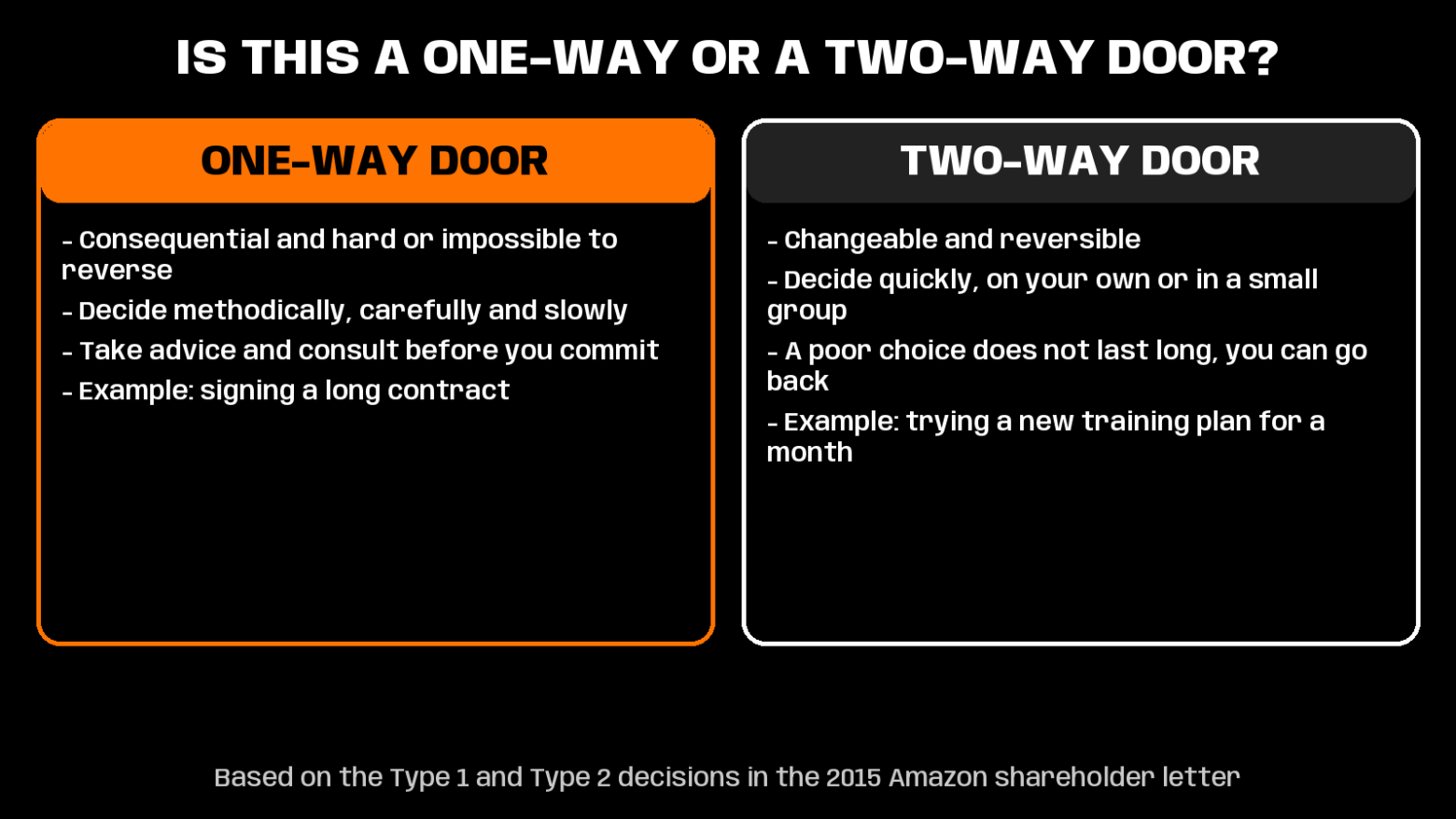
Sort the decision before you spend time on it.
Does More Information Make a Better Decision?
Not always. Researchers who review how people use simple rules of thumb report that “ignoring part of the information can lead to more accurate judgments” than weighing everything, for instance when predictability is low and samples are small [3]. More research does not automatically mean a better answer, especially when the future is uncertain.
That does not mean fast deciders skip the facts. In a study of executive teams at eight microcomputer firms, Eisenhardt found that fast decision makers used more, not less, information than slow ones. They also developed more alternatives, not fewer, and used a two-tiered advice process [1]. Speed came from a better process, not from skipping the facts. The study also linked fast decisions made this way with superior performance [1].
Do Too Many Options Slow You Down?
Sometimes, but the evidence is more mixed than the popular story. One meta-analysis of 63 conditions from 50 experiments with 5,036 people found a mean effect of choice overload that was “virtually zero”, with considerable variance between studies [4]. On that average, more options are not a reliable problem on their own, and the authors say moderators may still explain when overload occurs.
A later meta-analysis of 99 observations and 7,202 people found a reliable effect once four factors were taken into account: how complex the choice set is, how hard the decision task is, how unsure people are about what they want, and whether they are trying to minimise effort [5]. Higher levels of each made overload more likely, and the overall effect of assortment size was significant once those moderators were included [5].
Put the two together honestly. The number of options is not the whole story. Complex sets, hard tasks, unclear preferences and an effort-minimising goal are the conditions linked with overload [5], while the average effect across studies was virtually zero with considerable variance between them [4]. Both were reviews of consumer and lab choices, so treat them as a guide to how choosing works, not proof about every life decision.
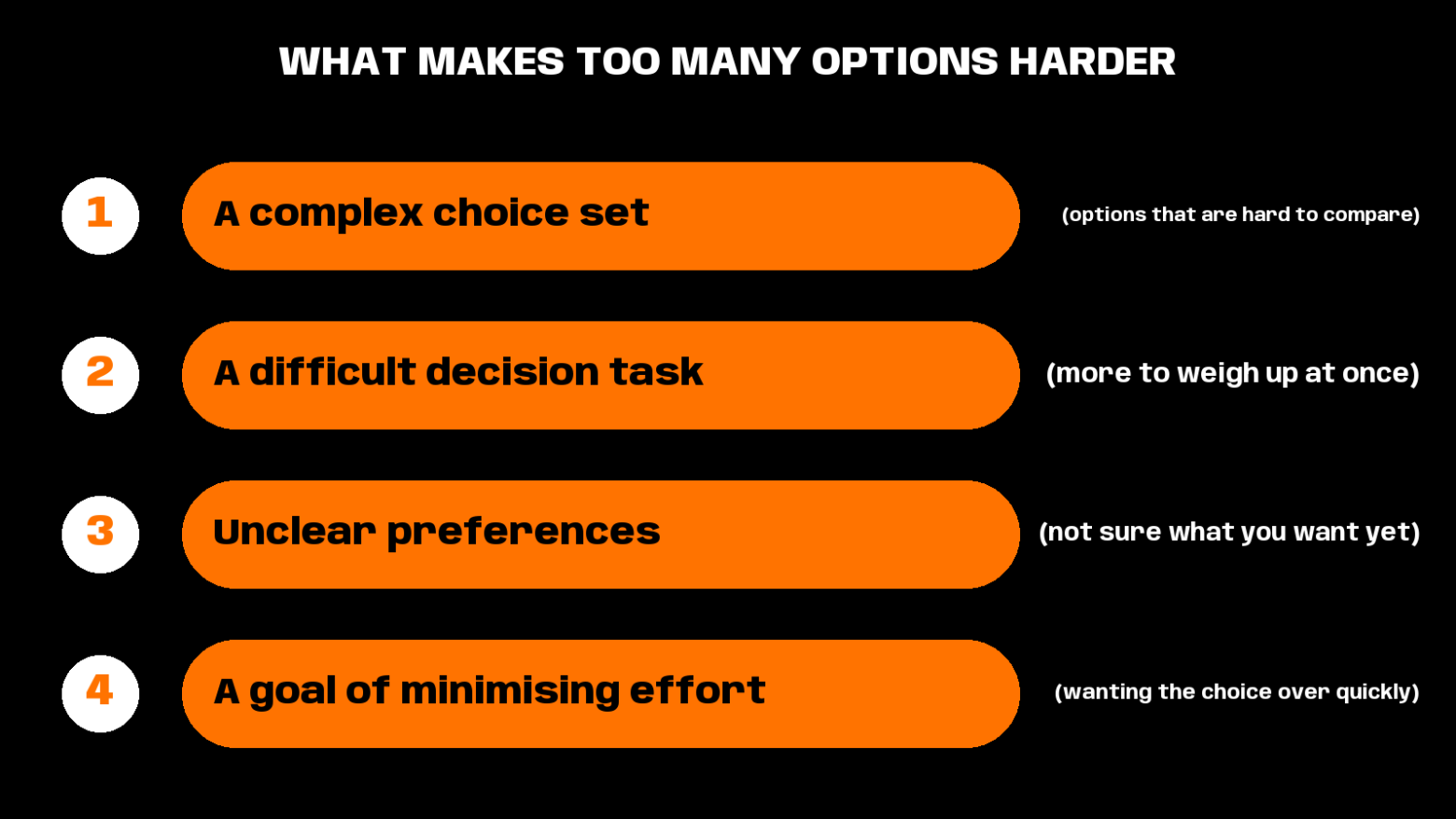
Four things that make a big choice harder to settle.
Does Chasing the Best Option Make You Happier?
Not on the evidence of one study of job seekers. Iyengar and colleagues followed final-year students as they searched for jobs. Students with high maximising tendencies secured jobs with 20% higher starting salaries than those with low maximising tendencies, yet they were less satisfied with the jobs they got and felt more negative affect during the search [6].
Chasing the best option can pay off in the outcome and cost you in how it feels. The authors found these effects were mediated by maximisers relying more on external sources of information and fixating on both the options they got and the ones they did not [6]. The sample was students looking for their first jobs, but the habit it describes is a familiar one: keep checking what else was out there.
If the hunt for the best also leaves you tired, our guide to decision fatigue explains how a long run of choices drains you. Our step on picking the first option that clears your bar is the practical answer to the maximising trap.
Should You Keep Your Options Open?
Less than you think. Gilbert and Ebert found that people prefer changeable decisions because they do not realise they may be more satisfied with unchangeable ones. Photography students who could change their minds about which prints to keep liked their prints less than those who could not [7].
The same paper reported that the chance to change their minds impaired the processes that normally help people feel satisfied after a decision, yet most participants still wanted that chance [7]. The sample was photography students choosing prints, so it is a narrow, specific setting. It still points at something many men do: leave every door ajar, then feel unsettled about the one they walked through.
There is also evidence that caution can run too high. In a large randomised field experiment, Levitt asked people who were having difficulty making a decision to flip a coin to help decide. For important decisions such as quitting a job or ending a relationship, people told by the coin to make a change were more likely to make it, more satisfied, and happier six months later than those told to stay put [8]. The author suggests “people may be excessively cautious” with major choices [8].
Do not read that as advice to let a coin run your life. These were people who were already stuck, and the study does not say coin tosses beat careful thought.
How Do You Make Decisions Faster? Six Steps
Work through six steps: sort the decision into a one-way or two-way door, set a deadline before you start, know your must-haves and compare two or three options, pick the first that clears your bar, trust your gut only where you have real practice, and decide at about 70 percent. Use them on one live decision this week, not in theory.
Some steps rest on research and some are our own practical advice. We flag which is which as we go, because none of the studies cited here tested this six-step sequence.
Step 1: Sort It as a One-Way or Two-Way Door
Ask whether you could undo the decision. In a letter to Amazon shareholders, Jeff Bezos described one-way doors, which are consequential and irreversible or nearly so, and two-way doors, which are changeable and reversible. He called them Type 1 and Type 2 decisions and said the Type 2 kind “can and should be made quickly” [9].
This is a business letter, not research, so treat it as one executive’s opinion and not a tested finding. It is still a useful sorting question. Bezos was writing about large organisations, which he said tend to use the heavy Type 1 process on many Type 2 decisions, and the result is slowness [9]. Plenty of men do the personal version, treating small choices as if they were permanent.
The Gilbert and Ebert result adds a reason to sort carefully. People who could change their minds liked their outcome less [7], so even on a two-way door it can help to treat the choice as made. Mark the door honestly: one-way gets time and consultation, two-way gets a quick answer. If you cannot tell which it is, assume two-way and ask what the first step back would be.
Step 2: Set a Deadline Before You Start
Decide when the decision will be made before you begin gathering anything. Write the time down, such as “I decide on Friday at 6pm” or “ten minutes, then done”. This step is our own advice. No study cited here tested deadlines, although the Eisenhardt paper opens with a computer firm whose delays and indecision cost it its early technical and market advantages [1].
The deadline does two jobs. It stops information gathering from filling all the time you give it, and it gives your mind a point at which the choice becomes final. Without one, the end of a decision is decided by how you feel, and a man who feels uncertain will keep going.
Match the deadline to the door from Step 1. A two-way door gets minutes or a day. A one-way door gets a longer window, but still a fixed date, because a long open-ended wait is just avoidance. For the wider cluster of focus habits, our guide to what intentional friction is is a good companion read.
Step 3: Know Your Must-Haves, Then Compare Two or Three Options
Write your must-haves first, then line up two or three real options against them side by side. The meta-analysis of choice overload found that higher preference uncertainty made overload more likely [5], so clarity about what you want before you look is a practical guard. The list of must-haves is our own wording of that idea.
Keep the list short: three to five items, with one or two non-negotiables. Then cap the shortlist. Eisenhardt found fast decision makers developed more alternatives, not fewer [1], so the aim is not a single option. It is a small set that you can hold in your head at once and compare directly.
Step 4: Pick the First Option That Clears Your Bar
Choose the first option that meets your must-haves and stop looking. This is the satisficing approach, settling for good enough. The job-search study suggests why it helps: maximisers got better pay, yet were less satisfied and felt more negative during the search [6].
You may give up some upside, and in that study the maximisers’ starting salaries were 20% higher, in return for the end of the search and a calmer decision. For many choices that is a good trade, and the research on maximisers shows the other side has a price [6]. The evidence is from job seekers, so this step is our own application of it to everyday choices.
Keep the bar honest. For a one-way door with large consequences, set the bar high and give it time. For a two-way door, a low-cost bar is fine. If you find yourself raising the bar after an option clears it, that is the perfectionism loop at work, and our perfectionist guide shows how to set a good enough bar and keep to it.
Step 5: Trust Your Gut Only Where You Have Real Practice
Use intuition in areas where you have had years of feedback, and slow down where you have not. Kahneman and Klein concluded that judging the quality of an intuitive call requires assessing how predictable the environment is and whether the person had the opportunity to learn its regularities [10].
That gives you a simple test. A man who has run the same type of project for ten years can lean on his gut about it. A man choosing in an area he has never faced has no such track record. The same paper warns that “Subjective experience is not a reliable indicator of judgment accuracy” [10], so feeling sure is not the same as being right.
This links back to simple rules. Heuristics that ignore part of the information can do well in some settings [3], but the settings matter. Use a fast rule where the environment is stable and you have practice, and use a slower check, or a second opinion, where you do not. The test is the first question in this step: have I had the chance to learn how this works?
Step 6: Decide at About 70 Percent and Commit
Make the call when you have roughly 70 percent of what you wish you knew, then commit. Bezos wrote that “most decisions should probably be made with somewhere around 70% of the information you wish you had” and that if you wait for 90 percent you are probably being slow [11]. Again, this is a business opinion from a letter, not research.
He also described “disagree and commit”, where people with a different view still back the decision once it is made [11]. For a man deciding alone, the personal version is to commit to your own choice and stop reopening it. The research on changeable decisions points the same way: people who could change their minds liked their outcome less [7], and in the coin toss study those told by the coin to make a change were happier six months later [8].
Commit with a safety net. If the door is a two-way one, name the signal that would make you reverse, and a date to check. That way the decision is final enough to settle you, and reversible enough to be safe. If your doubts cluster around real worry, not information, see the GP note below.
What Mistakes Slow Decisions Down?
The common ones are waiting for certainty, treating every choice as permanent and keeping the search open after you have an answer. Each feeds the same pattern of delay. Frost and Shows linked indecisiveness with compulsive checking and procrastination [2]. In our view, many of these habits are ways of putting off the moment of commitment.
**Waiting for 100 percent.** Certainty rarely arrives. Bezos argued that waiting for 90 percent usually means being slow [11], and he is describing a business setting, so scale it to your own stakes.
**Treating small choices as one-way doors.** Most are two-way doors, which can be made quickly [9]. Saving your slow process for the choices that deserve it frees time and nerve.
**Reopening a choice you have made.** Keeping the option to change your mind lowered liking of the outcome in the photography study [7]. Decide, note your reversal signal, and move on.
If indecision runs through most of your life, or comes with constant checking or worry, speak to your GP. Frost and Shows found indecisiveness was linked with obsessionality and general psychopathology scores [2], and support is available.
FAQ
How much information is enough before I decide?
No study gives a fixed number, but one business source suggests deciding at somewhere around 70 percent of the information you wish you had [11]. In the microcomputer firm study, fast decision makers still used more information than slow ones [1]. Gather what matters, then stop.
Is deciding fast the same as deciding carelessly?
No. The fast teams in Eisenhardt’s study used more information and developed more alternatives, and their fast decisions were linked with superior performance [1]. Gigerenzer and Gaissmaier also report that ignoring part of the information can improve accuracy in some settings [3].
Can too many options really make a decision harder?
They can, under conditions. A meta-analysis of 99 observations found overload was more likely with complex sets, hard tasks, unclear preferences and an effort-minimising goal [5]. An earlier meta-analysis of 63 conditions found a mean effect of virtually zero [4]. Clear preferences and a short list help.
Should I flip a coin to decide?
Only as a way to test your own reaction. In Levitt’s field experiment, people who had trouble deciding and were told by the coin to make a change on an important decision were happier six months later than those told to stay [8]. It does not prove a coin beats thought. It does suggest people may be excessively cautious when facing major life choices.
Is wanting the best option a problem?
It can be a trade. Student job seekers who chased the best option got jobs with 20% higher starting salaries but were less satisfied with them and felt more negative during the search [6]. Choosing the first option that clears a written bar is one way to ease that.
When should I speak to a GP about indecision?
If indecision affects your daily life, or comes with constant checking, procrastination or wider anxiety. Frost and Shows found indecisiveness was linked with obsessionality, compulsive checking and higher procrastination scores [2]. A GP can talk through what support suits you.
Final Recommendation
Match the effort to the door. Sort the choice, set a deadline, compare two or three options against your must-haves, pick the first that clears your bar, and commit at about 70 percent. Fast decision makers in one study used more information, not less [1], so speed here means a clear process, not a careless one.
If your delay comes mostly from fear of being wrong, start with steps 1 and 4 and the perfectionism guide. If it comes from endless searching, start with steps 2 and 3. If it affects your sleep, mood or relationships, speak to your GP.
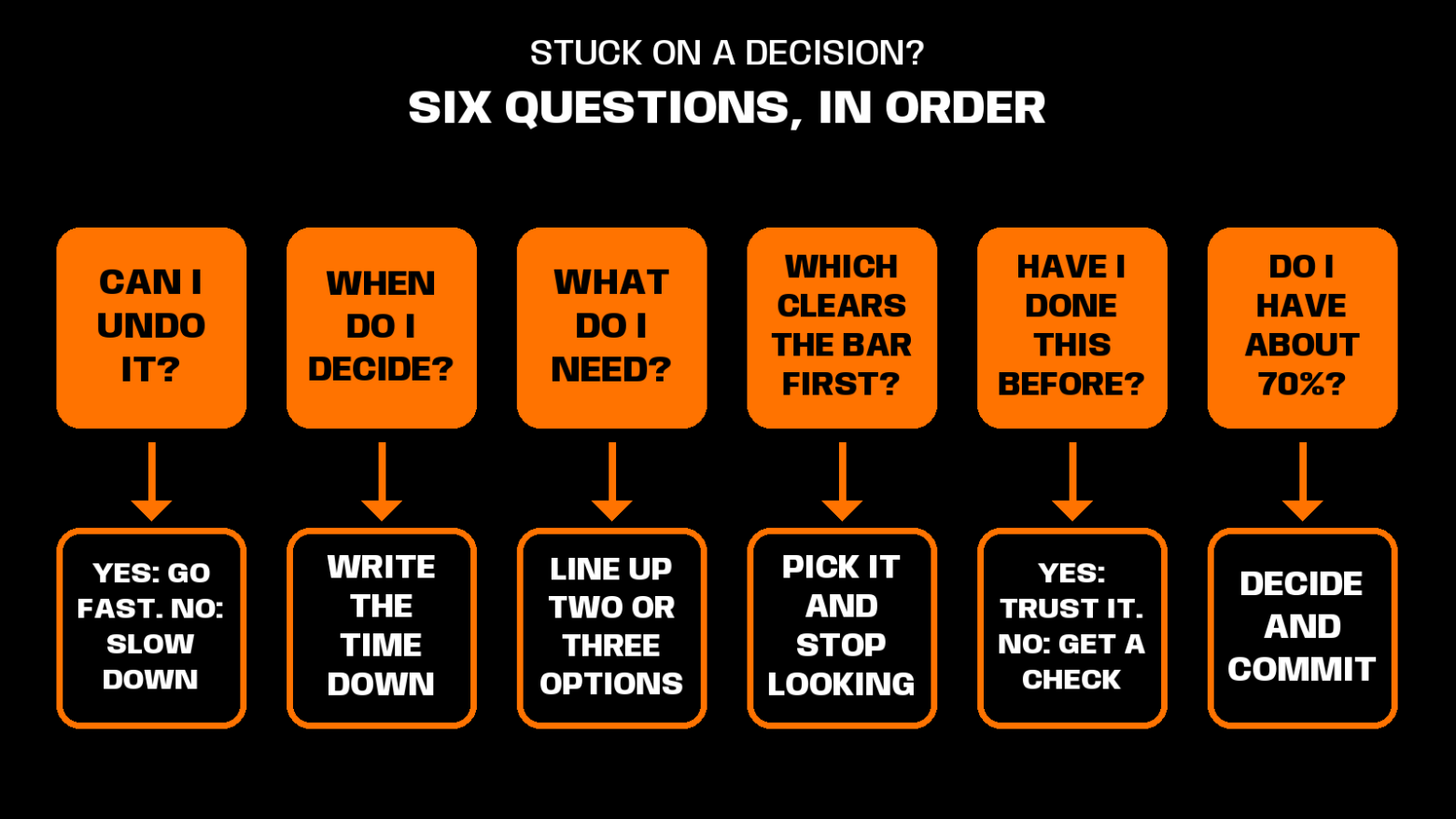
Six questions that take a decision from stuck to done.
Options for Men to Take Action
Most men understand the idea quickly, but with no system the plan stays an insight and the old habit of keeping every door open carries on.
The MenTools app runs challenges across mindset, fitness, nutrition and money, with levels you choose, daily actions, streak and progress tracking, journals and an AI coach. For this guide, its job is to turn the six steps into one small daily action, so the practice of deciding at good enough is repeated rather than remembered once.
How you can do this today: pick one daily action, “make one two-way-door decision within five minutes”, at the easiest level, and note in the journal each day what you chose, how long it took and whether you would reverse it.
Wins on cost: one subscription brings challenges, tracking, journals and an AI coach together, instead of paying for separate apps.
Wins on time: the challenges are already built, so you spend your time making the decision, not designing a plan.
Wins on practicality: you choose your level, so the first dose can be small enough to do on a bad day.
Watch-out: no study in this guide tested the MenTools app, so treat it as a structure for repetition, not a treatment for indecision. If indecision is tied to wider anxiety or is affecting your daily life, speak to your GP.
Hard days land better when the basics are covered, so a one a day multivitamin may help cover the simple daily foundation. For more on this topic, the MenTools focus hub collects every guide in one place. Sort the door, set the clock, then decide.
Last updated: 2026-11-19 v1.0
Disclaimer: This guide is for informational purposes only and does not constitute medical or psychological advice. Speak with a qualified professional before making significant changes if you have a medical or mental health condition.
References
- [1] Eisenhardt KM. Making fast strategic decisions in high-velocity environments. Academy of Management Journal, 1989;32(3):543-576. Link
- [2] Frost RO, Shows DL. The nature and measurement of compulsive indecisiveness. Behaviour Research and Therapy, 1993;31(7):683-692. Link
- [3] Gigerenzer G, Gaissmaier W. Heuristic decision making. Annual Review of Psychology, 2011;62:451-482. Link
- [4] Scheibehenne B, Greifeneder R, Todd PM. Can there ever be too many options? A meta-analytic review of choice overload. Journal of Consumer Research, 2010;37(3):409-425. Link
- [5] Chernev A, Böckenholt U, Goodman J. Choice overload: a conceptual review and meta-analysis. Journal of Consumer Psychology, 2015;25(2):333-358. Link
- [6] Iyengar SS, Wells RE, Schwartz B. Doing better but feeling worse. Psychological Science, 2006;17(2):143-150. Link
- [7] Gilbert DT, Ebert JEJ. Decisions and revisions: the affective forecasting of changeable outcomes. Journal of Personality and Social Psychology, 2002;82(4):503-514. Link
- [8] Levitt SD. Heads or tails: the impact of a coin toss on major life decisions and subsequent happiness. The Review of Economic Studies, 2021;88(1):378-405. Link
- [9] Bezos JP. 2015 letter to Amazon shareholders. Amazon.com, Inc., 2016. Link
- [10] Kahneman D, Klein G. Conditions for intuitive expertise: a failure to disagree. American Psychologist, 2009;64(6):515-526. Link
- [11] Bezos JP. 2016 letter to Amazon shareholders. Amazon.com, Inc., 2017. Link