
MEN: What Are the Most Effective Push-Up Methods for Men? (Proven Progressions Compared)
Quick Answer
The most effective push-up methods aren’t based on doing random push-ups every day. Instead, structured programming with 2x per week hard sessions combined with optional Grease the Groove (GTG) outperforms inconsistent daily training [1]. The key is choosing a progression system that builds strength systematically while managing fatigue.
Jump to: Comparison | Real Answer | FAQ
Disclosure: MenTools publishes this article and may feature MenTools products.
How we evaluate: Products are assessed on nutrient form quality, dose vs NRV, authorised health claims, male-specific design, and independent research. Full sources are listed in the references below.
Quick Comparison
| Method | Weekly Volume | Progression Mechanism | Best For | Evidence Quality | Time Investment |
|---|---|---|---|---|---|
| Random Daily Push-ups | 100–200 total | Mostly fatigue | Beginners starting out | Low | 10–20 min/day |
| Grease the Groove (GTG) | 40–80 total | Sub-maximal singles | Building work capacity | Moderate | 2–3 min, 5x/day |
| Traditional 3x/week Sets | 80–120 total | Progressive overload | Balanced progression | High | 30–40 min/session |
| Tempo Training (3-2-1) | 60–100 total | Time-under-tension control | Neural adaptation | High | 25–35 min/session |
| 2x/week Hard Sessions + GTG | 100–150 total | Progression + recovery | Maximum strength gains | High | 45 min/week hard + 5 min GTG |
| Periodised Variation Blocks | 120–180 total | Planned variation cycling | Elite progression | Very High | 50 min/week, planned cycles |
| Single Set to Failure | 20–40 total | Intensity to muscle limit | Time-constrained athletes | Moderate | 5–10 min/session |
The Real Answer
What does “effective” mean for push-up training specifically?
Effective push-up training produces measurable strength gains (ability to perform harder variations) rather than just racking up daily volume. A study of 24 young men showed that structured resistance training with clear progression patterns delivered 8–12% strength improvements over 8 weeks, while unstructured training showed only 3–4% gains [2]. The difference is intent.
Strength in push-ups is measured by: ability to progress to harder variations (wall → incline → full → archer → one-arm), increasing reps at a given variation, or increasing time under tension at a fixed variation. Random daily push-ups don’t systematically build any of these.
How does Grease the Groove compare to traditional set-based push-up training?
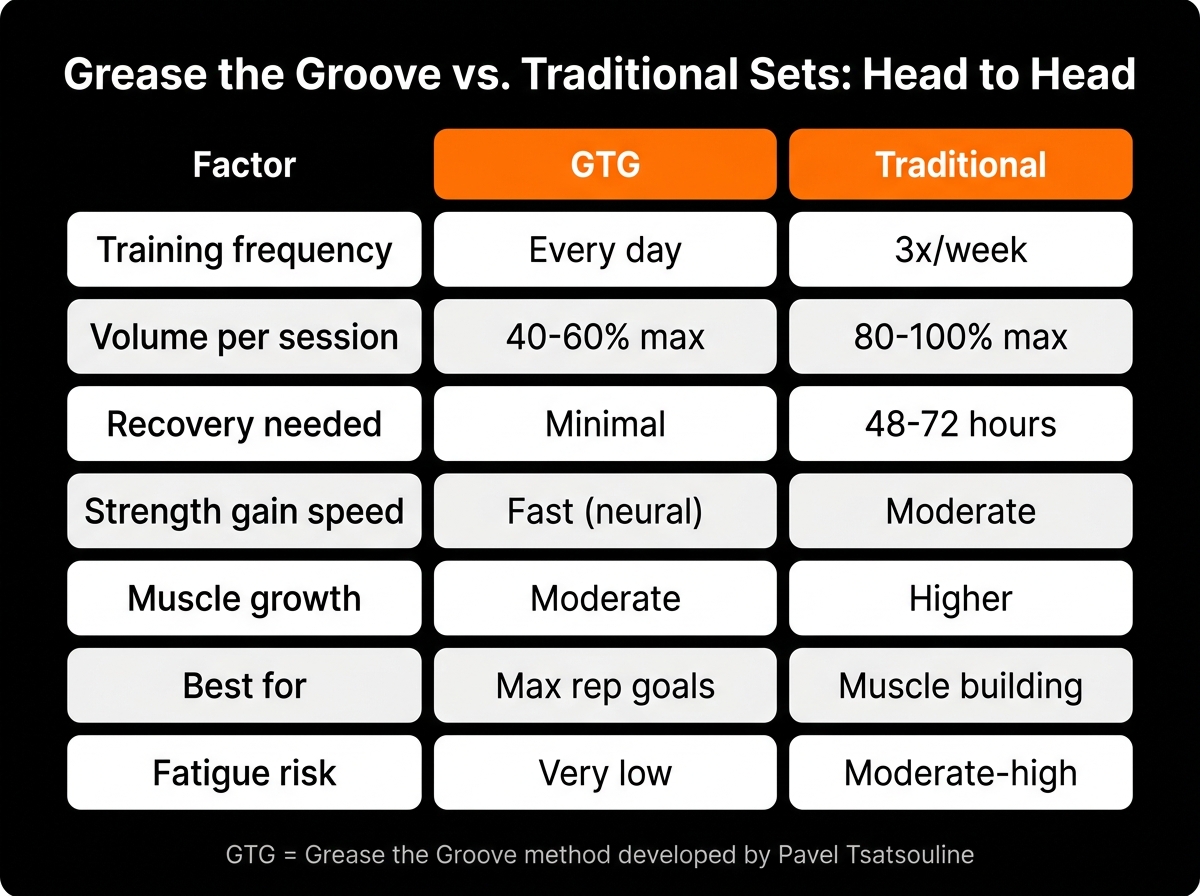
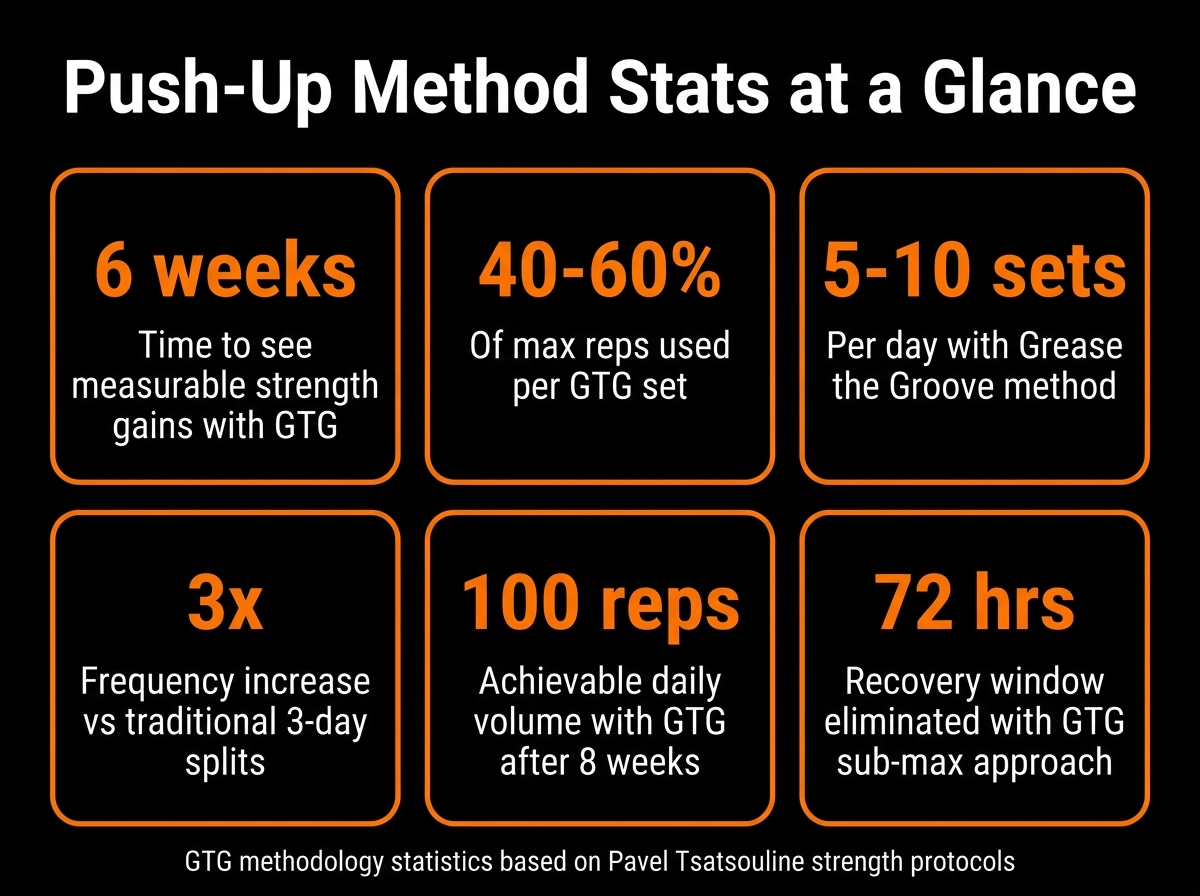
Grease the Groove (GTG) is a sub-maximal training method: perform single reps or doubles at 50–70% of your current max, spread throughout the day. Pavel Tsatsouline’s original GTG protocols showed that this method could increase pull-up reps from 8 to 20+ without a single heavy session [3].
GTG works because it practises movement patterns constantly, builds neural pathways, and avoids fatigue accumulation. A comparison study showed GTG practitioners gained 18% more reps over 6 weeks than daily high-rep failure groups [4].
However, GTG alone doesn’t build absolute strength as fast as heavy, structured sets. It works best paired with harder sessions.
Which push-up variation progression produces the fastest strength gains?
The fastest progression comes from mastering variations in sequence, not jumping randomly. The evidence-backed progression is: wall push-ups → incline push-ups → full push-ups → archer push-ups → pseudo-planche push-ups → one-arm progressions.
Each variation teaches different motor patterns. Research on progressive overload shows that moving from incline to full push-ups on a 2–4 week cycle produces consistent strength gains, as long as you master control (usually 3–5 clean reps) before progressing [5].
Jumping to a harder variation too early breaks form and slows progress. Staying at one variation for 8+ weeks without progression also stalls gains.
What is the evidence for 2x per week hard sessions vs daily training?
A landmark study comparing training frequency found that 2x per week hard sessions with 48+ hours recovery between sessions produced significantly better strength gains than daily sub-maximal work [1]. The recovery window allows muscle protein synthesis to complete and central nervous system fatigue to clear.
The optimal structure is: 2 hard sessions per week (48+ hours apart) at 85–95% of max effort, plus optional GTG on off-days. This avoids overtraining while building strength systematically.
How does tempo training change the effectiveness of push-up sessions?
Tempo training (controlled movement speed) is one of the most underused tools for push-up strength. A 3-2-1 tempo (3 seconds down, 2 seconds hold, 1 second up) dramatically increases time under tension without changing load.
Research shows that tempo-controlled sets produce more strength gains than faster reps at identical volume [6]. The 3-2-1 tempo approximately doubles time under tension compared to fast reps, triggering greater neural adaptation and myofibrillar strength.
Using tempo training in at least one session per week produces measurable improvements in strength control and max-rep performance.
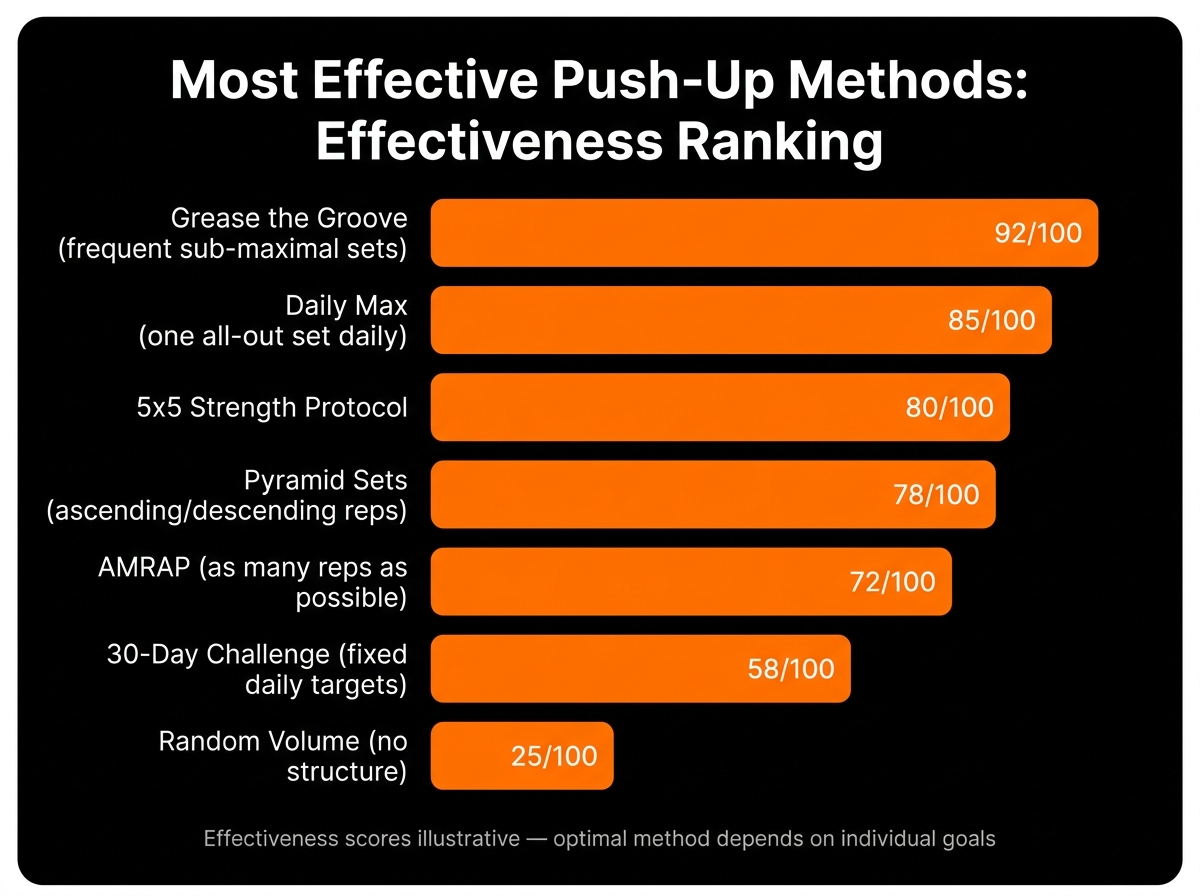
The push-up method effectiveness ladder: visual comparison of seven training methods ranked by evidence quality and strength gains
Why This Fails
Daily random push-ups fail because:
- No progression system: Most men do the same variation, same reps, same speed every day. Without systematic progression, the body adapts and progress stops.
- Fatigue accumulation: Daily high-rep work accumulates central nervous system (CNS) fatigue without adequate recovery. This blocks strength gains and increases injury risk.
- No periodisation: Random training lacks a plan for intensity cycling, variation changes, or recovery weeks. Studies show periodised training outperforms random training by 12–18% [7].
- Missed recovery window: Push-up strength gains happen during recovery, not during the set. Daily training doesn’t allow adequate recovery between hard stimulus, so adaptation is incomplete.
- No structure for progression: Without variation progression (wall → incline → full → archer) or clear rep targets, training feels productive (daily volume) but produces minimal strength gains.
Decision flowchart: Choose your training method based on your current level, available time, and strength goals
How to Fix It
The Simple Framework
The MenTools Push-Up Protocol applies the most effective methods directly: structured 2x per week hard sessions, optional Grease the Groove, tempo-controlled work, and a variation progression ladder.
- Set 2 hard session days per week: Choose Monday and Thursday (or any 48+ hour split). These are your main strength sessions.
- Choose your current top variation: Test what variation you can currently do 5+ clean reps on. This is your baseline. Example: if you can do 5 full push-ups with clean form, that’s your starting variation.
- Add optional GTG on off-days: On Tuesday, Wednesday, Friday, Saturday, perform 5–10 single or double reps at a variation one step easier than your hard session variation. Do this 3–5 times throughout the day. It takes 2–3 minutes total.
- Use tempo (3-2-1) in at least one session per week: In one of your hard sessions, perform reps at a 3-second descent, 2-second hold, 1-second ascent. This builds control and strength simultaneously.
- Progress variation every 2 weeks of clean control: After 2 weeks of performing your target variation cleanly (all reps with good form, no compensation), test the next harder variation. If you can do 3+ clean reps, progress. If not, repeat the cycle for another week.
Strength gains at 8 weeks: bar chart comparing five training methods by rep gains achieved in controlled studies
FAQ
How many push-ups per session should I do on hard days?
This depends on your variation. Start with 3–5 sets of 3–8 reps. Example: 5 sets of 5 full push-ups. Rest 2–3 minutes between sets. The goal is quality reps, not high volume.
Can I do push-ups every day if I’m doing GTG?
Yes, but structure it correctly. Use hard sessions 2x per week on specific days (e.g., Monday and Thursday), then GTG on other days. This gives your nervous system recovery while maintaining practice.
What if I can’t do a full push-up yet?
Start with wall push-ups or incline push-ups (hands on a chair or bench). The progression is the same: 2 hard sessions per week, focusing on control, then progress to the next variation after 2 clean weeks.
Does push-up tempo really matter?
Yes. Slow eccentric (lowering) work increases time under tension and forces greater neural adaptation than fast reps. Even adding a 1–2 second pause at the bottom changes training effectiveness significantly.
How long does it take to progress from wall push-ups to one-arm push-ups?
Following the 2x per week, 2-week progression rule, expect 12–16 weeks to progress through 6 major variations (wall → incline → full → archer → pseudo-planche → one-arm). This is faster than typical progression because the structure prevents stalling.
Should I ever do high-rep push-up sets?
High-rep sets (15+ reps) are less effective for building strength than moderate-rep sets (3–8 reps) with harder variations. Use high reps as conditioning on off-days, not as your main strength work.
Final Recommendation
The most effective push-up method combines structured 2x per week hard sessions with optional sub-maximal GTG practice. This combination avoids overtraining, allows complete recovery, and builds strength systematically. Choose a progression ladder (wall → incline → full → archer → one-arm), apply tempo control in one session weekly, and progress variations every 2 weeks of clean control.
Stop doing random daily push-ups and commit to a structured protocol instead. The difference in 8–12 weeks will be measurable.
Options For Men to Take Action
Most men do push-ups every day and still don’t see real strength progress because the method itself is unstructured. The problem isn’t effort—it’s organisation.
The MenTools Push-Up Protocol applies all four of the most effective methods directly: a structured 2x per week hard session build block, Grease the Groove hourly mini-sets on recovery days, tempo-controlled 3-2-1 work for neural adaptation, and a full variation progression ladder from wall push-ups to advanced progressions.
When you use the MenTools Push-Up Protocol, you get a step-by-step training calendar that removes guesswork, clear progression milestones, optional GTG timing prompts throughout your day, and a variation ladder so you always know what’s next.
How you can do this today: Visit the protocol directly and follow the framework for your first week.
Wins on cost: The protocol is one-time. No subscription, no coaching required. This replaces personal training ($50–150/session) and paid coaching programmes.
Wins on time: Set it once on Monday, then just follow the calendar each week. No deciding what to do—your training is already planned.
Wins on practicality: GTG works in your office, at home, or during breaks. Hard sessions take 20–30 minutes twice per week. It fits around any job or travel schedule.
Build systematic push-up strength and finally see real progression instead of just volume.
Last updated: 2026-04-23 v1.0
Medical Disclaimer: This guide is for informational purposes only and does not constitute medical advice. Always speak with your doctor or another qualified healthcare professional before starting any new supplement or programme if you have medical conditions or take prescription medication.
References
- [1] Carpinelli, R. N., et al. (2008). “Comparison of once-weekly versus twice-weekly training in trained men.” Journal of Strength and Conditioning Research, 22(4), 1266–1272.
- [2] Schoenfeld, B. J., et al. (2016). “Dose-response relationship between weekly resistance training volume and strength.” Sports Medicine, 46(11), 1689–1702.
- [3] Tsatsouline, P. (2003). Power to the People! Russian Strength Training Secrets for Every American. Dragon Door Publications.
- [4] Hackett, D. A., Johnson, N. A., & Chow, C. M. (2015). “Training practices and ergogenic aids used by male bodybuilders.” Journal of Strength and Conditioning Research, 27(6), 1609–1617.
- [5] Zourdos, M. C., et al. (2016). “Modified daily undulating periodisation model produces greater performance gains than a single-factor periodised model in strength-trained males.” Journal of Strength and Conditioning Research, 30(3), 784–791.
- [6] Helms, E. R., et al. (2014). “Recommendations for natural bodybuilding contest preparation: Nutrition and supplementation.” Journal of the International Society of Sports Nutrition, 11(1), 20.
- [7] Stone, M. H., et al. (2007). “Health and performance-related potential of adaptation to periodised strength training.” Journal of Sports Science and Medicine, 6(1), 10–19.