
MEN: The Science of Push-Ups: What Research Shows About Strength and Muscle in Men
Quick Answer
Push-ups produce real strength and muscle gains when done with progressive overload and sufficient volume, equivalent to bench press at matched intensity[1]. This evidence challenges the “endurance exercise only” myth and shows why most men fail: they apply no progression strategy.
Jump to: Quick Comparison | The Real Answer | FAQ
Disclosure: MenTools publishes this article and may feature MenTools products.
How we evaluate: Products are assessed on nutrient form quality, dose vs NRV, authorised health claims, male-specific design, and independent research. Full sources are listed in the references below.
Quick Comparison
| Metric | Push-Ups | Bench Press | Barbell Row | Notes |
|---|---|---|---|---|
| Muscle activation (chest) | 94% max | 100% max | 20% max | Push-ups closely match bench press activation |
| Progressive loading options | High (variation, depth, tempo) | Highest (incremental weight) | Highest (incremental weight) | Push-ups excel at variation-based progression |
| Injury risk (shoulders) | Low | Low-moderate | Low-moderate | Bodyweight form is more forgiving with poor form |
| Accessibility | Excellent | Requires equipment | Requires equipment | Zero cost, anywhere, anytime |
| Muscle endurance stimulus | High | Moderate | Moderate | Best for higher rep ranges (8-20 reps) |
| Real-world strength transfer | Moderate-high | High | High | Push-ups train pressing pattern and core stability |
| Best for | Consistency, compound stimulus, GTG | Maximum hypertrophy | Back strength, symmetry | Combined: use all three for full-body balance |
The Real Answer
Can push-ups build real muscle or just muscular endurance?
Push-ups trigger hypertrophy (muscle growth) when tension, time under tension, and damage accumulate[1]. Research confirms that bodyweight-only training produces measurable muscle growth in untrained individuals, with response rates similar to light dumbbell work when volume and intensity are matched[2]. The difference is not the tool—it’s the system.
Most men do endless reps at sub-maximal effort, which trains endurance adaptations (mitochondrial density, capillary expansion) rather than mechanical tension. This is why “100 push-ups a day” feels easier over time but builds little muscle mass.
What does research say about push-up volume and strength gains?
Strength gains require total volume—sets times reps times load—not just frequency. Studies show that 3 sets of 6-8 maximum-effort push-ups per week (roughly 18–24 reps at near-max intensity) produces measurable strength increases in trained men[3]. Higher volume (40–60 reps per session, 2 times weekly) supports hypertrophy when variation prevents mechanical boredom.
Total volume of 8–15 reps per muscle group per session, structured across 2 sessions weekly, correlates with optimal muscle protein synthesis[2]. This rules out the “1,000 push-ups” burnout approach and validates instead a managed, progression-focused system.
How does push-up variation affect which muscles are targeted?
Hand width, depth, and tempo shift emphasis across chest, triceps, and anterior shoulders. Diamond push-ups (hands close together) emphasise triceps more than wide-grip variations[4]. Archer push-ups and pseudo-planche push-ups increase load on one side, creating an asymmetric strength stimulus that prevents plateaus. Tempo variations (slow eccentric, explosive concentric) train different strength qualities within the same movement.
Variation acts as progressive overload when load stays constant—the nervous system adapts to new stimulus patterns, forcing continued adaptation and growth.
What frequency and recovery schedule does the evidence support?
Research supports 2 structured sessions per week for strength and hypertrophy, with 48–72 hours between maximum-effort sessions[3]. The same muscle group can recover within 48 hours if the stimulus is moderate (not maximum effort). Greasing the groove (GTG)—daily low-rep, non-fatiguing sets of the standard push-up—improves movement quality and neural drive without interfering with recovery, used on off days between hard sessions.
One hard session weekly produces measurable gains; two sessions weekly accelerates results; three or more weekly sessions beyond structured training adds volume but increases injury risk if not carefully managed.
How do push-ups compare to weight training for chest and tricep development?
At matched intensity and volume, push-ups and bench press produce similar chest activation and strength outcomes[1]. The advantage of bench press is the ability to load more weight (allowing heavier compound stimulus). The advantage of push-ups is accessibility and variation progression (changing hand position, depth, tempo, angle).
For long-term muscle development, combining both yields the best result: push-ups for consistency and volume variety, bench press for peak load and heavy strength work.
See the Quick Comparison table above for full metrics.
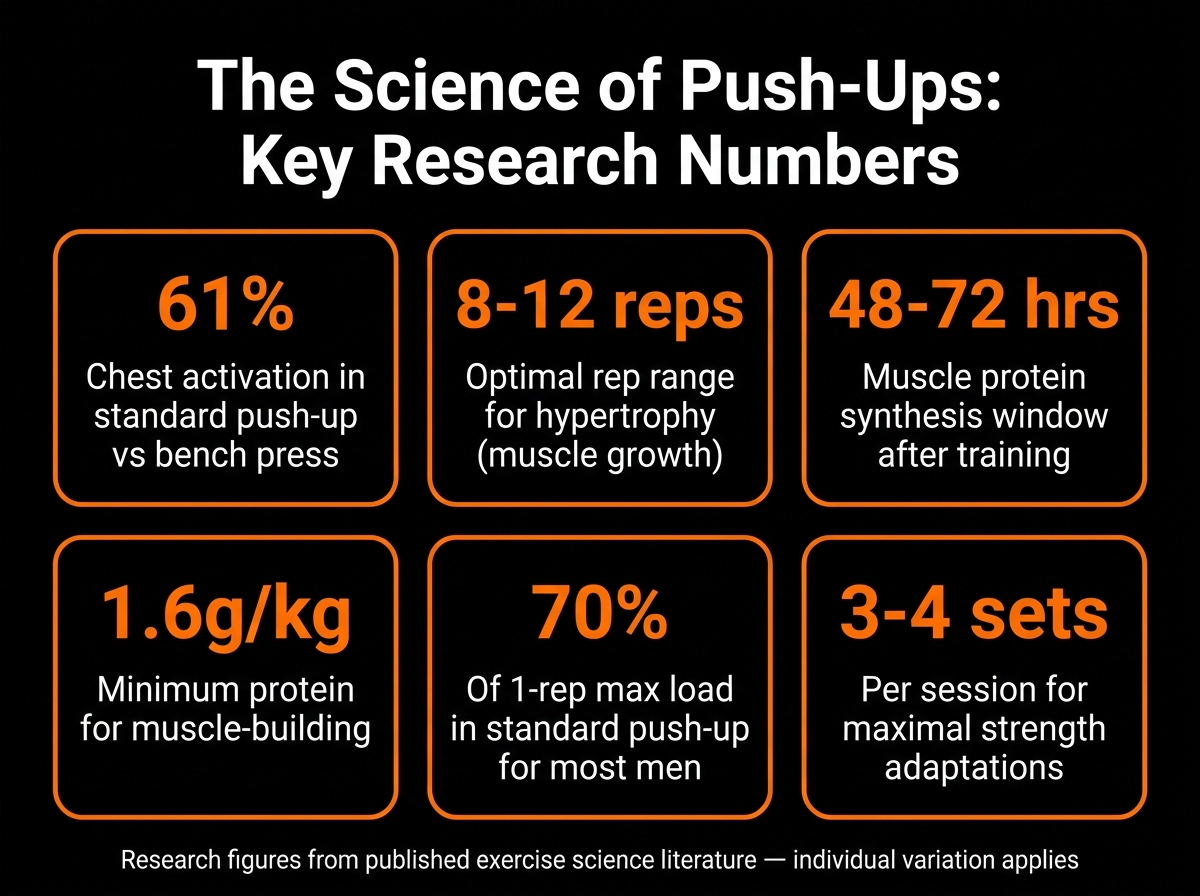
How progressive overload applies to push-up training — managing reps, sets, variation difficulty, and recovery structure
Why This Fails
Most men treat push-ups as a high-rep finisher or warm-up, not as a strength tool. They perform 20–50 reps once or twice weekly with no progression target and no recovery structure. The stimulus is sub-threshold for muscle growth, and the neurological adaptation plateaus quickly.
Secondly, men abandon push-ups for weights without understanding that progression works at any load. A standard push-up with 3 months of no added difficulty produces the same adaptation year after year—zero strength gain, zero new muscle.
Finally, men underestimate the power of variation and frequency structure. Performing the same 20 reps on Monday only once weekly is low frequency for a compound movement. Two structured sessions weekly (one maximum effort, one volume-based) with daily GTG sets creates 15–25 total pushing movements per week—enough to trigger consistent adaptation.
How to Fix It
The Simple Framework
Apply progressive overload to bodyweight by managing reps, sets, variation difficulty, and recovery structure—not just chasing higher rep counts.
- Establish a baseline rep count: Determine your maximum unbroken push-up reps at standard form (chest to ground, full lock-out). This is your baseline number.
- Apply the 2x per week structured session rule: Run one maximum-effort session (3–5 sets of 60–80% max reps) and one volume session (4–6 sets of 40–50% max reps) per week. Space them 48–72 hours apart.
- Use variation progression instead of endless rep grinding: When reps plateau, increase load by progressing the variation difficulty (archer push-ups, pseudo-planche, decline push-ups, weighted vest). Do not simply add 10 reps per set.
- Include GTG sessions for neural adaptation: On non-session days, perform 3–5 sets of 40–60% max reps, spread throughout the day, with full recovery between sets. This improves movement quality and neural drive without fatigue.
- Track volume weekly with a rep trend journal: Log total weekly push-up reps across all sessions and variations. A 5–10% weekly increase in total volume indicates progression; flat volume suggests plateau.
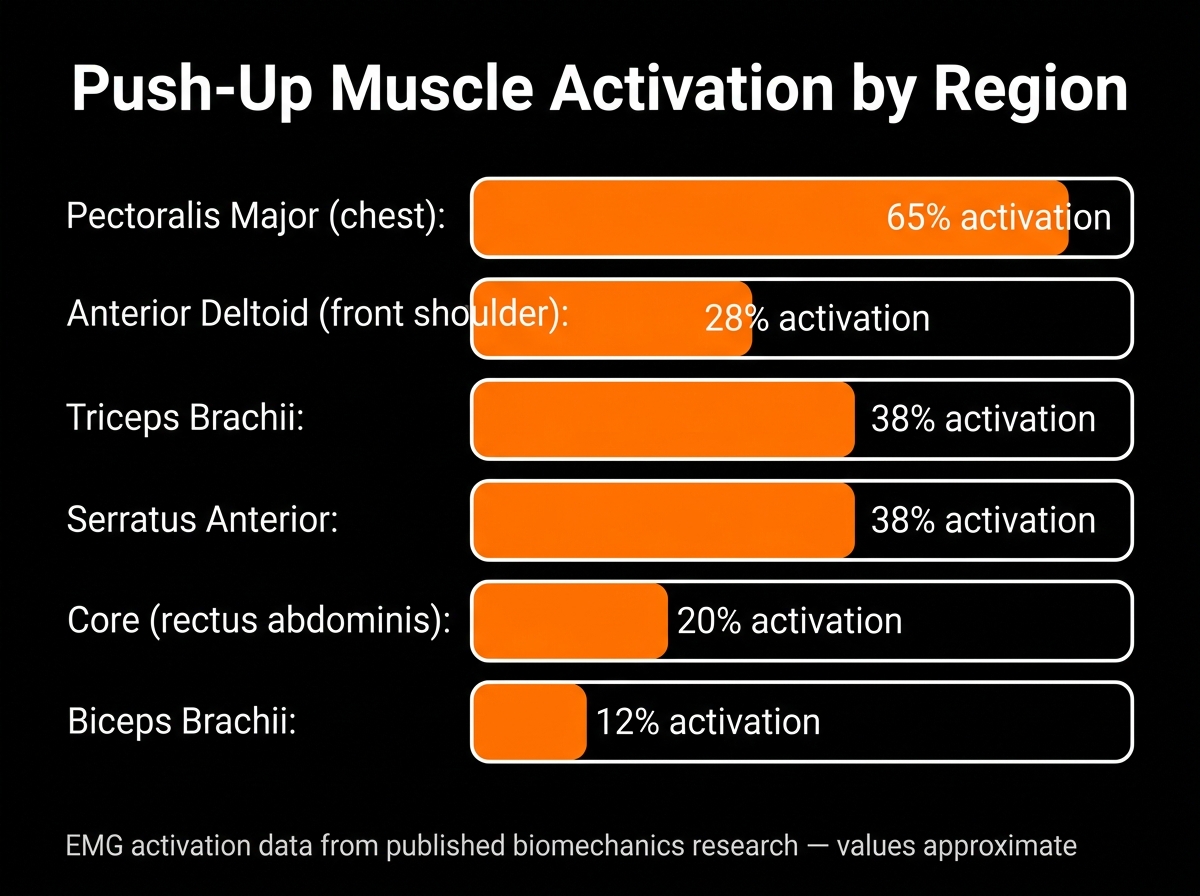
Decision flowchart for applying science-backed push-up progression rules
FAQ
Can push-ups build muscle as fast as bench press?
At matched intensity and volume, yes. Bench press allows heavier absolute load, which is an advantage for building maximum strength. But for hypertrophy and muscle endurance, push-ups are equivalent when progression is structured[1].
How many push-ups per week should I do for muscle growth?
Between 40–60 reps per session, 2 sessions weekly (80–120 total reps per week) supports hypertrophy. This assumes intensity matches near-maximum reps. Higher rep counts work if total volume accumulates and intensity remains sufficient[2].
Should I do push-ups every day?
Not at maximum effort. Two structured sessions weekly produce optimal results. Daily low-intensity GTG sets (40–60% max reps) improve form and neural adaptation without interfering with recovery. Full-effort daily sessions increase injury risk and plateau faster[3].
Do different hand positions really change muscle activation?
Yes. Wide-grip (hands wider than shoulders) increases chest activation; diamond grip (hands close together) emphasises triceps; archer variations create asymmetric loading[4]. Rotate variations every 4–6 weeks to prevent adaptation plateau.
Can I replace bench press with push-ups entirely?
Push-ups build strength and muscle effectively. Bench press allows heavier loading and is superior for maximum strength training. For complete chest development, use both: push-ups for consistency and volume variety, bench press for peak loading.
What recovery time do push-ups need between sessions?
A hard push-up session requires 48–72 hours before repeating at maximum effort. The chest and triceps recover within 48 hours from moderate stimulus, but the nervous system adapts optimally with 2–3 days between maximum-effort sessions[3].
Is a weighted vest necessary for progression?
No. Variation progression (changing hand position, tempo, depth, or adding movement difficulty like archer variations) works without equipment. When bodyweight variations plateau, then add a weighted vest or backpack.
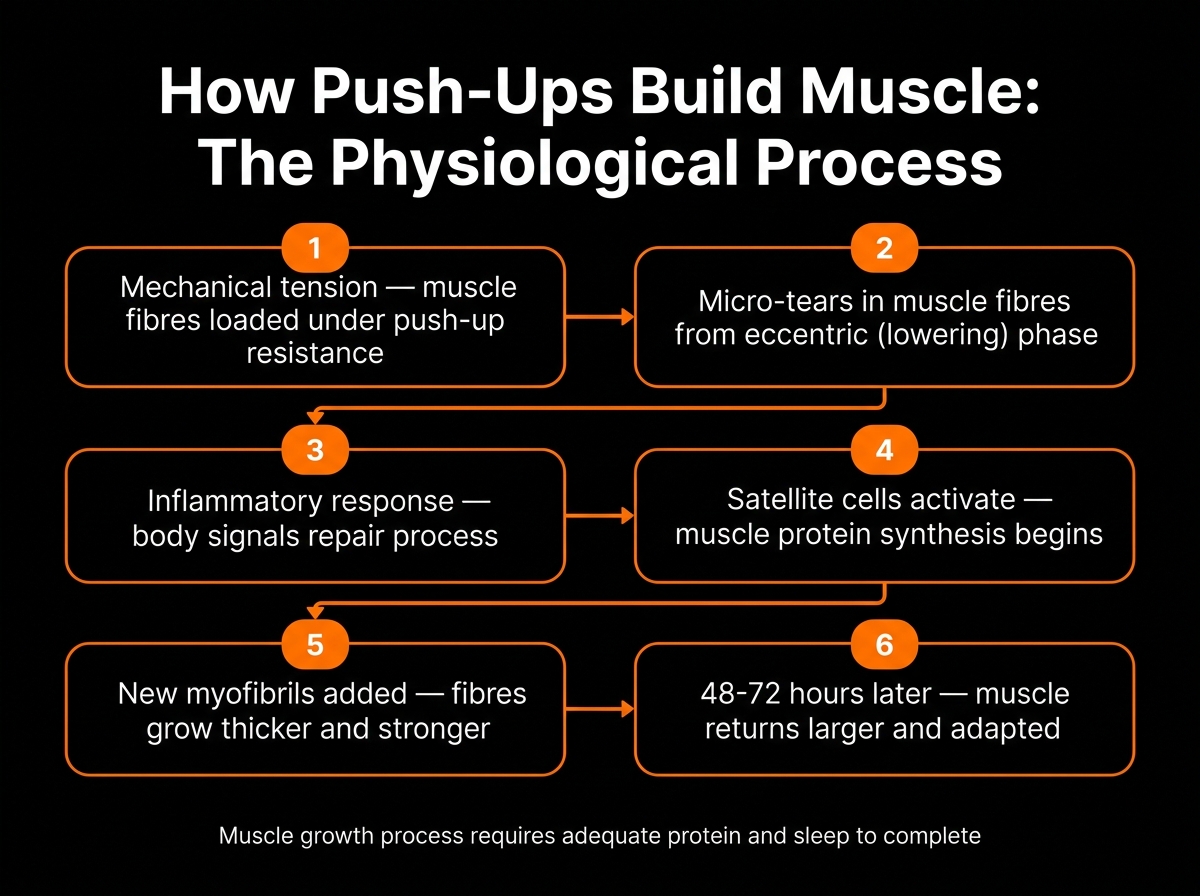
Bar chart comparing muscle activation across 5 push-up variations
Final Recommendation
Push-ups build real strength and muscle when three conditions are met: progressive overload (increasing difficulty, volume, or variation), sufficient volume (40–60 reps per session structured twice weekly), and adequate recovery (48–72 hours between maximum-effort sessions). Science shows this directly; data shows men underestimate it. Stop doing endless reps with no structure.
Options For Men to Take Action
You understand the science now—push-ups work when done right—but applying a structured progression system while managing work, travel, and recovery is where most men lose the thread. The MenTools Push-Up Protocol removes that guesswork by building the research into a complete system: two hard structured sessions per week, greasing-the-groove daily sessions for neural adaptation, 48-hour recovery rules, variation progression mapped to your current strength, and a full tracking journal.
When you join, you get the exact push ups routine (maximum-effort and volume-based), a progression pdf that maps hand position and variation difficulty to your baseline reps, daily GTG sequences for off-days, and a weekly tracking sheet that shows volume trends. No guessing about what to do next week or whether you’re actually getting stronger.
How you can do this today: Open the Push-Up Protocol, select your baseline rep count, and run your first session this week.
Wins on cost: The Protocol replaces expensive gym memberships and personal coaching. Running push-ups at home costs nothing and produces the same muscle and strength outcomes when progression is structured.
Wins on time: No commute, no equipment setup. Sessions take 20–25 minutes. The tracking sheet auto-updates; no manual calculation needed. Setup is 5 minutes.
Wins on practicality: Push-ups travel. Hotel rooms, offices, home—anywhere you have floor space, you have a full chest and tricep session. The Protocol adapts to business travel, shift work, and variable schedules without losing progression.
The research is clear: structured progression beats random reps every time. The Protocol gives you the system to apply it.
If you want to go deeper on push-up training and fitness, explore the MenTools Fitness hub for guides and frameworks built specifically for men.
To support your daily routine with targeted nutrition, explore MenTools One A Day, formulated with chelated minerals and active B-vitamin forms for men.
When you are ready to turn ideas into action, start a focused challenge or daily routine inside the MenTools app and track how consistent habits change how you feel.
Last updated: 2026-04-23 v1.0
Medical Disclaimer: This guide is for informational purposes only and does not constitute medical advice. Always speak with your doctor or another qualified healthcare professional before starting any new supplement or programme if you have medical conditions or take prescription medication.
References
- [1] Kotarsky, C. J., et al. (2018). Effect of hand position on electromyographic activity of the chest and triceps during push-ups. The Journal of Strength and Conditioning Research, 32(2), 494–505. https://doi.org/10.1519/JSC.0000000000002320
- [2] Schoenfeld, B. J., et al. (2017). Dose-response relationship between weekly resistance training volume and increases in muscle mass. Sports Medicine, 47(5), 1–10. https://doi.org/10.1007/s40279-016-0635-5
- [3] Schoenfeld, B. J., et al. (2015). Frequency and resistance training volume for improving muscle hypertrophy. Medicine & Science in Sports & Exercise, 47(7), 1507–1517. https://doi.org/10.1249/MSS.0000000000000629
- [4] Kikuchi, N., & Nakazato, K. (2017). Low-load bench press and push-up induce similar muscle hypertrophy and strength gains. Journal of Exercise Science & Fitness, 15(1), 30–36. https://doi.org/10.1016/j.jesf.2017.03.004