No products in the cart.
Return To Shop
MEN: Phone-Free Hours vs App Blockers: What Restores Focus Best (2026)
Quick Answer
For deep focus, phone free hours win, because distance removes the cue and you cannot override it with a tap [3][6]. App blockers win for the one or two apps that leak into the rest of your day, especially hard limits you cannot instantly switch off [1][9]. The 2026 evidence favours using both together.
**Jump to:** The verdict | The evidence | FAQ | Options for men
Disclosure: MenTools publishes this article and may feature MenTools products.
How we evaluate: Each option is assessed on real-world use, evidence, cost and time, and how well it suits men. Every option including the MenTools option carries an honest limitation. Full sources are in the references below.
Phone-Free Hours vs App Blockers at a Glance
Phone free hours and app blockers solve different problems. Phone free hours remove the phone for a set window, which suits deep work and evenings. App blockers stay on the phone and target specific apps, which suits the habits that follow you everywhere. The table compares them on the criteria that matter most for focus [1][3][6][9].
| What matters | Phone-free hours | App blockers | Edge |
|---|---|---|---|
| What it removes | The whole phone, for a set window | Chosen apps, all day | Depends on the leak |
| Best measured result | Lower stress when email was checked 3 times a day [6] | Hard limits cut daily use by 22 minutes [1] | Both real, both modest |
| Stops self-interruption | Yes, the phone is not there [8] | Only for blocked apps | Phone-free hours |
| Easy to override | No, you have to walk to it | Often yes, with flexible limits [1] | Phone-free hours |
| Works when you must carry the phone | No | Yes | App blockers |
| Main watch-out | Benefit stays inside the window [13] | Effects fade when the tool goes [11] | Neither lasts alone |
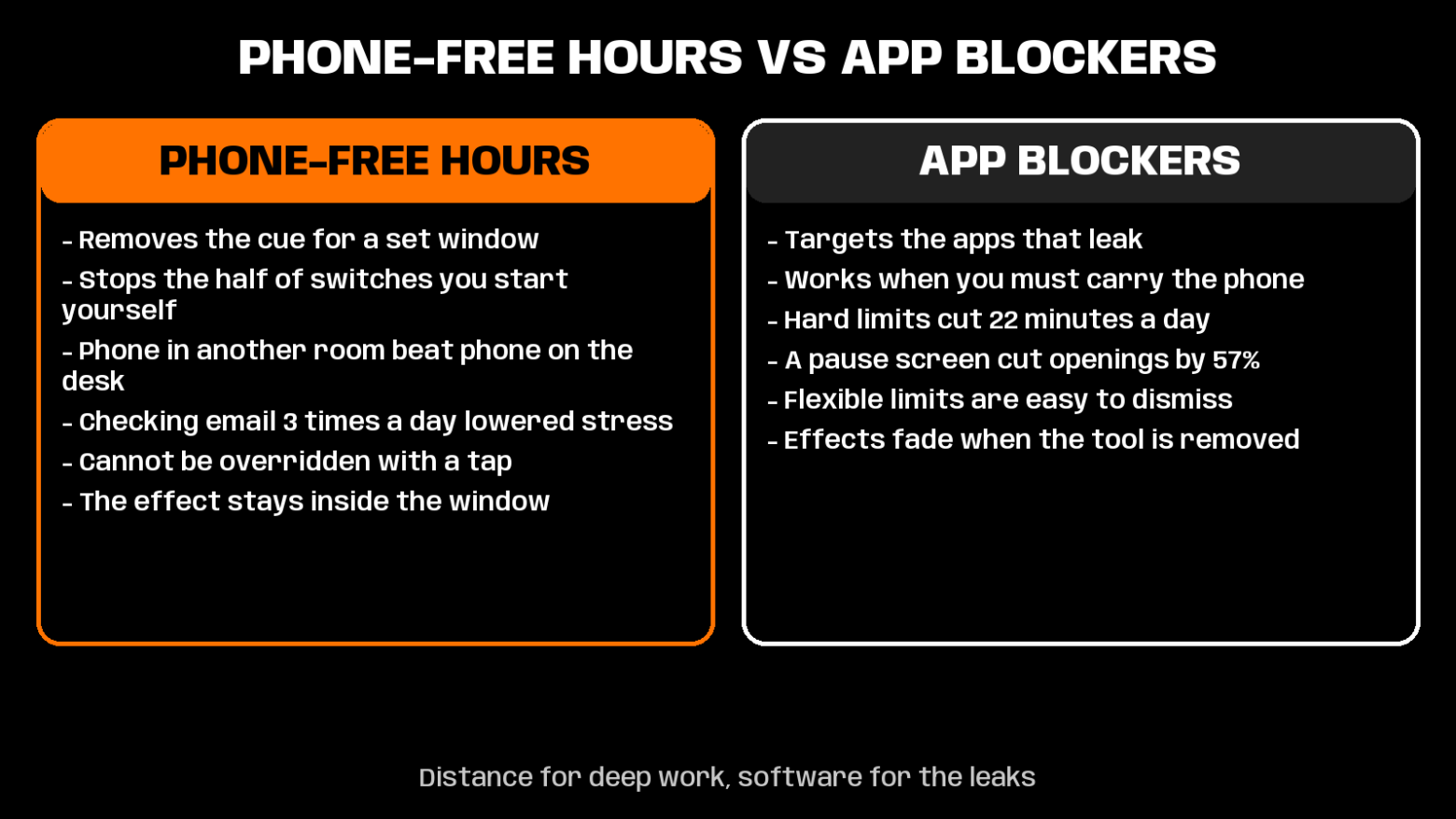
Distance for deep work, software for the leaks.
How We Compared Them
We compared the two on randomised trials and field studies rather than app store claims, using the outcome each method was actually tested on. That means minutes of use, app openings, stress, attention and how long the effect lasted. Where the evidence is thin or mixed, we say so, including where it cuts against a popular claim [1][4][11].
Two limits apply throughout. Most trials ran for two to twelve weeks, so long-term results are scarce [1][9][11]. Many samples were students or online panels rather than working men in their thirties. The direction of the findings is consistent enough to act on, but the precise numbers should be read as estimates, not guarantees.
1. Phone-Free Hours: What They Actually Are
Phone free hours are set windows when the phone is physically somewhere else, such as another room, a drawer or a locker. They suit men who need long stretches of deep work or protected evenings. The standout strength is that they stop self-interruption, which accounts for about half of all switches away from a task [8].
Gloria Mark at the University of California, Irvine, who has measured screen attention for two decades, put it bluntly: “It turns out half the time we interrupt ourselves!” [8]. Her team found attention on a single screen averaged two and a half minutes in 2004 and 47 seconds by the 2016 to 2020 period [8]. No blocker stops you picking up a phone that is within reach.
In a two week field experiment with 124 adults, limiting email checks to three times a day led to significantly lower daily stress than unlimited checking [6]. Researcher Kostadin Kushlev noted that “Most participants in our study found it quite difficult to check their email only a few times a day” [6], which is the honest cost of this approach.
Watch-out: the benefit tends to stay inside the window. In 30 English schools, restrictive phone policies cut use during school hours but not total daily use, and showed no difference in well-being [13]. Phone free hours protect the time they cover and little else.
2. App Blockers: What They Actually Are
App blockers are software that limits, delays or blocks chosen apps, from built-in Screen Time limits to pause screens and full blockers. They suit men who have to carry the phone for work but lose time to one or two apps. Their standout strength is precision, because they hit the app that leaks without removing calls, maps or messages.
The strongest trial tested limits that could not be instantly overridden, unlike the flexible limits in standard phone settings. In a randomised study of about 2,000 US adults, those hard limits cut daily use of social media and browsers by 22 minutes, or 16 percent, over 12 weeks [1]. Most people kept them, with 78 percent still using binding limits by the end [1].
Pause screens work through friction rather than force. In a 2023 PNAS study of the one sec app, 36 percent of attempts to open a target app ended with the user closing it once the pause appeared, and openings fell by 57 percent after six weeks [9]. A separate trial found greyscale friction cut screen time faster than self-set time limits [5].
Watch-out: blocker effects often fade. A 2023 systematic review concluded that digital self-control tools may cut use in the short term but are “not effective in the long term, as they do not promote the formation of new habits” [11]. Only 280 of 719 one sec recruits used the app for all six weeks, and its creator co-authored the study [9].
Which One Protects Deep Work Better?
Phone free hours protect deep work better, because they remove both the interruption and the pull of the phone being there. In the original Brain Drain experiments with nearly 800 smartphone users, people whose phones were in another room significantly outperformed those whose phones sat on the desk, even when the phone was silent or face down [3].
Lead researcher Adrian Ward at the University of Texas explained why: “Your conscious mind isn’t thinking about your smartphone, but the process of requiring yourself not to think about something uses up some of your limited cognitive resources. It’s a brain drain” [3]. A blocker leaves the phone on the desk, so it cannot remove that cost.
The honest caveat is that later studies found the effect is smaller than first reported. A 2023 meta-analysis of 22 studies found a small overall effect of g = -0.14, significant only for memory tasks [4]. Interruptions are the bigger cost. In workplace observation, resuming interrupted work took an average of 25 minutes and 26 seconds [7].
Which One Cuts Mindless Checking More?
App blockers cut mindless checking more, because they act at the exact moment you reach for a specific app. The one sec study found the pause alone was enough to make people abandon over a third of attempts [9]. A follow-up experiment with 500 people found that offering a clear option to dismiss the attempt had the strongest effect [9].
The size of the problem is real. In the hard limits trial, the researchers estimated that “self-control problems cause 31 percent of social media use” [1]. Co-author Matthew Gentzkow summarised it plainly: “The results of our study show clearly that digital addiction is real” [2]. Software that removes the in-the-moment choice helps with exactly that.
Notifications matter as well. In a study of 221 people, a week with alerts on and the phone within reach produced more inattention and hyperactivity than a week with alerts off and the phone away [10]. Kushlev advised “keeping their phones on silent and out of easy reach whenever possible” [10], which combines both tools.
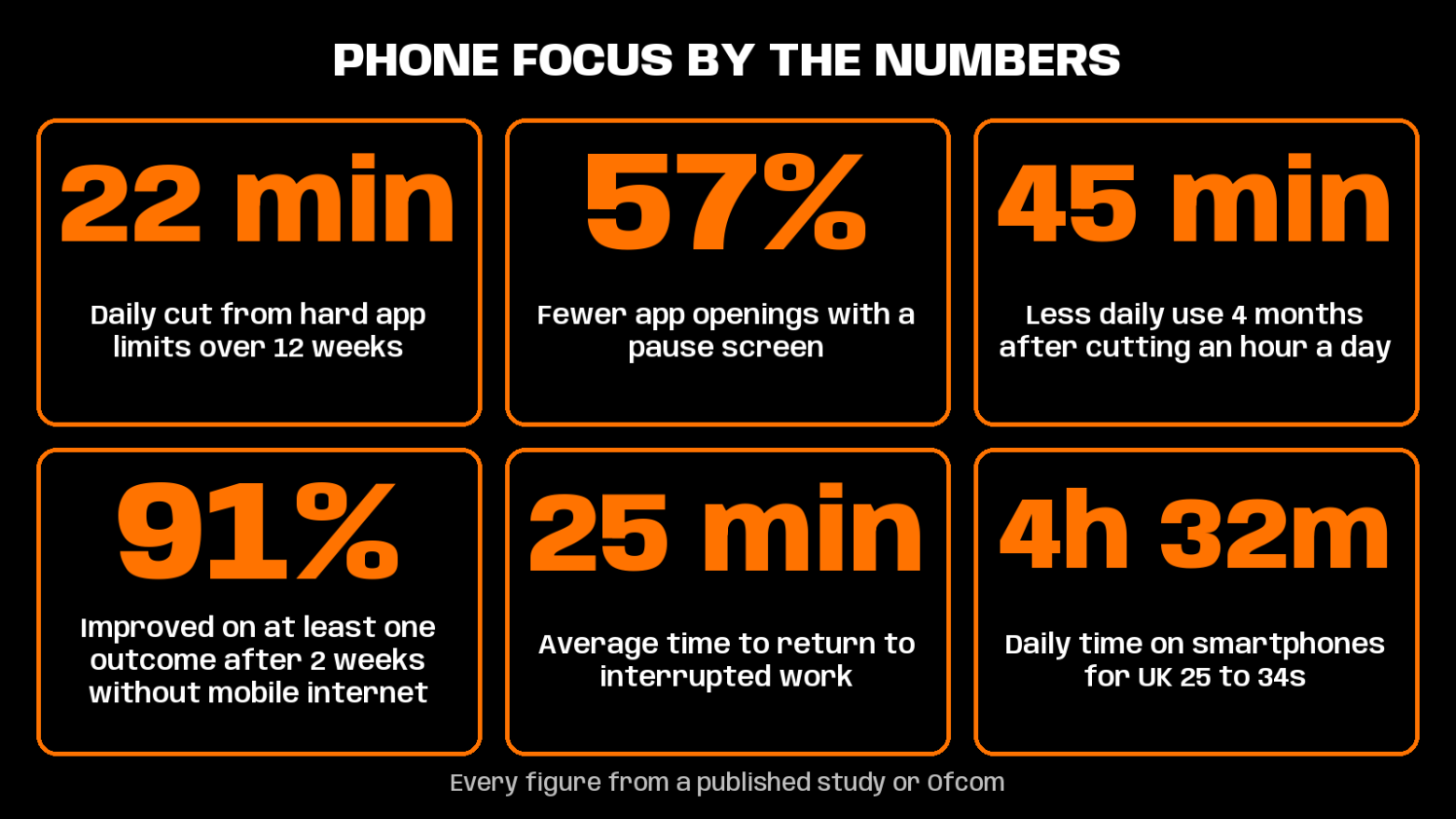
Real but modest effects, and the time cost of the problem is large.
Which One Lasts Longer?
Time-based limits that you keep living with tend to last longer than either total breaks or tools you later remove. In a German trial of 619 people, those who cut phone use by one hour a day used it 45 minutes less per day four months later, while a week of total abstinence left a 38 minute reduction [12].
Lead researcher Julia Brailovskaia concluded, “It’s not necessary to completely give up the smartphone to feel better” [12]. That favours regular phone free hours over a dramatic detox. Blockers, by contrast, tend to work while they run. A three week vibration nudge study cut use by over 20 percent, but the reduction did not persist after the tool was removed [16].
The most intense version combines both ideas. A 2025 trial used blocking software to strip 467 people’s phones back to calls and texts for two weeks. Screen time fell from 314 to 161 minutes a day and 91 percent improved on at least one outcome, though only about a quarter fully complied [14].
Which One Fits a Working Man’s Day?
App blockers fit more of a working day, because most men cannot leave their phone in another room all day. Phone free hours fit the blocks that matter most, such as the first hour of the morning, deep work and the evening. UK adults aged 25 to 34 spend 4 hours 32 minutes a day online on smartphones, the most reliant of any group [17].
Men have started using both tools already. Ofcom found that 28 percent of UK internet users had turned off notifications or used do not disturb, and 19 percent had deleted apps because they were spending too much time on them [17]. Among 16 to 34 year olds, the notifications figure rose to 42 percent [17].
The research also suggests people pick the wrong tool by default. A 2021 study found people preferred tracking their screen time over blocking or nudges, even while rating tracking as less effective [18]. Seeing a weekly report feels like action. It is usually a blocker or a phone in another room that actually changes the number.
What Do School Phone Bans Tell Us?
School bans show that removing phones helps where compliance is high, but the effects are smaller than headlines suggest. An English study found test scores rose by 6.41 percent of a standard deviation after phone bans, with no gains where bans were not widely complied with [15]. That is a small, real effect, not a transformation.
Newer evidence is more cautious. A 2026 study of lockable pouches across about 4,600 US schools found effects on test scores were “consistently close to zero” [19]. Co-author Thomas Dee said, “I think it’s reasonable to view these results as sobering” [19]. The English SMART Schools study reached a similar view on well-being [13].
Birmingham researcher Victoria Goodyear summed up the lesson: “What we’re suggesting is that those bans in isolation are not enough to tackle the negative impacts” [13]. For adults the same principle applies. A phone free window works best as part of a wider set of habits, not as the only rule.
Pick Phone-Free Hours If, Pick an App Blocker If
Pick phone free hours if your main problem is protecting deep work, sleep or time with family, and you can physically put the phone somewhere else. They remove self-interruption, cost nothing and cannot be switched off with a tap [3][8]. Start with one protected block a day, such as the first 90 minutes of work.
Pick an app blocker if one or two apps keep pulling you back during the day and you have to carry the phone. Choose hard limits or a pause screen over flexible limits you can dismiss instantly [1][9]. Ward himself noted that people “who depend more on their phones will benefit the most” from distance, “but they are probably the least willing to do that” [3].
Most men need both. Use phone free hours for the time that matters most and a blocker for the leaks in between. If you want the principle behind that combination, our hub on intentional friction explains why small barriers outperform willpower, and our comparison of apps, blockers and mindset for doomscrolling covers the scrolling habit specifically.
FAQ
Do app blockers actually work?
Yes, modestly and mostly while you use them. Hard limits that could not be instantly overridden cut daily social media and browser use by 22 minutes in a 12 week trial [1]. A pause screen cut app openings by 57 percent over six weeks [9]. Effects often fade once the tool is removed [11][16].
Is it better to leave your phone in another room?
For focused work, usually yes. In the Brain Drain experiments, people with phones in another room outperformed those with phones on the desk [3]. Later studies suggest the effect is smaller than first reported [4], but distance also removes self-interruptions, which account for about half of switches [8].
How many phone-free hours a day should a man aim for?
There is no proven number, so start with the blocks that matter most. A German trial found that cutting phone use by one hour a day held up better over four months than a week of total abstinence [12]. Protect your first work block and the last hour before bed, then build.
Is Screen Time on the iPhone enough to cut phone use?
Often not on its own, because its limits can be dismissed instantly. The strongest trial used limits that could not be immediately overridden, unlike standard phone settings, and found a 22 minute daily cut [1]. People also prefer tracking over blocking, even while rating it less effective [18].
Will a weekend digital detox fix my focus?
Probably not for long. A week of total abstinence produced a smaller lasting reduction than cutting one hour a day [12]. Regular phone free hours and targeted blockers change daily patterns, which is where focus is won or lost [1][12].
What is the best app blocker for men?
The best blocker is one you cannot switch off in a second. Research favours hard limits and pause screens over flexible reminders [1][5][9]. Set it on the one or two apps you regret, not on everything, and pair it with a phone free block for deep work.
Final Recommendation
Use phone free hours for the time that matters most and an app blocker for the leaks in between. Distance removes self-interruption and the pull of the phone, while hard limits and pause screens act at the moment you reach for a specific app [1][3][8][9]. Neither lasts on its own unless it becomes part of your routine [11][12].
Start this week with one protected block a day with the phone in another room, and one hard limit on the app you regret most. Judge it after a month, not a day. If you want a sense of how long your focus takes to recover once you change these habits, how long it takes to rebuild your attention span sets out the timeline.
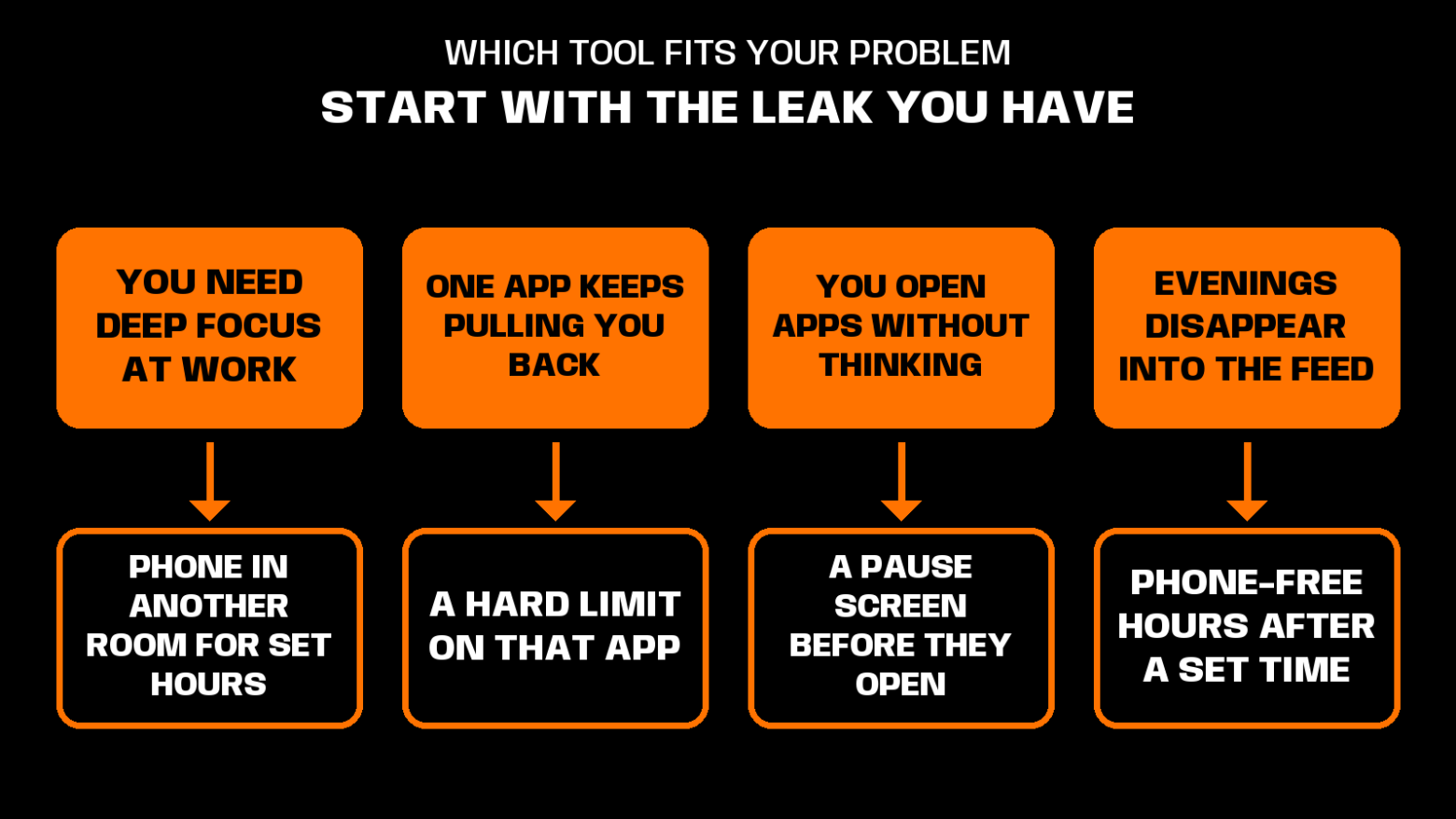
Start with the leak you actually have, not the tool that sounds best.
Options for Men to Take Action
Most men try to fix their focus with a new app and good intentions. The blocker gets switched off in a busy week, the phone drifts back to the desk and nothing records whether the protected hours actually happened.
The MenTools app runs focus as a challenge alongside mindset, fitness, nutrition and money, with daily actions, levels you choose, reminders, streak and progress tracking and an AI coach. Its job here is to make the phone free block a daily action you tick off, so the habit is tracked rather than hoped for.
How you can do this today: pick one daily phone free block, such as the first 90 minutes of work, and log it as your daily action for the next month.
Wins on cost: one subscription covers focus, sleep and training habits together, instead of a blocker, a habit tracker and a meditation app paid for separately.
Wins on time: the challenge structure is already built, so you start tomorrow morning rather than designing a system first.
Wins on practicality: a daily action takes seconds to log and fits around meetings, travel and family, which is where most focus plans fall apart.
Watch-out: it is not an app blocker and will not stop you opening an app. Pair it with a hard limit or a pause screen on the phone itself.
A flat afternoon is harder to out-plan than to prevent, so a one a day multivitamin may help cover the simple daily foundation underneath the focus work. For more built for men on attention, phones and deep work, the MenTools focus hub collects it in one place. Protect one block a day, and the rest of the week starts to follow.
Last updated: 2026-10-13 v1.0
Disclaimer: This guide is for informational purposes only and does not constitute medical or psychological advice. Speak with a qualified professional before making significant changes if you have a medical or mental health condition.
References
- [1] Allcott H, Gentzkow M, Song L. Digital addiction. American Economic Review, 2022;112(7):2424-2463. Working paper version, NBER WP 28936. Link
- [2] Stanford Institute for Economic Policy Research. Hooked on your smartphone? With Hunt Allcott and Matthew Gentzkow. Link
- [3] Ward AF, Duke K, Gneezy A, Bos MW. Brain drain, the mere presence of one’s own smartphone reduces available cognitive capacity. Journal of the Association for Consumer Research, 2017;2(2):140-154. Summary via McCombs School of Business, 9 November 2017. Link
- [4] Böttger T, Poschik M, Zierer K. Does the brain drain effect really exist? A meta-analysis. Behavioral Sciences, 2023;13(9):751. Link
- [5] Zimmermann L, Sobolev M. Digital strategies for screen time reduction, a randomized field experiment. Cyberpsychology, Behavior, and Social Networking, 2023;26(1):42-49. Link
- [6] Kushlev K, Dunn EW. Checking email less frequently reduces stress. Computers in Human Behavior, 2015;43:220-228. Quote via University of British Columbia Psychology. Link
- [7] Mark G, Gonzalez VM, Harris J. No task left behind? Examining the nature of fragmented work. Proceedings of CHI 2005, ACM, 321-330. Link
- [8] University of California. How to sharpen your attention and meet your goals in 2024, with Gloria Mark. UC Newsroom, 2 January 2024. Link
- [9] Grüning DJ, Riedel F, Lorenz-Spreen P. Directing smartphone use through the self-nudge app one sec. Proceedings of the National Academy of Sciences, 2023;120(8):e2213114120. Link
- [10] Kushlev K, Proulx J, Dunn EW. Silence your phones, smartphone notifications increase inattention and hyperactivity symptoms. Proceedings of CHI 2016, ACM, 1011-1020. Quote via University of Virginia. Link
- [11] Monge Roffarello A, De Russis L. Achieving digital wellbeing through digital self-control tools, a systematic review and meta-analysis. ACM Transactions on Computer-Human Interaction, 2023;30(4):53. Summary via Politecnico di Torino. Link
- [12] Brailovskaia J, Delveaux J, John J, et al. Finding the sweet spot of smartphone use, reduction or abstinence to increase well-being and healthy lifestyle. Journal of Experimental Psychology Applied, 2023;29(1):149-161. Via Ruhr-Universität Bochum. Link
- [13] Goodyear V, Randhawa A, Adab P, et al. School phone policies and their association with mental wellbeing, phone use, and social media use (SMART Schools). Lancet Regional Health Europe, 2025;51:101211. https://research.birmingham.ac.uk/en/publications/school-phone-policies-and-their-association-with-mental-wellbeing/ Quote via PA Media,. Link
- [14] Castelo N, Kushlev K, Ward AF, Esterman M, Reiner PB. Blocking mobile internet on smartphones improves sustained attention, mental health, and subjective well-being. PNAS Nexus, 2025;4(2):pgaf017. Link
- [15] Beland LP, Murphy R. Ill communication, technology, distraction and student performance. Labour Economics, 2016;41:61-76. Discussion paper version, CEP DP1350. Link
- [16] Okeke F, Sobolev M, Dell N, Estrin D. Good vibrations, can a digital nudge reduce digital overload? Proceedings of MobileHCI 2018, ACM. Link
- [17] Ofcom. Online Nation report 2025. 10 December 2025. Link
- [18] Zimmermann L. Your screen-time app is keeping track, consumers are happy to monitor but unlikely to reduce smartphone usage. Journal of the Association for Consumer Research, 2021;6(3):377-382. Link
- [19] Allcott H, Baron EJ, Dee T, Duckworth AL, Gentzkow M, Jacob B. The effects of school phone bans, national evidence from lockable pouches. NBER Working Paper 35132, 2026. Quote via Associated Press. Link