MEN: Porn and Extreme Content: Why It Feels So Addictive (and How Men Can Protect Themselves)
Quick Answer
Porn feels addictive due to cue reward loops and novelty that sustains arousal. The fastest practical move is a structured reset that combines blockers, accountability, habit replacement, and a weekly review, which can be achieved using the Quit Porn Protocol.
Jump to: The Real Answer | How to Fix It | Options For Men to Take Action
Disclosure: MenTools publishes this article and may feature MenTools products.
Comparison Table
| Approach | How it works | Effort | Best for |
|---|---|---|---|
| Cold turkey reset | Full 30 day abstinence with hard blocks and daily check ins. | High in week 1, lower after week 2. | Men with frequent binges and clear high risk windows. |
| Gradual taper | Preplanned reduction in days, duration, and triggers. | Moderate planning, steady discipline. | Men with moderate use and strong routines. |
| Blockers and filters | Device and DNS filters add friction at every access point. | Low after setup. | Men with multi device access and late night scrolling. |
| Accountability partner | Share goals, track streaks, and review lapses weekly. | Moderate, social. | Men who respond to social commitment. |
| CBT or therapy | Identify thinking traps and build coping skills. | Moderate to high. | Men with compulsive patterns, shame, or coexisting anxiety. |
| Mindfulness training | Urge surfing, breath, and body scans to reduce cue reactivity. | Low daily practice. | Men with stress driven use and rumination. |
| Habit replacement | Swap trigger time for workouts, cold showers, hobbies, or learning. | Moderate in weeks 1 to 2. | Men needing energy outlets and quick dopamine alternatives. |
| Community challenges | Shared resets, leaderboards, and check ins. | Moderate, gamified. | Men who like structure and competition. |
The Real Answer
Is porn addiction a disorder or a compulsion pattern?
The World Health Organization classifies compulsive sexual behavior disorder in ICD‑11 as a persistent pattern of lack of control over sexual impulses that causes distress or impairment [2]. Many men experience porn use as a compulsion loop rather than a standalone disease, but the functional impact can be very real. Seek a qualified clinician if your use causes significant distress, relationship strain, or interferes with work.
Why does novelty escalate to more extreme content?
Habituation lowers arousal to repeated stimuli, and novelty can temporarily restore response, a pattern shown in sexual psychophysiology studies [9]. That novelty seeking can drift toward more intense content not because “you are broken,” but because the loop is chasing a stronger signal. Setting boundaries on content and time helps interrupt escalation before it becomes a default.
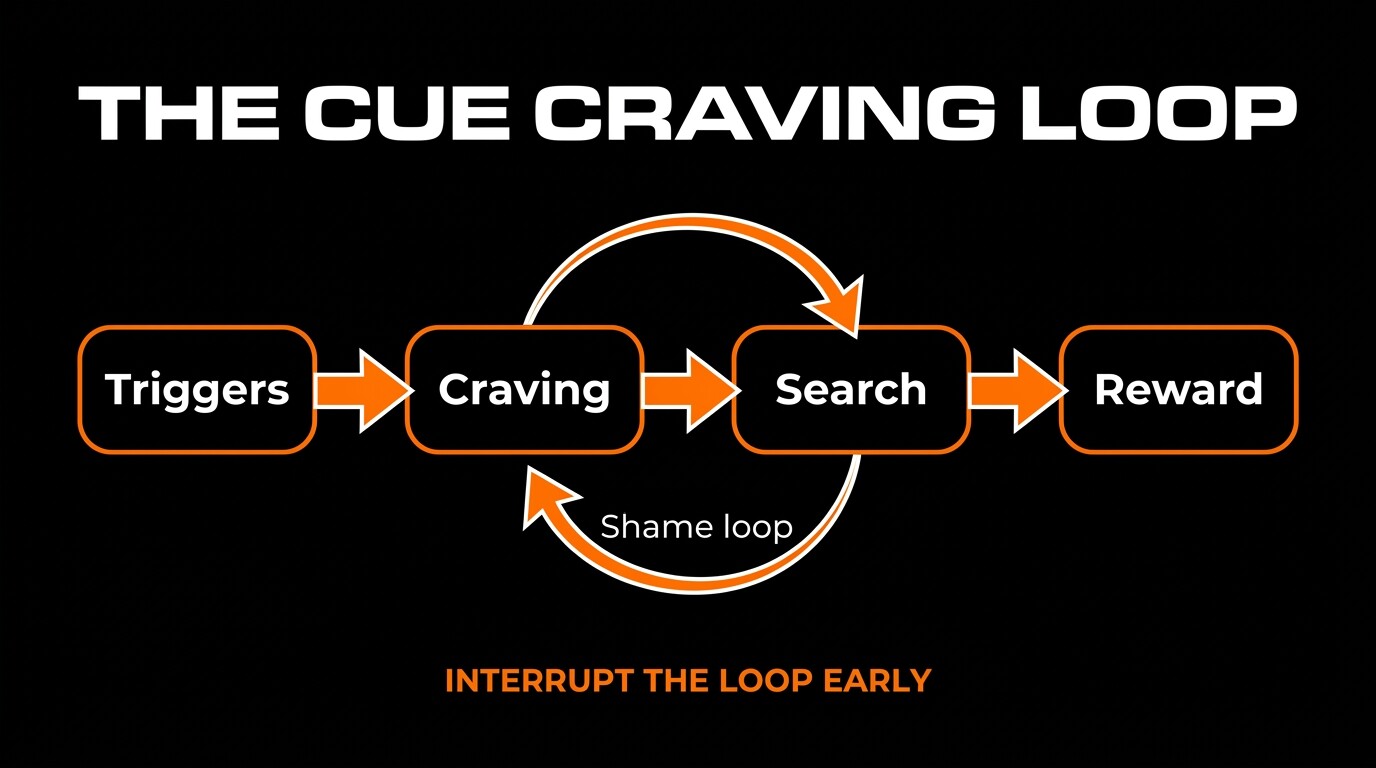
The cue craving loop for porn: triggers lead to craving, search, reward, and a shame loop that reinforces use.
What brain systems and habits keep the loop running?
Dopamine teaches the brain which cues predict rewards, so repeated pairing of stress or boredom with porn makes those cues feel urgent over time [6]. A cross‑sectional fMRI study of 64 healthy men found higher hours of porn use were associated with lower gray matter volume in the right caudate and reduced functional connectivity to prefrontal regions, suggesting adaptation in reward control circuits without proving causation [1]. In practice, tiny habits like late night phone scrolling become the on‑ramps for the loop.
How do stress, shame, and isolation increase use?
Chronic stress increases relapse risk across addictive behaviors by sensitizing stress and reward systems and narrowing coping options [8]. In the U.S., the Surgeon General reports about 1 in 2 adults experience measurable loneliness, which can amplify cue reactivity and evening drift into screens [7]. Shame often fuels secrecy and avoidance, which keeps patterns hidden and unchallenged.
When should men seek clinical help?
Consider clinical support if you cannot cut back despite repeated attempts, if escalation is distressing, or if use contributes to depression or anxiety. Cognitive behavioral therapy and skills based coaching may help restructure triggers and responses while reducing shame [2]. Speak with a qualified clinician for personalized guidance.
Why this fails
Most plans lean on willpower while leaving unlimited access and untracked triggers in place, which makes lapses likely during high stress windows. Implementation intentions that turn goals into “if‑then” rules have a medium to large effect on goal success, far outperforming vague promises [3]. Without hard friction and data, the loop outpaces motivation.
How to Fix It
This is education, not medical advice.
The simple framework
- Block access on every surface. Reduce cues in rooms, feeds, and routines.
- Replace rewards fast. Add movement, cold exposure, learning, or social calls at the same time of day.
- Track and review weekly. Use streaks, check ins, and data to tighten boundaries.
Who this is for:
- Men who want to reduce or stop porn use without moralizing.
- Men who notice stress or boredom drives their use.
- Men who prefer practical, tool based plans.
Who this is not for:
- Anyone experiencing coercive or unsafe behavior toward others.
- Men with active severe depression or suicidality.
- Anyone under clinical care requiring individualized medical guidance.
5 step plan
- Install device and DNS blockers. Cover phones, laptops, and Wi‑Fi so late night slips hit friction before search loads; DNS and device blocks reduce spontaneous access across contexts [6]. Set a non‑obvious admin passcode with a trusted person.
- Map triggers and high risk windows. Log time of day, mood, and location for one week to find patterns; loneliness and stress are common precursors for many men [7][8]. Protect those windows first.
- Replace with frictionless alternatives. Pair urge windows with 10 minute workouts, cold showers, breath drills, or a queued learning video so you can switch quickly; forming automaticity typically takes a median of 66 days, so make early swaps easy [4]. Keep gear and links prepped the night before.
- Use accountability and weekly check ins. Convert goals into “if‑then” rules like “If I’m alone after 10 pm, I plug my phone outside the bedroom,” which meta analysis shows improves follow through with a medium to large effect [3]. Do a 15 minute Sunday review to adjust blockers and routines.
- Review data and tighten boundaries. If a lapse happens, analyze the last 15 minutes, then add one new friction point and one new replacement. Mindfulness based skills can reduce craving intensity across addictive behaviors with small to moderate effects, improving urge surfing over time [5].
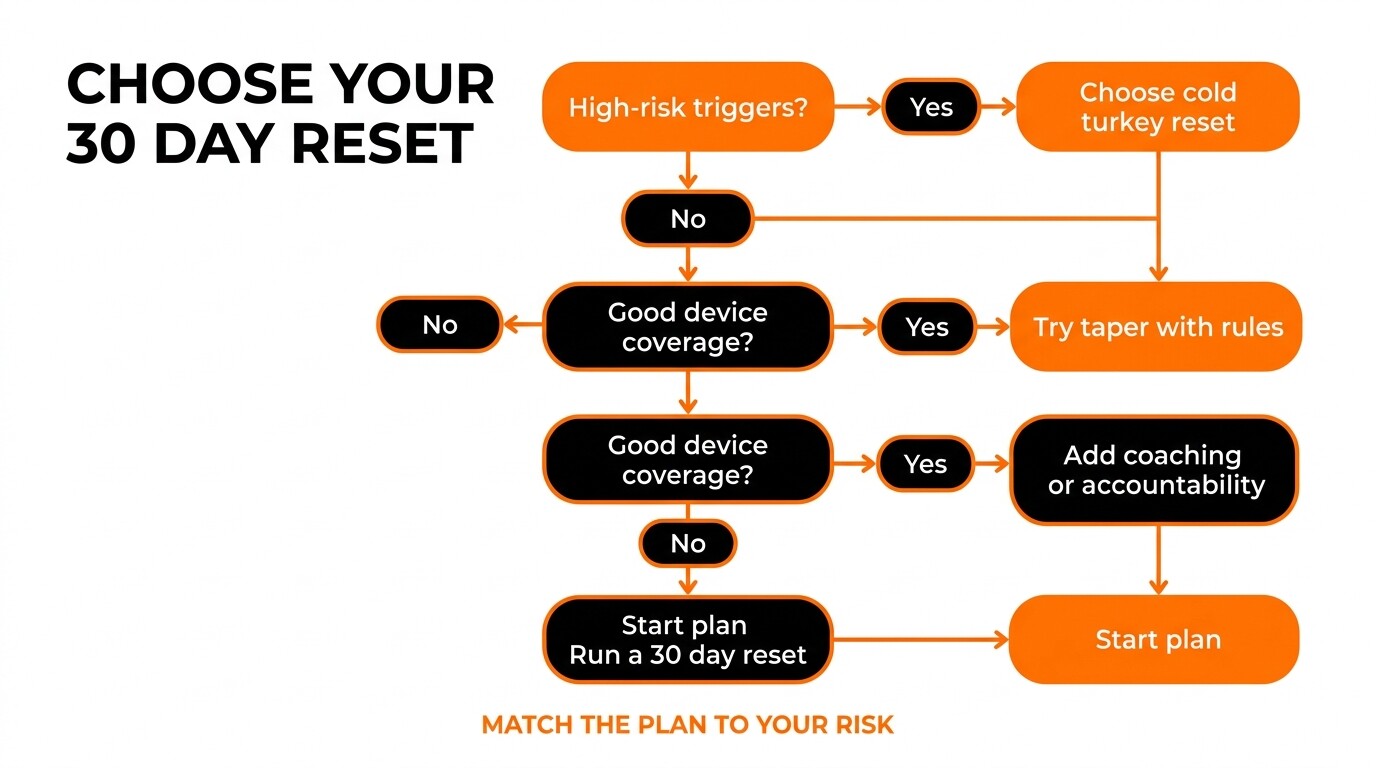
Decision flowchart: Choose your 30 day reset based on risk windows, device coverage, and social support.
FAQ
How long until urges drop after stopping?
Early urges often spike in week 1 to 2, then settle as cues lose power, but timelines vary. Habit automaticity in other domains averages 66 days, which frames expectations for building new routines [4].
Do partners cause or fix the problem?
Partners do not cause compulsive patterns, and they cannot fix them alone. They can support boundaries and accountability while you build your own loop controls.
Are blockers enough on their own?
Blockers are the seatbelt, not the engine. They reduce impulsive access, but skills like implementation intentions and mindfulness improve follow through and urge tolerance [3][5].
What if fantasies keep escalating?
Escalation often follows habituation and novelty seeking [9]. Set clear content boundaries, shrink time windows, and redirect to replacement rewards before search begins.
How to handle lapses without quitting?
Treat lapses as data, not identity. Add one friction upgrade and one replacement habit within 24 hours, and resume the plan with your next scheduled check in.
When is therapy a good idea?
If porn use causes significant distress, interferes with life, or you cannot cut back, therapy can help with shame, coping, and skill building. Speak with a qualified clinician.
Final Recommendation
Pick a 30 day reset that matches your highest risk windows, combine blockers with simple if‑then rules, and review weekly to tighten boundaries. Keep replacements frictionless for the first 2 to 3 weeks while you build momentum.
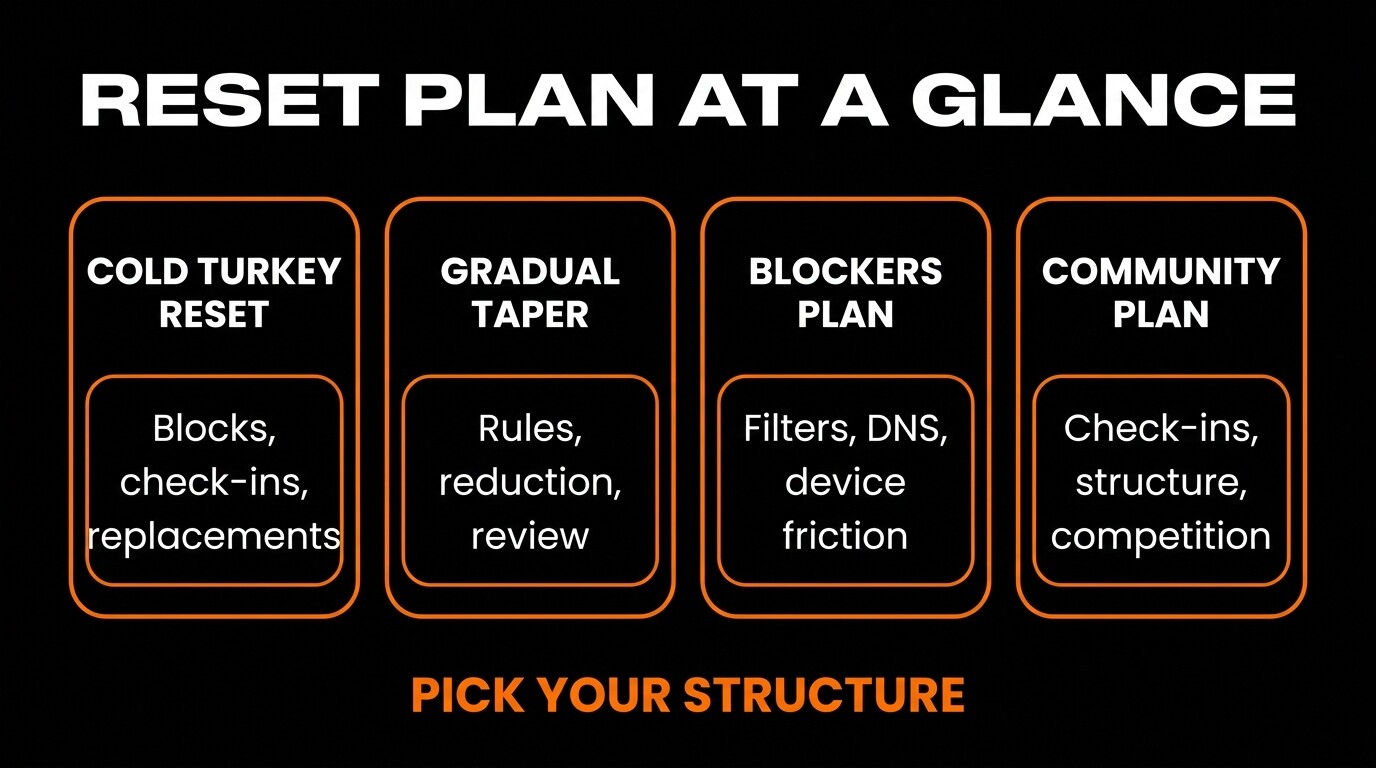
Reset plan at a glance: which tools are included in cold turkey, taper, blockers, and community plans.
Options For Men to Take Action
Most men try to fix this with willpower and scattered tips, then relapse when cues surge, and access stays open. The fragmented approach wastes time and keeps stress high. The Quit Porn Protocol brings blockers, prompts, tracking, coaching, timing, and progression into one place so you can run a clean 30 day reset without reinventing the wheel.
When you join, you get step by step setup for digital boundaries, prebuilt if‑then rules, daily journal prompts, and weekly reviews that adjust to your risk windows. You track streaks and lapses in one app and get practical action replacements queued for your peak times. Start now and get into a routine in the next 24 hours using your phone: install boundaries, pick your emergency anchors, and schedule your first accountability review with the Quit Porn Protocol.
- Wins on cost: It consolidates blockers, habit plans, and check ins that would otherwise mean multiple apps, subscriptions, or paid coaching. You replace piecemeal tools with one integrated flow that keeps out-of-pocket spend predictable.
- Wins on time: You skip weeks of research with vetted device and DNS setups, prewritten routines, journals and checklists. Setup is guided so you avoid trial and error during the hardest days.
- Wins on practicality: It fits busy schedules with 10 minute daily actions, bundle of tools and techniques to help you in any scenario, and the best solutions during your high risk windows.
Commit to one structured week, month or 3-month period and let the system handle friction, timing, and follow-through so you can focus on daily performance and habit building.
If you want to go deeper on porn recovery and habit change, explore the MenTools Habits hub for guides and frameworks built specifically for men.
To support your daily routine with targeted nutrition, explore MenTools One A Day, formulated with chelated minerals and active B-vitamin forms for men.
When you are ready to turn ideas into action, start a focused challenge or daily routine inside the MenTools app and track how consistent habits change how you feel.
Last updated: 2026-03-04 v1.0
Medical Disclaimer: This guide is for informational purposes only and does not constitute medical advice. Always speak with your doctor or another qualified healthcare professional before starting any new supplement or programme if you have medical conditions or take prescription medication.
References
- [1] Kühn, S., & Gallinat, J. (2014). Brain structure and functional connectivity associated with pornography consumption: The brain on porn. JAMA Psychiatry. https://jamanetwork.com/journals/jamapsychiatry/fullarticle/1874574
- [2] World Health Organization. ICD‑11: Compulsive sexual behaviour disorder. https://icd.who.int/browse11/l-m/en#/http://id.who.int/icd/entity/1630268048
- [3] Gollwitzer, P. M., & Sheeran, P. (2006). Implementation intentions and goal achievement: A meta-analysis. Advances in Experimental Social Psychology. https://doi.org/10.1016/S0065-2601(06)38002-1
- [4] Lally, P., van Jaarsveld, C. H. M., Potts, H. W. W., & Wardle, J. (2009). How are habits formed: Modelling habit formation in the real world. European Journal of Social Psychology. https://onlinelibrary.wiley.com/doi/abs/10.1002/ejsp.674
- [5] Li, W., Howard, M. O., Garland, E. L., McGovern, P., & Lazar, M. (2017). Mindfulness treatment for substance and behavioral addictions: A meta-analysis. Journal of Substance Abuse Treatment. https://doi.org/10.1016/j.jsat.2017.01.008
- [6] National Institute on Drug Abuse. Drugs, brains, and behavior: The science of addiction. https://nida.nih.gov/publications/drugs-brains-and-behavior-science-addiction
- [7] U.S. Surgeon General. (2023). Our epidemic of loneliness and isolation. https://www.hhs.gov/sites/default/files/surgeon-general-social-connection-advisory.pdf
- [8] Sinha, R. (2008). Chronic stress, drug use and vulnerability to addiction. Annals of the New York Academy of Sciences. https://www.ncbi.nlm.nih.gov/pmc/articles/PMC4553654/
- [9] Koukounas, E., & Over, R. (2000). Habituation and dishabituation of sexual arousal produced by visual stimuli. Journal of Sex Research. https://doi.org/10.1080/00224490009552056