No products in the cart.
Return To Shop
MEN: How Do You Quiet Your Inner Critic as a Man?
Quick Answer
You quiet it by changing how you respond to it, not by arguing with it. In four experiments, treating a failure with compassion was linked to more motivation to improve than a self-esteem control [1]. Training in self-compassion reduced self-criticism in controlled trials [2][3]. Repeating the critic’s harshest word aloud until it loses its punch also cut the discomfort of the thought in a student study [4].
**Jump to:** At a glance | What it is | Does harshness work? | Is it soft? | Men and self-compassion | Criticism vs correction | Does training work? | Noticing the thought | Writing it down | How to do it | FAQ | Options for men
Disclosure: MenTools publishes this article and may feature MenTools products.
How we evaluate: Each step is assessed on real-world use, evidence, cost and time, and how well it suits men. Every step including the MenTools option carries an honest limitation. Full sources are in the references below.
How Do You Quiet the Inner Critic? At a Glance
The inner critic is your habit of judging yourself harshly, and the evidence supports four ways to turn it down. You can treat a failure the way you would treat a mate, you can notice the thought instead of obeying it, you can write it out, and you can swap blame for a specific fix. The table gives each one and what the research does and does not show.
| Approach | What you do | What the research shows |
|---|---|---|
| Self-compassion | Respond to a failure with understanding and a plan, not an attack | More study time after a failure than a self-esteem control, in a four-experiment paper [1] |
| Self-compassion training | Complete a structured course, ideally in a group | Self-criticism fell against controls (g = 0.56, in a review of 27 trials) [2] |
| Defusion | Say the thought as a single word, over and over, until it loses grip | Less discomfort and less belief in the thought than distraction, in one study of students [4] |
| Writing it down | Write about the thing that is bothering you | A small average benefit across 146 randomised studies (r = .075) [5] |
| Self-correction | Name the specific error and the specific fix | A compassionate response raised the belief that a personal weakness can change [1] |
| Harsh self-talk | Call yourself names so you do better next time | Not tested head to head in the studies reviewed here |
What Is the Inner Critic?
The inner critic is the running commentary that judges you, and psychologists call the habit self-criticism. One review defines it plainly as “the process of negative self-evaluation” [3]. It is the voice that says you are useless after a missed target, a bad set or a row with your partner.
Kristin Neff, who wrote the article that defined the construct, describes the healthy alternative as “being kind and understanding toward oneself in instances of pain or failure rather than being harshly self-critical” [6]. Note what that sentence leaves in. It does not say ignore the failure. It says stop attacking yourself about it.
Many men assume the voice is just part of how they are wired, or that it is the engine behind their work ethic. Both ideas are worth testing. The sections below look at what the studies find when harshness is compared with a kinder response, and at what actually turns the volume down.
A note on scope. Everything here is about the ordinary inner critic that most men carry, not a clinical condition. If the voice is constant, is stopping you working or seeing people, or comes with thoughts of harming yourself, speak to your GP.
Does Harsh Self-Talk Make Men Perform Better?
No study in this guide shows that harshness improves performance, and one set of experiments found the kinder response led to more motivation. People who treated their own failure with compassion spent more time studying after failing a test than people in a self-esteem control group [1]. The belief that you have to be hard on yourself to improve is a belief, not a finding.
Breines and Chen ran four experiments covering personal weaknesses, moral transgressions and test performance [1]. Participants in the self-compassion condition expressed greater belief that a personal weakness could change, reported more motivation to make amends for a moral slip, and preferred to compare themselves with people doing better [1]. The abstract does not give sample sizes, so treat the result as a strong signal rather than a precise estimate.
The authors summarised it this way: “somewhat paradoxically, taking an accepting approach to personal failure may make people more motivated to improve themselves” [1]. The word “paradoxically” is theirs, and note the “may”: it is a careful finding, not a guarantee. It is the reverse of what most of us were taught on a pitch or a shop floor.
The wider pattern points the same way. In a meta-analysis of 20 samples from 14 studies, self-compassion and psychopathology were linked with “a large effect size for the relationship between compassion and psychopathology” [7]. The size was 0.54, with the link running in the negative direction, so more self-compassion went with fewer symptoms [7]. That is a correlation, so it cannot tell you which causes which.
Our guide to how to stop overthinking as a man covers the looping side of the voice, the replaying of the same moment. This post is about the verdict the voice hands down.
Is Self-Compassion Soft, or a Performance Tool?
It is a performance tool. Self-compassion is defined as a healthy way of relating to yourself “motivated by a desire to help rather than harm” [2], and the experiments above found it increased the drive to improve [1]. Softness would mean lowering the standard. Self-compassion keeps the standard and drops the attack.
Neff splits it into three parts. Self-kindness is the first. The second is common humanity, which means seeing your struggle “as part of the larger human experience” rather than as separating and isolating [6]. The third is mindfulness, defined as “holding painful thoughts and feelings in balanced awareness rather than over-identifying with them” [6].
Read that third part again, because it is the one that works on the voice itself. You do not have to believe the critic or fight it. You hold the thought in view, name it for what it is and carry on. That is a skill, and skills can be trained.
The size of the link with how people function is not small. A meta-analysis of 79 samples and 16,416 people found a relationship of r = .47 between self-compassion and well-being [8]. The authors also note that “a subsample of studies indicated a causal effect of self-compassion on well-being” [8]. It is a sizeable association with some causal support, not a proven cure.
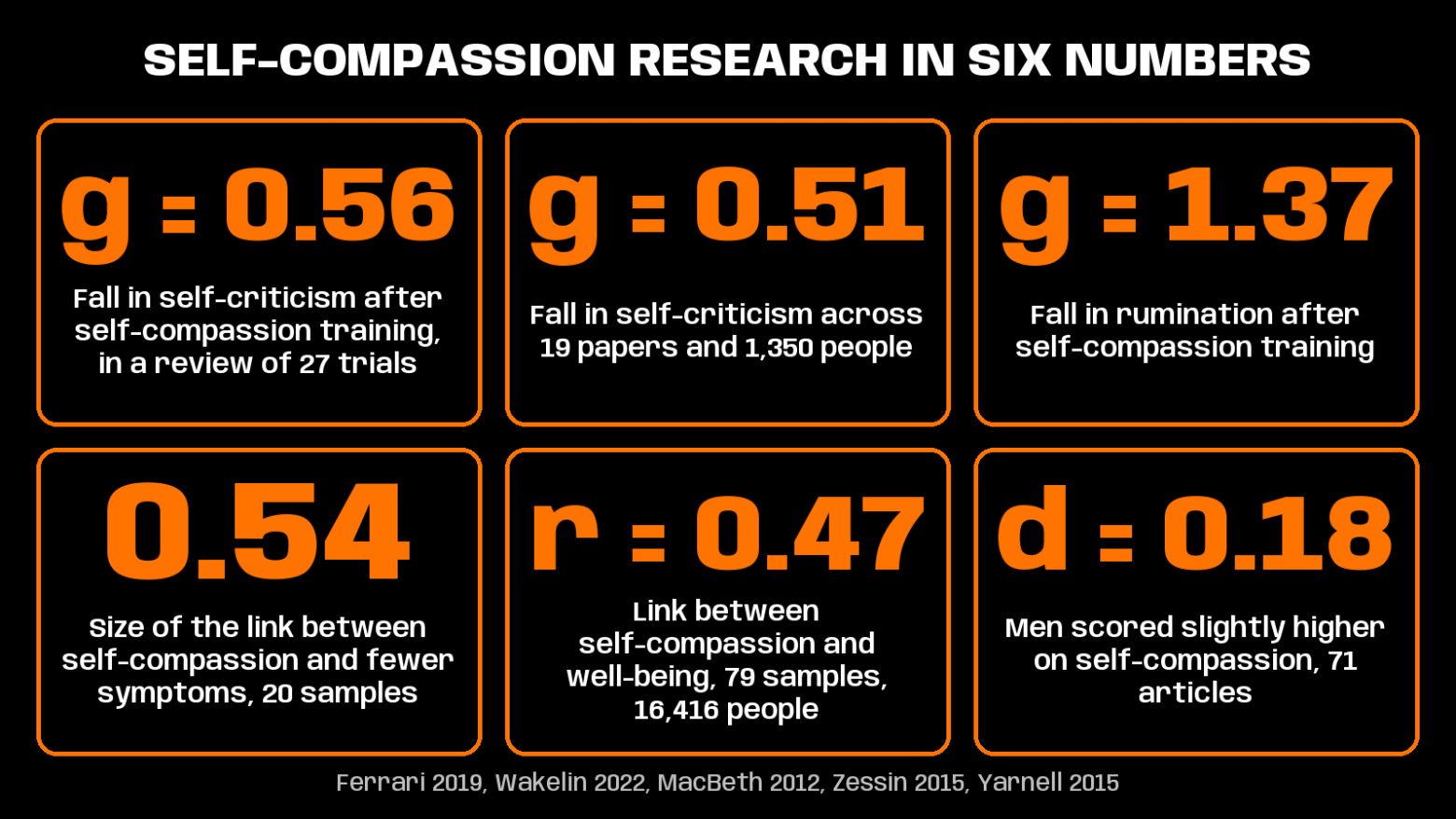
Six numbers from the self-compassion research, all from meta-analyses.
Do Men Have Less Self-Compassion?
Not on the average scores. A meta-analysis of 71 articles and dissertations, covering 88 estimates, found that “males had slightly higher levels of self-compassion than females” [9]. The effect size was small, d = .18, and the authors warn against “overemphasizing gender differences in self-compassion as being large in size” [9].
So the idea that men are simply lacking in self-compassion is not what the numbers say. The same paper raises a different point in its opening, namely that “gender norms may hinder the development of self-compassion by women on one hand, and men on the other” [9]. In plain terms, the rules about what a man should be can get in the way of learning to treat yourself well, even if the average score is not low.
The abstract does not say which norms, or how large that hindrance is, so we will not guess. What it does give you is permission to treat the skill as normal. If your instinct is that being kind to yourself after a failure is unmanly, that instinct is a learned rule, and the people who scored a little higher on average were men.
There is also a practical identity point. A man who holds himself to a high standard and a man who is kind to himself after missing it are the same man at two different moments. The first sets the bar. The second is what lets him get back up to it. Our guide to what mental fitness is treats both as parts of one trainable system.
What Is the Difference Between Self-Criticism and Self-Correction?
Self-criticism attacks the person, and self-correction names the error and the fix. “I am a failure” is criticism. “I rushed the prep and skipped the check, so tomorrow I do the check first” is correction. The first gives you nothing to do, while the second gives you a next action.
The research on motivation fits that split. In the Breines and Chen experiments, the compassionate condition led to a greater belief that a weakness could change, which is the belief you need before a fix makes sense [1]. Attack tends to freeze that belief and leave the weakness looking like a fixed part of you.
A few signs help you spot which one you are doing:
– Criticism uses “always” and “never”, and correction names one event.
– Criticism is about who you are, and correction is about what you did.
– Criticism ends with a feeling, and correction ends with an action and a time.
Use the test whenever the voice starts up. If the thought contains a fix you can do before the end of tomorrow, keep it and write the fix down. If it contains only a verdict, it is noise, and the next two sections are for that case.
Can Self-Compassion Training Quiet the Critic?
Yes, and the effect on self-criticism is medium in size. A review of 20 randomised trials, with 1,350 participants in the 19 papers that had enough data, found that self-compassion interventions “produce a significant, medium reduction in self-criticism in comparison with control groups” (Hedges’ g = 0.51) [3]. Trials of longer interventions tended to show bigger reductions [3].
A second meta-analysis of 27 randomised controlled trials found improvement across 11 psychosocial outcomes compared with controls [2]. For self-criticism the effect was g = 0.56, for stress 0.67, for anxiety 0.57 and for depression 0.66 [2]. The largest effects were for rumination (g = 1.37) and eating behaviour (g = 1.76) [2]. For anyone whose critic mostly shows up as replaying a mistake, the rumination figure is the interesting one.
Format mattered too. The Ferrari review found results were “stronger for the group over individual delivery methods”, and self-compassion gains were maintained at follow-up [2]. If you want to train this properly, a structured course with other people is a better bet than a one-off pep talk.
The honest limits sit in the same abstracts. Wakelin and colleagues rated the studies as moderate quality with high heterogeneity, and asked for more trials with active controls and follow-up [3]. Ferrari and colleagues note that publication bias may be present [2]. This is a promising result from a lot of trials, not a settled one.
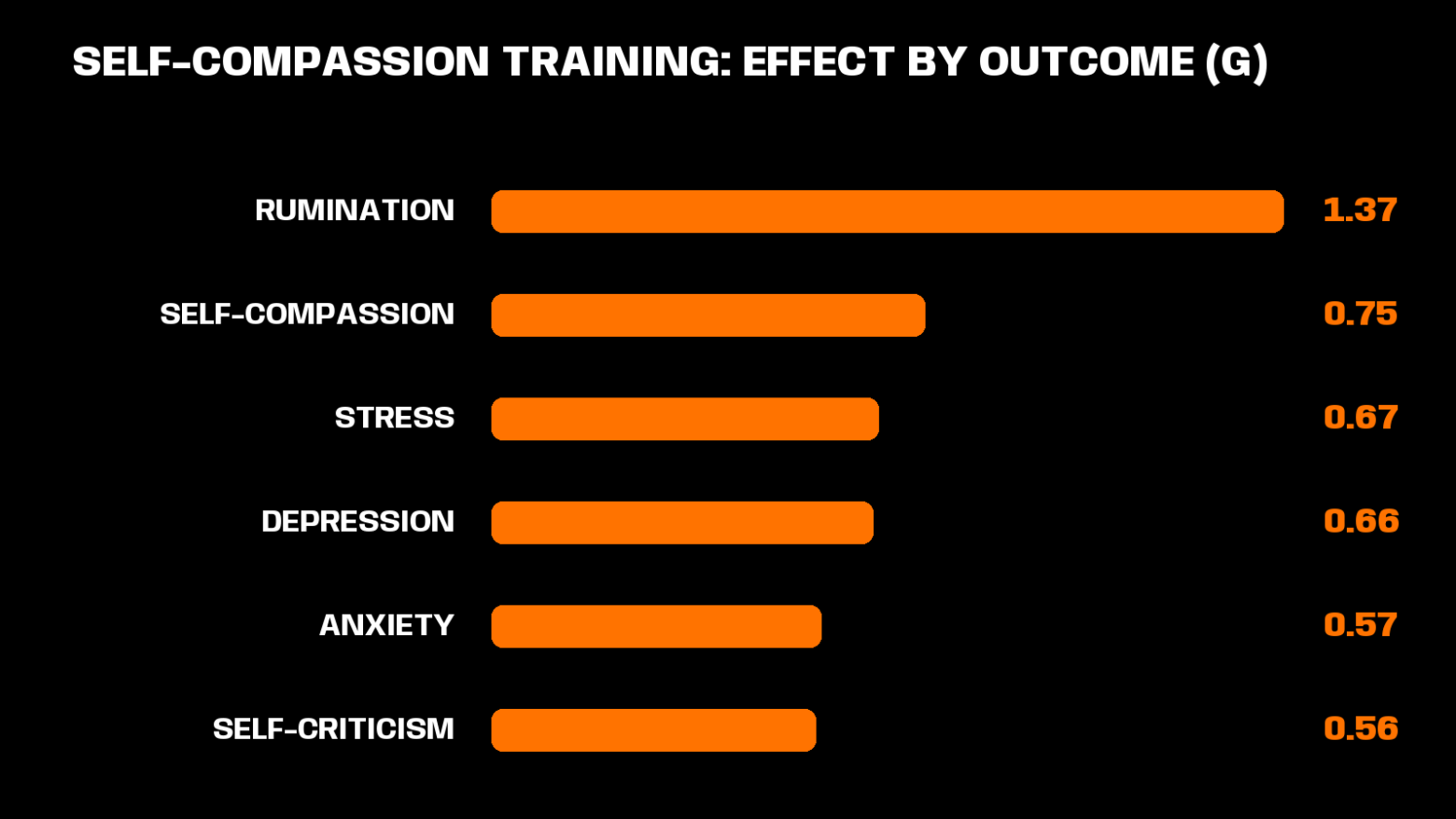
Effect of self-compassion training against controls, by outcome.
Does Noticing the Thought Help Quiet It?
Yes, in the lab studies, because it changes your relationship to the thought and leaves its content alone. The technique is called defusion, from Acceptance and Commitment Therapy. In one study, repeating a one-word version of a negative self-judgement quickly out loud “reduced the emotional discomfort and believability of negative self-referential thoughts significantly greater than comparison conditions” [4].
That study used non-clinical undergraduates randomly assigned to one of three protocols, and the comparison included thought distraction [4]. Favourable results were also reported for participants with higher depressive symptoms [4]. It is one study of students, so treat it as an example of the method, not a guarantee for every man in every mood.
The wider research base is larger. A meta-analysis of 66 laboratory-based component studies found significant positive effects for acceptance, defusion, present moment and values components compared with inactive comparison conditions [10]. It also found larger effects for components that included experiential methods, such as exercises and metaphors, than for a rationale alone [10]. Reading about defusion does less than doing it.
In practice it looks like this. The voice says “you are pathetic”. You pick the key word, “pathetic”, and say it out loud for 30 seconds until it sounds like a noise. Or you label it, “I am having the thought that I am pathetic”. Neither argues with the thought, and both loosen it.
Our guide to building confidence covers a different trick, talking to yourself by name, so we will not repeat it here. Defusion is the one to reach for when the thought is a verdict about you.
Does Writing the Critic Down Help?
It helps a little on average, and the benefit is real but small. A meta-analysis of 146 randomised studies of experimental disclosure, meaning disclosing thoughts and feelings about personal and meaningful topics, found a “positive and significant average r-effect size of .075” [5]. A figure of .075 is a modest benefit, not a transformation.
The same meta-analysis found a number of moderators, which means some conditions work better than others [5]. The abstract does not list them, so we cannot tell you which ones. What it does support is a simple claim: putting difficult material into words has a positive average effect across a large body of trials.
For the inner critic, writing earns its place for a different reason as well. It forces the vague voice to become a sentence you can read. Once the thought is on a page, you can run the test from earlier and ask whether it is criticism or correction.
Keep it short and specific. Write the thought as the voice says it, write what happened, and write one fix if there is one. Our guide to how to regulate emotions has more on getting a feeling out of your head and into something you can work on.
How Do You Quiet Your Inner Critic Step by Step?
Run the same five steps each time the voice starts: notice it, label it, sort it into criticism or correction, answer it as you would a mate, and write the result down. Each step is built on one of the studies above, and the order and wording of the steps are our own advice.
**Step 1: notice it and label it.** Say “I am having the thought that I am useless”. Mindfulness, in Neff’s definition, is holding painful thoughts “in balanced awareness rather than over-identifying with them” [6].
**Step 2: defuse the harshest word.** Pick the single word that stings, such as “failure”, and repeat it aloud until it goes flat. Defusion reduced discomfort and belief in the thought more than distraction did, in one student study [4].
**Step 3: sort it.** Ask whether the thought is criticism or correction. If it names a specific error and a fix, keep it as correction. If it only gives a verdict about you, put it down.
**Step 4: answer it like a mate.** Say what you would say to a friend who made the same mistake, then add the next action. Treating a failure with compassion led to more study time afterwards [1], so this step is the one that keeps you moving.
**Step 5: write it down and repeat.** Put the thought, the fact and the fix in two or three lines. Trials of longer interventions tended to show bigger reductions in self-criticism [3], so count the repeats rather than the good days.
FAQ
Is it normal for men to have an inner critic?
The studies reviewed here do not give a rate for how many men have one. Self-criticism is defined as “the process of negative self-evaluation” [3], a description of a process rather than a male fault. Males scored slightly higher on self-compassion on average, with a small effect size of d = .18 [9].
Does being hard on myself make me work harder?
The studies reviewed here do not show that. After a failure, people in a self-compassion condition spent more time studying than people in a self-esteem control group [1]. The authors described it as somewhat paradoxical that accepting failure may make people more motivated to improve [1]. Keep the standard and drop the attack.
Is self-compassion a form of making excuses?
Not in the research. In the Breines and Chen experiments, self-compassion increased motivation to make amends for a moral transgression and to avoid repeating it [1]. Excuse-making would lower that. Self-compassion also showed a large association with lower psychopathology across 20 samples [7], which is a correlation and not proof of cause.
How long does it take to quiet the inner critic?
The studies reviewed here do not give a time to a quiet mind. They do show that trials of longer self-compassion interventions tended to find bigger reductions in self-criticism [3], and that self-compassion gains were maintained at follow-up [2]. Think in terms of weeks of regular practice, not a single session, and measure it by how long a bad moment lasts.
Does repeating a word really help?
In one study of non-clinical undergraduates it reduced emotional discomfort and the believability of a negative thought more than comparison conditions [4]. A wider meta-analysis found positive effects for defusion components against inactive comparisons, with larger effects when people did the exercise rather than read about it [10]. It is worth a two-week trial.
When should I see a GP about it?
If the voice is constant, is stopping you working, sleeping or seeing people, or comes with thoughts of harming yourself, speak to your GP. The research here covers the ordinary inner critic. The review of self-compassion interventions itself notes that mechanisms of change need more research [2].
Final Recommendation
Do not try to win the argument with the voice. Respond to it the way a good coach would, with a straight account of what went wrong and a next action, and without the abuse. Self-compassion increased the wish to improve [1], and training it reduced self-criticism in randomised trials [3][2].
If your sticking point is a single harsh word that will not leave, use defusion [4]. If it is a vaguer weight you cannot pin down, put it into words, which has a small average benefit [5]. If it is a belief that kindness is for other men, remember that males scored slightly higher on average in a meta-analysis of 71 articles [9]. If it is constant, speak to your GP.
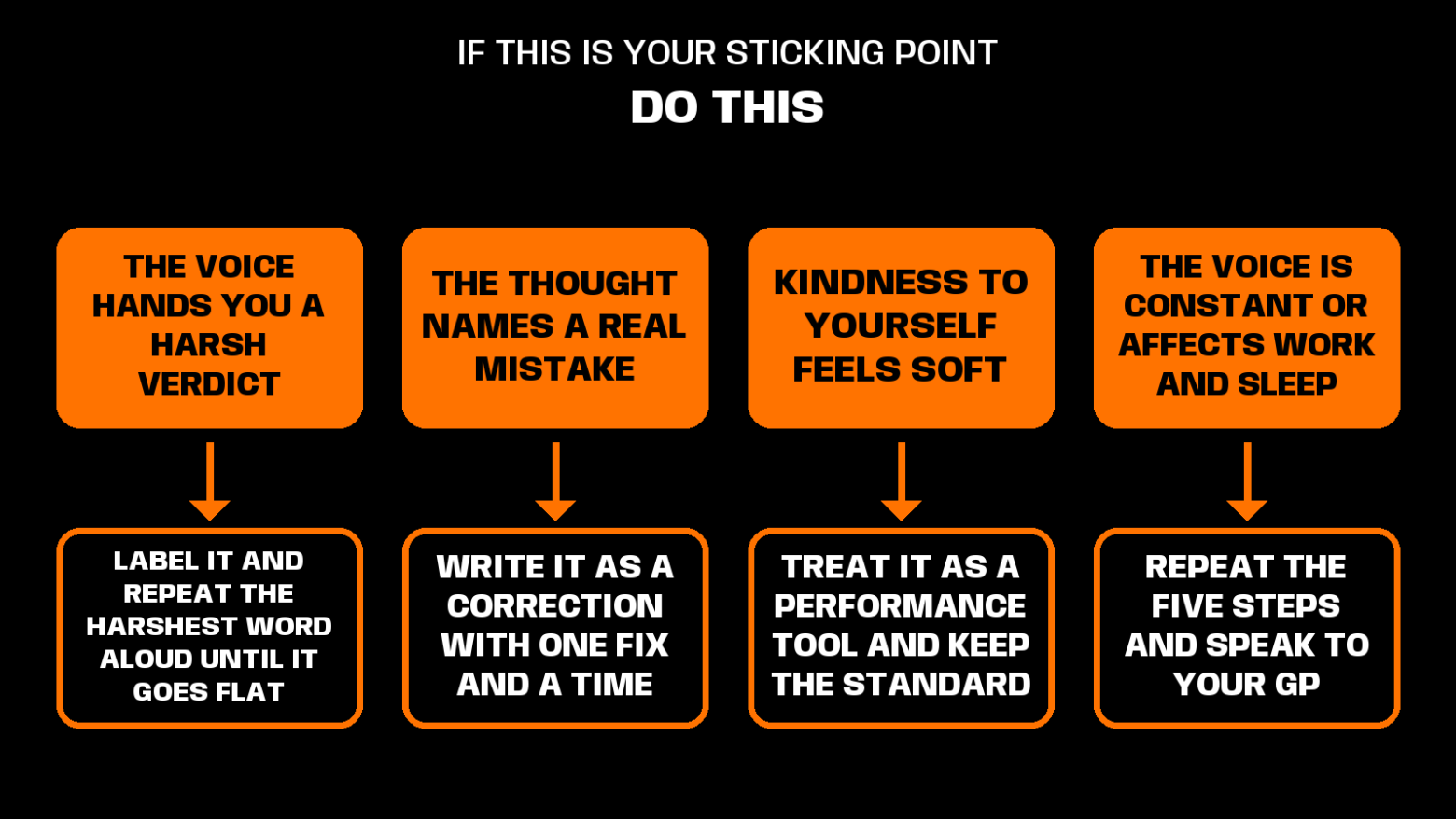
Four sticking points and what to do about each.
Options for Men to Take Action
Most men know the voice is not helping, but with no system the plan stays at “be less hard on myself”, and the first bad day wipes it out.
The MenTools app runs challenges across mindset, fitness, nutrition and money, with levels you choose, daily actions, streak and progress tracking, journals and an AI coach. For this guide, its job is to turn the five steps into one daily action you can tick off, with the journal as the place to write the thought, the fact and the fix.
How you can do this today: add one mindset action at the easiest level, and write the thought, the fact and the fix in the journal for two weeks.
Wins on cost: one subscription brings challenges, tracking, journals and an AI coach together, instead of paying for separate apps.
Wins on time: the challenges are already built, so you spend your time on the rep and not on designing a plan.
Wins on practicality: you choose your level, so the first dose can be small enough to do on a bad day.
Watch-out: none of the studies in this guide tested the MenTools app, so treat it as a structure for repetition and not as a treatment for self-criticism. If the voice is severe or constant, speak to your GP.
A hard week is easier to meet when the basics underneath are covered, so a one a day multivitamin may help cover the simple daily foundation. For more on this topic, the MenTools mindset hub collects every guide in one place. Hold the standard, drop the attack, and write down the next step.
Last updated: 2026-11-17 v1.0
Disclaimer: This guide is for informational purposes only and does not constitute medical or psychological advice. Speak with a qualified professional before making significant changes if you have a medical or mental health condition.
References
- [1] Breines JG, Chen S. Self-compassion increases self-improvement motivation. Personality and Social Psychology Bulletin, 2012;38(9):1133-1143. Link
- [2] Ferrari M, Hunt C, Harrysunker A, Abbott MJ, Beath AP, Einstein DA. Self-compassion interventions and psychosocial outcomes: a meta-analysis of RCTs. Mindfulness, 2019;10(8):1455-1473. Link
- [3] Wakelin KE, Perman G, Simonds LM. Effectiveness of self-compassion-related interventions for reducing self-criticism: a systematic review and meta-analysis. Clinical Psychology and Psychotherapy, 2022;29(1):1-25. Link
- [4] Masuda A, Twohig MP, Stormo AR, Feinstein AB, Chou YY, Wendell JW. The effects of cognitive defusion and thought distraction on emotional discomfort and believability of negative self-referential thoughts. Journal of Behavior Therapy and Experimental Psychiatry, 2010;41(1):11-17. Link
- [5] Frattaroli J. Experimental disclosure and its moderators: a meta-analysis. Psychological Bulletin, 2006;132(6):823-865. Link
- [6] Neff KD. Self-compassion: an alternative conceptualization of a healthy attitude toward oneself. Self and Identity, 2003;2(2):85-101. Link
- [7] MacBeth A, Gumley A. Exploring compassion: a meta-analysis of the association between self-compassion and psychopathology. Clinical Psychology Review, 2012;32(6):545-552. Link
- [8] Zessin U, Dickhauser O, Garbade S. The relationship between self-compassion and well-being: a meta-analysis. Applied Psychology: Health and Well-Being, 2015;7(3):340-364. Link
- [9] Yarnell LM, Stafford RE, Neff KD, Reilly ED, Knox MC, Mullarkey M. Meta-analysis of gender differences in self-compassion. Self and Identity, 2015;14(5):499-520. Link
- [10] Levin ME, Hildebrandt MJ, Lillis J, Hayes SC. The impact of treatment components suggested by the psychological flexibility model: a meta-analysis of laboratory-based component studies. Behavior Therapy, 2012;43(4):741-756. Link