
MEN: How Do You Stop Doomscrolling at Night? Evidence-Based Reset Guide for Men
Quick Answer
Doomscrolling at night is not a willpower problem. It is a conditioned dopamine loop reinforced by your environment, your phone’s design, and depleted decision-making capacity after a full day.
The evidence-based fix combines three things: environment design, habit replacement, and trigger removal. Start by moving your phone charger out of the bedroom tonight. That single change eliminates the most common access point for nighttime scrolling without requiring any willpower at all.
Jump to: How to Fix It | Quick Comparison | FAQ
Disclosure: MenTools publishes this article and may feature MenTools products.
How we evaluate: Products are assessed on nutrient form quality, dose vs NRV, authorised health claims, male-specific design, and independent research. Full sources are listed in the references below.
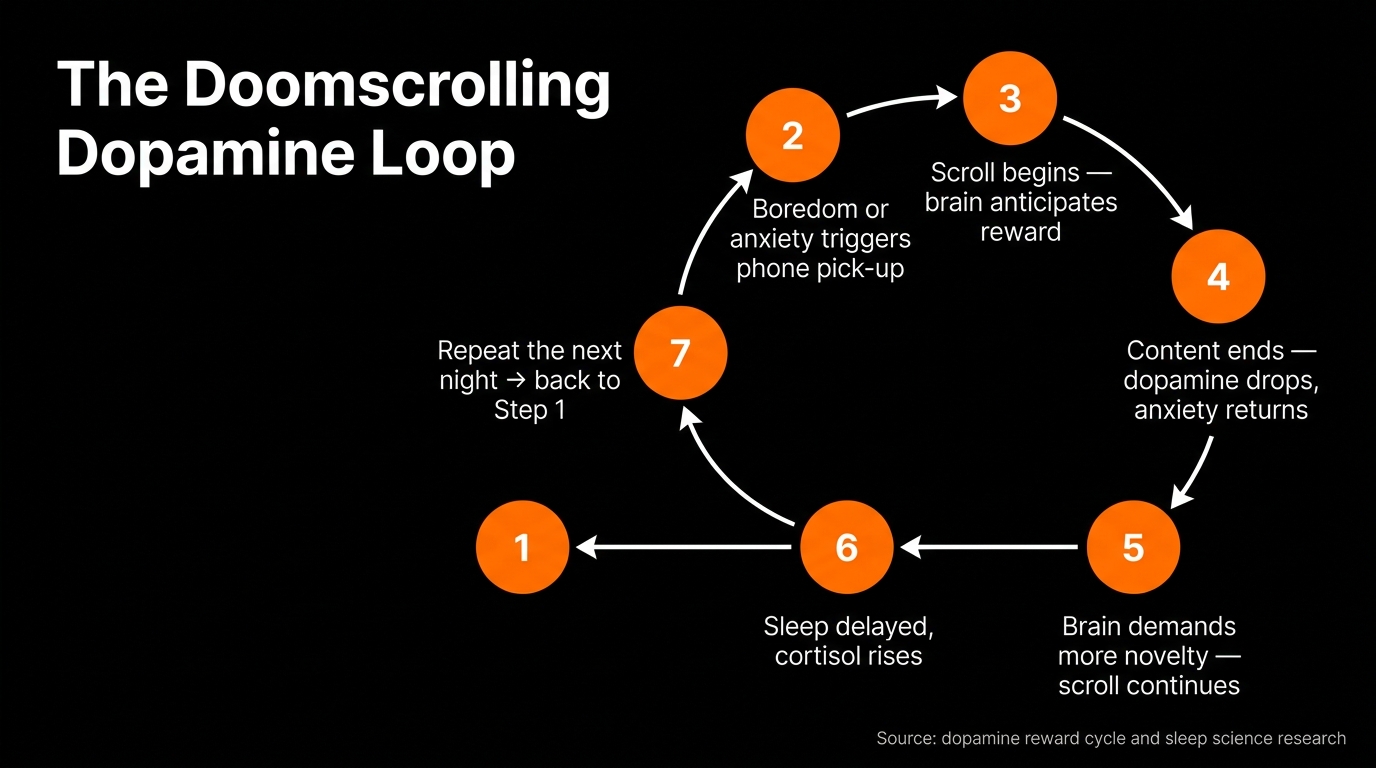
The Doomscrolling Trap: How one scroll becomes 90 minutes — the dopamine feedback loop explained.
Quick Comparison
Not all approaches to stopping doomscrolling are equally effective. Here is how the most common methods stack up based on evidence and real-world durability.
| Method | Effort Level | Long-term Effectiveness | Best for |
|---|---|---|---|
| Move phone out of bedroom | Low | Very High | Anyone who charges beside the bed |
| App screen time limits | Very Low | Low | Testing initial awareness only |
| Grayscale display mode | Very Low | Moderate | Reducing visual appeal of apps |
| Blue light glasses | Low | Low | Eye strain only — won’t stop the scroll |
| Habit replacement (book/journal) | Moderate | High | Men who need a defined swap activity |
| Sleep protocol stack (routine + cutoff) | Moderate | Very High | Men wanting a full reset system |
| Delete or hide trigger apps | Low | High | Men with specific platform addictions |
| Cold turkey phone ban | High | Moderate | Short-term resets only |
The Real Answer
Why do men specifically doomscroll at night?
Night-time is when decision fatigue is at its worst. After a full day of choices, the pre-frontal cortex — the part of your brain responsible for self-control — is running on empty. The path of least resistance is picking up the phone.
Research confirms this pattern. According to an American Academy of Sleep Medicine poll, 50% of adults use a screen in bed every day, and a further 33% do so most nights.[1] The scroll is not random; it fills a gap that structured wind-down habits would otherwise occupy.
What is doomscrolling doing to your brain?
Doomscrolling activates your brain’s dopaminergic reward pathways. Each new post or headline triggers a small dopamine release, and the variable reward schedule — you do not know if the next scroll will be interesting or alarming — makes it particularly hard to stop.[2]
The content itself compounds the problem. Negative and threat-based articles overstimulate the amygdala, keeping your stress response active long after you have put the phone down. A 2024 study of 800 adults published in Computers in Human Behavior Reports found that doomscrolling is associated with significantly elevated levels of existential anxiety.[3]
How badly does it affect your sleep?
The damage is measurable. A large study of 45,202 Norwegian university students found that each additional hour of screen use increased the odds of insomnia symptoms by 59% and reduced total sleep duration by approximately 24 minutes.[4]
Blue light is one mechanism. Harvard research demonstrated that blue light suppressed melatonin for approximately twice as long as green light and shifted circadian rhythms by three hours compared to just 1.5 hours for other light sources.[5] A separate study found that two hours of LED tablet use before bed caused a 55% decrease in melatonin levels and delayed its onset by 1.5 hours compared to reading a printed book.[6]
Is doomscrolling a habit or an addiction?
It sits between the two. The behaviour follows a classic habit loop — cue, routine, reward — but the neurochemical reinforcement is strong enough to make it compulsive for many men. Research published in PMC describes smartphone scrolling as activating dopaminergic pathways in ways that mirror problematic use patterns.[2]
The practical implication is that treating it as a pure habit underestimates how much environmental redesign is needed. You need to engineer the environment to make the default the right choice.
Why This Fails
Most men try app screen time limits first. They set a 30-minute daily cap on Instagram or Twitter, the notification fires, and they tap “ignore limit” and keep scrolling. The system relies on in-the-moment decision-making — exactly when willpower is at its lowest.
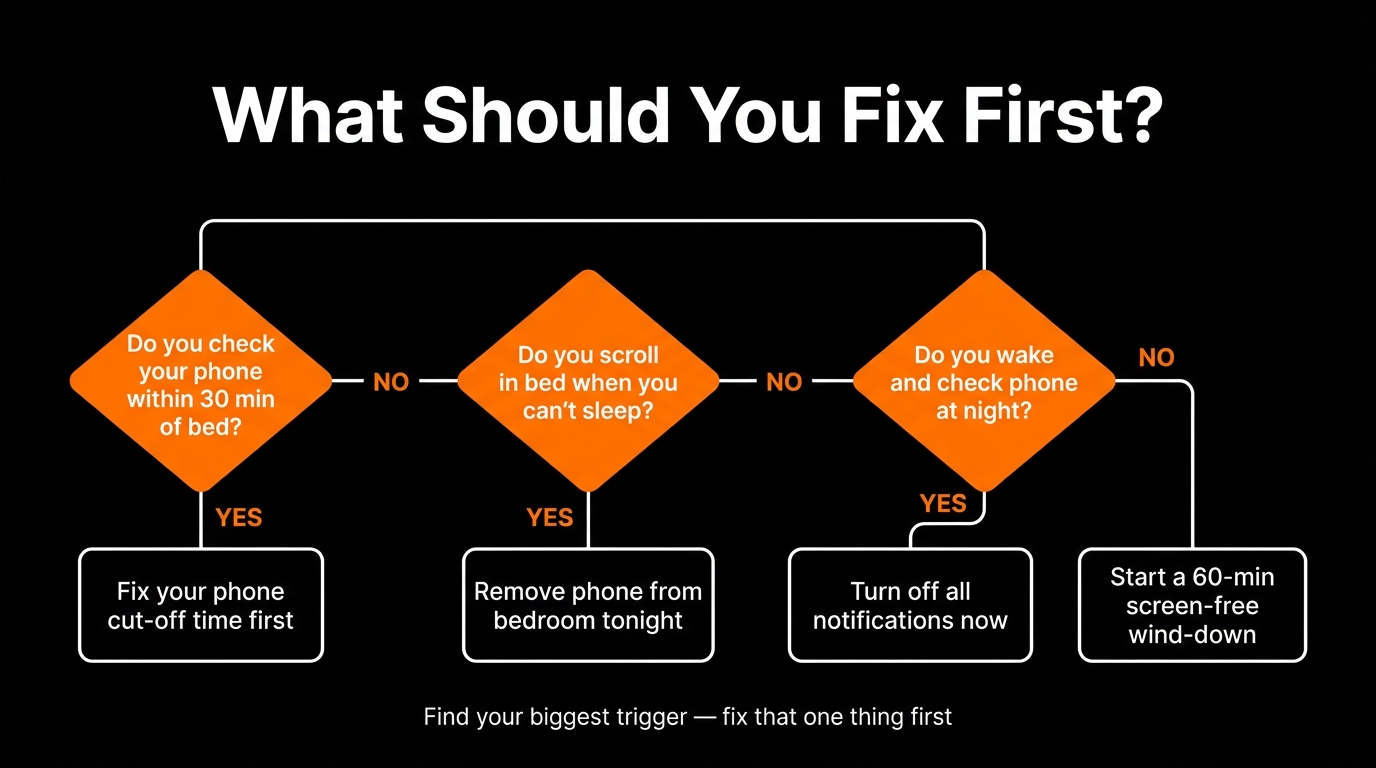
Which Doomscrolling Fix Should You Try First? Use this decision matrix to find your highest-impact starting point.
Grayscale mode and blue light glasses are also popular. Grayscale has some evidence — a randomised controlled trial found it reduced problematic smartphone use and anxiety.[7] But neither approach removes access to the phone. They make scrolling slightly less engaging; they do not make it harder to start.
The deeper failure is treating doomscrolling as an information problem. Men read about why scrolling is bad and expect that knowledge alone to change the behaviour. It does not. Research is clear that breaking screen habits requires structural changes, not just awareness.[4]
How to Fix It
The Simple Framework
Environment design beats willpower every time. The goal is to make the default behaviour — picking up your phone in bed — structurally harder while making the replacement behaviour structurally easier.
This is the three-part reset: Remove access. Kill triggers. Install a replacement.
5-step plan
- Set a hard phone cutoff 60 minutes before your intended sleep time. The AASM recommends avoiding screens and blue light 30 to 60 minutes before bedtime as the minimum effective dose.[1] Set the cutoff as a calendar event or alarm so it becomes a system, not a decision.
- Move your phone charger permanently out of the bedroom. Charge in the hallway, kitchen, or any room that is not your sleeping space. This is the single highest-impact environmental change in the research.[4] It removes the object from the environment where the habit occurs.
- Delete or bury the top three scroll-trigger apps from your home screen. You do not need to delete them permanently. Move them into a folder three taps deep, or delete and reinstall when needed for a specific purpose. Friction kills automaticity.
- Define and install one replacement activity in the scroll slot. The activity must be physical and non-digital: reading a book, writing in a journal, stretching, or a breathing protocol. The replacement must be as easy to access as the phone was — book on the nightstand, journal and pen within reach.
- Track your streak for 14 consecutive nights. Habit research consistently shows that tracking accelerates consolidation. A 14-day streak is enough to establish a new baseline pattern. Use a simple paper tracker on the wall beside your bed.
FAQ
How long does it take to break a doomscrolling habit?
Habit formation research suggests it takes anywhere from 18 to 254 days, with a median around 66 days. However, most men notice meaningful improvement in sleep quality and the urge to scroll within the first 14 nights of consistent environmental changes.
Should I use a phone blocker app?
Blocker apps can help as a short-term bridge. They are most effective when used alongside environmental changes rather than as the primary fix. On their own, they still rely on willpower to bypass the block.
Does blue light actually affect sleep that much?
Yes. Harvard research showed blue light suppressed melatonin for twice as long as other light sources and shifted circadian rhythms by three hours.[5] That said, the content you are consuming matters as much as the light — threat-based media activates your stress system independently of the blue light effect.
What should I do instead of scrolling before bed?
Choose one activity that is physical, low-stimulus, and non-digital. Reading a physical book is the most evidence-backed alternative. Journalling, light stretching, or a structured breathing protocol also work. The key is that it must be pre-decided and physically accessible before you get into bed.
Can doomscrolling cause anxiety?
Yes. Research consistently links excessive negative news consumption to elevated cortisol, psychological distress, and existential anxiety.[3] The relationship runs in both directions: anxious men are more likely to doomscroll, and doomscrolling increases anxiety the next day.
Is night mode or dark mode enough to fix the problem?
No. Night mode reduces blue light output but does not address the dopamine loop or the emotional arousal from content. Men who rely on night mode alone often report scrolling for longer, not less.
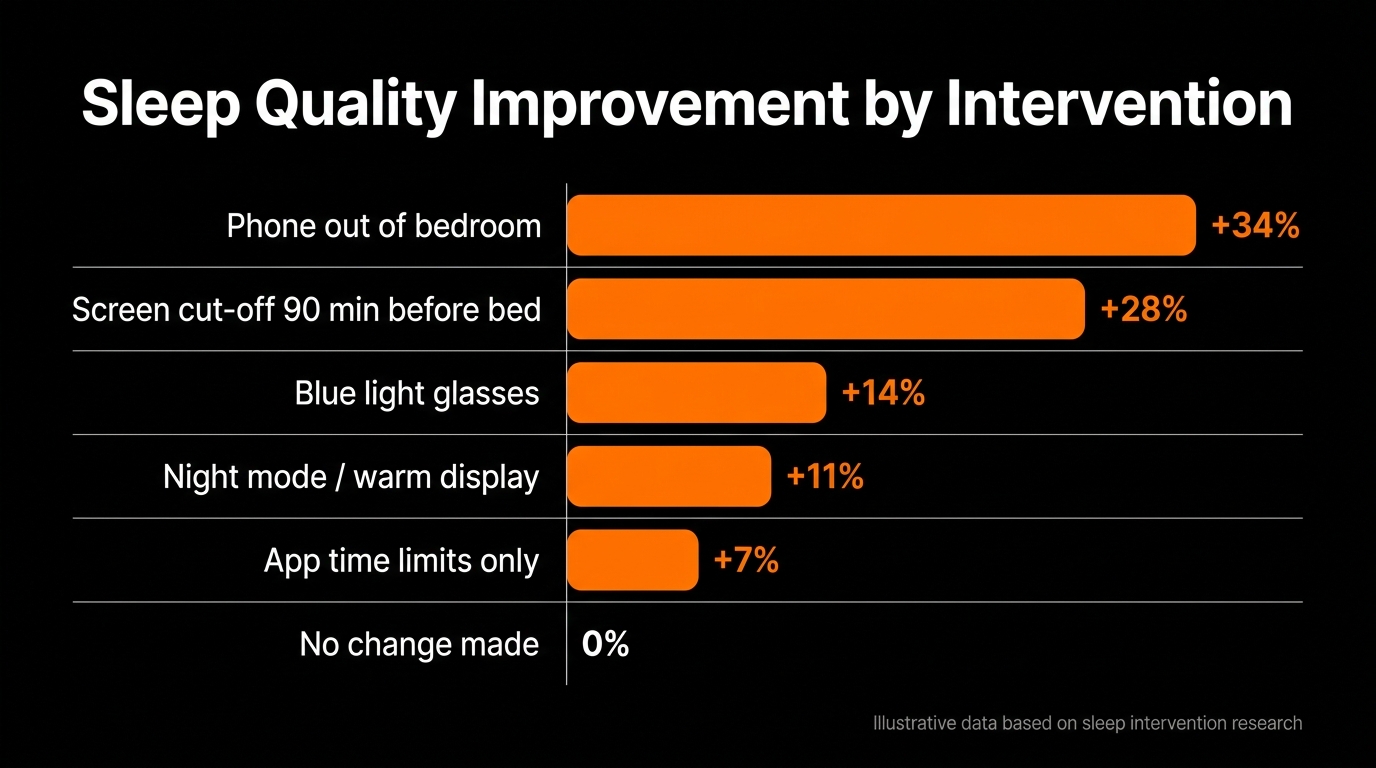
Sleep Quality by Intervention: removing the phone from the bedroom consistently outperforms other nighttime screen strategies.
Final Recommendation
Move the phone out of the bedroom tonight. That is the starting point, not the goal.
The goal is a complete reset of your nighttime default — an environment where the phone is not available, the trigger apps are not accessible, and a defined replacement habit fills the 60 minutes before sleep. Men who build this system report not just better sleep but lower baseline anxiety and sharper morning focus.
Do not rely on willpower, screen time warnings, or knowledge that scrolling is bad. Those approaches have all failed already. Structural change is the intervention.
Options For Men to Take Action
Most men trying to fix doomscrolling piece things together on their own — a reminder here, a blocker app there, a vague intention to stop checking the news. None of it holds because there is no system.
The MenTools Stop Doom Scrolling Protocol is a structured 14-day challenge that gives you a daily protocol: environment resets, habit swaps, craving management tools, and a tracking system built specifically for men. You do not have to design the system yourself.
How to start now: access the challenge on your phone, complete the Day 1 environment audit in 10 minutes, and set your first phone cutoff alarm before you go to bed tonight.
Wins on cost: The protocol replaces expensive sleep coaching, sleep apps, and premium blue light programmes — all of which treat the symptom rather than the behaviour.
Wins on time: The daily tasks take 10 to 15 minutes. There is no research phase, no planning required — the system is already built.
Wins on practicality: The protocol works for men with demanding schedules, shift work, and travel. Every task is phone-based, offline-capable, and designed around the moments men actually have available.
Stop building a workaround. Build the system, run it for 14 nights, and recover the sleep you have been losing.
If you want to go deeper on doomscrolling and digital habits, explore the MenTools Habits hub for guides and frameworks built specifically for men.
To support your daily routine with targeted nutrition, explore MenTools One A Day, formulated with chelated minerals and active B-vitamin forms for men.
When you are ready to turn ideas into action, start a focused challenge or daily routine inside the MenTools app and track how consistent habits change how you feel.
Last updated: 2026-03-12 v1.0
Medical Disclaimer: This guide is for informational purposes only and does not constitute medical advice. Always speak with your doctor or another qualified healthcare professional before starting any new supplement or programme if you have medical conditions or take prescription medication.
References
- American Academy of Sleep Medicine. Americans are doomscrolling at bedtime, prioritizing screen time over sleep. AASM, 2024. Link
- PMC. Dopamine-scrolling: a modern public health challenge requiring urgent attention. 2024. Link
- Zacher H, Rudolph CW. Doomscrolling and existential anxiety. Computers in Human Behavior Reports, 2024.
- Norwegian University Study, 45,202 participants. Screen use and sleep outcomes. Referenced via Sleepless in Arizona. Link
- Harvard Health Publishing. Blue light has a dark side. Harvard Medical School. Link
- Hale L, et al. The influence of blue light on sleep, performance and wellbeing in young adults: A systematic review. PMC, 2022. Link
- Torous J, et al. A nudge-based intervention to reduce problematic smartphone use: Randomised controlled trial. PMC, 2022. Link