No products in the cart.
Return To Shop
MEN: 7 Mental Fitness Habits You Can Train Like a Workout (2026)
Quick Answer
The mental fitness habits with the clearest evidence in 2026 are trainable reps with a dose: lift twice a week, hold one wake time, breathe slowly for five minutes, train attention for 12 to 15 minutes, get two hours outside a week, write things out and review your week [5][8][13][17][20][25][27]. Start with two, not seven.
**Jump to:** The 7 habits at a glance | FAQ | Options for men
Disclosure: MenTools publishes this article and may feature MenTools products.
How we evaluate: Each habit is assessed on real-world use, evidence, cost and time, and how well it suits men. Every habit including the MenTools option carries an honest limitation. Full sources are in the references below.
The 7 Habits at a Glance
Each habit below has a training dose from published research, so you know what a set looks like before you start. The table shows who each habit suits best, the dose, the standout finding and the honest watch-out. Strength training and sleep timing carry the largest studies, while breathing and writing rest on smaller ones [4][8][15][25].
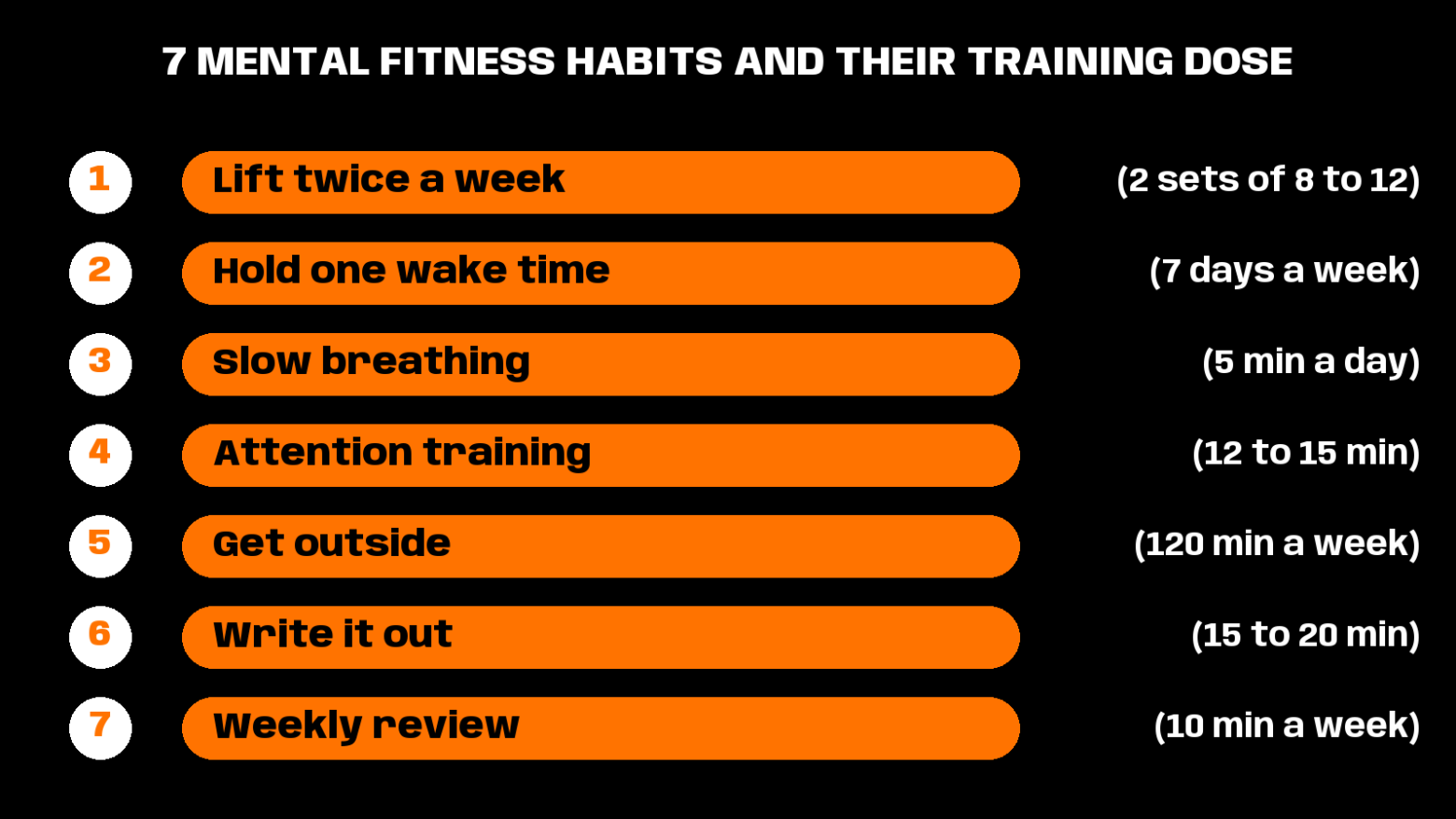
Seven reps for your head, and what each one costs you in a normal week.
| Habit | Best for | Training dose | Standout | Watch-out |
|---|---|---|---|---|
| Lift twice a week | Men who feel flat or anxious | 2 sets of 8 to 12 reps, 2 days a week | 33 trials, 1,877 people | Trial quality is low |
| Hold one wake time | Men who wake up foggy | Within 30 to 60 minutes, 7 days | 38% lower depression risk | Observational evidence |
| Five minutes of slow breathing | Men whose stress spikes in the day | 5 minutes daily | Beat mindfulness on mood in a month | Small, mostly student samples |
| Attention training | Men whose focus keeps breaking | 12 to 15 minutes, most days | Results at 8 weeks, not 4 | No better than exercise |
| Two hours outside | Men who live and work indoors | 120 minutes a week | 19,806 people in England | Cross-sectional data |
| Write it out | Men who chew things over | 15 to 20 minutes, 3 or 4 sessions | Larger effects in men | You may feel worse at first |
| Weekly review | Men who start strong and drift | One written check a week | 138 studies on tracking progress | Weekly is a practical choice |
How We Chose These 7 Habits
We chose habits that have a measurable dose in published research, that a working man can run without rearranging his life, and that train a specific part of mental fitness. The UK Chief Medical Officers set the tone: “For good physical and mental health, adults should aim to be physically active every day” [1]. We applied the same logic to the head.
Exercise for mental health ranked sixth in the American College of Sports Medicine’s 2026 worldwide trends, up two places [2]. Exercise physiologist Cayla McAvoy said, “Exercise is now being embraced as much for the mind as for the body, serving as a go-to strategy for stress relief, mood, and resilience” [2]. Every habit below carries a real watch-out, because none of them is a treatment.
The training comparison is not just a metaphor. A 2025 review of military mindfulness training put it directly: “To bolster physical fitness of a particular system (e.g., cardiovascular), physical exercises must be repeated consistently over time. Similarly, mindfulness exercises may target specific mental processes (e.g., attentional control) to bolster neurocognitive fitness” [3].
1. Lift Twice a Week
Lift weights twice a week, two sets of eight to twelve reps on the big movements, adding load as you get stronger. Strength training is the habit with the largest body of trial evidence here, and you do not need a huge programme for it to work on your mood. It suits most men who already know their way round a gym.
What it is: Progressive resistance training aimed at how you feel, not just how you look.
Best for: Men who feel flat, restless or anxious and want a habit they already understand.
The workout: two non-consecutive days a week, two sets of 8 to 12 reps on six to eight compound lifts, for eight weeks. One trial used exactly that structure, including squats, bench press and deadlifts, and found a large fall in anxiety symptoms, d = 0.85 [5].
Standout: A meta-analysis of 33 trials with 1,877 people found resistance training reduced depressive symptoms with a moderate effect, “regardless of health status, total prescribed volume of RET, or significant improvements in strength” [4]. In a 2024 BMJ analysis of 218 studies, strength training cut depression symptoms with an effect of g = -0.49 [6]. Researcher Michael Noetel summed it up: “If exercise was a pill, it would fly off the shelves” [7].
Watch-out: Trial quality is low, and in the BMJ analysis strength training looked stronger in studies with more women, while yoga and qigong looked stronger in studies with more men [6]. Mix in walking, running or yoga if lifting alone is not shifting things. Noetel is clear that “anyone getting treatment for depression should talk to their doctor before changing what they are doing” [7].
2. Hold One Wake Time, Seven Days a Week
Get up at the same time every day, weekends included, within half an hour to an hour either side. Sleep regularity turns out to matter for mood separately from sleep length. It is the cheapest habit on this list and one of the best studied, although all of the evidence is observational.
What it is: A fixed alarm that does not move at the weekend, with bedtime settling around it.
Best for: Men who wake up foggy and irritable even after a full night.
The workout: one wake time, every day, held within 30 to 60 minutes. Sleep researcher Jean-Philippe Chaput says, “Bedtimes and wake-up times don’t need to be exactly the same every day,” but advises keeping them “within 30-60 minutes of your usual schedule” [12].
Standout: In 79,666 UK Biobank adults tracked for a median of 7.5 years, regular sleepers had a 38 percent lower risk of depression and a 33 percent lower risk of anxiety than irregular sleepers, even when sleep length was adequate [8]. A study of 60,977 people found sleep regularity predicted mortality better than sleep duration [9], and in 2,115 junior doctors, smaller day-to-day shifts in wake time were linked to better mood the next day [10].
Watch-out: These are associations, not trials, and irregular sleepers in one study still had a 26 percent higher risk of heart events even when they slept long enough [11]. Shift workers and new fathers cannot always hold a fixed time. Persistent insomnia or loud snoring is a GP conversation, not a habit fix. Our sleep guide for men covers the rest.
3. Five Minutes of Slow Breathing a Day
Spend five minutes a day breathing slowly, either with cyclic sighing or at about six breaths a minute. It is the quickest rep in the whole programme and the one you can use in the middle of a bad day. The evidence is real but modest, and most of it comes from small trials.
What it is: A structured breathing drill. Cyclic sighing means a slow breath in, a second short breath in to fill the lungs, then a long, slow breath out [13].
Best for: Men whose stress spikes during the working day and who want a tool they can use anywhere.
The workout: one set of five minutes, once a day. A slow-breathing study found five minutes raised heart rate variability, a marker of the calming side of the nervous system, as much as 20 minutes did [14].
Standout: In a Stanford trial, five minutes a day of cyclic sighing for a month improved mood more than mindfulness meditation and lowered resting breathing rate [13]. Psychiatrist David Spiegel explained why breathing works as a lever: “What’s interesting about the breath is that it’s right on the edge of conscious control” [16]. A meta-analysis of 12 trials and 785 adults found breathwork lowered stress, g = -0.35 [15].
Watch-out: The effects are small, and most of the Stanford volunteers were university students [13]. The meta-analysis authors warned against “a miscalibration between hype and evidence” [15]. Stop if you feel dizzy, and never practise breath holding in water or while driving. Our breathwork vs meditation comparison covers when to use which.
4. Train Your Attention for 12 to 15 Minutes
Give your attention a short daily session, 12 to 15 minutes of focused practice on most days, and run it for at least eight weeks. Attention is trainable like any other system, but the results arrive later than most men expect. Quit at four weeks and you may see nothing at all.
What it is: A short guided mindfulness or focus practice: hold attention on one thing, notice when it drifts, bring it back.
Best for: Men whose focus breaks every few minutes and who feel scattered by the end of the day.
The workout: 12 to 15 minutes, at least four or five days a week, for eight weeks. A 2025 review suggested at least three to four 15-minute sessions a week for four weeks as the minimum for measurable change [3].
Standout: In a trial of 13 minutes a day, eight weeks, “but not 4 weeks”, of brief daily meditation reduced negative mood and improved attention and memory [17]. Neuroscientist Amishi Jha, who studied Marines before deployment, described her own first retreat as “kind of like a boot camp for attention” [31]. Of the Marines, she said, “If they practiced less than 12 minutes or not at all, they degraded in their functioning” [18].
Watch-out: A review of 47 trials found mindfulness programmes helped with anxiety but found “no evidence that meditation programs were better than any active treatment”, such as exercise [19]. The 12-minute figure comes from small military groups and Jha’s own summary of them [18]. If sitting still feels impossible, a focused walk counts as a start.
5. Get Two Hours Outside Every Week
Spend at least 120 minutes a week in green or open space, in one long walk or several shorter ones. Time in nature is linked to better health and wellbeing at a clear threshold, and for most men it is the easiest habit to stack with something they already do.
What it is: Time in parks, woods, coast or countryside, with the phone in your pocket.
Best for: Men who live and work indoors and go days without real daylight or open space.
The workout: 120 minutes a week, for example four sessions of 30 minutes. A study of urban dwellers found the stress benefit per minute was greatest at 20 to 30 minutes per outing [23].
Standout: In 19,806 people in England, good health and high wellbeing became significantly more likely at 120 minutes a week or more, peaking at 200 to 300 minutes, and it did not matter how the time was split [20]. Lead researcher Mat White said, “Two hours a week is hopefully a realistic target for many people” [21]. In a separate trial, a 90-minute nature walk reduced rumination, while an urban walk did not [22].
Watch-out: The 120-minute finding comes from a survey at one point in time, so it shows a link rather than a cause [20]. The trials are small, with 38 and 36 people [22][23]. A busy high street is not the same as a park, according to the walking trial [22].
6. Write It Out When Something Is Weighing on You
When something keeps circling in your head, write about it for 15 to 20 minutes on three or four occasions. Expressive writing is one of the few habits here where the research found larger effects in men than in women. It is also the one most likely to feel worse before it feels better.
What it is: Writing continuously about a stressful experience and what you think and feel about it, for your eyes only.
Best for: Men who chew things over at night and do not talk them through with anyone.
The workout: 15 to 20 minutes, three or four sessions, one to three days apart, with 20 minutes as the maximum [24][25]. Psychologist James Pennebaker, who developed the method, puts it simply: “Set aside 15 minutes a day for three or four days” [26]. His one rule: “The only rule I have is to write continuously. Don’t stop” [26].
Standout: A review of the research reported that in an earlier meta-analysis “the effects were greater for males than for females” [24]. A 2023 meta-analysis of 31 trials and 4,012 people found the benefit showed up after a delay, and that shorter gaps of one to three days between sessions worked best [25]. Pennebaker adds, “It doesn’t need to be a trauma, it could be just awareness that you’re not happy in life” [26].
Watch-out: “The immediate impact of expressive writing is usually a short-term increase in distress” [24], and the overall effect in large reviews is small, g = -0.12 [25]. It “should not replace appropriate medical or psychological treatment” [24]. Keep sessions short and stop if it makes things worse.
7. Review Your Week in Writing
Once a week, take ten minutes to check off which habits you actually did and write the numbers down. Tracking progress is what turns six good intentions into a programme. It is also the habit that keeps the other six alive past the first fortnight.
What it is: A short written weekly check on the reps you did and missed, ideally shared with someone.
Best for: Men who start strong on Monday and have quietly dropped everything by the following week.
The workout: one written review a week, ten minutes. Write it down rather than keeping it in your head, and tell one person how the week went.
Standout: A meta-analysis of 138 studies with 19,951 people found that prompting people to monitor their progress improved goal attainment, d = 0.40, and that the effect was larger “when the outcomes were reported or made public, and when the information was physically recorded” [27]. Lead author Benjamin Harkin said, “Prompting people to monitor their progress can help them to achieve their goals” [28].
Watch-out: Most of those studies tracked health goals such as diet and activity rather than mood, and the research supports more frequent monitoring without naming weekly as the best rhythm [27]. A paper notebook works as well as an app. Tracking apps, including the MenTools app, make the check faster and add reminders, but they cost money and still rely on you opening them.
How Do You Train Mental Fitness Like a Workout?
Treat it like a programme: pick a small number of habits, set a dose for each, track what you did and add load slowly. That is the logic of progressive training, and the research above supplies the doses. Mental fitness, like physical fitness, comes from consistent reps over months rather than one heroic week [3][29].
Start with two habits rather than seven, usually lifting and a fixed wake time because they carry the largest studies [4][8]. After a month, add one more. The weekly review is the glue, because tracking is what raised goal attainment across 138 studies [27]. Our guide to what mental fitness is and how men train it explains the six areas these habits sit in.
Men often wait too long to start. The Mental Health Foundation notes that men are “less likely to talk to family or friends about their mental health” [30]. Training ahead is the alternative to waiting for a crisis, and our guide on whether you can train resilience covers why it works.
How Long Before Mental Fitness Habits Start to Work?
Expect the first changes in a few weeks and real results at around two months. The breathing trial found mood improvements within a month of daily practice [13], the meditation trial found benefits at eight weeks but not at four [17], and the strength training trial ran for eight weeks [5]. Expressive writing often shows its benefit after a delay [25].
Making the habit automatic takes longer. In a real-world study of habit formation, a new daily behaviour took an average of 66 days to become automatic, ranging from 18 to a predicted 254 days [29]. Missing a single day did not derail the process, so a missed session is not a reason to quit [29].
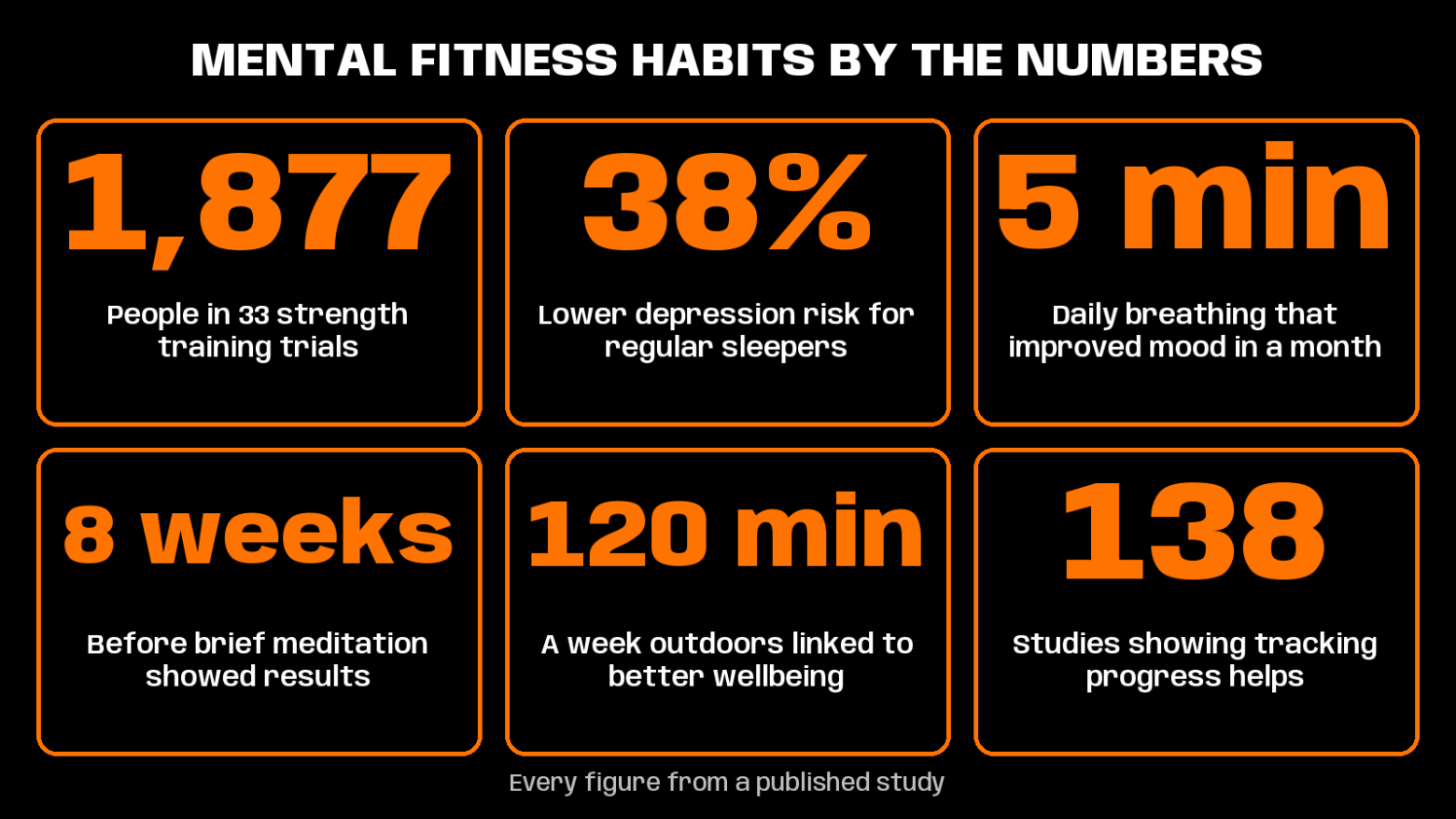
Every figure from a published study cited in this guide.
FAQ
What is the best mental fitness habit to start with?
Strength training or a fixed wake time, because they carry the largest studies. Resistance training reduced depressive symptoms across 33 trials and 1,877 people [4], and regular sleepers had a 38 percent lower risk of depression in a study of 79,666 adults [8]. Pick whichever you will actually do.
How many mental fitness habits should I do at once?
Two to start. Habits take an average of 66 days to become automatic [29], so stacking seven at once usually means dropping all of them. Run two for a month, then add a third, and use a weekly written review to keep track [27].
Can mental fitness habits replace therapy?
No. They are preventive training that works alongside professional support. Expressive writing, for example, should not replace medical or psychological treatment [24], and anyone being treated for depression should speak to their doctor before changing their routine [7]. If low mood lasts for weeks, see your GP.
Is walking enough for mental fitness?
Walking helps more than most men think. In the 2024 BMJ analysis, walking or jogging had one of the largest effects on depression symptoms, g = -0.62 [6], and two hours a week outdoors was linked to better wellbeing [20]. Pair it with one other habit for a fuller programme.
Do I need an app to track mental fitness habits?
No. The research on tracking found the biggest benefit when progress was physically recorded or shared [27], which a notebook does well. Apps make the habit faster and add reminders, but the habit is the writing down, not the tool.
What time of day should I do mental fitness habits?
Whenever you will do them consistently. Morning suits a fixed wake time and a short breathing set, while lifting and walks fit wherever your day allows. Consistency matters more than timing, because missed days, not the clock, are what break habit formation [29].
Final Recommendation
Train your head like your body. Pick two habits with a clear dose, lift twice a week and hold one wake time if you are unsure, and run them for eight weeks before you judge them [4][5][8]. Add five minutes of slow breathing once those feel automatic [13].
Write the week down every Sunday, because tracking is what kept goals on course across 138 studies [27]. If you are struggling now rather than training ahead, speak to your GP first. These habits support professional help. They do not replace it.
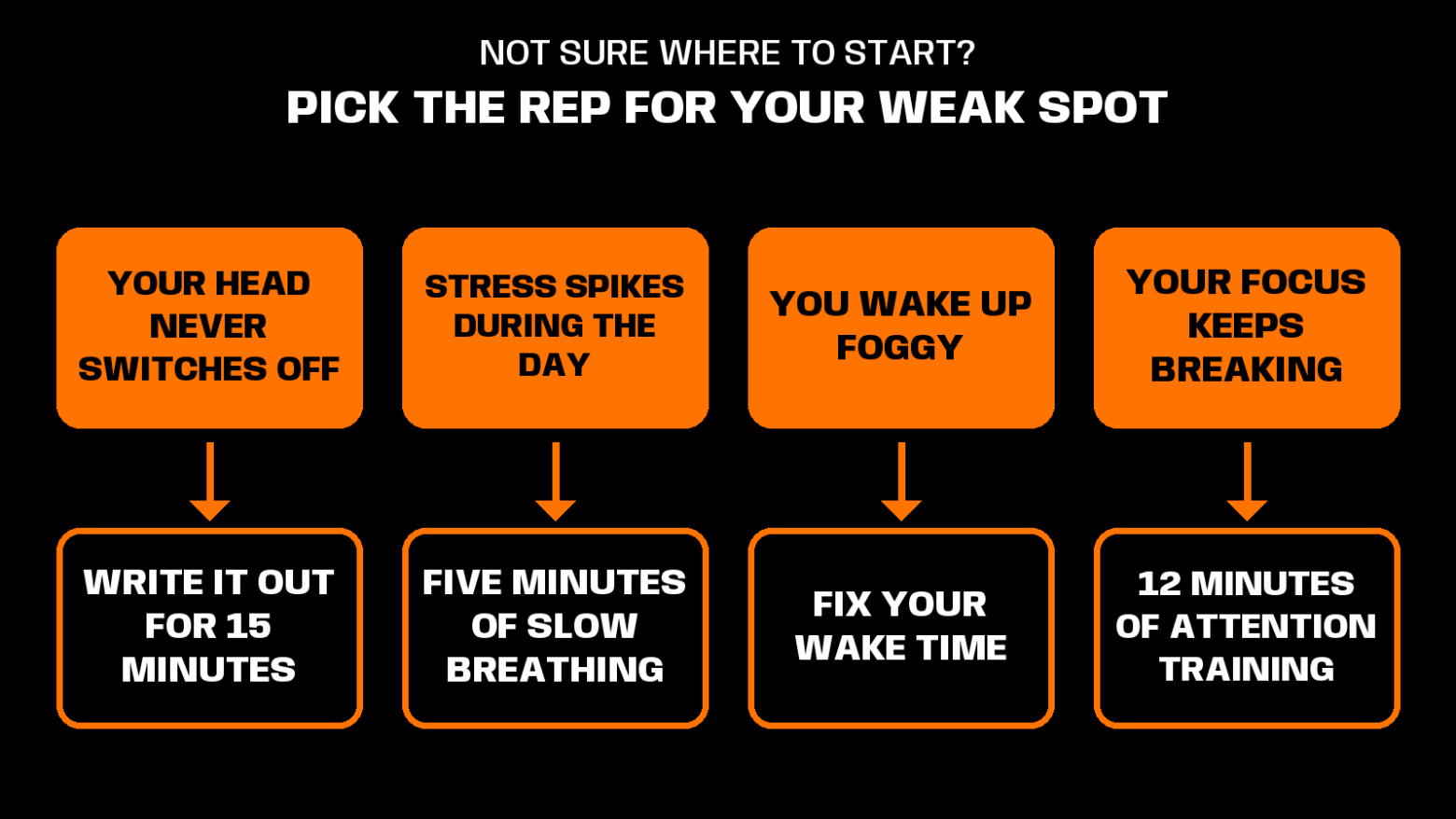
Start with the rep that matches your weak spot.
Options for Men to Take Action
Most men already know these habits would help. The problem is running them together, with workouts in one app, sleep in another, breathing on a timer somewhere and no record of whether any of it happened last week.
The MenTools app runs mindset as a challenge alongside fitness, nutrition and money, with levels you choose, daily actions, reminders, streak and progress tracking, journals and an AI coach. For these seven habits its job is to hold the reps in one place and make the weekly review a two-minute check.
How you can do this today: choose two habits from the table and set one small daily action for each.
Wins on cost: one subscription covers training, sleep, breathing and journalling habits, instead of separate fitness, meditation and habit apps.
Wins on time: the challenges are already built, so you start training this week rather than designing a programme first.
Wins on practicality: each action takes minutes and fits around work, family and the gym.
Watch-out: it is a habit and consistency tool, not therapy or a clinical service. If you are struggling now, professional support comes first.
Training the mind runs on the same basics as training the body, so a one a day multivitamin may help cover the simple daily foundation underneath the work. For more on the thinking side, the MenTools mindset hub collects everything in one place. Train the reps, and the head responds the way the body does.
Last updated: 2026-10-21 v1.0
Disclaimer: This guide is for informational purposes only and does not constitute medical or psychological advice. Speak with a qualified professional before making significant changes if you have a medical or mental health condition.
References
- [1] Department of Health and Social Care. UK Chief Medical Officers’ physical activity guidelines. GOV.UK, updated 10 July 2026. Link
- [2] American College of Sports Medicine. ACSM top fitness trends 2026. 22 October 2025. Link
- [3] Jha AP, Izaguirre MK, Adler AB. Mindfulness training in military settings, emerging evidence and best-practice guidance. Current Psychiatry Reports, 2025;27(6):393-407. Link
- [4] Gordon BR, McDowell CP, Hallgren M, et al. Association of efficacy of resistance exercise training with depressive symptoms, meta-analysis and meta-regression analysis of randomized clinical trials. JAMA Psychiatry, 2018;75(6):566-576. Link
- [5] Gordon BR, McDowell CP, Lyons M, Herring MP. Resistance exercise training for anxiety and worry symptoms among young adults, a randomized controlled trial. Scientific Reports, 2020;10:17548. Link
- [6] Noetel M, Sanders T, Gallardo-Gomez D, et al. Effect of exercise for depression, systematic review and network meta-analysis of randomised controlled trials. BMJ, 2024;384:e075847. Link
- [7] University of Queensland. Exercising your way out of depression. UQ News, 15 February 2024. Link
- [8] Li DR, Li ZX, Li MH, et al. Regular sleep patterns, not just duration, critical for mental health, association of accelerometer-derived sleep regularity with incident depression and anxiety. Psychological Medicine, 2025;55:e239. Link
- [9] Windred DP, Burns AC, Lane JM, et al. Sleep regularity is a stronger predictor of mortality risk than sleep duration, a prospective cohort study. Sleep, 2024;47(1):zsad253. Link
- [10] Fang Y, Forger DB, Frank E, Sen S, Goldstein C. Day-to-day variability in sleep parameters and depression risk, a prospective cohort study of training physicians. npj Digital Medicine, 2021;4:28. Link
- [11] Chaput JP, Biswas RK, Ahmadi M, et al. Sleep regularity and major adverse cardiovascular events, a device-based prospective study in 72 269 UK adults. Journal of Epidemiology and Community Health, 2025;79(4):257-264. Link
- [12] Guy J. Irregular sleep patterns may raise risk of heart attack and stroke, study suggests. CNN, 28 November 2024. Link
- [13] Balban MY, Neri E, Kogon MM, et al. Brief structured respiration practices enhance mood and reduce physiological arousal. Cell Reports Medicine, 2023;4(1):100895. Link
- [14] You M, Laborde S, Zammit N, et al. Single slow-paced breathing session at six cycles per minute, investigation of dose-response relationship on cardiac vagal activity. International Journal of Environmental Research and Public Health, 2021;18(23):12478. Link
- [15] Fincham GW, Strauss C, Montero-Marin J, Cavanagh K. Effect of breathwork on stress and mental health, a meta-analysis of randomised-controlled trials. Scientific Reports, 2023;13:432. Link
- [16] Leggett H. A five-minute breathing exercise for anxiety and mood. Greater Good Magazine, 24 February 2023. Link
- [17] Basso JC, McHale A, Ende V, Oberlin DJ, Suzuki WA. Brief, daily meditation enhances attention, memory, mood, and emotional regulation in non-experienced meditators. Behavioural Brain Research, 2019;356:208-220. Link
- [18] Association for Psychological Science. Breathing in vs. spacing out, reprinted from The New York Times, January 2014. Link
- [19] Goyal M, Singh S, Sibinga EMS, et al. Meditation programs for psychological stress and well-being, a systematic review and meta-analysis. JAMA Internal Medicine, 2014;174(3):357-368. Link
- [20] White MP, Alcock I, Grellier J, et al. Spending at least 120 minutes a week in nature is associated with good health and wellbeing. Scientific Reports, 2019;9:7730. Link
- [21] University of Exeter. Two hours a week is key dose of nature for health and wellbeing. ScienceDaily, 13 June 2019. Link
- [22] Bratman GN, Hamilton JP, Hahn KS, Daily GC, Gross JJ. Nature experience reduces rumination and subgenual prefrontal cortex activation. PNAS, 2015;112(28):8567-8572. Link
- [23] Hunter MR, Gillespie BW, Chen SY. Urban nature experiences reduce stress in the context of daily life based on salivary biomarkers. Frontiers in Psychology, 2019;10:722. Link
- [24] Baikie KA, Wilhelm K. Emotional and physical health benefits of expressive writing. Advances in Psychiatric Treatment, 2005;11(5):338-346. Link
- [25] Guo L. The delayed, durable effect of expressive writing on depression, anxiety and stress, a meta-analytic review of studies with long-term follow-ups. British Journal of Clinical Psychology, 2023;62(1):272-297. Link
- [26] WRVO. Writing for your health, and why the words you choose matter. Take Care, 26 August 2017. Link
- [27] Harkin B, Webb TL, Chang BP, et al. Does monitoring goal progress promote goal attainment? A meta-analysis of the experimental evidence. Psychological Bulletin, 2016;142(2):198-229. Link
- [28] Armenpress. Scientists, frequently monitoring progress toward goals increases chance of success. 30 October 2015. Link
- [29] Lally P, van Jaarsveld CHM, Potts HWW, Wardle J. How are habits formed, modelling habit formation in the real world. European Journal of Social Psychology, 2010;40(6):998-1009. Link
- [30] Mental Health Foundation. Men and mental health. Link
- [31] NPR TED Radio Hour. Amishi Jha, how can we pay better attention to our attention? 25 May 2018. Link