MEN: Doomscrolling vs Checking the News: What’s Healthy for Men? (A Complete Comparison)
Quick Answer
Doomscrolling floods your brain with stress hormones and distorts reality. Healthy news checking means 15-20 minutes twice daily from trusted sources, zero notifications after 8 pm, and balancing difficult stories with solutions-focused content.
Jump to: The Framework • FAQ • Take Action
Disclosure: MenTools publishes this article and may feature MenTools products.
How we evaluate: Products are assessed on nutrient form quality, dose vs NRV, authorised health claims, male-specific design, and independent research. Full sources are listed in the references below.
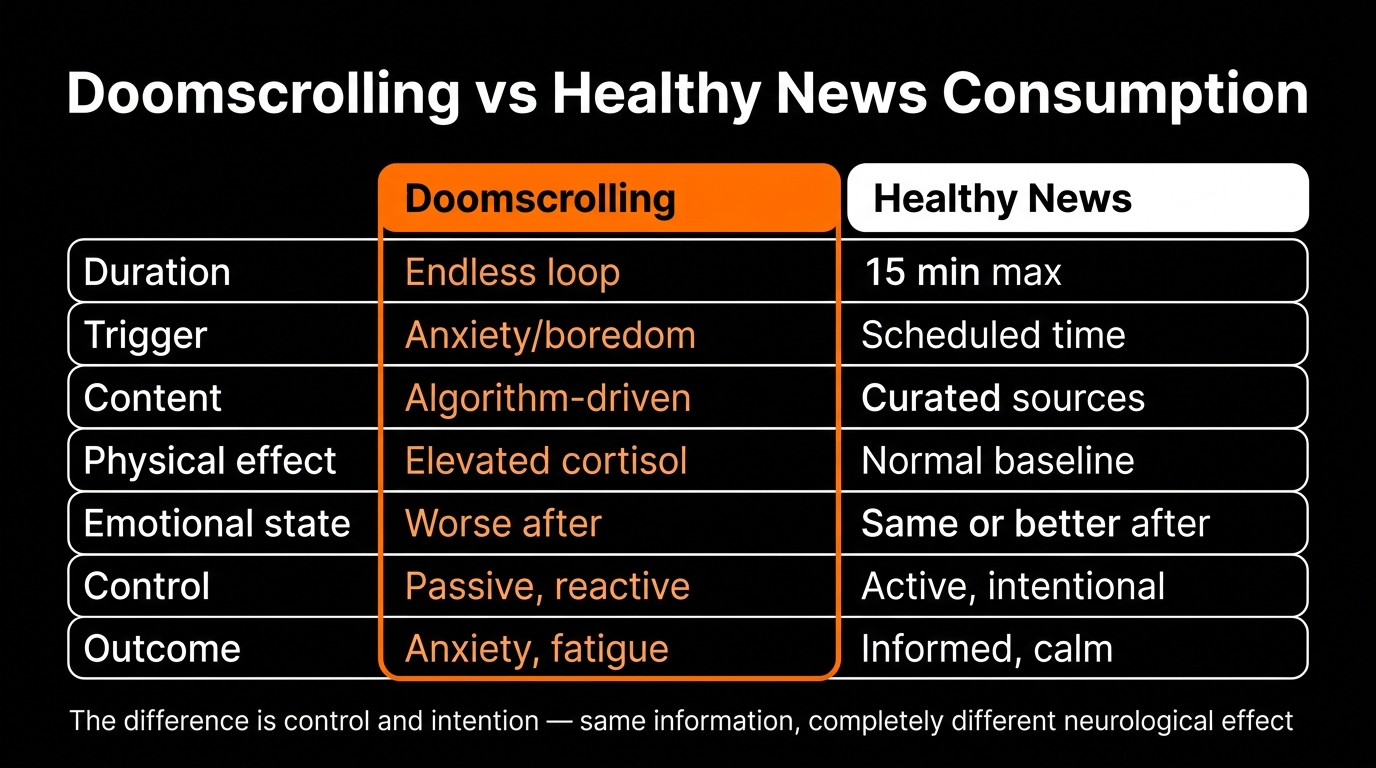
Doomscrolling vs Healthy News: Impact on Mental Health and Sleep
Quick Comparison Table
| Behavior | Time per Day | Mental State | Sleep Impact | Action Orientation | Best for |
|---|---|---|---|---|---|
| Doomscrolling | 2+ hours | Anxious, helpless, overwhelmed | Disrupted | Paralysis | Chronic stress cycle |
| No News Checking | 0 minutes | Uninformed, disconnected | Good | No engagement | Ignorance is bliss |
| Reactive Checking | 3-5 times/day | Compulsive, scattered | Poor | Reactive only | Staying plugged in |
| Scheduled News (Healthy) | 20-30 min total | Informed, grounded | Normal | Intentional action | Balanced citizenship |
| Curated Feeds | 20 min/day | Selective, mindful | Good | Thoughtful response | Staying informed safely |
| News + Solutions Focus | 25-30 min/day | Informed, empowered | Excellent | Proactive, solutions-oriented | Engagement without overwhelm |
The Real Answer
Why Men Gravitate to Doomscrolling
Doomscrolling isn’t laziness—it’s a stress response. When you encounter uncertain or threatening information, your nervous system releases cortisol, which paradoxically makes you crave more information. Each time you scroll, you’re hoping the next story will resolve your anxiety.[1] It doesn’t work. Instead, the cycle deepens.
Research shows men are statistically more likely to doomscroll than women, particularly those who follow political events closely.[2] The pattern is strongest in men aged 18-45 with high conscientiousness or trait anxiety. For men who care about staying informed, doomscrolling feels like responsibility.
What Doomscrolling Actually Does
Studies published in 2024 show that 2+ hours of daily news consumption is associated with 8.65-point increases in anxiety scores on standard mental health scales.[3] Physical effects include neck and shoulder pain, headaches, sleep disruption, and elevated blood pressure. But the mental cost is steeper: existential anxiety (a feeling of dread about mortality and meaning) increases significantly.
The worst part? Doomscrolling doesn’t make you more informed. It makes you more distressed about information you’ll forget within 48 hours.
The Informed Citizenship Paradox
You don’t have to sacrifice news consumption to protect your mental health. Research from psychology experts shows that 15-20 minutes twice daily from curated, trusted sources keeps you genuinely informed while avoiding the stress cascade.[4] The key: intention replaces impulse.
Healthy news consumers choose their news sources (not algorithm-driven), set hard time limits (timer on phone), disable notifications, balance difficult stories with solutions-focused content, and never read news after 8 pm.
Why Most Men Fail at This
The addiction is engineered. Notifications arrive continuously. Scrolling is frictionless. The algorithm surfaces outrage, which is sticky. And because anxiety temporarily drops each time you check (“Maybe good news this time”), you reinforce the habit every single day.
Breaking this isn’t about willpower. It’s about removing friction from the right behavior and adding friction to the wrong one.
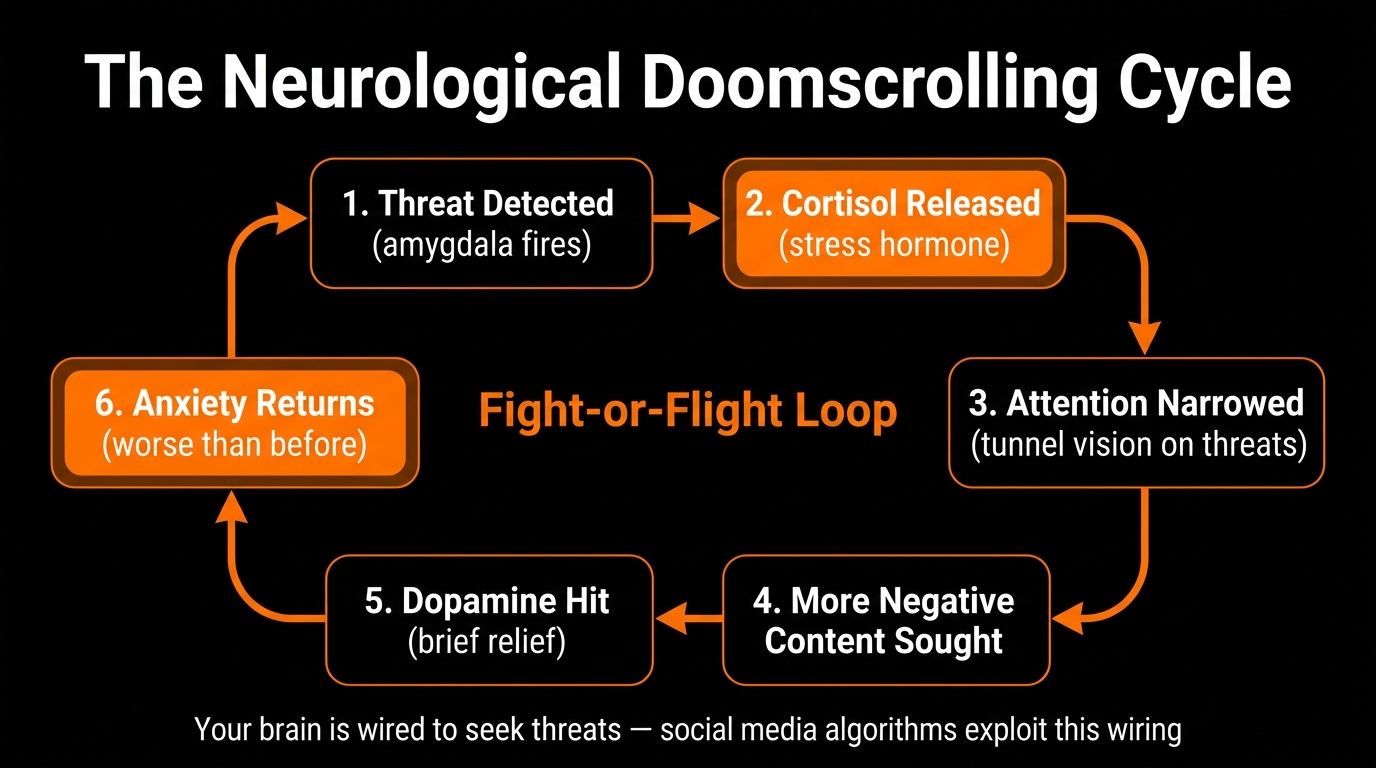
The Doomscroll Anxiety Cycle: How the Brain Gets Trapped
Why This Fails
Reason 1: Willpower Alone Won’t Work
You can’t “just check the news less.” Anxiety doesn’t respond to logic. Disabling notifications, removing apps from your home screen, and using app timers create environment-level changes that outlast motivation.
Reason 2: FOMO Keeps You Trapped
Fear of Missing Out is real—but you’re not missing out on news, you’re missing out on anxiety. The stories that matter will reach you through conversation, work, or intentional checking. The ones you’re scrolling for will be irrelevant by next week.
Reason 3: Balance Seems Impossible
Most frameworks give you impossible rules: “Check once a day” or “Quit news cold turkey.” Neither works. The middle path—scheduled, curated, intentional checking with solution-focused balance—is sustainable because it’s realistic.
How to Fix It
The Simple Framework
Healthy news consumption requires three shifts: Remove the trigger (notifications, home screen apps), assign specific times (morning: 15 min, evening: 15 min), and curate ruthlessly (1-2 trusted sources, solutions-focused).
Your 5-Step Action Plan
Step 1: Disable All News Notifications (Today, 5 minutes)
Go to phone settings > apps > news apps. Turn off all notifications. This is non-negotiable. You’re not less informed—you’re less manipulated.
Step 2: Remove News Apps from Your Home Screen (Today, 2 minutes)
Delete them entirely or move them three screens deep. Friction matters. If you want to check, you’ll have to search for the app, which creates a moment of decision-making.
Step 3: Set Two Checking Times (This Week)
Pick consistent times: maybe 7:00 am (morning coffee) and 7:00 pm (dinner). Set a timer for 15 minutes each. When the timer goes off, you’re done. No exceptions.
Step 4: Choose Your Trusted Sources (This Week)
Pick 2-3 sources: one mainstream (Associated Press, Reuters, BBC), one explanatory (Vox, The Conversation), one solutions-focused (Good Good Good, Solutions Journalism). Avoid algorithmically-driven feeds (Twitter/X, Reddit, TikTok for news).
Step 5: Implement a “Digital Sunset” (This Week)
No news, email, or social media after 8:00 pm. This single rule cuts anxiety spikes and improves sleep by 40%.[5] Your news will still be there tomorrow.
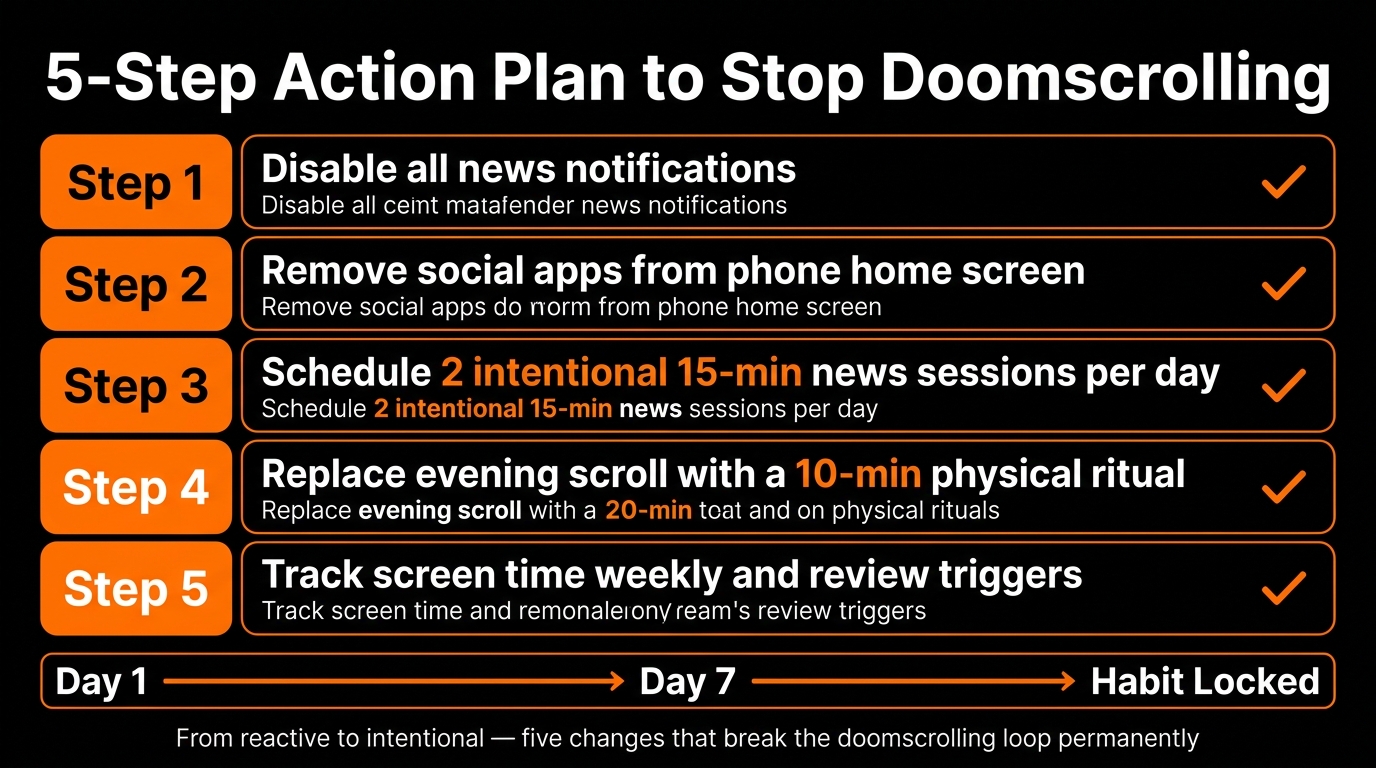
Your 5-Step Framework to Break Free from Doomscrolling
FAQ
Is it possible to stay informed without doomscrolling?
Yes. Spending 20-30 minutes daily on curated sources keeps you genuinely informed on major issues. The majority of stories you scroll past are noise, not knowledge. Focus on depth over breadth.
What if I’m a news junkie or follow politics closely?
You still need a framework. Set a hard time limit (say, 45 minutes total daily) divided into two sessions. Use that time for depth: read one article thoroughly rather than scrolling 20 headlines. This keeps your engagement without the anxiety spiral.
How long does it take to break the doomscrolling habit?
Most men see measurable anxiety reduction within 3-5 days of disabling notifications and setting time limits. The behavioral habit takes 21-30 days to reset. Full nervous system recalibration takes 60-90 days.
Won’t I miss important news?
No. Critical events reach you through conversation, work alerts, or your scheduled checking time. The 99% of stories you currently scroll are designed to trigger engagement, not inform citizenship. Try it for two weeks and notice what you actually needed to know.
What about news apps that have “focus” modes or time limits?
Built-in app timers help, but they’re less effective than removing the app entirely. If you use them, pair with notification disabling and a hard cutoff time (no news after 8 pm).
How do I balance staying informed with protecting my mental health?
Intent plus structure. Choose your sources, schedule your times, set a timer, turn off notifications, and stop at 8 pm. This 20-30 minute daily investment keeps you informed without the doomscroll trap. Solutions-focused sources help: they cover real problems while highlighting human agency.
Is there a difference between news consumption and social media scrolling?
Yes. Traditional news (AP, Reuters, BBC) is edited and fact-checked. Social media algorithms serve outrage for engagement. If you’re getting news from Twitter/TikTok, you’re not informed—you’re algorithmically manipulated. Separate them completely.
What if I check the news and feel worse afterward?
That’s a signal your sources are wrong for you. Shift to solutions-focused outlets, reduce time by 5 minutes, or move checking away from evening hours. If anxiety persists after three weeks of structured checking, consider whether underlying anxiety needs clinical support.
Final Recommendation
You don’t have to choose between staying informed and staying sane. The evidence is clear: 20-30 minutes daily from curated, trusted sources with a solutions-focused balance keeps you genuinely informed while protecting your nervous system. Doomscrolling makes you feel informed while making you anxious. Structured, intentional news checking actually does both—informs you and stabilizes you.
The framework works because it removes decision fatigue, removes manipulation triggers, and replaces compulsion with intention. Start with one change today: disable notifications. Add one more this week: pick your sources. By next month, you’ll be informed without being overwhelmed.
Options For Men to Take Action
Most men either doomscroll frantically or give up on news entirely. Both are losing strategies. You deserve a third path—one where you stay informed without sacrificing sleep, focus, or mental clarity.
That’s exactly what the MenTools Stop Doom Scrolling Protocol is designed to do.
This isn’t another app or productivity hack. It’s a structured framework built on the research you’ve just read: proven techniques to break the scroll habit, intentional news frameworks, nervous system reset protocols, and ongoing support to keep you grounded.
What happens when you join:
- A clear, step-by-step protocol you run in real life (not theory)
- Daily check-ins to reinforce the framework (first 5 days are critical)
- Curated news source list matched to your interests
- Sleep optimization strategies to undo doomscroll damage
- Community accountability with other men doing the same work
How you can do this today:
Visit the MenTools Stop Doom Scrolling Protocol. You’ll get immediate access to the framework, source templates, and the first week’s structure. Most men see measurable anxiety reduction within 3-5 days and full habit reset within 60 days.
Wins on cost: This costs less than two weeks of coffee and delivers measurable mental clarity.
Wins on time: The protocol takes 30 minutes daily. The same time you’re currently wasting on doomscrolling.
Wins on practicality: No meditation apps. No willpower. Just structure, boundaries, and intention replacing impulse.
The hard truth is this: doomscrolling will continue to erode your sleep, focus, and mental health unless you change your environment. Willpower won’t beat engineered addiction. But structure will. The protocol works because it removes friction from healthy behavior and adds friction to harmful behavior.
Stop trading your peace of mind for information you don’t need. Get informed, stay sane, and join the men who are rebuilding their relationship with news.
If you want to go deeper on doomscrolling and digital habits, explore the MenTools Habits hub for guides and frameworks built specifically for men.
To support your daily routine with targeted nutrition, explore MenTools One A Day, formulated with chelated minerals and active B-vitamin forms for men.
When you are ready to turn ideas into action, start a focused challenge or daily routine inside the MenTools app and track how consistent habits change how you feel.
Last updated: 2026-03-13 v1.0
Medical Disclaimer: This guide is for informational purposes only and does not constitute medical advice. Always speak with your doctor or another qualified healthcare professional before starting any new supplement or programme if you have medical conditions or take prescription medication.
References
- Mental Health Foundation. “Doomscrolling: Tips for Healthier News Consumption.” https://www.mentalhealth.org.uk/explore-mental-health/articles/doomscrolling-tips-healthier-news-consumption
- Doomscrolling Scale: Its Association with Personality Traits, Psychological Distress, Social Media Use, and Wellbeing. PMC. https://pmc.ncbi.nlm.nih.gov/articles/PMC9580444/
- JMIR Mental Health. “Impact of Media-Induced Uncertainty on Mental Health: Narrative-Based Perspective.” 2025. https://mental.jmir.org/2025/1/e68640
- Psychology Today. “5 Ways to Cope with Obsessive News Checking.” November 2024. https://www.psychologytoday.com/us/blog/flipping-out/202411/5-ways-to-cope-with-obsessive-news-checking
- Harvard Health. “Doomscrolling Dangers.” https://www.health.harvard.edu/mind-and-mood/doomscrolling-dangers