MEN: Best Push-Up Coaches and Influencers for Men to Follow (2026 List)
Quick Answer
The five push-up coaches worth following are Mike Thurston for physique-focused upper body work, James Smith PT for no-nonsense progressive training, Jocko Willink for military-standard discipline and volume, Wes Watson for mental toughness and high-rep calisthenics, and David de las Morenas for beginner-to-intermediate bodyweight training.
Pick one based on how you respond to coaching tone and what you are training for. Following multiple coaches with conflicting methods is one of the most common reasons men stall on push-up progress.
Jump to: Quick Comparison | Each Coach Breakdown | How to Pick One
Disclosure: MenTools publishes this article and may feature MenTools products.
How we evaluate: Products are assessed on nutrient form quality, dose vs NRV, authorised health claims, male-specific design, and independent research. Full sources are listed in the references below.
Quick Comparison
The table below compares all five coaches across the metrics that matter for push-up training.
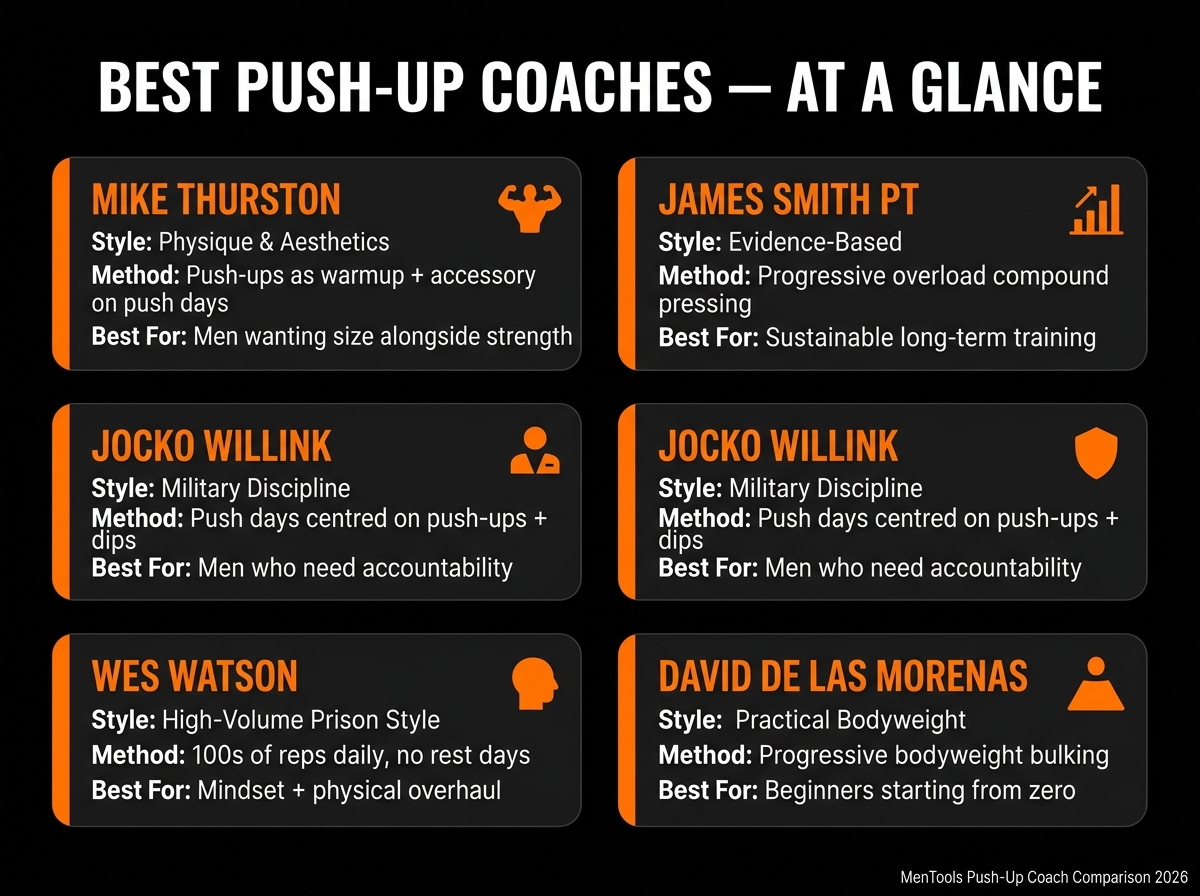
Five push-up coaches compared by training style and approach — Mike Thurston, James Smith PT, Jocko Willink, Wes Watson, and David de las Morenas.
| Coach | Style | Push-Up Approach | Programme Available | Best for |
|---|---|---|---|---|
| Mike Thurston | Physique / aesthetics | Push-up variations as warmup and accessory on chest and shoulder days | THRST app (paid) | Men who want size alongside push-up strength |
| James Smith PT | Evidence-based, no-nonsense | Push included in compound movement days with progressive overload emphasis | James Smith Academy (paid) | Men who want a sustainable, science-backed plan |
| Jocko Willink | Military / discipline-first | Push days built around push-ups, dips, and pressing — high volume | Jocko Workout Guide (free/paid) | Men who respond to accountability and structure |
| Wes Watson | Prison-style, mental toughness | High-volume daily push-ups — hundreds of reps, no rest days | Watson Fit (paid) | Men who need a mindset overhaul alongside training |
| David de las Morenas | Confidence and fitness, practical | Bodyweight Bulking Routine with progressive push-up structure | How to Beast programmes (paid) | Beginners and intermediates building from zero |
| No equipment / travel | Any of the above | Wes Watson or Jocko provide the most equipment-free volume protocols | See individual programmes above | Men who train at home or on the road |
| Advanced volume seeker | Any of the above | Wes Watson for raw volume; Jocko for structured push/pull/lift split | See individual programmes above | Men already doing 50+ push-ups who want to go harder |
The Real Answer
What makes a push-up coach actually worth following?
A push-up coach is worth following when they can explain the why behind the rep count, not just the number. The best coaches give you a progression logic, a training split that includes push work, and a philosophy you can actually stick to for more than six weeks.
Research published in the Journal of Strength and Conditioning Research found that push-ups and bench press at equivalent loads produce similar hypertrophy outcomes over eight weeks, confirming that push-up coaching is not second-rate strength coaching [1]. This matters because it means who you learn push-up programming from is as important as who you learn barbell programming from.
Is Mike Thurston’s approach right for men who want physique results?
Mike Thurston trains six days a week with a structured push, pull, and leg split that incorporates push-up variations as warmup and accessory work on chest and shoulder days. His approach is aesthetics-first, built around achieving a lean, developed upper body through progressive load increases of five to ten percent every three weeks, followed by a deload week [2].
He is not a pure calisthenics coach, but his chest and shoulder days include push-up work that builds the same pectorals, anterior deltoid, and tricep engagement as bench pressing. For men following his content on his First Things THRST podcast, the push-up sits within a broader physique system rather than as a standalone movement.
What does Jocko Willink’s method teach about push-up discipline?
Jocko Willink structures his training around a push, pull, lift, and squat split, where push days are built directly around push-ups, dips, and pressing variations. His daily training begins at 4:30 AM and his push days treat bodyweight pressing as the foundation, not a warm-up shortcut [3].
His military background in the Navy SEALs is relevant because push-up standards in the military are volume and consistency-based, not rep-max focused. Men who read about Jocko Willink on MenTools will find a coach who treats the push-up as a serious strength tool, not a beginner exercise to discard once you own a gym membership.
Why do men respond to Wes Watson’s prison-style training approach?
Wes Watson built his training system in California state prison without access to a gym, using bodyweight exercises — push-ups, squats, burpees, and pull-ups — with daily high volume and no rest days. He describes push-ups as the multi-vitamin of bodyweight exercises, central to everything he does [4].
What separates Watson from most coaches is the mindset angle. His approach deliberately targets the internal resistance men feel when training feels uncomfortable and frames daily push-up volume as mental conditioning as much as physical development. Harvard research published in JAMA Network Open found that men who could complete over 40 push-ups had a significantly lower 10-year cardiovascular event risk than men who could complete fewer than 10 [5], which aligns with Watson’s volume-first philosophy.
Does David de las Morenas cover push-ups seriously enough to follow?
David de las Morenas, known online as How to Beast, built a training system after quitting his software engineering career and systematically building 40 pounds of lean muscle. His Bodyweight Bulking Routine and general content take push-ups seriously as a primary upper body strength tool for men who do not have consistent gym access [6].
He sits at the practical end of the spectrum, with content pitched at men who are new to structured training or coming back after time off. His How to Beast profile on MenTools shows where he fits within the broader coaching ecosystem — alongside Jocko and Thurston as a complementary rather than competing approach.
What is James Smith PT’s take on push-up training for regular men?
James Smith PT built his reputation on debunking fitness industry nonsense and giving men sustainable, evidence-based training advice. When gym time is limited, he recommends compound pushing, pulling, and squatting as the non-negotiable framework, with push-up variations fitting naturally into that structure [7].
Smith’s academy and books emphasise long-term consistency over intensity spikes. His position on push-ups is that they are a legitimate compound pressing movement when loaded progressively, and should be trained as such rather than treated as filler. His tone is direct and often confrontational toward fitness misinformation, which works well for men who need someone to cut through the noise.
Why This Fails
The most common reason men get nothing from following push-up coaches is fragmentation. They watch three different coaches in the same week, each recommending a different volume, frequency, and variation approach, and end up paralysed or inconsistent.
A second pattern is passive consumption without application. A man can follow Jocko, Wes Watson, and James Smith simultaneously for six months without making structural changes to how many push-ups he actually does per week or how he progressively loads them. Content is not a programme.
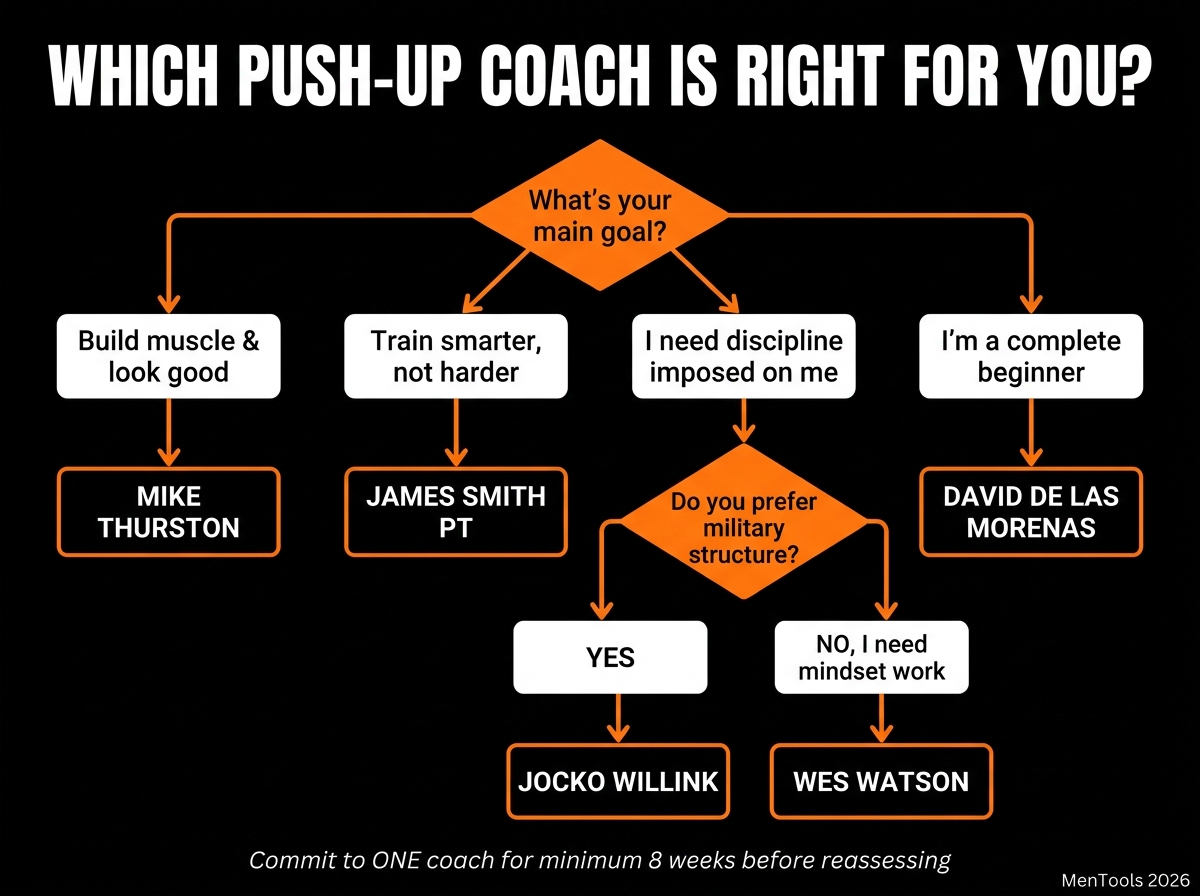
How to select the right push-up coach — match on training goal, environment, and tone preference before committing.
How to Fix It
The Simple Framework
Commit to one coach’s philosophy for a minimum of eight weeks before reassessing. Eight weeks is long enough to run a complete progressive push-up cycle and measure change, but short enough that you are not stuck with a bad fit indefinitely.
The framework is: pick, understand, extract, plan, measure.
- Pick one coach from the five above based on the Quick Comparison table — match on training style and tone, not on social media following.
- Understand their push-up philosophy specifically by consuming their push-specific content for one week.
- Extract a weekly push-up structure — sets, reps, frequency, and progression rule — from their method.
- Plan a four-week block with a specific starting point (for example, 4 sets of 15 reps three times per week) and a progression target (add two reps per set per week).
- Measure your starting max-rep set on day one and retest on day 28. Use the result to decide whether to continue the same approach or adjust.
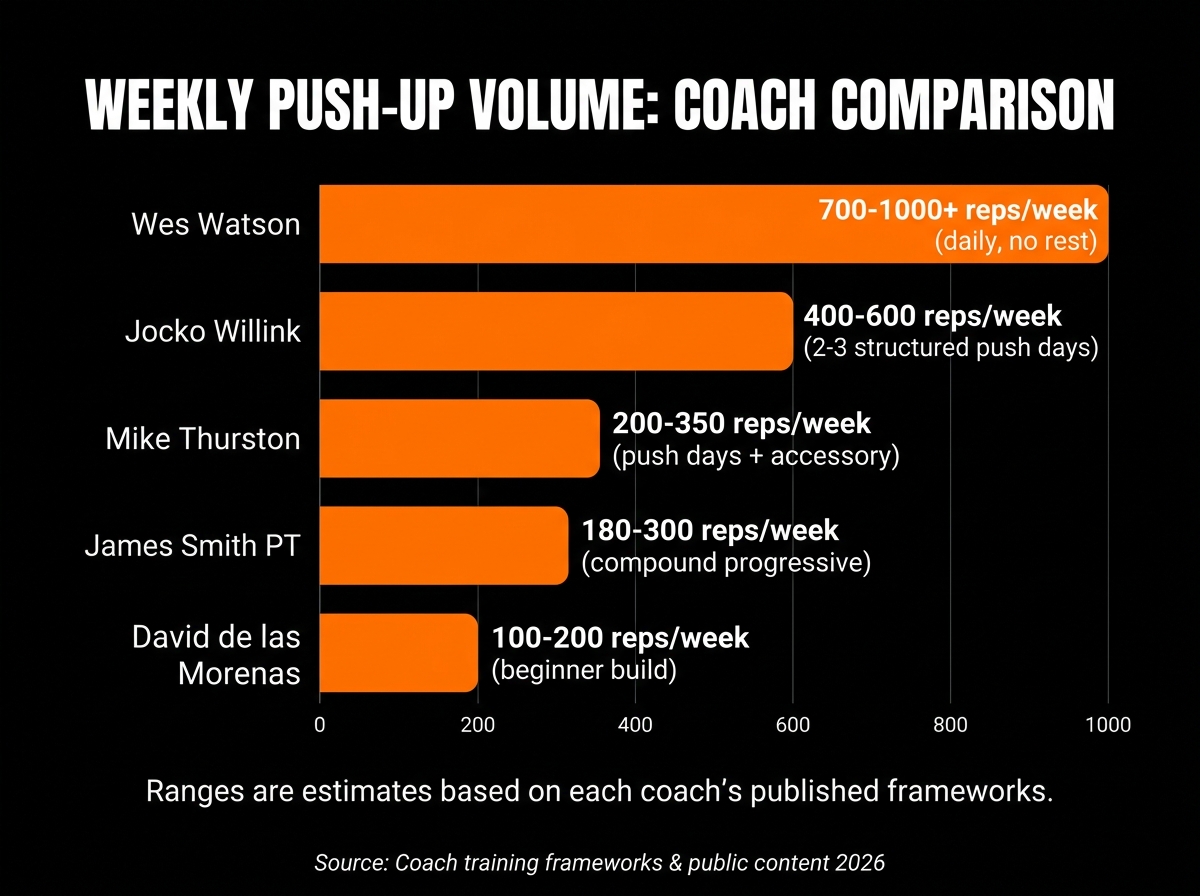
Weekly push-up volume comparison across all five coaches — from Wes Watson’s daily high-rep approach to structured progressive models.
FAQ
Which push-up coach is best for absolute beginners?
David de las Morenas is the most accessible starting point for men new to structured push-up training. His How to Beast Bodyweight Bulking Routine is designed specifically for men building from a low baseline, with clear progressions and no assumed fitness level.
Do any of these coaches offer a specific push-up programme?
Jocko Willink’s free workout guide includes a push day built around push-ups and dips. Wes Watson’s Watson Fit platform includes high-volume calisthenics programming. David de las Morenas offers a Bodyweight Bulking Routine as a paid programme. James Smith Academy includes push-based compound days within its full training plans.
How many push-ups do these coaches typically recommend per week?
Wes Watson advocates the highest weekly volume, with daily training and no rest days, often reaching hundreds of reps per session. Jocko’s push days sit within a structured four-day split, producing two to three push sessions per week. James Smith and Mike Thurston both favour structured progressive overload with two to three push sessions per week. Sports science benchmarks suggest 20 to 30 push-ups in a single set as a solid male fitness standard [8].
Can I follow more than one of these coaches at the same time?
You can consume content from multiple coaches, but you should follow only one training plan at a time. Conflicting volume recommendations and progression models will produce inconsistent stimulus and slow results. Use secondary coaches for motivation and perspective, not for programming.
Is Jocko Willink’s approach too intense for men who are not military?
No. Jocko’s training split is demanding but scalable. His push days are built around push-ups, dips, and pressing variations — not military PT tests. The intensity he brings comes from consistency and frequency, not from movements that require special preparation. The 4:30 AM approach is optional; the training structure is not military-only.
Does Mike Thurston focus only on gym lifts, or does he include push-ups?
Thurston’s training includes push-up variations on chest and shoulder days as warmup and accessory movements. He primarily trains with weights via the THRST app framework, but his upper body days do incorporate bodyweight pressing. For men who want a pure push-up focus, Jocko or Wes Watson are a better primary reference.
Final Recommendation
If you want physique results with a structured plan, start with Mike Thurston’s THRST framework. If you want evidence-based training you can sustain for years, James Smith PT is the right fit. If you respond to discipline and accountability, Jocko Willink’s push-day structure will hold you to a standard. If you need your mindset rebuilt alongside your body, Wes Watson is the most effective choice. If you are starting from zero, David de las Morenas gives you the clearest on-ramp.
Do not switch until you have run at least eight weeks on one plan. The coaches are all credible. The variable is your consistency.
Options For Men to Take Action
Most men follow great coaches and still do not progress because they have no structure tying their training together day to day. They watch the content, feel motivated, and then either train randomly or skip sessions when work or life pushes back.
The MenTools Push-Up Protocol gives you a complete system built around the same push-up principles these coaches teach, structured into a daily accountability framework you can run without a gym. When you join, you get a 30-day push-up progression plan, daily check-ins, form guidance, and a community of men working the same programme at the same time.
How you can do this today: go to the MenTools Challenges section and start the Push-Up Challenge to run a structured push-up programme with built-in daily accountability. If you want more, the full MenTools app gives you access to every protocol across fitness, mindset, and habits.
Wins on cost: The MenTools system replaces a personal trainer, multiple apps, and scattered online content with a single structured programme. One plan, zero recurring coaching cost.
Wins on time: There is no research phase or programme design required. The plan is ready to run on day one, with progressions built in and form cues included.
Wins on practicality: The Push-Up Protocol requires no gym, no equipment, and no fixed schedule. It works during travel, around shift work, and on days when a full gym session is not realistic.
Every man on this list built his physical foundation on consistent, structured push-up volume. The tool that removes the gap between watching and doing is already built.
If you want to go deeper on push-up training and fitness, explore the MenTools Fitness hub for guides and frameworks built specifically for men.
To support your daily routine with targeted nutrition, explore MenTools One A Day, formulated with chelated minerals and active B-vitamin forms for men.
When you are ready to turn ideas into action, start a focused challenge or daily routine inside the MenTools app and track how consistent habits change how you feel.
Last updated: 2026-05-12 v1.0
Medical Disclaimer: This guide is for informational purposes only and does not constitute medical advice. Always speak with your doctor or another qualified healthcare professional before starting any new supplement or programme if you have medical conditions or take prescription medication.
References
- [1] Calatayud J, et al. Muscle activation differences between push-up and bench press at equivalent loading. Journal of Human Kinetics. 2015. Link
- [2] Jacked Gorilla. Mike Thurston’s Workout Routine (Updated 2026). Link
- [3] Exercise with Style. Jocko Willink Workout Routine And Diet Plan 2026. Link
- [4] Typehuman. Wes Watson’s Philosophy on Life, Fitness, and Redemption. Link
- [5] Yang J, et al. Association between push-up exercise capacity and future cardiovascular events among active adult men. JAMA Network Open. 2019. Link
- [6] Muscle and Strength. How to Beast — David De Las Morenas author profile. Link
- [7] James Smith Academy. You Can’t Progress What You Don’t Track. Link
- [8] GetToText. Optimal Push-Up Standards for Men and Women: Insights from Sports Scientists. 2024. Link