No products in the cart.
Return To Shop
MEN: How Do You Stop Being a Perfectionist Without Lowering Your Standards?
Quick Answer
Keep the high standards and work on the fear of mistakes. Research separates perfectionistic strivings from perfectionistic concerns, and it is the concerns that track with burnout [1]. The research supports the split [2] and shows the fear side can be reduced [3]. Our six steps put that into practice: name which one is driving you, set a good enough bar, timebox, ship and review, treat mistakes as data and cap your checking.
**Jump to:** Standards vs fear | Why it is rising | Self-criticism | Can it change? | Six steps | Common mistakes | FAQ | Options for men
Disclosure: MenTools publishes this article and may feature MenTools products.
How we evaluate: Each step is assessed on real-world use, evidence, cost and time, and how well it suits men. Every step including the MenTools option carries an honest limitation. Full sources are in the references below.
Can You Keep High Standards and Still Stop Being a Perfectionist?
Yes, because perfectionism is two things stuck together. Researchers separate perfectionistic strivings, which are high personal standards, from perfectionistic concerns, which are fear of mistakes, doubt and harsh self-judgement. The strivings are linked with positive traits. The concerns are the part linked with burnout [2][1].
The Stoeber and Otto review reached a careful conclusion on this. They wrote that “self-oriented perfectionistic strivings are positive, if perfectionists are not overly concerned about mistakes and negative evaluations by others” [2]. In plain terms, wanting to do things well is fine. Being overly concerned about getting them wrong is the condition that changes the picture.
The burnout data show the split clearly. A meta-analysis of 43 studies with 9,838 people, covering work, sport and education, found that perfectionistic strivings had “small negative or non-significant relationships with overall burnout” [1]. By contrast, perfectionistic concerns “displayed medium-to-large and medium positive relationships” with burnout and its symptoms [1]. Same label, opposite pattern.
This is why the title of this guide is not a trick. You are not being asked to care less about your work, your training or your finances. You are being asked to loosen the grip of the fear that sits underneath the caring. If your standards stay and the dread goes, you keep the part that built your reputation and lose the part that keeps you up at night.
It also fits how we think about mental fitness more widely. Our guide to what mental fitness is treats your reaction to your own mistakes as a trainable skill, which is exactly where this guide spends its time.
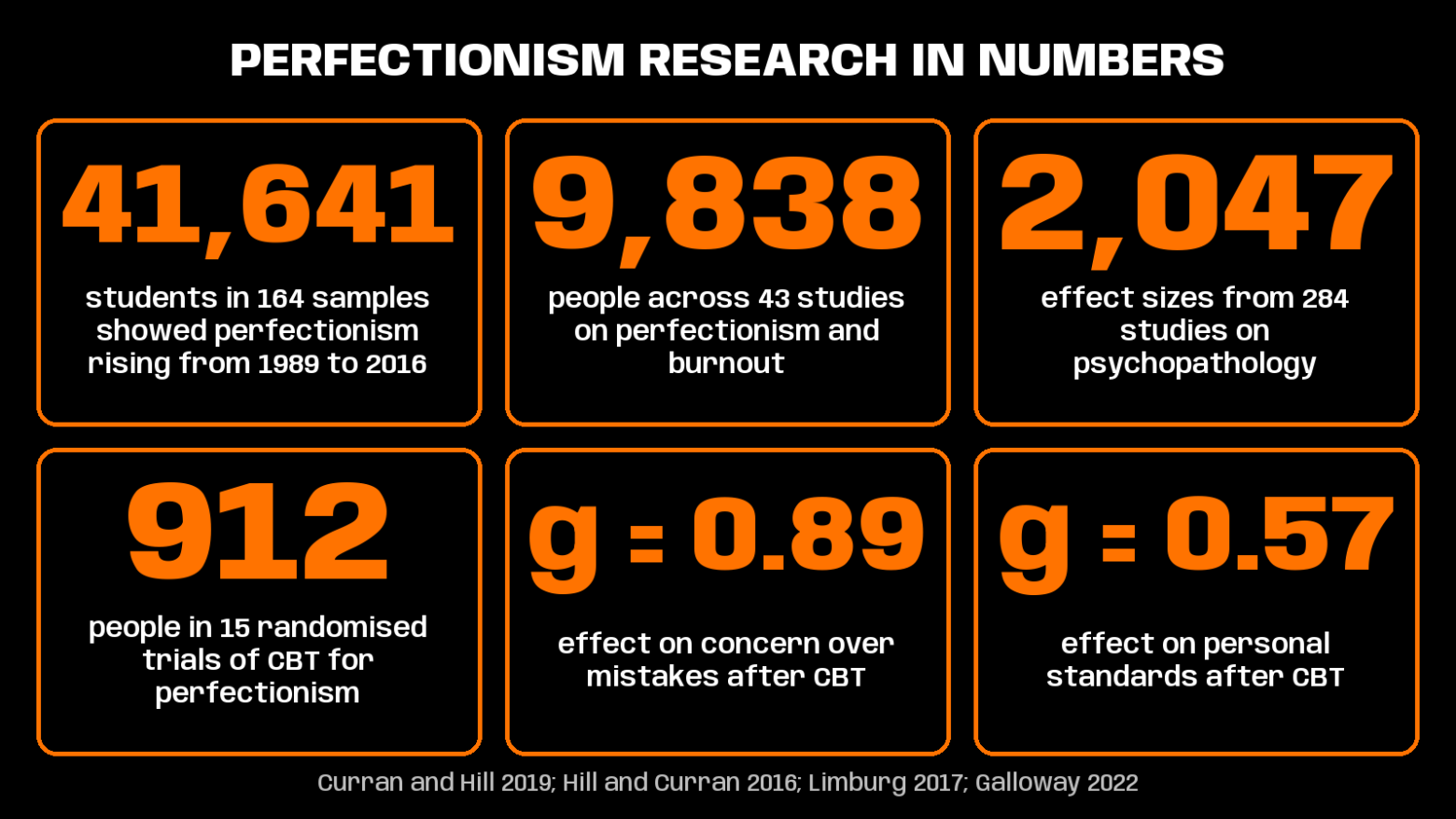
The research behind the strivings and concerns split, in numbers.
Why Is Perfectionism Rising, and What Does It Cost?
The authors ask whether cultural changes coincided with that rise, and the costs in other studies sit mostly on the concerns side. A meta-analysis of 164 samples and 41,641 college students found self-oriented, socially prescribed and other-oriented perfectionism all increased in a straight line between 1989 and 2016 [4]. If you feel the pull to perfect everything, the data say you are far from alone.
Read that finding with its limits in mind. The samples were American, Canadian and British college students, and 70.92% were female, so it describes college students in those countries rather than all men [4]. The authors’ summary is still worth quoting: “recent generations of young people perceive that others are more demanding of them, are more demanding of others, and are more demanding of themselves” [4].
The links show up in mental health research. A meta-analysis of 284 studies and 2,047 effect sizes concluded that “both dimensions are associated with various forms of psychopathology” [5]. The abstract does not rank the two dimensions, so we will not claim which is worse here. What it supports is simple: perfectionism, including its strivings side, is worth taking seriously rather than treating as a harmless quirk.
Work is the arena where many men feel it most, and there the picture is mixed. A meta-analysis of perfectionism in the workplace found “sizable and consistent relationships with several organizationally relevant factors but an equivocal overall relationship with job performance” [6]. Put bluntly, being a perfectionist does not reliably make you better at your job. It makes you more tired, which is a poor trade.
This also helps explain why perfectionism and putting things off are so often found together: when finishing feels like exposing yourself to judgement, starting gets harder. Our post on why men procrastinate so much covers that side, so we will keep this guide on the standards.
Is the Problem Your Standards or the Way You Judge Yourself?
Usually the judging. The classic clinical analysis defines the problem as “the overdependence of self-evaluation on the determined pursuit (and achievement) of self-imposed personally demanding standards” [7]. The trouble is not that the standard is high. It is that your worth as a man gets tied to hitting it, every time, in front of everyone.
That analysis also describes why clinical perfectionism is hard to satisfy. The authors suggest that people with perfectionism “react to failure to meet their standards with self-criticism” and that when they do meet them, “the standards are re-evaluated as being insufficiently demanding” [7]. Miss the bar and the reaction is self-criticism. Clear the bar and the standard gets re-evaluated as too low. Either way, the finish line moves.
This is a loop you can interrupt. The self-criticism is the part to quieten, and our guide to how to quiet your inner critic goes through that in detail. Here we are more interested in the practical changes to how you set and judge standards, which come next.
A related trap is the urge to find the best possible option every time. In seven samples, people who scored high on a “maximizing” scale, meaning the desire to get the best option, reported lower happiness, optimism, self-esteem and life satisfaction, and higher depression, perfectionism and regret [8]. In a separate study in the same paper, maximisers were less satisfied than satisficers, who settle for good enough, with consumer decisions [8]. Our piece on decision fatigue shows how that same hunt for the perfect choice drains you.
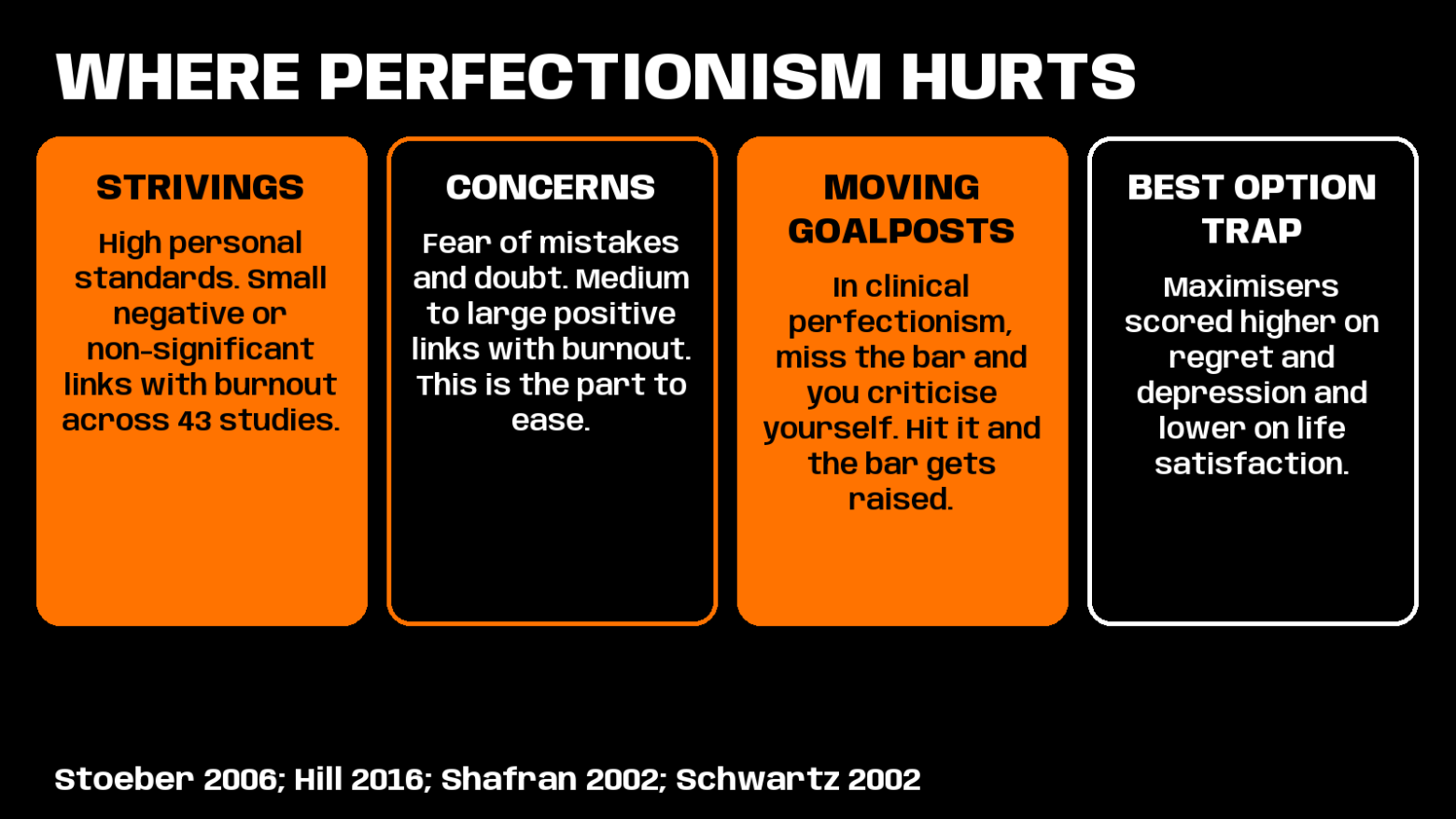
Keep the standards, work on the fear.
Can Perfectionism Actually Be Reduced?
Yes, at least in the settings studied. A meta-analysis of 15 randomised controlled trials of cognitive behaviour therapy for perfectionism, with 912 participants and a mean pooled age of 23, found medium or large effects on perfectionism measures [3]. Concern over mistakes dropped the most, with an effect size of g = 0.89, against g = 0.57 for personal standards [3].
That pattern is useful. The thing that changed most was the fear of mistakes rather than the standards themselves, although both fell, and it fits the idea that the concerns are the more movable and more harmful part. The same review found medium effects on depression (g = 0.60) and a small to medium effect on anxiety (g = 0.42) [3].
Treat the limits honestly. The authors noted the small number of trials and the lack of comparisons with other active treatments [3]. An earlier review of 8 studies in people with psychiatric disorders linked to perfectionism, or with high levels of perfectionism, found “Large pooled effect sizes” on personal standards and concern over mistakes [9]. Those were clinical groups, and none of this tested the simple habits below.
So the steps in this guide are not therapy and are not a trial result. They are everyday moves that point at the same targets the therapy research points at: the fear of mistakes, the all or nothing self-judgement and the endless checking. If your perfectionism is hurting your sleep, work, relationships or mood, speak to your GP, because CBT for perfectionism is a real option.
How Do You Stop Being a Perfectionist? Six Steps
Work through six steps: name which kind of perfectionist you are, set a good enough bar in advance, timebox the task, ship and then review, treat mistakes as data, and cap your checking. Do them on one live task, not in theory. The research behind each step is cited where it exists, and the practical wording and order are our own advice.
Pick something small and current, such as a report, a workout plan, a message you keep redrafting or a budget. Run the six steps on that single task for a week. Perfectionism is a habit of mind, and habits change through repetition on real work rather than through one good insight.
Step 1: Name Which Kind of Perfectionism You Have
Write down whether your drive is wanting it done well or fearing it done badly. Strivings sound like “I want this to be excellent”. Concerns sound like “what if they see a mistake”. Strivings had small negative or non-significant links with burnout, while concerns had clear positive links, so this one distinction points you at what to work on [1].
Try a simple test on your last stalled task. Ask what you were actually afraid of. If the honest answer is “being judged” or “being wrong”, you are dealing with concerns. If it is “I want to do a good job and I know how”, you are mostly dealing with strivings, and you may only need a deadline.
This step matters because it stops you attacking the wrong target. The aim is not to care less. The review quoted earlier suggests self-oriented strivings are positive when you are not overly concerned about mistakes and the judgement of others [2]. Naming the fear lets you leave the standard alone and go after the fear.
Step 2: Set a Good Enough Bar Before You Start
Decide in advance, in writing, what finished looks like, and stop when you reach it. For example, “the report answers the three questions, has no factual errors and goes out by 4pm”. A fixed bar protects you from the pattern where, as the clinical analysis describes it, standards get re-evaluated as insufficiently demanding when you meet them [7].
Choose your bar by asking what the person receiving the work needs, not what would impress the most critical person you can imagine. Then write it where you can see it. When you hit it, you are done, even if you could keep polishing.
Setting the bar also limits the search for the best option. The people who aimed for the best possible choice, the maximisers, scored higher on regret and lower on life satisfaction, and were less satisfied with consumer decisions than satisficers, who settle for good enough [8]. A written bar is a way of choosing to be a satisficer on purpose, for the tasks where the difference is small.
Keep the bar high where it matters. A good enough bar for a gym log is different from one for a safety check or a legal document. This is about matching effort to stakes, not about lowering standards across your life.
Step 3: Timebox the Task
Give the task a fixed block of time and stop when it ends, then decide what, if anything, needs a second block. Perfectionism expands to fill whatever time you give it, so the time limit does the work your willpower cannot. This step is our own advice, and none of the cited studies tested timeboxing.
A practical way to start is to halve the time you would normally take, set a timer and work until it rings. Many men find the first draft is better than expected because the limit forces decisions. If the result falls short of your written bar from Step 2, schedule one more block rather than drifting on.
Timeboxing also helps with the avoidance that often comes with perfectionism. When the task has an end, starting feels less like signing up for an endless judgement. Our procrastination guide has more on getting started when the pressure is high.
Step 4: Ship It, Then Review It
Send the work out at your good enough bar, then review it afterwards with a short, factual note. Shipping gives you real evidence about what happens when something is imperfect, and the review turns that into learning rather than a verdict on you. The review comes after the release, not before it.
Keep the review to three lines: what went well, what I would change, and what happened that I feared. That last line matters. Perfectionistic concerns are predictions of disaster, and most of the time the record will show the disaster did not arrive. In the CBT trials, concern over mistakes was the measure that fell furthest [3], and checking your fears against outcomes is the everyday version of that work.
Do this on low stakes work first. Release a draft to a colleague, post the training log, send the invoice without a third read. Each one is a small experiment, and the results build a record you can trust more than your anxiety.
Step 5: Treat Mistakes as Data
When you spot an error, write down what it tells you and fix the cause, then move on without grading yourself. How people bounce back from mistakes depends on their beliefs about learning. In one study, a growth mind-set was linked to “superior accuracy after mistakes” compared with a more fixed mind-set [10].
The researchers described the two views clearly: for people with a growth mind-set, “mistakes are seen as opportunities to learn and improve”, while for a fixed mind-set they “indicate lack of ability” [10]. The error is the same. The meaning you give it is different, and the meaning decides what you do next.
Turn this into a habit by keeping a short error log. Write the mistake, the cause and the one change you will make. Avoid adding a verdict such as “idiot” or “typical”, because that is the self-criticism from earlier returning in disguise [7]. Facts and fixes only. Over a few weeks the log shows that most errors are small, specific and fixable.
Step 6: Cap Your Checking
Allow yourself one check pass, with a list, and then stop. Repeated rereading and redrafting feel like diligence, but they mostly feed the doubt, because each pass raises a new thing to worry about. This step is our own advice and the cited studies do not measure checking directly.
Write your check list once, such as numbers match, names are spelled correctly and the attachment is there. Run through it one time and tick it off. If you catch yourself starting a second pass, that is the moment to use the bar from Step 2: if the work meets it, you are finished.
If you find you cannot stop checking even after trying, or the doubt is consuming your day, that is a reason to talk to your GP rather than to push harder. Ongoing checking can belong to wider anxiety, and the CBT research shows that support exists [3].
What Mistakes Make Perfectionism Worse?
The usual ones are lowering the standard in a panic, adding more rules, and judging yourself for still being a perfectionist. Each of these keeps the underlying fear in place. The aim is to ease the concerns while the standards stay where they are, so any change that attacks the standard itself tends to backfire.
**Dropping standards across the board.** That swaps a perfectionism problem for a quality problem. Keep high standards for the tasks that matter and a written good enough bar for the rest.
**Treating the steps as a new test.** If you fail to follow all six, that is data, not a verdict. The self-evaluation trap in the clinical analysis applies to this guide as well [7].
**Going it alone for too long.** The trials above suggest CBT and related psychological treatment can reduce perfectionism and the symptoms around it [3][9]. If your perfectionism is heavy, do not wait.
FAQ
Is perfectionism always bad?
No. The research separates perfectionistic strivings from perfectionistic concerns. Strivings had small negative or non-significant relationships with burnout, while concerns had medium to large positive ones [1]. The authors of one review suggested that self-oriented strivings are positive if you are not overly concerned about mistakes and the judgement of others [2].
Will I lose my edge if I stop being a perfectionist?
Not necessarily. A workplace meta-analysis found an equivocal overall relationship between perfectionism and job performance [6]. Keeping high standards while easing the fear of mistakes is the aim, and the strivings side is the part with only small negative or non-significant links to burnout [1].
Why do I feel like nothing I do is good enough?
One explanation is the moving goalposts pattern. People with clinical perfectionism may re-evaluate their standards as insufficiently demanding when they meet them [7]. A written good enough bar, set in advance, gives you a finish line that cannot move.
Is perfectionism getting worse?
In college students from the United States, Canada and Britain, perfectionism rose in a straight line from 1989 to 2016 [4]. That sample was 70.92% female and limited to students, so it does not tell us about every man, but it fits the sense that the pressure has grown [4].
Can therapy help with perfectionism?
It can. A meta-analysis of 15 randomised trials found medium or large effects of CBT on perfectionism measures, with the biggest change in concern over mistakes [3]. The authors noted the small number of trials. Speak to your GP if perfectionism is affecting your health or work.
Is wanting the best choice a form of perfectionism?
It is linked. In seven samples, maximizing, the desire to get the best option, correlated positively with perfectionism, regret and depression, and negatively with happiness and life satisfaction [8]. Setting a good enough bar before you choose is one way to work against it.
Final Recommendation
Keep the standards and work on the fear. Strivings had small negative or non-significant links with burnout, while concerns had positive links [1], and CBT trials moved concern over mistakes the most [3]. Run the six steps on one real task for a week: name the kind, set the bar, timebox, ship and review, log mistakes as data and cap your checking.
If your perfectionism is mostly about work output, start with steps 2 to 4. If it is mostly harsh self-judgement, start with step 5 and the inner critic guide. If it is affecting your sleep, mood or relationships, speak to your GP.
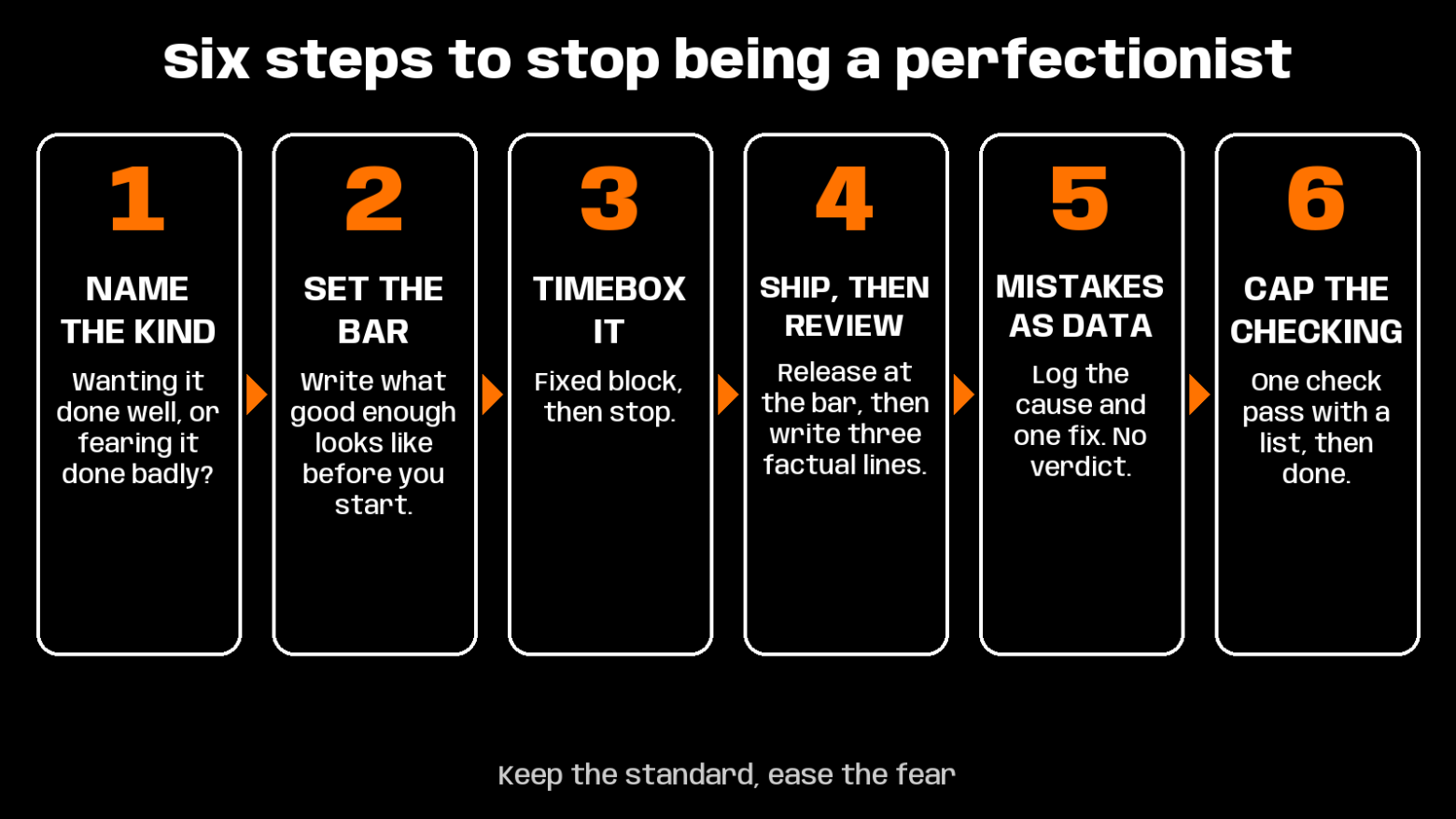
Six steps that keep the standard and ease the fear.
Options for Men to Take Action
Most men understand the idea quickly, but with no system the plan stays an insight and the old habit of redrafting everything carries on.
The MenTools app runs challenges across mindset, fitness, nutrition and money, with levels you choose, daily actions, streak and progress tracking, journals and an AI coach. For this guide, its job is to turn the six steps into one small daily action, so the practice of shipping at good enough is repeated rather than remembered once.
How you can do this today: pick one task, add “ship at my written bar” as a daily action at the easiest level and note in the journal each day what you feared and what actually happened.
Wins on cost: one subscription brings challenges, tracking, journals and an AI coach together, instead of paying for separate apps.
Wins on time: the challenges are already built, so you spend your time on the action rather than designing a plan.
Wins on practicality: you choose your level, so the first dose can be small enough to do on a bad day.
Watch-out: none of the studies in this guide tested the MenTools app, so treat it as a structure for repetition, not a treatment for perfectionism. If perfectionism is hurting your mood, sleep or work, speak to your GP.
Hard days land better when the basics are covered, so a one a day multivitamin may help cover the simple daily foundation. For more on this topic, the MenTools mindset hub collects every guide in one place. Set the bar, ship the work, then log it.
Last updated: 2026-11-18 v1.0
Disclaimer: This guide is for informational purposes only and does not constitute medical or psychological advice. Speak with a qualified professional before making significant changes if you have a medical or mental health condition.
References
- [1] Hill AP, Curran T. Multidimensional perfectionism and burnout: a meta-analysis. Personality and Social Psychology Review, 2016;20(3):269-288. Link
- [2] Stoeber J, Otto K. Positive conceptions of perfectionism: approaches, evidence, challenges. Personality and Social Psychology Review, 2006;10(4):295-319. Link
- [3] Galloway R, Watson H, Greene D, Shafran R, Egan SJ. The efficacy of randomised controlled trials of cognitive behaviour therapy for perfectionism: a systematic review and meta-analysis. Cognitive Behaviour Therapy, 2022;51(2):170-184. Link
- [4] Curran T, Hill AP. Perfectionism is increasing over time: a meta-analysis of birth cohort differences from 1989 to 2016. Psychological Bulletin, 2019;145(4):410-429. Link
- [5] Limburg K, Watson HJ, Hagger MS, Egan SJ. The relationship between perfectionism and psychopathology: a meta-analysis. Journal of Clinical Psychology, 2017;73(10):1301-1326. Link
- [6] Harari D, Swider BW, Steed LB, Breidenthal AP. Is perfect good? A meta-analysis of perfectionism in the workplace. Journal of Applied Psychology, 2018;103(10):1121-1144. Link
- [7] Shafran R, Cooper Z, Fairburn CG. Clinical perfectionism: a cognitive-behavioural analysis. Behaviour Research and Therapy, 2002;40(7):773-791. Link
- [8] Schwartz B, Ward A, Monterosso J, Lyubomirsky S, White K, Lehman DR. Maximizing versus satisficing: happiness is a matter of choice. Journal of Personality and Social Psychology, 2002;83(5):1178-1197. Link
- [9] Lloyd S, Schmidt U, Khondoker M, Tchanturia K. Can psychological interventions reduce perfectionism? A systematic review and meta-analysis. Behavioural and Cognitive Psychotherapy, 2015;43(6):705-731. Link
- [10] Moser JS, Schroder HS, Heeter C, Moran TP, Lee YH. Mind your errors: evidence for a neural mechanism linking growth mind-set to adaptive posterror adjustments. Psychological Science, 2011;22(12):1484-1489. Link