No products in the cart.
Return To Shop
MEN: Can You Actually Train Resilience, or Are You Born With It?
Quick Answer
Both, but mostly trained. Twin studies put the genetic share of resilience at roughly 25 to 50 percent, so at least half comes from environment and experience [1][2]. Resilience is also common, seen in about two in three people after hardship [6]. Training gives small to moderate gains that fade without regular practice [10][14].
**Jump to:** Born vs built at a glance | Is resilience genetic? | FAQ | Options for men
Disclosure: MenTools publishes this article and may feature MenTools products.
How we evaluate: Each factor is assessed on real-world use, evidence, cost and time, and how well it suits men. Every factor including the MenTools option carries an honest limitation. Full sources are in the references below.
Born vs Built at a Glance
Resilience is part inheritance and part training, and the evidence for each part is different in size and quality. Genes set some of your starting point, mostly through temperament. Training, habits and the people around you build the rest. The table shows what the research says about each piece and how strong that research is [1][2][6][10][14][16].
| Factor | Born or built | What the evidence shows | Strength of evidence |
|---|---|---|---|
| Genes | Born | 25 to 50 percent of the variation between people [1][2] | Twin studies, 7,500 and 6,636 twins |
| Temperament | Mostly born | Neuroticism carries most of the genetic share [4] | One large twin study |
| Bouncing back | Common | 65.7 percent follow a resilient path after hardship [6] | Review of 54 studies |
| Formal training | Built | Moderate effect of 0.44 on resilience scores [10] | 11 trials, low to very low certainty |
| Keeping it up | Built | Workplace gains fell from 0.26 to 0.07 after a month [14] | 37 studies |
| Past hardship | Shaped | Some adversity beat none and a lot [16] | Panel of 2,398 people, correlational |
Is Resilience Genetic?
Partly. The best twin studies find that genes explain between a quarter and a half of the differences in resilience between people. In a study of 3,318 male twin pairs, the heritability of resilience was 25 percent [2]. In 7,500 adult twins, it was about 31 percent, rising to about 50 percent once measurement error was removed [1].
That leaves a large share for everything else. In the same 7,500 twins, environmental influences “contributed roughly equally to level of resilience” once the statistics were cleaned up [1]. The authors concluded that “Environmental influences can have an enduring effect on resilience” [1]. No twin study found resilience to be mostly or wholly genetic.
The all-male study adds one more useful detail. It found “there was no genetic factor specific to resilience” [2]. In other words, there is no resilience gene. What you inherit is a broader sensitivity to stress, and the rest is built on top of it.
What Does Heritability Actually Mean for You?
Heritability describes the spread of a trait across a population. It does not tell you what share of your own resilience is fixed. A heritability of 31 percent means genes account for about 31 percent of the differences between people in that study, not that 31 percent of your resilience is locked in [1]. Your personal ceiling is not printed on a test result.
Much of the genetic piece runs through temperament. A follow-up study of the same twins found that the genes behind traits such as neuroticism, optimism and self-esteem accounted for between 7 and 60 percent of the heritability of resilience, with neuroticism carrying the most [4]. You inherit a tendency to react strongly or calmly. What you do with that reaction is learnable. Psychiatrists Steven Southwick and Dennis Charney note that how people respond to stress “depends on numerous genetic, developmental, cognitive, psychological, and neurobiological risk and protective factors” [19].
George Bonanno, the Columbia psychologist whose work reshaped resilience research, is blunt on this point. “But personality and genes are just two of the many pieces of the puzzle and they are actually small pieces,” he said [5]. He added that “no single demographic, personality or biological factor has been shown to predict or enhance resilience by more than a small degree” [5].
How Common Is Resilience?
Much more common than most men assume. A 2018 review of 54 studies found that, on average, 65.7 percent of people followed a resilient path after a potentially traumatic event, with stable functioning throughout [6]. Another 20.8 percent recovered after an initial struggle, 10.6 percent had chronic difficulties and 8.9 percent struggled later [6].
The same pattern shows up in real disasters. In a sample of 2,752 New York residents in the six months after the 11 September attacks, 65.1 percent were resilient, and even in the most exposed groups it “never fell below one third” [7]. Bonanno’s earlier review argued that resilience “is more common than is often believed” [8].
Developmental psychologist Ann Masten reached the same conclusion from decades of research on children facing adversity. “Resilience does not come from rare and special qualities, but from the everyday magic of ordinary, normative human resources in the minds, brains, and bodies of children, in their families and relationships, and in their communities,” she wrote [9]. Ordinary resources can be built on.
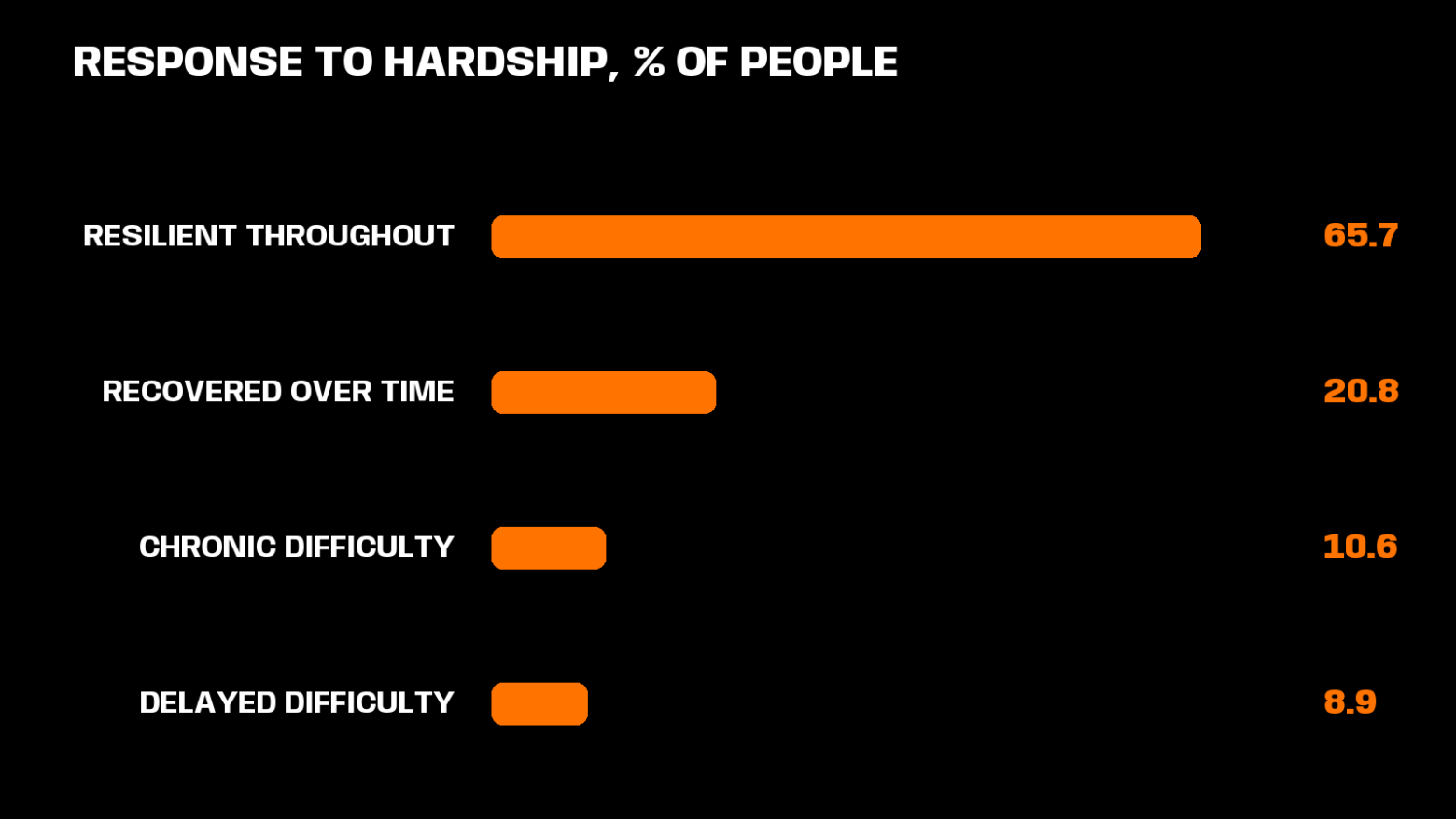
Resilience is the most common response to hardship, not the rare one.
Does Resilience Training Actually Work?
Yes, with modest and honest effects. A 2018 meta-analysis of 11 randomised trials found resilience training had “a moderate positive effect”, with a pooled effect size of 0.44 [10]. Programmes that combined cognitive behavioural skills with mindfulness performed best, and the authors said they “appear to have a positive impact on individual resilience” [10].
Other reviews land in the same range. A Cochrane review of training for healthcare workers found an effect of 0.45 on resilience across 12 studies and 690 people, plus lower stress [11]. A 2014 review of 25 trials found a pooled effect of 0.37 [12], and the largest analysis, covering 268 studies, found an overall effect of 0.48 [13].
The caveats are real and worth knowing. Cochrane called the evidence “very uncertain” and asked for “high-quality replications and improved study designs” [11]. Most trials used self-report questionnaires, and 68 percent of the Cochrane participants were women [11]. Evidence on men aged 25 to 40 specifically is thin, so treat these numbers as a guide, not a guarantee.
Why Do the Effects of Training Fade?
Because resilience behaves like fitness, not like a qualification. A meta-analysis of 37 workplace studies found a small overall effect of 0.21, and the effect dropped from 0.26 within a month of the programme to 0.07 after that [14]. The authors summed it up plainly: “Resilience-building programmes have had a modest effect in the workplace” [14].
Fading is not universal, which is the useful part. In the 2018 meta-analysis, the effect of mindfulness based programmes was 0.58 at six months across three trials, “similar to the effect size seen immediately after training” [10]. Those programmes build a daily practice, which is the difference between a course and a habit.
Psychiatrists Brian Iacoviello and Dennis Charney, who studied highly resilient people including former prisoners of war, put the lesson in two sentences. “Changing in these areas typically involves training regularly and rigorously. Change requires systematic and disciplined activity” [15]. A one-off workshop is a single session. Resilience needs a programme.
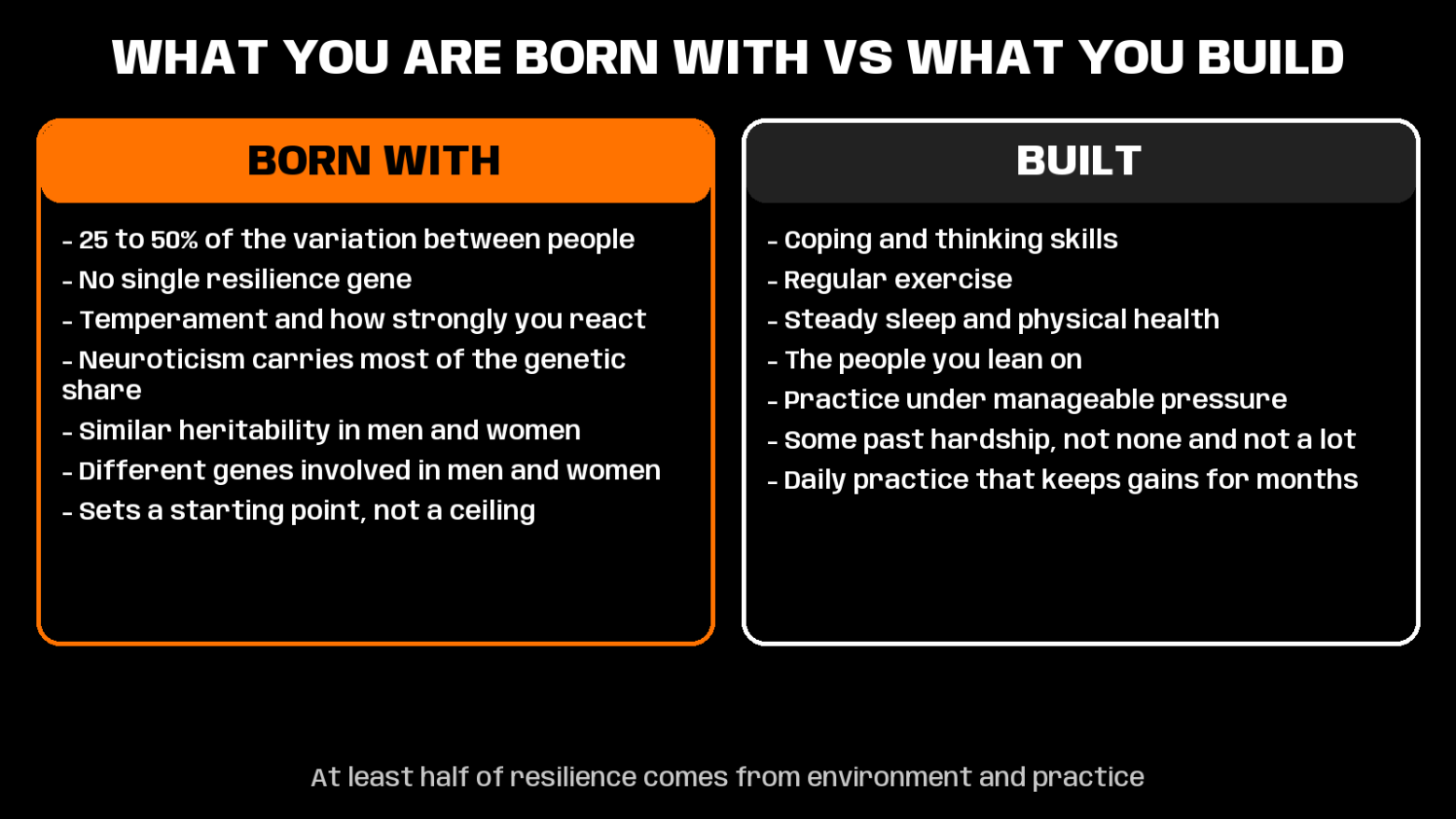
You inherit a starting point. Most of what matters is built on top of it.
Does Hardship Make You Stronger?
In moderation, the evidence suggests it can. A national panel study tracked 2,398 people from 2001 to 2004 and found a U-shaped pattern: people with some lifetime adversity had lower distress, less impairment and higher life satisfaction than people with either no adversity or a great deal [16]. The authors wrote, “in moderation, whatever does not kill us may indeed make us stronger” [16].
Lead author Mark Seery thinks everyday challenges count too. “Although we studied major lifetime adversity,” he said, “there is reason to believe that other relatively mundane experiences should also contribute to resilience” [17]. That is the logic behind stress inoculation, which Iacoviello and Charney describe as “prior exposure to manageable stressors” that reduces the response to later ones [15].
The honest limit is that this study shows a link, not a cause, and the release itself notes “these data cannot establish causation” [17]. Nobody should go looking for trauma. The practical version is choosing manageable discomfort on purpose: hard training, difficult conversations and skills practised before you need them. Trauma researcher Rachel Yehuda put it simply: “Ideally, we want to enhance resilience before trauma occurs by practicing how we would respond to a trauma” [5].
Which Parts of Resilience Can a Man Train?
Most of them. The factors linked to resilience in the research are largely skills and habits: optimism, cognitive flexibility, active coping, a supportive network, looking after your physical health and a clear set of values [15]. A wider review lists reappraisal, acceptance, humour, exercise, social support and stress inoculation among them [18]. Very few are fixed traits.
Exercise is one of the easiest to start. In a study of 111 healthy adults put through a standard stress test, people who exercised at least once a week lost less positive mood afterwards than people who did not [20]. The authors called it “modest support” that exercise protects against the emotional hit of stress [20]. It is a small study, but the habit costs little.
Thinking skills are trainable too. Bonanno’s lab focuses on flexibility, how you read a situation, the range of responses you have and how you adjust, because “it seems to me to be learnable” [5]. Our guide on how to regulate your emotions as a man turns that into steps, and mental toughness for men covers the harder edge.
Are Men Born More or Less Resilient Than Women?
Neither, on the best evidence, but men may build it differently. One large study found the overall heritability of resilience was the same for men and women, although “the genes affecting resilience are not equivalent between males and females” [1]. Another found it higher in men, at 0.52 against 0.38 in women [3].
That second study had a finding with a practical edge. It reported that “compared to women, men appear to derive additional benefits from environmental mastery” [3], meaning a sense of control over the demands of daily life. For many men, building competence, routine and control over small things may be a direct route to resilience.
The weak spot for men is usually support. The Mental Health Foundation notes that men are “less likely to talk to family or friends about their mental health” and more likely to use harmful coping methods such as drink or drugs [21]. Yet a supportive network is one of the best evidenced resilience factors, and Iacoviello and Charney report that “interviews with resilient individuals often yield acknowledgment of invaluable social support” [15].
How Long Does It Take to Build Resilience?
Expect early changes within weeks and to keep practising for months. Most training trials measure gains within a few weeks to three months [10][12], and the gains held at six months only where people kept a regular practice going [10]. Workplace programmes without that follow-through faded within a month [14].
The habits underneath take time to become automatic. In a real-world study of habit formation, a new daily behaviour took an average of 66 days to become automatic, ranging from 18 to a predicted 254 days [22]. That is a sensible horizon for any resilience practice, whether it is training, a breathing routine or a weekly call with a mate.
Think of it as a block in the gym rather than a course you pass. Measure something simple, such as how quickly you settle after a bad day, and review it every couple of weeks. The broader picture of how this fits with sleep, movement and attention is in our guide to what mental fitness is and how men train it.
FAQ
Is resilience a personality trait?
Partly. Some of it tracks temperament, especially how strongly you react to stress, and genes behind traits such as neuroticism explain a share of it [4]. But researchers treat resilience as a process as much as a trait, built from coping skills, habits and relationships that can change over time [9][15].
Can you lose resilience?
Yes. Training effects fade without practice, and workplace programme gains dropped sharply within a month in one meta-analysis [14]. Long periods of heavy stress, poor sleep or isolation also wear down the resources resilience depends on. The fix is the same as fitness: keep a regular practice going [10][15].
What are the signs of a resilient man?
He recovers from setbacks in days rather than weeks, adapts his approach when one stops working, keeps his routines under pressure and asks for help early. The research links resilience to cognitive flexibility, active coping and a supportive network rather than to never feeling stress [15][18].
Does stress inoculation work for building resilience?
The principle is supported. Prior exposure to manageable stressors has been shown to reduce the response to later ones [15], and people with some past adversity did better than those with none in a large panel study [16]. Keep the dose manageable. More hardship is not better.
Is resilience training worth paying for?
Possibly, but the evidence favours practice over the course itself. One to one formats such as coaching performed best in workplace studies, while computer based programmes performed worst [14]. Whatever you choose, the gains only last if you keep the skills going afterwards [10][14].
Can therapy build resilience?
Yes. The training approaches with the best results combine cognitive behavioural skills and mindfulness, which are also core therapy tools [10]. If stress, low mood or anger is affecting your life for weeks, speak to your GP, because professional support builds the same skills faster and more safely.
Final Recommendation
You are not stuck with the resilience you were born with. Genes set part of the starting point, but at least half of the picture is environment and practice, and resilience is the most common response to hardship anyway [1][2][6]. The question is not whether you have it. It is whether you are training it.
Pick two practices with evidence behind them, such as regular training and one skill for handling stress, and run them for two months [20][22]. Add one manageable challenge on purpose, and keep at least one person you can be straight with [15][16]. If you are struggling now rather than preparing, start with your GP.
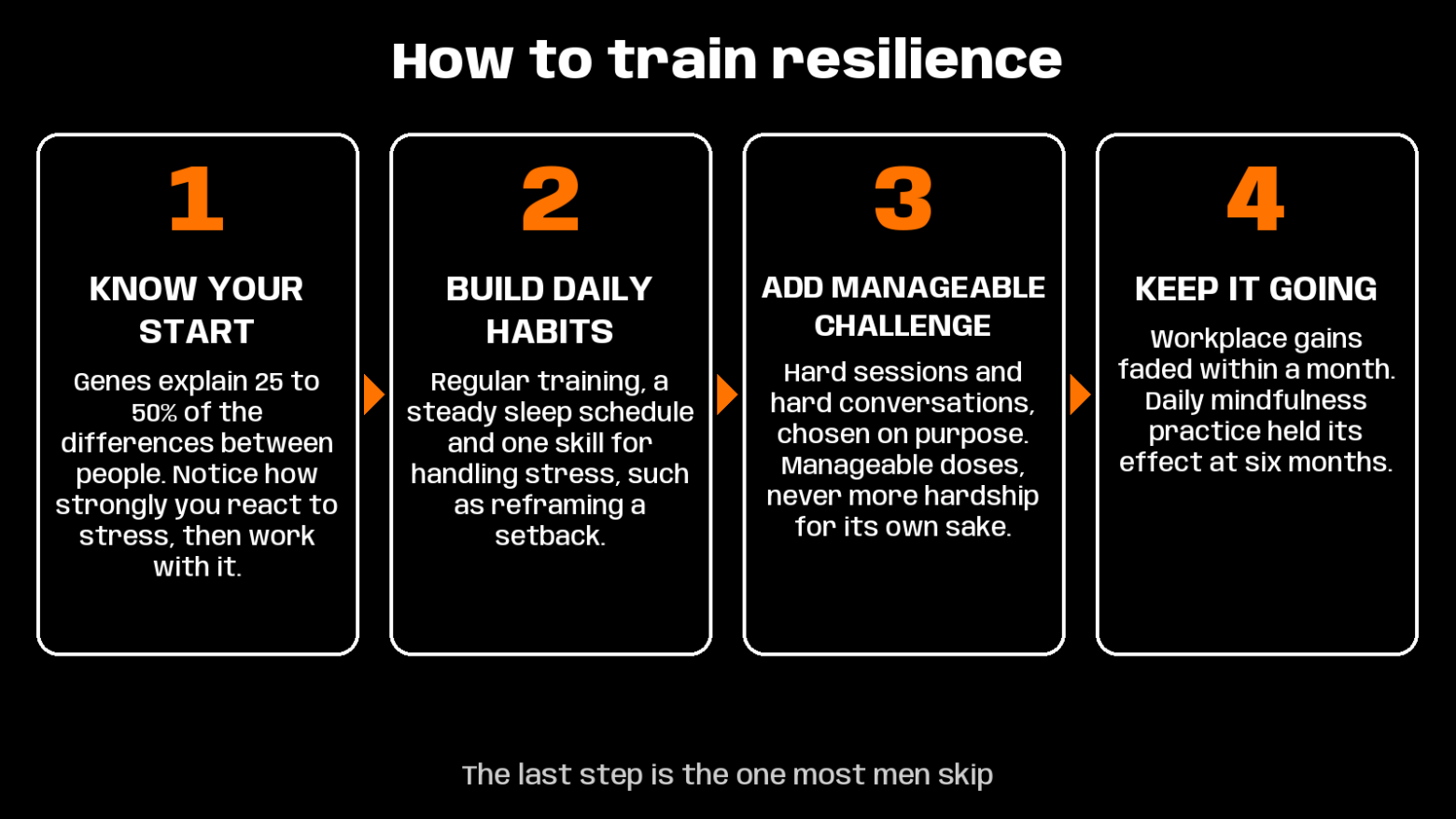
Resilience is trained like fitness. The last step is the one most men skip.
Options for Men to Take Action
Most men know what builds resilience. The problem is keeping it going once the motivation fades, with training in one place, notes in another and nothing that shows whether the practice is still happening a month later.
The MenTools app runs challenges across mindset, fitness, nutrition and money, with levels you choose, daily actions, streak and progress tracking, journals and an AI coach. For resilience its job is the part the research says most programmes miss: keeping two or three daily reps going for months, not days.
How you can do this today: pick one physical habit and one mindset habit from this guide and set a small daily action for each.
Wins on cost: one subscription covers training, mindset and habit tracking, instead of separate apps or a one-off course that fades.
Wins on time: the challenges and levels are already built, so you start practising today rather than designing a programme first.
Wins on practicality: each action takes minutes and fits around work, family and the gym.
Watch-out: it is a habit and consistency tool, not therapy or a clinical service. If you are struggling now, professional support comes first.
Resilience also rests on the physical basics, so a one a day multivitamin may help cover the simple daily foundation underneath the work. For more on staying driven when it gets hard, the MenTools motivation hub collects everything in one place. Train it like fitness, and it holds up like fitness.
Last updated: 2026-10-20 v1.0
Disclaimer: This guide is for informational purposes only and does not constitute medical or psychological advice. Speak with a qualified professional before making significant changes if you have a medical or mental health condition.
References
- [1] Amstadter AB, Myers JM, Kendler KS. Psychiatric resilience, longitudinal twin study. British Journal of Psychiatry, 2014;205(4):275-280. Link
- [2] Wolf EJ, Miller MW, Sullivan DR, et al. A classical twin study of PTSD symptoms and resilience, evidence for a single spectrum of vulnerability to traumatic stress. Depression and Anxiety, 2018;35(2):132-139. Link
- [3] Boardman JD, Blalock CL, Button TM. Sex differences in the heritability of resilience. Twin Research and Human Genetics, 2008;11(1):12-27. Link
- [4] Amstadter AB, Moscati A, Oxon MA, et al. Personality, cognitive and psychological traits and psychiatric resilience, a multivariate twin study. Personality and Individual Differences, 2016;91:74-79. Link
- [5] Southwick SM, Bonanno GA, Masten AS, Panter-Brick C, Yehuda R. Resilience definitions, theory, and challenges, interdisciplinary perspectives. European Journal of Psychotraumatology, 2014;5:25338. Link
- [6] Galatzer-Levy IR, Huang SH, Bonanno GA. Trajectories of resilience and dysfunction following potential trauma, a review and statistical evaluation. Clinical Psychology Review, 2018;63:41-55. Link
- [7] Bonanno GA, Galea S, Bucciarelli A, Vlahov D. Psychological resilience after disaster, New York City in the aftermath of the September 11th terrorist attack. Psychological Science, 2006;17(3):181-186. Link
- [8] Bonanno GA. Loss, trauma, and human resilience. American Psychologist, 2004;59(1):20-28. Link
- [9] Masten AS. Ordinary magic, resilience processes in development. American Psychologist, 2001;56(3):227-238. Link
- [10] Joyce S, Shand F, Tighe J, et al. Road to resilience, a systematic review and meta-analysis of resilience training programmes and interventions. BMJ Open, 2018;8(6):e017858. Link
- [11] Kunzler AM, Helmreich I, Chmitorz A, et al. Psychological interventions to foster resilience in healthcare professionals. Cochrane Database of Systematic Reviews, 2020;7:CD012527. Link
- [12] Leppin AL, Bora PR, Tilburt JC, et al. The efficacy of resiliency training programs, a systematic review and meta-analysis of randomized trials. PLoS One, 2014;9(10):e111420. Link
- [13] Liu JJW, Ein N, Gervasio J, et al. Comprehensive meta-analysis of resilience interventions. Clinical Psychology Review, 2020;82:101919. Link
- [14] Vanhove AJ, Herian MN, Perez ALU, Harms PD, Lester PB. Can resilience be developed at work? A meta-analytic review of resilience-building programme effectiveness. Journal of Occupational and Organizational Psychology, 2016;89(2):278-307. Link
- [15] Iacoviello BM, Charney DS. Psychosocial facets of resilience, implications for preventing posttrauma psychopathology, treating trauma survivors, and enhancing community resilience. European Journal of Psychotraumatology, 2014;5:23970. Link
- [16] Seery MD, Holman EA, Silver RC. Whatever does not kill us, cumulative lifetime adversity, vulnerability, and resilience. Journal of Personality and Social Psychology, 2010;99(6):1025-1041. Link
- [17] Donovan P. Study confirms whatever doesn’t kill us can make us stronger. University at Buffalo News Center, 15 October 2010. Link
- [18] Southwick SM, Vythilingam M, Charney DS. The psychobiology of depression and resilience to stress, implications for prevention and treatment. Annual Review of Clinical Psychology, 2005;1:255-291. Link
- [19] Southwick SM, Charney DS. The science of resilience, implications for the prevention and treatment of depression. Science, 2012;338(6103):79-82. Link
- [20] Childs E, de Wit H. Regular exercise is associated with emotional resilience to acute stress in healthy adults. Frontiers in Physiology, 2014;5:161. Link
- [21] Mental Health Foundation. Men and mental health. Link
- [22] Lally P, van Jaarsveld CHM, Potts HWW, Wardle J. How are habits formed, modelling habit formation in the real world. European Journal of Social Psychology, 2010;40(6):998-1009. Link